Introduction
Performance management platforms help organizations set goals, run reviews, support continuous feedback, and improve manager effectiveness in a structured way. Instead of relying on irregular check-ins and subjective annual ratings, these tools create repeatable cycles for goal setting, coaching, recognition, calibration, and development planning. When implemented well, they make performance discussions clearer, fairer, and more actionable for both managers and employees.
Common real-world use cases include:
- Running consistent performance reviews across teams and locations
- Managing goals and outcomes with clear alignment to business priorities
- Improving manager coaching with structured check-ins and feedback workflows
- Enabling continuous feedback and peer recognition to support growth
- Standardizing performance calibration for fairness and consistency
What buyers should evaluate before selecting a platform:
- Goal management quality (OKRs, alignment, progress tracking)
- Review cycle flexibility (continuous, quarterly, annual)
- Feedback and coaching workflows (1:1s, prompts, templates)
- Calibration support for fairness and rating consistency
- Reporting for HR and leadership (trends, completion, performance insights)
- Employee development planning (skills, growth plans, learning links)
- Integration fit with HR systems and identity workflows
- Governance (roles, permissions, audit trails, retention controls)
- Ease of adoption for managers and employees
- Support quality and rollout enablement
Best for: HR leaders, People Operations teams, and managers in SMB to enterprise organizations that want consistent reviews, goal alignment, ongoing coaching, and fair performance decisions.
Not ideal for: very small teams that can manage performance with simple recurring 1:1s, organizations that do not want structured cycles, or teams that are not ready to invest in manager training and process discipline.
Key Trends in Performance Management Platforms
- Shift from “annual rating events” to continuous coaching and recurring check-ins
- More focus on goal clarity and outcomes alignment across teams and departments
- Stronger calibration workflows to reduce bias and inconsistency in ratings
- Increased emphasis on employee development and growth planning inside performance cycles
- More manager enablement: prompts, coaching tips, and conversation support
- Better linkage between performance signals and retention risk or engagement insights (varies)
- Integrations becoming a must-have so HR data stays accurate and workflows stay simple
- More demand for transparency and fairness: clear rubrics, evidence-based feedback
- Higher expectations for governance, permissions, and audit-friendly workflows
- Performance insights evolving into operational reporting for leadership decisions
How We Selected These Tools
- Strong recognition and adoption as performance management platforms
- Breadth of core performance capabilities, not only goal tracking
- Practical fit for managers and employees in real work settings
- Flexibility across different performance philosophies and cycles
- Reporting usefulness for HR and leadership stakeholders
- Implementation practicality and onboarding expectations
- Integration readiness for common HR ecosystems
- Balance between enterprise suites and fast-adoption mid-market tools
- Clear differentiation in workflows, depth, and target customer segment
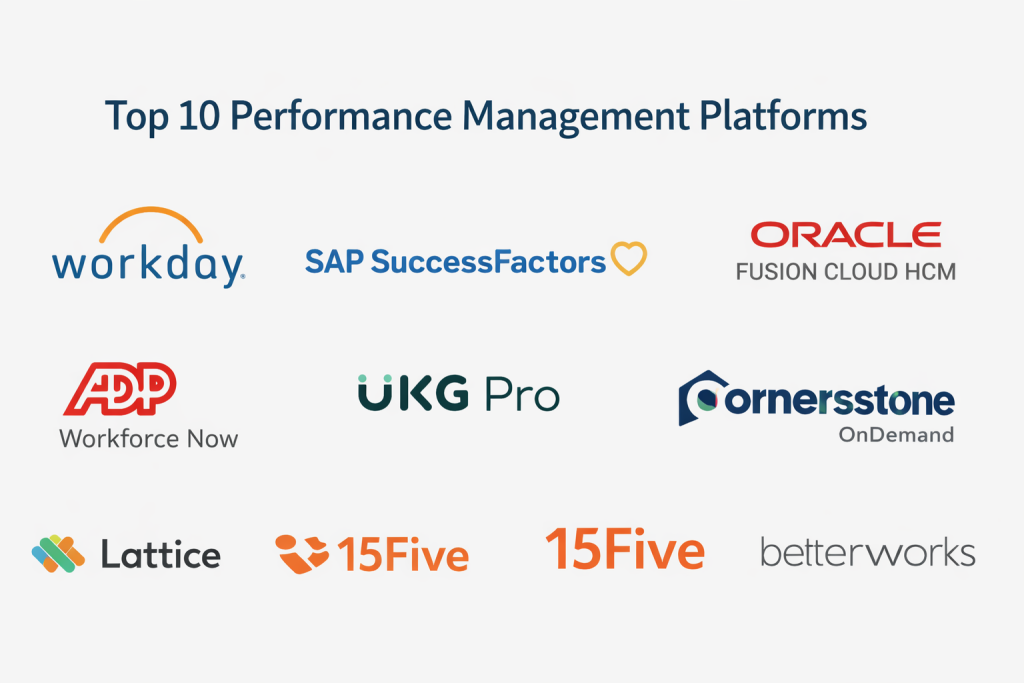
Top 10 Performance Management Platforms
1 — Workday
A broad HCM suite that includes performance management capabilities, often used by enterprises that want consistent reviews, goal alignment, and manager workflows integrated with core HR data.
Key Features
- Performance review cycles with configurable templates (varies)
- Goal management and alignment workflows (varies)
- Manager and employee self-evaluation workflows
- Calibration and approvals support (varies)
- Reporting for completion, performance trends, and workforce insights (varies)
- Role-based access and governance aligned to enterprise workflows (varies)
Pros
- Strong fit when performance must align with enterprise HR processes
- Benefits from HR data consistency across the organization
- Useful for complex org structures and large-scale programs
Cons
- Implementation and configuration can be heavy
- Performance experience depends on how the organization designs workflows
- Some detailed security and compliance claims are not publicly stated here
Platforms / Deployment
- Web
- Cloud
Security and Compliance
- Not publicly stated
Integrations and Ecosystem
Workday typically sits at the center of enterprise HR stacks where performance is connected to HR records, org structure, and reporting.
- HR data alignment supports goal visibility and manager reporting
- Integration depth varies based on enterprise architecture (varies / not publicly stated)
- Export and analytics workflows depend on internal reporting strategy
Support and Community
Varies / Not publicly stated.
2 — SAP SuccessFactors
An enterprise HCM platform that includes performance and goals capabilities, often used by organizations needing structured cycles, calibration workflows, and large-scale HR governance.
Key Features
- Performance review cycles and configurable forms (varies)
- Goals and alignment workflows (varies)
- Calibration and rating consistency workflows (varies)
- Continuous feedback features (varies)
- Reporting dashboards for HR and leadership stakeholders (varies)
- Governance controls and role-based permissions (varies)
Pros
- Strong fit for enterprise-scale performance programs
- Supports structured cycles with approvals and governance
- Works well when combined with broader talent workflows
Cons
- Setup and configuration can be complex
- User experience depends heavily on configuration and change management
- Security and compliance details are not publicly stated
Platforms / Deployment
- Web
- Cloud
Security and Compliance
- Not publicly stated
Integrations and Ecosystem
SAP SuccessFactors often operates in ecosystems where performance ties into broader talent and HR workflows.
- HR and org structure alignment supports consistency
- Integration approach depends on enterprise environment (varies)
- Reporting and export needs vary with analytics maturity
Support and Community
Varies / Not publicly stated.
3 — Oracle Fusion Cloud HCM
An enterprise HCM suite that includes performance management and talent workflows, often used by organizations needing structured performance cycles aligned to broader HR processes.
Key Features
- Performance reviews and structured evaluation workflows (varies)
- Goals and alignment tracking (varies)
- Approvals, workflows, and governance controls (varies)
- Reporting for HR and leadership decision-making (varies)
- Talent workflows that may connect to development planning (varies)
- Role-based access and administrative governance (varies)
Pros
- Strong fit for organizations standardizing HR and talent processes
- Supports structured workflows at scale
- Centralized reporting for performance programs
Cons
- Implementation can be heavier than mid-market tools
- Performance outcomes depend on workflow design and manager adoption
- Security and compliance details are not publicly stated
Platforms / Deployment
- Web
- Cloud
Security and Compliance
- Not publicly stated
Integrations and Ecosystem
Oracle Fusion Cloud HCM is typically part of large HR ecosystems with centralized governance.
- HR data alignment supports performance program accuracy
- Integration patterns vary by enterprise setup (varies / not publicly stated)
- Reporting exports vary by internal analytics needs
Support and Community
Varies / Not publicly stated.
4 — ADP Workforce Now
A widely used HR platform that can include performance workflows depending on packaging and configuration. Often chosen by organizations that want HR and performance processes connected in one environment.
Key Features
- Performance review workflows (varies by plan)
- Goal and feedback features (varies)
- Manager workflows and employee self-service (varies)
- Reporting dashboards for HR operations (varies)
- Org structure alignment through HR data (varies)
- Governance features and permissions (varies)
Pros
- Useful when HR and performance workflows must stay connected
- Often fits SMB and mid-market HR operating models
- Supports manager workflows and process consistency
Cons
- Feature depth depends on plan and configuration
- Advanced calibration and analytics depth may be limited
- Security and compliance details are not publicly stated
Platforms / Deployment
- Web
- Cloud
Security and Compliance
- Not publicly stated
Integrations and Ecosystem
ADP Workforce Now typically fits in HR stacks where payroll and HR data alignment matter for reporting and program consistency.
- HR data mapping supports performance program reporting
- Integration depth varies by environment and plan (varies)
- Exports and reporting workflows vary by operational needs
Support and Community
Varies / Not publicly stated.
5 — UKG Pro
An HR and workforce management platform that can include performance workflows depending on configuration. Often used when organizations want structured HR processes and manager routines supported by a centralized system.
Key Features
- Performance review workflows (varies)
- Goal and feedback capabilities (varies)
- Manager and employee self-service workflows
- Reporting for HR operations and completion tracking (varies)
- Role-based permissions and governance (varies)
- Workflow automation and approvals (varies)
Pros
- Useful for organizations standardizing HR processes and manager routines
- Can support repeatable performance cycles across teams
- Works well when tied to structured HR operations
Cons
- Feature depth varies by modules and configuration
- Advanced performance analytics may be limited compared to dedicated tools
- Security and compliance details are not publicly stated
Platforms / Deployment
- Web
- Cloud
Security and Compliance
- Not publicly stated
Integrations and Ecosystem
UKG Pro typically fits into HR ecosystems where performance is one part of broader workforce processes.
- Org structure alignment supports segmentation and reporting
- Integration depth varies by setup (varies / not publicly stated)
- Reporting exports vary based on HR analytics needs
Support and Community
Varies / Not publicly stated.
6 — Cornerstone OnDemand
A talent suite often known for learning and talent workflows, with performance management capabilities depending on configuration. Often used by organizations that want performance tied to development and talent planning.
Key Features
- Performance reviews and evaluation workflows (varies)
- Goal alignment and progress tracking (varies)
- Feedback and coaching workflows (varies)
- Reporting dashboards for talent operations (varies)
- Development planning support (varies)
- Governance controls and role-based access (varies)
Pros
- Strong fit when performance is connected to development programs
- Useful for structured talent operations at scale
- Can support repeatable performance cycles
Cons
- Experience and depth depend on configuration and modules
- Implementation can require careful program design
- Security and compliance details are not publicly stated
Platforms / Deployment
- Web
- Cloud
Security and Compliance
- Not publicly stated
Integrations and Ecosystem
Cornerstone OnDemand is often used in talent ecosystems where performance, development, and learning are connected.
- HR data alignment is important for accurate role mapping
- Integration depth varies by enterprise environment (varies)
- Exports and reporting workflows depend on internal reporting needs
Support and Community
Varies / Not publicly stated.
7 — Lattice
A performance management platform often adopted by SMB and mid-market organizations for reviews, goals, feedback, and manager routines. Known for usability and manager adoption focus.
Key Features
- Performance reviews with flexible templates and cycles
- Goal tracking and alignment workflows (varies)
- Continuous feedback and recognition features (varies)
- Manager 1:1 support and conversation workflows (varies)
- Reporting for review completion and trends (varies)
- Calibration features (varies)
Pros
- Strong usability and adoption among managers
- Practical for organizations building repeatable performance routines
- Good fit for combining reviews, goals, and feedback
Cons
- Enterprise governance depth may vary by plan
- Deep analytics may be lighter than enterprise suites
- Security and compliance details are not publicly stated
Platforms / Deployment
- Web
- Cloud
Security and Compliance
- Not publicly stated
Integrations and Ecosystem
Lattice is commonly used in people stacks where performance workflows must align with HR data and manager routines.
- HR alignment supports accurate goal ownership and reporting
- Exports and reporting vary by configuration
- Integration depth varies by plan (varies / not publicly stated)
Support and Community
Varies / Not publicly stated.
8 — 15Five
Focuses on continuous performance management through check-ins, feedback, and manager enablement. Often selected by organizations that want performance to be driven through ongoing conversations.
Key Features
- Recurring check-ins and manager workflows
- Performance review cycles (varies)
- Feedback and recognition workflows (varies)
- Goal setting and alignment features (varies)
- Manager enablement content and coaching prompts (varies)
- Reporting for participation and completion tracking (varies)
Pros
- Strong fit for continuous coaching and manager habits
- Helps performance become a routine, not an event
- Usable manager workflows that encourage adoption
Cons
- Deep calibration and enterprise governance may vary
- Analytics depth depends on configuration and plan
- Security and compliance details are not publicly stated
Platforms / Deployment
- Web
- Cloud
Security and Compliance
- Not publicly stated
Integrations and Ecosystem
15Five often fits into people stacks where ongoing conversations drive performance improvement.
- HR data alignment supports team targeting and reporting
- Export options vary
- Integration depth varies by plan (varies / not publicly stated)
Support and Community
Varies / Not publicly stated.
9 — Betterworks
Often associated with goals and performance workflows, especially for organizations using structured goal frameworks and regular review cycles.
Key Features
- Goal management and alignment workflows (varies)
- Performance review support (varies)
- Continuous feedback and check-in workflows (varies)
- Reporting for progress and performance cycles (varies)
- Alignment views for leadership to track execution
- Workflow support for managers and teams (varies)
Pros
- Strong fit when goals and execution alignment are a priority
- Helps managers keep performance conversations structured
- Useful for organizations standardizing performance cadence
Cons
- Effectiveness depends on goal quality and manager discipline
- Some features vary by modules and configuration
- Security and compliance details are not publicly stated
Platforms / Deployment
- Web
- Cloud
Security and Compliance
- Not publicly stated
Integrations and Ecosystem
Betterworks is commonly used where performance and goals must be consistently tracked across teams.
- HR and org alignment supports goal ownership
- Export and reporting needs vary
- Integration depth varies by environment (varies / not publicly stated)
Support and Community
Varies / Not publicly stated.
10 — Leapsome
A people enablement platform that includes performance reviews, feedback, and related routines. Often adopted by mid-market organizations that want a practical balance of performance structure and usability.
Key Features
- Performance reviews and cycle management (varies)
- Goals and alignment workflows (varies)
- Continuous feedback and peer feedback options (varies)
- Manager workflows for recurring conversations (varies)
- Reporting dashboards and completion tracking
- Development planning support (varies)
Pros
- Good balance of structure and usability for managers
- Supports recurring performance routines across teams
- Flexible configuration for different performance styles
Cons
- Enterprise-level governance depth may vary
- Analytics depth depends on plan and configuration
- Security and compliance details are not publicly stated
Platforms / Deployment
- Web
- Cloud
Security and Compliance
- Not publicly stated
Integrations and Ecosystem
Leapsome typically fits into mid-market HR stacks where performance must be repeatable and manager-friendly.
- HR alignment supports accurate reporting and targeting
- Export options vary
- Integration depth varies by plan (varies / not publicly stated)
Support and Community
Varies / Not publicly stated.
Comparison Table
| Tool Name | Best For | Platform(s) Supported | Deployment | Standout Feature | Public Rating |
|---|---|---|---|---|---|
| Workday | Enterprise HR-aligned performance programs | Web | Cloud | Performance connected to core HR data | N/A |
| SAP SuccessFactors | Structured enterprise performance cycles | Web | Cloud | Governance and calibration workflows | N/A |
| Oracle Fusion Cloud HCM | Large organizations standardizing HR and talent | Web | Cloud | Structured performance workflows at scale | N/A |
| ADP Workforce Now | HR-connected performance workflows for SMB to mid-market | Web | Cloud | HR and performance in one environment | N/A |
| UKG Pro | Repeatable performance cycles in structured HR operations | Web | Cloud | Manager workflows aligned to HR structure | N/A |
| Cornerstone OnDemand | Performance linked to development and talent programs | Web | Cloud | Performance plus development planning support | N/A |
| Lattice | Usable performance reviews and manager adoption | Web | Cloud | Flexible cycles with strong manager workflows | N/A |
| 15Five | Continuous coaching and check-in driven performance | Web | Cloud | Manager enablement and recurring check-ins | N/A |
| Betterworks | Goal-driven performance with alignment focus | Web | Cloud | Goals and execution visibility | N/A |
| Leapsome | Balanced performance routines for mid-market teams | Web | Cloud | Practical performance plus feedback workflows | N/A |
Evaluation and Scoring
Scoring model notes:
- Scores are comparative and intended for shortlisting, not final procurement decisions.
- If governance, audit, or retention requirements are strict, treat “Not publicly stated” as a verification requirement.
- A higher weighted total suggests stronger overall fit for common performance management needs.
- Run a pilot cycle with one department to validate adoption, cycle completion, and manager experience.
Weights used:
- Core features – 25%
- Ease of use – 15%
- Integrations and ecosystem – 15%
- Security and governance – 10%
- Analytics and reporting – 15%
- Support and enablement – 10%
- Price and value – 10%
| Tool Name | Core (25%) | Ease (15%) | Integrations (15%) | Security (10%) | Analytics (15%) | Support (10%) | Value (10%) | Weighted Total (0–10) |
|---|---|---|---|---|---|---|---|---|
| Workday | 9 | 7 | 9 | 8 | 9 | 8 | 6 | 8.25 |
| SAP SuccessFactors | 9 | 7 | 9 | 8 | 9 | 8 | 6 | 8.25 |
| Oracle Fusion Cloud HCM | 8 | 7 | 8 | 8 | 8 | 7 | 6 | 7.65 |
| ADP Workforce Now | 7 | 8 | 7 | 7 | 7 | 7 | 7 | 7.20 |
| UKG Pro | 7 | 8 | 7 | 7 | 7 | 7 | 7 | 7.20 |
| Cornerstone OnDemand | 8 | 7 | 8 | 7 | 8 | 7 | 6 | 7.45 |
| Lattice | 8 | 9 | 7 | 7 | 7 | 7 | 8 | 7.65 |
| 15Five | 8 | 9 | 7 | 7 | 7 | 7 | 8 | 7.65 |
| Betterworks | 8 | 8 | 7 | 7 | 7 | 7 | 7 | 7.45 |
| Leapsome | 8 | 8 | 7 | 7 | 7 | 7 | 7 | 7.45 |
How to interpret the scores:
- If you need HR-aligned programs and governance, prioritize Core plus Integrations.
- If adoption is your biggest risk, prioritize Ease and Support.
- If leadership reporting matters, prioritize Analytics and Reporting.
- If cost sensitivity is high, focus on Value and avoid over-buying modules.
- Validate governance and retention requirements before scaling.
Which Performance Management Platform Is Right for You
Solo or Freelancer
Very small teams often succeed with simple 1:1 routines and lightweight goal tracking.
- Best fits: 15Five or Lattice for structured manager habits
- Why: easier adoption and continuous conversation support
- Watch-outs: avoid over-building process for small headcount
SMB
SMBs benefit from usability, flexible cycles, and manager routines.
- Best fits: Lattice, 15Five, Leapsome
- Why: manager-friendly workflows plus practical review cycles
- Watch-outs: keep cycles simple and focus on coaching and clarity
Mid-Market
Mid-market teams need stronger reporting, consistent cycles, and more durable governance.
- Best fits: Betterworks, Leapsome, Lattice, Cornerstone OnDemand
- Why: goal alignment plus repeatable review structures
- Watch-outs: invest in calibration practices and manager training
Enterprise
Enterprises often need deep governance, complex org support, and standardized programs across regions.
- Best fits: Workday, SAP SuccessFactors, Oracle Fusion Cloud HCM, Cornerstone OnDemand
- Why: enterprise workflows, governance controls, and scalability
- Watch-outs: implementation success depends heavily on program design and rollout discipline
Budget vs Premium
- Budget-leaning approach: Lattice, 15Five, Leapsome (value depends on packaging and adoption)
- Premium approach: Workday, SAP SuccessFactors, Oracle Fusion Cloud HCM (best when deeply integrated into HR strategy)
A practical approach is to pilot a manager-focused tool and compare it to your HR suite capabilities before committing.
Feature Depth vs Ease of Use
- Most usable manager experience: Lattice, 15Five
- Best goal alignment emphasis: Betterworks
- Most HR-suite governance depth: Workday, SAP SuccessFactors, Oracle Fusion Cloud HCM
- Best performance plus development workflows: Cornerstone OnDemand
Integrations and Scalability
If your HR suite is central, validate these in a pilot:
- Accurate org mapping and manager hierarchy
- Role-based permissions for HR, leaders, and managers
- Export workflows for leadership reporting
- Cycle automation, reminders, and completion tracking
Security and Governance Needs
Performance data is sensitive, so validate governance early:
- Role-based access and permission controls
- Audit-friendly workflow history
- Retention and deletion policies
- Clear admin controls for cycle configuration changes
Frequently Asked Questions
FAQ 1 — Should performance management be continuous or cycle-based?
Many teams use a hybrid approach: regular check-ins plus a structured review cycle. The best approach depends on team size, manager maturity, and how decisions are made.
FAQ 2 — What is the biggest mistake teams make with performance tools?
Treating the platform as the solution. Process design, manager training, and clear expectations drive success. Without them, tools become admin work.
FAQ 3 — How do we prevent performance reviews from feeling biased?
Use clear rubrics, require evidence in feedback, run calibration, and train managers. Consistency matters more than perfect wording.
FAQ 4 — Do we need ratings?
Not always. Some organizations use ratings for compensation and promotions, while others focus on growth conversations. Choose what matches your culture and decision needs.
FAQ 5 — How do we connect goals to performance effectively?
Keep goals measurable, limited in number, and aligned to team priorities. Review progress regularly, not only at the end of a cycle.
FAQ 6 — How long does implementation usually take?
Lightweight tools can roll out quickly if workflows are simple. Larger HR suites depend on configuration, approvals, and change management.
FAQ 7 — What integrations matter most?
Org structure alignment from HR data is the most important. Identity workflows and data export options also matter for governance and reporting.
FAQ 8 — Can performance platforms help with promotions and compensation?
They can support evidence collection and review consistency. However, compensation decisions still require clear policy, calibration, and leadership governance.
FAQ 9 — How do we increase manager adoption?
Make workflows simple, provide training, and show leaders using the tool. Adoption improves when managers see that it reduces confusion and improves fairness.
FAQ 10 — What is a good alternative if we do not want a platform yet?
Start with structured 1:1 templates, clear goal documents, and a simple review form. But as the team grows, manual processes become inconsistent.
Conclusion
Performance management platforms help organizations build fair, repeatable performance conversations that improve clarity, growth, and accountability. The best choice depends on whether you want a manager-first experience, deep goal alignment, or enterprise-grade governance connected to a broader HR suite. Tools succeed when workflows are simple, expectations are clear, and managers are trained to coach consistently. A smart next step is to shortlist two or three platforms, run a pilot with one department, and validate adoption, reporting clarity, and governance controls before scaling across the organization.

Best Cardiac Hospitals Near You
Discover top heart hospitals, cardiology centers & cardiac care services by city.
Advanced Heart Care • Trusted Hospitals • Expert Teams
View Best Hospitals