Introduction
Predictive maintenance platforms are advanced digital ecosystems that leverage data from industrial assets to forecast when a machine is likely to fail. Unlike traditional preventive maintenance, which follows a rigid calendar, these platforms use real-time monitoring and machine learning to intervene only when necessary. By analyzing variables such as vibration, heat, and pressure, the software identifies microscopic anomalies long before they escalate into catastrophic breakdowns. In the current industrial landscape, this technology has become the cornerstone of high-efficiency manufacturing, energy production, and logistics, turning raw data into a strategic shield against unplanned downtime.
As we move deeper into an era of hyper-connectivity, the ability to predict the future of a machine’s health is no longer a luxury but a baseline for survival. Modern platforms now integrate seamlessly with existing enterprise systems, providing a unified view of global asset health. This shift allows organizations to optimize their spare parts inventory, extend the operational life of aging machinery, and ensure a safer working environment for technicians. Evaluating these tools requires a focus on their analytical accuracy, the ease of integrating with diverse sensor networks, and the ability to scale from a single production line to a worldwide fleet of facilities.
Best for: Asset-intensive organizations in oil and gas, aerospace, utilities, and large-scale manufacturing that manage critical machinery where downtime results in significant financial or safety risks.
Not ideal for: Small businesses with low-cost, easily replaceable equipment or operations where machinery failure has a negligible impact on overall production goals.
Key Trends in Predictive Maintenance Platforms
- Edge-to-Cloud Intelligence: Processing data directly at the machine level (the edge) allows for sub-second anomaly detection while the cloud handles long-term trend analysis.
- Prescriptive Insights: Platforms are evolving from simply predicting a failure to prescribing the exact repair steps and identifying the necessary spare parts automatically.
- Digital Twin Synchronization: Creating a virtual replica of a physical asset allows for complex “what-if” simulations and more accurate remaining useful life forecasts.
- Democratized Machine Learning: Modern interfaces allow reliability engineers to build and deploy predictive models without needing a PhD in data science.
- Sustainability and Energy Tracking: Integration of energy consumption metrics into maintenance alerts to help companies meet carbon reduction goals through optimized machinery.
- Universal Connectivity Standards: A massive move toward open protocols like MQTT and OPC-UA to ensure sensors from different vendors can talk to a single AI platform.
- AI-Generated Technical Guidance: The use of large language models to provide technicians with instant, conversational access to maintenance manuals and historical repair data.
- Fleet-Wide Model Replication: The ability to train an AI model on one asset and instantly deploy it across hundreds of similar machines globally.
How We Selected These Tools
- Market Presence and Reliability: We focused on platforms with a proven track record in heavy industrial environments and high-stakes production cycles.
- Analytical Depth: Each tool was evaluated based on its ability to utilize advanced machine learning for high-accuracy failure forecasting.
- Integration Maturity: Priority was given to software that connects natively with major Enterprise Asset Management and IoT ecosystems.
- Security Architecture: We assessed the strength of data encryption, identity management, and compliance with industrial cybersecurity standards.
- User Experience for Technicians: The selection includes tools that bridge the gap between complex data and actionable insights for field workers.
- Scalability and Flexibility: We looked for platforms that can start with a pilot program and grow into an enterprise-wide reliability framework.
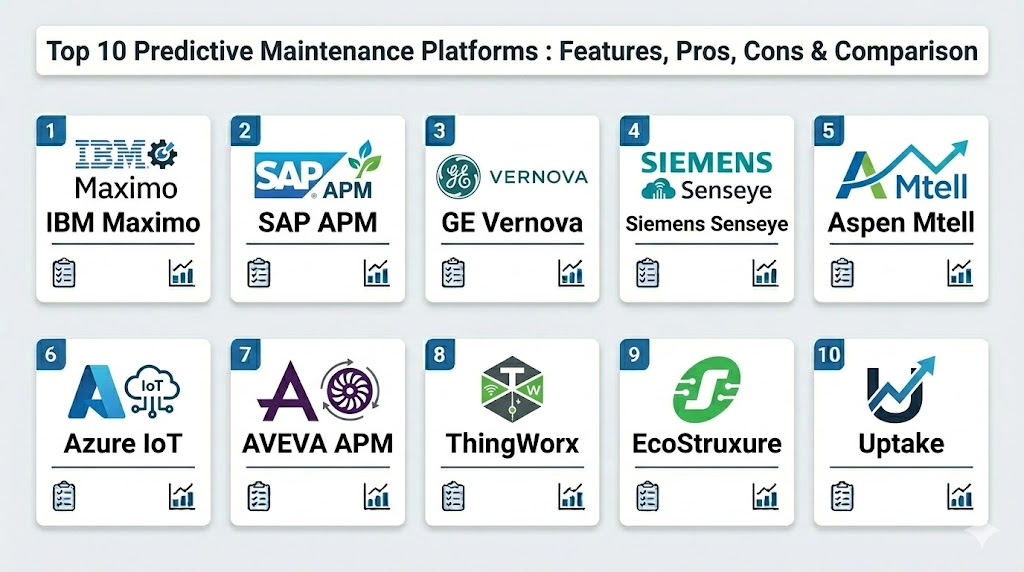
Top 10 Predictive Maintenance Platforms
1. IBM Maximo Application Suite
This is a comprehensive enterprise asset management ecosystem that uses Watson AI to provide deep insights into asset health. It is the gold standard for global organizations requiring a centralized, highly secure platform for managing millions of data points across a distributed fleet.
Key Features
- AI-driven failure probability scores for critical industrial assets.
- Native digital twin capabilities for simulating asset behavior over time.
- Seamless integration with environmental and historical maintenance records.
- Mobile-first tools for technicians to receive and close predictive alerts.
- Advanced reliability modeling to optimize long-term maintenance strategies.
Pros
- Unmatched scalability for the world’s largest industrial enterprises.
- Deep integration with the broader IBM Watson AI ecosystem.
Cons
- Extremely complex implementation that requires specialized consultants.
- High total cost of ownership compared to specialized startups.
Platforms / Deployment
Windows / macOS / Linux / iOS / Android
Cloud / Hybrid
Security & Compliance
ISO 27001, SOC 2, and GDPR compliant with robust MFA and SSO.
Not publicly stated.
Integrations & Ecosystem
It serves as a massive central hub for industrial data, connecting easily with specialized sensors and global supply chain systems. It supports all major industrial protocols and enterprise connectors.
Support & Community
Backed by a global network of partners and a massive annual user conference. Support is enterprise-grade with 24/7 dedicated assistance for critical sites.
2. SAP Asset Performance Management (APM)
Designed for organizations already deep in the SAP environment, this platform aligns maintenance data with financial and operational workflows. It excels at turning technical alerts into business-ready decisions that impact the bottom line.
Key Features
- Native integration with SAP S/4HANA for finance-to-field synchronization.
- Risk-based maintenance prioritization based on asset criticality.
- Automated maintenance requests triggered by AI-detected anomalies.
- Real-time condition monitoring with built-in machine learning models.
- Comprehensive asset health dashboards visible at the executive level.
Pros
- Best-in-class data continuity for existing SAP users.
- Strong focus on aligning maintenance with financial budgeting.
Cons
- Not an ideal choice for organizations not already using SAP.
- Implementation can be slow due to the depth of enterprise configuration.
Platforms / Deployment
Web / Windows / macOS / Linux
Cloud / Hybrid
Security & Compliance
SOC 2 Type II, ISO 27001, and HIPAA compliant.
Not publicly stated.
Integrations & Ecosystem
The platform is the heart of the SAP Intelligent Asset Management suite, offering seamless data flow between procurement, finance, and maintenance.
Support & Community
A worldwide community of SAP professionals and consultants provides a wealth of specialized industry knowledge and custom extensions.
3. GE Vernova APM (formerly GE Digital)
A powerhouse in “heavy” industries like power generation and oil and gas. It offers unrivaled domain expertise in rotating equipment and turbines, providing some of the most advanced mechanical diagnostics in the world.
Key Features
- SmartSignal technology for early warning of equipment failure modes.
- Advanced thermal and vibration analysis specifically for heavy machinery.
- Risk-based inspection modules to ensure safety compliance.
- Multi-site “fleet” health monitoring from a single operations center.
- Deep digital twin simulations for high-value industrial assets.
Pros
- The deepest mechanical domain expertise in the industrial market.
- Exceptional for high-risk environments where failure is not an option.
Cons
- User interface can feel technical and dense for general maintenance staff.
- Long deployment cycles often spanning several months.
Platforms / Deployment
Windows / Web
Cloud / Hybrid / Self-hosted
Security & Compliance
ISO 27001, SOC 2 Type II, and deep audit logging for regulated industries.
Not publicly stated.
Integrations & Ecosystem
Designed for deep industrial connectivity, it integrates with almost all major control systems and historians used in power and energy sectors.
Support & Community
High-touch professional support with a strong focus on engineering-led customer success and reliability excellence.
4. Siemens Senseye Predictive Maintenance
This platform is focused on rapid ROI and ease of use for the factory floor. It uses automated, self-learning AI to detect anomalies across a wide range of assets without requiring a team of data scientists.
Key Features
- Automated “Attention Index” that prioritizes which machines need help first.
- Self-learning algorithms that adapt to new machinery without manual setup.
- Built-in ROI tracking to show the financial value of avoided downtime.
- Simple, intuitive interface designed for maintenance technicians.
- Rapid implementation templates for common factory equipment.
Pros
- Faster implementation and faster time-to-value than giant suites.
- Highly user-friendly for teams without an AI background.
Cons
- Less focus on “heavy” infrastructure like jet engines or massive turbines.
- Dependency on cloud connectivity for real-time model updates.
Platforms / Deployment
Web / iOS / Android
Cloud
Security & Compliance
ISO 27001 and GDPR compliant with secure industrial gateways.
Not publicly stated.
Integrations & Ecosystem
Integrates natively with the Siemens industrial ecosystem but remains open enough to connect with a variety of third-party PLCs and sensors.
Support & Community
Strong technical documentation and a dedicated onboarding team focused on industrial ROI and scalability.
5. Aspen Mtell (AspenTech)
A highly specialized platform that focuses on “low-touch” machine learning. It is unique in its ability to handle “dirty” or noisy industrial data and provide a wide window of warning before a failure occurs.
Key Features
- Precise “Remaining Useful Life” forecasting for critical process equipment.
- Ability to replicate success across hundreds of similar assets quickly.
- Low-code interface designed for reliability engineers to build agents.
- Early detection of subtle degradation patterns in continuous processes.
- Integration with major EAMs for automated work order generation.
Pros
- Provides an exceptionally wide warning window, often weeks in advance.
- Highly effective in complex chemical and process industries.
Cons
- Primarily focused on prediction rather than broader workflow management.
- Learning curve can be steep for those unfamiliar with pattern-based AI.
Platforms / Deployment
Windows / Web
Local / Hybrid
Security & Compliance
Standard industrial security protocols for data-at-rest and transit.
Not publicly stated.
Integrations & Ecosystem
Deeply integrated with the AspenTech suite for process optimization and connects to major industrial historians.
Support & Community
Highly specialized support team with deep knowledge of process engineering and reliability mathematics.
6. Microsoft Azure IoT Central
While a broader IoT platform, Azure provides a highly scalable foundation for predictive maintenance. It is the preferred choice for developers who want to build custom, highly integrated reliability solutions.
Key Features
- Pre-built templates for predictive maintenance and condition monitoring.
- Seamless connection to Azure Digital Twins for spatial intelligence.
- Power BI integration for advanced, executive-level visualization.
- Scalable machine learning pipelines through Azure ML.
- Global edge computing support to process data near the machine.
Pros
- Unmatched flexibility for building custom, unique reliability tools.
- Seamless integration with the global Microsoft 365 ecosystem.
Cons
- Requires an internal development team to build the final application.
- Not an “out-of-the-box” maintenance hub like specialized rivals.
Platforms / Deployment
Web / Windows / Linux
Cloud / Hybrid
Security & Compliance
Backed by Microsoft’s $1 billion annual investment in cybersecurity.
SOC 2, ISO 27001, and HIPAA compliant.
Integrations & Ecosystem
Provides the ultimate connectivity hub, bridging the gap between billions of IoT devices and enterprise IT data.
Support & Community
Massive global developer community and 24/7 enterprise support via Microsoft.
7. AVEVA APM (incorporating OSIsoft PI)
This platform excels at managing high-velocity real-time operations data. It is particularly strong in the process and manufacturing sectors where data continuity from the factory floor to the cloud is essential.
Key Features
- Advanced pattern recognition for detecting subtle deviations in performance.
- Deep integration with the industry-standard OSIsoft PI System.
- Decision support tools that help operators take immediate action.
- Modular design that allows companies to start small and scale.
- Physics-based modeling combined with AI for high-accuracy predictions.
Pros
- Exceptional at handling massive volumes of high-speed sensor data.
- Strong modularity allows for a customized digital transformation journey.
Cons
- High resource requirement for IT during the initial data mapping phase.
- Advanced features often require moving to the highest pricing tiers.
Platforms / Deployment
Windows / Web
Local / Cloud / Hybrid
Security & Compliance
SOC 2 Type II and data-at-rest encryption with full audit logs.
Not publicly stated.
Integrations & Ecosystem
Strongest in the process industry, it integrates with almost all major PLCs, SCADA, and DCS systems globally.
Support & Community
Dedicated online learning portal and a strong global presence in the industrial vertical.
8. PTC ThingWorx
ThingWorx is a leading platform for connected machinery, often used by OEMs (Original Equipment Manufacturers) to provide predictive maintenance services to their own customers.
Key Features
- Remote diagnostics and troubleshooting for global equipment fleets.
- AR-enabled visualization for field technicians to “see” internal data.
- Rapid application development environment for custom IoT portals.
- Integration with a wide range of third-party sensors and gateways.
- Digital performance management to track overall equipment effectiveness.
Pros
- Exceptional for manufacturers who want to offer PdM as a service.
- Rapid prototyping and deployment for modern IoT-ready machinery.
Cons
- Heavily reliant on the broader PTC platform for advanced features.
- Less focus on deep “reliability engineering” than specialized APMs.
Platforms / Deployment
Windows / Linux / Web
Cloud / Self-hosted / Hybrid
Security & Compliance
Enterprise-grade security for shared, multi-tenant cloud environments.
Not publicly stated.
Integrations & Ecosystem
Built on an open architecture that supports thousands of industrial devices and enterprise system connectors.
Support & Community
A strong network of industrial partners and an extensive library of developer resources.
9. Schneider Electric EcoStruxure Asset Advisor
A specialized platform focusing on the health of electrical and automation systems. It provides 24/7 remote monitoring and predictive alerts for critical power infrastructure and rotating machinery.
Key Features
- 24/7 remote monitoring by Schneider Electric’s expert service bureau.
- Smart alarming for electrical systems and transformer health.
- Augmented reality for instant diagnosis of non-communicating assets.
- Condition-based monitoring for essential rotating motors and pumps.
- Mobile-first alerting with direct access to Schneider’s service experts.
Pros
- Exceptional for managing the health of electrical and power assets.
- Provides a full package: the sensors, connectivity, and expert service.
Cons
- Not a general-purpose maintenance hub; focuses on power and automation.
- Can be expensive for smaller operations with fewer critical assets.
Platforms / Deployment
Web / iOS / Android
Cloud / Hybrid
Security & Compliance
Uses highly secure proprietary wireless protocols and secure gateways.
SOC 2 compliant.
Integrations & Ecosystem
Deeply integrated with Schneider’s own hardware but capable of monitoring a wide variety of industrial electrical assets.
Support & Community
High-touch customer service with a global network of reliability and electrical experts.
10. Uptake
An AI-first platform that provides pre-built failure models for thousands of common industrial assets. It is designed to be a rapid, low-friction entry into the world of AI-enabled maintenance.
Key Features
- Access to a massive library of pre-trained failure models for common machinery.
- Rapid deployment using pre-built templates for specific industries.
- Cloud-agnostic architecture that works across AWS, Azure, and GCP.
- Advanced root-cause analysis for understanding why a failure occurred.
- Simplified dashboarding focused strictly on asset reliability and ROI.
Pros
- Very fast time-to-value due to ready-made asset models.
- Strong in heavy equipment industries like transportation and mining.
Cons
- Limited customization options for very niche or unique industrial assets.
- Lacks the broader “Asset Strategy” depth of larger enterprise suites.
Platforms / Deployment
Web / iOS / Android
Cloud
Security & Compliance
Standard modern SaaS security with data encryption and identity protection.
Not publicly stated.
Integrations & Ecosystem
API-first design allows it to integrate easily with major EAMs and cloud-based data lakes.
Support & Community
Professional support focused on rapid onboarding and helping clients achieve a fast return on investment.
Comparison Table
| Tool Name | Best For | Platform(s) Supported | Deployment | Standout Feature | Public Rating |
| 1. IBM Maximo | Global Enterprise | Win, macOS, Mobile | Hybrid | Watson AI | N/A |
| 2. SAP APM | SAP Users | Web, Win, Mobile | Hybrid | Finance Sync | N/A |
| 3. GE Vernova | Heavy Industry | Win, Web | Hybrid | SmartSignal | N/A |
| 4. Siemens Senseye | Rapid ROI | Web, Mobile | Cloud | Attention Index | N/A |
| 5. Aspen Mtell | Process Industry | Win, Web | Local | Warning Window | N/A |
| 6. Azure IoT | Custom Developers | Web, Win, Linux | Cloud | Digital Twins | N/A |
| 7. AVEVA APM | Real-time Ops | Win, Web | Hybrid | OSIsoft PI | N/A |
| 8. ThingWorx | OEMs / IoT | Win, Linux, Web | Hybrid | Remote Diags | N/A |
| 9. EcoStruxure | Power Assets | Web, Mobile | Hybrid | 24/7 Bureau | N/A |
| 10. Uptake | Rapid Models | Web, Mobile | Cloud | Pre-built AI | N/A |
Evaluation & Scoring
| Tool Name | Core (25%) | Ease (15%) | Integrations (15%) | Security (10%) | Perf (10%) | Support (10%) | Value (15%) | Total |
| 1. IBM Maximo | 10 | 4 | 10 | 9 | 9 | 9 | 5 | 8.20 |
| 2. SAP APM | 9 | 5 | 10 | 9 | 8 | 9 | 6 | 7.95 |
| 3. GE Vernova | 10 | 4 | 9 | 9 | 10 | 8 | 6 | 8.05 |
| 4. Siemens Senseye | 8 | 9 | 8 | 8 | 9 | 8 | 8 | 8.25 |
| 5. Aspen Mtell | 10 | 5 | 8 | 7 | 10 | 8 | 7 | 7.95 |
| 6. Azure IoT | 7 | 4 | 10 | 9 | 10 | 9 | 9 | 7.85 |
| 7. AVEVA APM | 9 | 6 | 9 | 8 | 10 | 8 | 7 | 8.15 |
| 8. ThingWorx | 8 | 7 | 9 | 8 | 9 | 8 | 7 | 7.95 |
| 9. EcoStruxure | 7 | 8 | 7 | 9 | 8 | 10 | 7 | 7.75 |
| 10. Uptake | 8 | 8 | 8 | 8 | 9 | 8 | 8 | 8.15 |
The scores above are designed to help you differentiate between these market leaders. A high score in “Core” reflects the platform’s ability to provide high-accuracy predictions, while “Ease” scores indicate how quickly a maintenance team can start seeing results without extensive training. For example, Siemens Senseye scores very high in Ease and Value because it is designed for rapid deployment, whereas IBM Maximo leads in Core and Integrations due to its massive enterprise reach. Choosing based on your specific weighted needs will ensure the best fit for your facility.
Which Predictive Maintenance Software Tool Is Right for You?
Solo / Freelancer
For a consultant or independent reliability expert, the focus should be on tools like Uptake or Blender (if in 3D visualization) that provide rapid modeling without requiring a massive infrastructure. These tools allow you to show value to clients quickly.
SMB
Small manufacturers should prioritize Siemens Senseye. Its “Self-Learning” AI means you don’t need to hire a data scientist to get started, and its focus on ROI helps justify the investment to stakeholders.
Mid-Market
For companies with multiple sites but moderate complexity, AVEVA APM or ThingWorx offer a great balance. They allow you to scale your monitoring as your IoT infrastructure matures without the “enterprise tax” of the largest suites.
Enterprise
Global organizations with high-stakes assets must choose IBM Maximo or SAP APM. The primary driver here is data continuity and security—having one “source of truth” that talks to finance, procurement, and operations is worth the higher implementation cost.
Budget vs Premium
If budget is the primary concern, building a custom solution on Azure IoT can be cheaper in the long run if you have an internal dev team. For those seeking the “best of the best” regardless of cost, GE Vernova or IBM Maximo are the premium choices.
Feature Depth vs Ease of Use
Aspen Mtell offers incredible depth in failure prediction but requires a technical user. Senseye and Uptake prioritize ease of use, allowing any maintenance manager to understand and act on the data immediately.
Integrations & Scalability
If your goal is to eventually connect every asset in your company, IBM Maximo and AVEVA provide the most scalable frameworks that won’t break as you add thousands of sensors and new facility locations.
Security & Compliance Needs
For highly regulated industries like nuclear power or aerospace, GE Vernova and Schneider Electric offer the most robust compliance frameworks and audit trails required to meet strict government safety standards.
Frequently Asked Questions (FAQs)
1. How does predictive maintenance differ from preventive maintenance?
Preventive maintenance is done on a fixed schedule (like changing your car oil every 5,000 miles), while predictive maintenance uses data to tell you exactly when the part is failing, often saving money by avoiding unnecessary work.
2. What are the most common sensors used for these platforms?
Most platforms rely on vibration sensors, thermal cameras, and acoustic sensors to detect microscopic changes in how a machine sounds or feels before a human can notice anything is wrong.
3. Is it possible to implement these platforms without a data scientist?
Yes, many modern platforms like Siemens Senseye and Uptake are “low-code” and use automated AI that can be managed by existing maintenance engineers with minimal training.
4. How long does it take to see a return on investment?
Most organizations report a full ROI within 12 to 18 months, primarily through the avoidance of a single major unplanned downtime event that could have cost millions.
5. Can I use these tools on old, “dumb” machinery?
Yes, you can “retrofit” older machines by adding external IoT sensors. These sensors then send data to the platform, making your legacy equipment as smart as your newest machines.
6. What is “Remaining Useful Life” or RUL?
RUL is a prediction of how much longer a part or machine can operate safely before it will fail, allowing maintenance teams to plan repairs during scheduled downtime.
7. Do these platforms require a constant internet connection?
While many are cloud-based, most industrial platforms use “Edge” devices that can monitor the machine locally and send alerts even if the main internet connection is temporarily lost.
8. Are these platforms secure against hackers?
Yes, professional-grade platforms use end-to-end encryption and secure industrial gateways to ensure that your factory data is never exposed to the public internet.
9. Why do some implementations fail?
Most failures are due to “dirty” data or poor sensor placement. Success requires a clear maintenance strategy and ensuring that the data being fed into the AI is accurate and consistent.
10. Can I start with just one or two machines?
Absolutely. In fact, most experts recommend starting with a “pilot” on your most critical asset to prove the value before scaling the software to the rest of your facility.
Conclusion
Navigating the transition from reactive to predictive maintenance is a transformative journey for any industrial organization. The platforms highlighted in this guide represent the pinnacle of current reliability technology, offering diverse paths toward eliminating unplanned downtime. Whether you prioritize the deep mechanical expertise of GE, the rapid ROI of Siemens, or the enterprise-wide integration of IBM, the goal remains the same: transforming raw sensor data into actionable business intelligence. By choosing a platform that aligns with your specific asset criticality and technical maturity, you can ensure a more stable, safe, and profitable operational future.

Best Cardiac Hospitals Near You
Discover top heart hospitals, cardiology centers & cardiac care services by city.
Advanced Heart Care • Trusted Hospitals • Expert Teams
View Best Hospitals