Introduction
Product Information Management, commonly referred to as PIM, is the centralized process of managing all the information required to market and sell products through various distribution channels. In a digital-first economy, a single product may have thousands of data points, including technical specifications, marketing descriptions, localized translations, and high-resolution media. Without a centralized hub, this data often becomes trapped in fragmented spreadsheets, legacy databases, and disconnected email chains, leading to inaccuracies that damage brand trust and slow down time-to-market.
A modern PIM solution acts as the definitive source of truth, allowing teams to collect, enrich, and distribute product data with precision. This is particularly vital in the contemporary landscape where buyers expect a seamless, “omnichannel” experience. Whether a customer is browsing on a mobile app, a third-party marketplace, or a physical storefront, the product details must be consistent and compelling. Furthermore, the rise of automated commerce agents and complex global compliance standards means that structured, high-quality data is no longer a luxury but a fundamental requirement for operational survival.
Real-World Use Cases
- Omnichannel Distribution: Ensuring that a retail brand’s product attributes are perfectly synchronized across Amazon, Walmart, and their own direct-to-consumer website.
- Global Localization: Managing the complex translation and regional adaptation of product catalogs for expansion into diverse international markets.
- Complex Data Modeling: Organizing intricate product relationships, such as multi-layered variants, bundles, and spare part associations for industrial manufacturers.
- Regulatory Compliance: Centralizing the documentation required for environmental certifications, material transparency, and safety standards across different jurisdictions.
Evaluation Criteria for Buyers
- Data Modeling Flexibility: The ability to handle complex product hierarchies and custom attributes.
- Syndication Breadth: The number and quality of native connectors to major marketplaces and retailers.
- Digital Asset Management (DAM): Capabilities for storing, transforming, and linking high-resolution media.
- User Interface and Experience: How easily non-technical marketing teams can navigate and update data.
- Workflow Automation: The presence of internal task routing and approval processes to ensure data quality.
- API Architecture: The robustness of the system’s ability to connect with ERP, CRM, and eCommerce platforms.
- Scalability: The platform’s performance when managing hundreds of thousands or millions of Stock Keeping Units (SKUs).
- Security Frameworks: The inclusion of role-based access control, audit logs, and encryption protocols.
Best for: Mid-market to enterprise-level retailers, B2B manufacturers with complex catalogs, and digital brands selling across multiple regions or platforms. It is indispensable for organizations struggling with manual data entry errors and slow product launch cycles.
Not ideal for: Small businesses with a limited number of static products or those who sell exclusively through a single storefront where the built-in catalog tools are sufficient.
Key Trends in Product Information Management (PIM)
- Automation through Artificial Intelligence: Platforms are increasingly incorporating generative models to automate the creation of product descriptions, SEO metadata, and alt-text for images.
- Digital Transparency and Traceability: New requirements for “Digital Product Passports” are driving PIM systems to store more detailed information about material sourcing and sustainability lifecycles.
- Composable and Headless Architectures: There is a significant shift toward API-first models that allow businesses to “plug in” a PIM to a wider stack of best-of-breed microservices.
- Agentic Commerce Readiness: Data is now being optimized not just for human readers, but for AI-driven search agents that require highly structured and verified information to make purchasing recommendations.
- Unified Digital Asset Management: The boundary between PIM and DAM is blurring, with many platforms now offering high-level media transformation tools natively within the enrichment workflow.
- Data Quality Scoring: Modern systems provide real-time “health” scores for product data, flagging missing fields or inconsistencies before they are published to live channels.
- Social Commerce Integration: Direct, real-time synchronization with social media marketplaces allows for instantaneous updates during live shopping events.
- Predictive Analytics: Using historical data to predict which product descriptions or images will lead to higher conversion rates across specific demographic segments.
How We Selected These Tools (Methodology)
The selection process for this list involved a comprehensive analysis of the current software landscape, focusing on the following factors:
- Market Adoption and Reliability: We evaluated platforms with established track records and significant user bases across diverse industries.
- Depth of Feature Sets: We prioritized tools that offer a complete lifecycle for product data, from initial ingestion to final syndication.
- Integration Ecosystems: Consideration was given to how easily these tools connect with standard enterprise resource planning (ERP) and eCommerce systems.
- User Feedback and Intuition: We looked at the learning curve associated with each platform and the degree of autonomy it provides to marketing teams.
- Security and Governance: We assessed the presence of industry-standard security signals and the granularity of user permission models.
- Scalability and Performance: The tools were vetted for their ability to maintain speed and data integrity under high volumes of information.
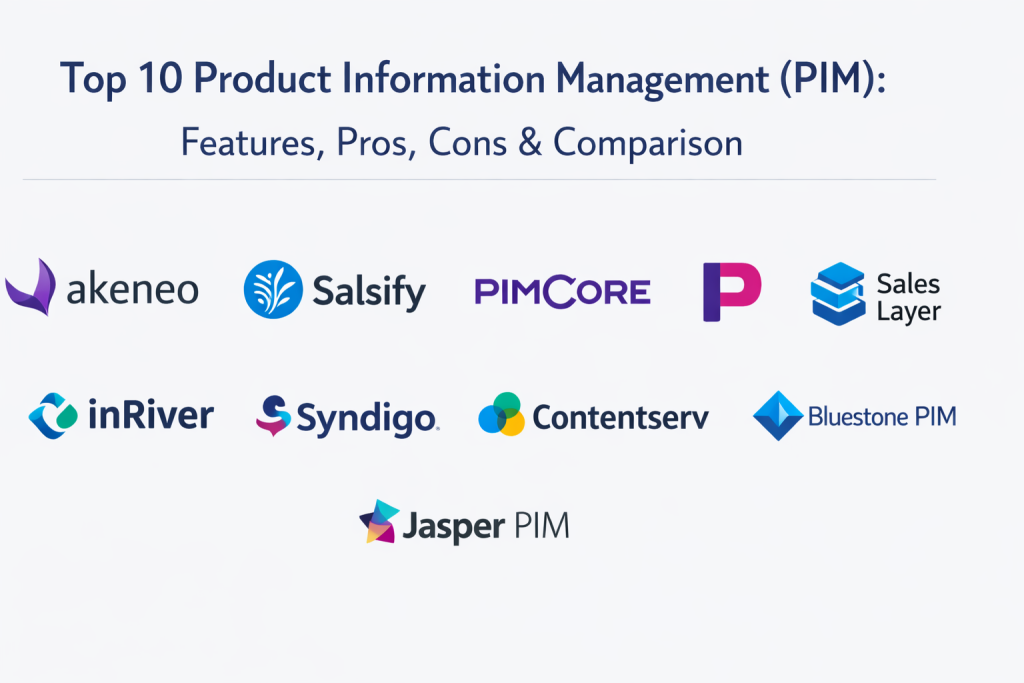
Top 10 Product Information Management (PIM)
1. Akeneo
Akeneo is a premier solution designed for organizations that want to prioritize the “Product Experience.” It provides a unified environment where marketing teams can collaborate on data enrichment, ensuring that every product story is accurate and emotionally resonant across every channel.
Key Features
- Product Cloud Environment: A comprehensive suite that combines PIM, DAM, and supplier onboarding tools.
- Governance and Validation: Sophisticated workflows that require approval before any data is pushed to live storefronts.
- Attribute Management: Highly flexible data modeling that supports complex relationships and localized content.
- Connectivity Link: A standardized framework for high-speed API integrations with external systems.
- Supplier Data Manager: A dedicated portal that allows vendors to upload their own data directly for internal review.
- Asset Transformation: Native tools for resizing and formatting images for specific channel requirements.
Pros
- Exceptionally intuitive user interface that reduces the need for extensive technical training.
- One of the largest and most active partner ecosystems in the industry.
Cons
- The higher-tier editions represent a significant investment that may be out of reach for smaller companies.
- Advanced customization of the data model can sometimes require specialized consultancy.
Platforms / Deployment
- Web / iOS / Android
- Cloud
Security & Compliance
- SSO/SAML, MFA, Audit Logs, RBAC.
- SOC 2 Type II, ISO 27001, GDPR.
Integrations & Ecosystem
Akeneo is known for its “marketplace” approach, offering a wide array of pre-built connectors that facilitate rapid deployment.
- Salesforce Commerce Cloud
- Adobe Commerce
- Shopify Plus
- Microsoft Dynamics
- SAP ERP
Support & Community
Akeneo maintains a robust educational platform known as the Akeneo Academy, alongside a dedicated support team for enterprise clients and an active developer forum.
2. Salsify
Salsify is a Product Experience Management (PXM) platform that focuses on helping brands win on the “Digital Shelf.” It is particularly strong in the area of retail syndication, making it a favorite for brands that distribute through major global retailers.
Key Features
- Retailer Readiness Tools: Automated checks that ensure product data meets the specific, often rigid, requirements of individual retailers.
- Direct Syndication Engine: A powerful system for pushing data to thousands of global endpoints simultaneously.
- AI-Driven Enrichment: Automated tools for generating high-quality product content and optimizing for search visibility.
- Enhanced Content Modules: Specialized tools for creating rich, interactive layouts for product detail pages.
- Workflow Orchestration: Advanced internal task management that coordinates efforts between marketing, sales, and IT.
Pros
- Unmatched capabilities for brands whose primary revenue comes from third-party retail channels.
- High levels of automation that significantly reduce the manual effort involved in data syndication.
Cons
- The platform can be overly complex for businesses that only sell through their own direct-to-consumer store.
- Pricing is typically geared toward the enterprise market.
Platforms / Deployment
- Web
- Cloud
Security & Compliance
- SSO, MFA, Encryption at rest, Audit trails.
- SOC 2, ISO 27001, GDPR.
Integrations & Ecosystem
Salsify serves as a central hub for the modern commerce stack, integrating deeply with inventory systems and downstream retail partners.
- NetSuite
- Oracle
- BigCommerce
- Amazon Brand Registry
Support & Community
The platform provides professional onboarding services and a dedicated customer success model for its users, supported by a comprehensive technical knowledge base.
3. Pimcore
Pimcore is a unique, open-source platform that offers a consolidated solution for PIM, Master Data Management (MDM), and Digital Asset Management. It is built for organizations that require absolute control and flexibility over their data architecture.
Key Features
- Multi-Domain MDM: Capability to manage any type of enterprise data, including product, customer, and supplier information.
- Open Source Core: Provides the freedom to customize every aspect of the software to fit specific business needs.
- Digital Experience Management: Integrated CMS features that allow for the direct creation of web and mobile experiences.
- Headless Capability: Fully API-driven architecture that supports modern, decoupled front-end frameworks.
- Print Publishing: Tools for generating high-quality PDF catalogs and brochures directly from product data.
Pros
- Incredible flexibility that allows for the creation of highly customized data models.
- No licensing fees for the community edition, making it a powerful option for teams with strong development capabilities.
Cons
- Requires a high level of technical expertise to set up, maintain, and secure.
- The extensive feature set can create a steep learning curve for non-technical administrators.
Platforms / Deployment
- Web
- Cloud / Self-hosted / Hybrid
Security & Compliance
- RBAC, LDAP integration, detailed audit logs.
- GDPR compliant.
Integrations & Ecosystem
Pimcore’s API-first nature makes it highly extensible, allowing it to act as the “brain” of a complex multi-platform environment.
- GraphQL and REST APIs
- Adobe Experience Manager
- Elasticsearch
- Microsoft Power BI
Support & Community
Supported by a massive global community of developers and an enterprise division that provides SLA-backed support and consultancy.
4. Plytix
Plytix is designed with the philosophy that PIM should be accessible to everyone. It is specifically tailored for small and medium-sized businesses that need to scale their digital presence without the complexity or cost of traditional enterprise software.
Key Features
- Flat-Fee Pricing Model: A transparent approach that avoids charging per user or per channel.
- Product Feed Management: Simplifies the process of creating and distributing product feeds for Google Shopping and social media.
- Brand Portals: Allows users to create password-protected digital catalogs for wholesalers and sales representatives.
- Unlimited Users: Encourages wide-scale collaboration across the entire organization without additional costs.
- Simplified Data Import: Tools that make it easy to migrate data from spreadsheets into a structured PIM environment.
Pros
- Extremely fast implementation times, often allowing companies to go live in a matter of days.
- Transparent and predictable pricing that does not penalize a company for its growth.
Cons
- Lacks some of the deep MDM and engineering-focused features found in enterprise-grade rivals.
- Data modeling is more streamlined and may not support extremely complex hierarchical relationships.
Platforms / Deployment
- Web
- Cloud
Security & Compliance
- SSO, RBAC, standard data encryption.
- GDPR.
Integrations & Ecosystem
Plytix focuses on a “one-click” style of integration for the most popular eCommerce and marketing platforms.
- Shopify
- WooCommerce
- Google Merchant Center
- Amazon
Support & Community
Plytix is highly regarded for its personalized customer support and its educational resources aimed at helping SMBs succeed in eCommerce.
5. Sales Layer
Sales Layer is an agile PIM solution that emphasizes ease of use and rapid deployment. It is particularly effective for mid-market companies that need to improve their data quality and speed up their multi-channel distribution.
Key Features
- Agile AI Quality Scoring: A system that automatically evaluates the completeness and accuracy of product data.
- Automated Catalog Generation: Tools for creating digital and print catalogs with a single click.
- Cloud-Native Sync: Real-time updates across multiple connectors to ensure data consistency.
- Multi-Language Support: Advanced tools for managing localized content and translations.
- Task Management: Internal notifications and workflows to ensure team members complete their enrichment tasks.
Pros
- A very low barrier to entry with a user interface that is easy to master.
- Strong focus on data governance through its automated quality monitoring.
Cons
- Built-in DAM features are not as comprehensive as those found in dedicated media management tools.
- May reach its limits in highly specialized industrial scenarios requiring massive custom attribute sets.
Platforms / Deployment
- Web
- Cloud
Security & Compliance
- SSO/SAML, Encryption, RBAC.
- ISO 27001, GDPR.
Integrations & Ecosystem
Sales Layer provides a reliable library of connectors for the most common mid-market eCommerce and ERP systems.
- BigCommerce
- Adobe Commerce
- Microsoft Dynamics
- Amazon
Support & Community
The platform is known for its rapid onboarding process and responsive technical support team.
6. inRiver
inRiver is a high-end enterprise PIM that focuses on the entire lifecycle of a product. It is built for manufacturers and retailers who need to manage complex information from the design phase through to sales and eventual recycling.
Key Features
- Elastic Data Model: Designed to handle the most complex product relationships in industries like manufacturing and fashion.
- Digital Shelf Analytics: Built-in tools that monitor how products are performing on retail sites in real-time.
- In-Context Editing: Allows marketers to see exactly how their data will appear on the final channel while they are editing it.
- Sustainability Tracking: Modules designed to manage the environmental data required for modern compliance.
- Syndication Engine: Robust tools for distributing data to both digital marketplaces and traditional print channels.
Pros
- Unrivaled for B2B organizations with deeply technical and multi-variant product lines.
- Strong emphasis on strategic data governance and the “Product Journey.”
Cons
- Significant cost of ownership makes it strictly an enterprise-level tool.
- Implementation projects are typically long-term and require dedicated resources.
Platforms / Deployment
- Web
- Cloud
Security & Compliance
- SSO/SAML, MFA, Audit Logs.
- SOC 2, ISO 27001, GDPR.
Integrations & Ecosystem
inRiver is designed to integrate into high-level enterprise architectures, connecting deeply with PLM and ERP systems.
- SAP
- Oracle
- Salesforce
- Optimizely
Support & Community
Offers a structured enterprise support model and a dedicated community for experts and developers.
7. Syndigo
Syndigo is a global power in the PIM and MDM space, particularly after its integration of Riversand. It is the go-to solution for large-scale retailers and global brands that require massive data throughput and absolute accuracy.
Key Features
- Massive Scalability: Proven to handle over 100 million SKUs without degradation in performance.
- GDSN Certification: Native integration with the Global Data Synchronization Network for retail standards.
- Multi-Domain Capability: Manages product, vendor, and location data in a single, unified platform.
- Active Content Engine: Provides real-time syndication to a vast network of global retailers.
- Advanced Data Cleansing: AI-driven tools that automatically identify and correct errors in large datasets.
Pros
- The definitive choice for global conglomerates that need to synchronize data across vast retail networks.
- Provides a complete “end-to-end” solution for data management and syndication.
Cons
- The user interface can feel more technical and “corporate” than newer SaaS-only PIMs.
- Implementation is a major undertaking that usually requires significant technical consultancy.
Platforms / Deployment
- Web
- Cloud
Security & Compliance
- Enterprise SSO, MFA, RBAC, Encryption.
- SOC 2, ISO 27001, HIPAA.
Integrations & Ecosystem
Syndigo sits at the heart of the global retail ecosystem, with connections to every major ERP and retailer on the planet.
- SAP S/4HANA
- Microsoft Dynamics
- Salesforce
- All major global retailers
Support & Community
Provides a high-level professional services team and a global support network tailored for enterprise clients.
8. Contentserv
Contentserv offers an integrated Product Experience Platform that combines PIM, DAM, and MDM. It is designed to help marketing teams create personalized and emotionally engaging product stories for global audiences.
Key Features
- Integrated DAM: A built-in digital asset management system that eliminates the need for third-party media tools.
- Contextual Data Delivery: The ability to serve different product descriptions based on the shopper’s location or persona.
- Visual Workflow Engine: A drag-and-drop tool for building and visualizing complex data approval paths.
- AI-Powered Insights: Uses machine learning to identify which products have the highest potential for marketing enrichment.
- Local Content Management: Advanced tools for managing the nuances of local markets and languages.
Pros
- Reduces the “tool fatigue” caused by switching between separate PIM and DAM platforms.
- Excellent at managing high-volume marketing content for international brands.
Cons
- The modular pricing structure can make it difficult to predict the final cost of the solution.
- Implementation generally requires an experienced third-party partner.
Platforms / Deployment
- Web
- Cloud
Security & Compliance
- SSO/SAML, MFA, Encryption, RBAC.
- SOC 2, ISO 27001, GDPR.
Integrations & Ecosystem
The platform features an extensive library of connectors for the marketing and eCommerce technology stack.
- Adobe
- Shopify
- Salesforce
- Amazon
Support & Community
Highly rated for its customer support services and its structured approach to partner integration.
9. Bluestone PIM
Bluestone PIM is a cloud-native solution built on modern, “headless” principles. It is the preferred choice for businesses that are moving toward a composable commerce architecture and want a PIM that is highly flexible and API-first.
Key Features
- MACH Architecture: Built on Microservices, API-first, Cloud-native, and Headless standards.
- App Marketplace: A modular system that allows users to add specific functionalities as needed.
- High-Performance Scaling: Capable of managing millions of SKUs with sub-second response times.
- Digital Collaboration Hub: Tools specifically designed to facilitate communication between different departments.
- Supplier Onboarding: Simplifies the ingestion of data from external vendors.
Pros
- A future-proof choice for organizations that want to build a customized, best-of-breed tech stack.
- Exceptional performance and speed for very large datasets.
Cons
- Lacks some of the “out-of-the-box” marketing templates found in more traditional PIM platforms.
- Best suited for organizations with a degree of technical maturity.
Platforms / Deployment
- Web
- Cloud
Security & Compliance
- SSO/SAML, MFA, API Security, RBAC.
- ISO 27001, GDPR.
Integrations & Ecosystem
Designed to be the “data hub” in a headless eCommerce environment, connecting seamlessly via REST APIs.
- Commercetools
- BigCommerce
- Shopify Plus
- Contentful
Support & Community
Offers strong technical documentation and a responsive support model focused on developer needs.
10. Jasper PIM
Jasper PIM is a focused solution that excels in the eCommerce space, particularly for brands that operate multiple storefronts. It is known for its tight integration with the Shopify and BigCommerce ecosystems.
Key Features
- Multi-Storefront Synchronization: Manage data for dozens of different digital storefronts from one central dashboard.
- Bi-Directional Data Flow: Ensures that changes made in the PIM are reflected in the eCommerce store and vice versa.
- Price Book Management: Tools for managing complex, scheduled pricing across different regions.
- Asset Mapping: Automatically links images and videos to the correct product variants based on SKUs.
- User Permission Control: Granular settings to control who can edit specific sets of product data.
Pros
- One of the most streamlined and effective solutions for brands that are heavily invested in the Shopify ecosystem.
- Very straightforward implementation process with clear value for mid-market merchants.
Cons
- Not as effective for heavy industrial manufacturers who require deep engineering data management.
- Syndication to non-eCommerce retail channels is less robust than some enterprise rivals.
Platforms / Deployment
- Web
- Cloud
Security & Compliance
- Standard SSO, RBAC, Encryption.
- GDPR.
Integrations & Ecosystem
Jasper focuses its integration efforts on the core platforms used by digital merchants.
- Shopify / Shopify Plus
- BigCommerce
- Amazon
- Google Merchant Center
Support & Community
Known for providing high-touch, human support that helps merchants navigate the complexities of multi-store management.
Comparison Table
| Tool Name | Best For | Platforms Supported | Deployment | Standout Feature | Public Rating |
| Akeneo | Marketers & Enterprise | Web, Mobile | Cloud | User Experience | 4.5/5 |
| Salsify | Retail Syndication | Web | Cloud | Retailer Readiness | 4.6/5 |
| Pimcore | Customization & Devs | Web | Hybrid | Open Source Core | 4.5/5 |
| Plytix | SMBs | Web | Cloud | Flat Pricing | 4.7/5 |
| Sales Layer | Agile Mid-Market | Web | Cloud | AI Quality Score | 4.8/5 |
| inRiver | Manufacturers | Web | Cloud | Product Journey | 4.2/5 |
| Syndigo | Global Retail | Web | Cloud | Massive Scalability | 4.4/5 |
| Contentserv | Content Marketing | Web | Cloud | Integrated PIM & DAM | 4.1/5 |
| Bluestone PIM | Headless Commerce | Web | Cloud | MACH Architecture | 4.6/5 |
| Jasper PIM | Shopify Store Owners | Web | Cloud | Multi-Store Sync | 4.9/5 |
Evaluation & Scoring of Product Information Management (PIM)
| Tool Name | Core (25%) | Ease (15%) | Integrations (15%) | Security (10%) | Performance (10%) | Support (10%) | Value (15%) | Weighted Total |
| Akeneo | 10 | 9 | 10 | 10 | 9 | 9 | 7 | 9.15 |
| Salsify | 9 | 8 | 10 | 10 | 9 | 9 | 7 | 8.85 |
| Pimcore | 10 | 4 | 9 | 8 | 10 | 7 | 10 | 8.40 |
| Plytix | 7 | 10 | 8 | 8 | 8 | 10 | 10 | 8.55 |
| Sales Layer | 8 | 10 | 8 | 10 | 8 | 9 | 9 | 8.75 |
| inRiver | 10 | 6 | 8 | 10 | 9 | 8 | 6 | 8.15 |
| Syndigo | 10 | 5 | 9 | 10 | 10 | 7 | 6 | 8.15 |
| Contentserv | 9 | 7 | 8 | 10 | 8 | 8 | 7 | 8.15 |
| Bluestone PIM | 9 | 7 | 10 | 10 | 10 | 8 | 8 | 8.85 |
| Jasper PIM | 7 | 9 | 9 | 8 | 8 | 10 | 9 | 8.55 |
Scores are assigned based on a comparative analysis of each tool’s performance within its target market segment. A high “Ease of Use” score indicates the tool is accessible to marketing teams, while a high “Core” score reflects the depth of data modeling and enrichment features.
Which Product Information Management (PIM) Is Right for You?
Solo / Freelancer
For an individual or very small shop, a full PIM system is usually more infrastructure than you need. Your focus should be on the built-in management tools of your eCommerce platform. If you have a growing catalog of unique items, Plytix offers a free entry point that can help you organize your data before you scale.
SMB
Small and medium businesses should prioritize ease of implementation and cost predictability. Plytix is an excellent choice due to its flat pricing and unlimited user model. If you are a mid-market brand that needs high levels of data quality automation, Sales Layer provides an intuitive path to multi-channel success.
Mid-Market
Companies with growing international footprints and expanding product lines should consider Akeneo for its superior marketing interface or Bluestone PIM if they are adopting a modern, headless tech stack. Jasper PIM is the specialized choice for brands that live and breathe within the Shopify ecosystem.
Enterprise
Global organizations with massive, complex datasets and significant retail syndication needs should shortlist Akeneo, Salsify, and Syndigo. If your business requires complete control over the underlying code and has a strong in-house engineering team, Pimcore is the definitive professional choice.
Budget vs Premium
For those prioritizing budget, Plytix and the community edition of Pimcore are the leaders. For those seeking premium, high-automation features and global retail connectivity, Salsify and Akeneo Enterprise are the standard.
Feature Depth vs Ease of Use
If you need deep data modeling for complex manufacturing, inRiver and Syndigo provide the most depth. If your priority is getting your marketing team up and running quickly with minimal friction, Sales Layer and Plytix are the most accessible.
Integrations & Scalability
For businesses building a modern, composable architecture, Bluestone PIM offers the most agile API-first approach. For organizations needing to scale across millions of SKUs while maintaining retail standards, Syndigo is the robust veteran.
Security & Compliance Needs
Organizations in highly regulated sectors should focus on tools with established ISO 27001 and SOC 2 certifications, such as Akeneo, Salsify, and Sales Layer.
Frequently Asked Questions (FAQs)
What is the primary difference between a PIM and an ERP?
An ERP handles the transactional and operational data of a business, such as stock levels, pricing, and orders. A PIM handles the descriptive and marketing data, such as product stories, specifications, and media, ensuring it is ready for customer consumption.
Can I manage my product images inside a PIM?
Yes, most PIM solutions include at least basic media management. However, for organizations with complex creative workflows, high-resolution video requirements, or massive image libraries, a PIM with an integrated or connected Digital Asset Management (DAM) system is recommended.
How does a PIM help with search engine optimization?
By centralizing data, a PIM ensures that SEO fields like titles, alt-text, and meta-descriptions are applied consistently across all channels. Many modern PIMs also use AI to suggest keywords and ensure that data is formatted correctly for search engines.
Is it difficult to migrate from spreadsheets to a PIM?
While the initial data cleansing can be time-consuming, most PIM tools offer automated import wizards and mapping tools that allow you to bring in data from Excel or CSV files with relative ease.
Do PIM systems support multiple languages?
Yes, localization is one of the core strengths of a PIM. They allow you to manage different versions of your product descriptions for different regions, often integrating directly with translation services to automate the process.
What is the “Digital Shelf”?
The digital shelf refers to any place where a consumer can discover, research, or buy your products online. This includes your website, third-party marketplaces like Amazon, and social media shops. A PIM ensures your brand is represented accurately across this entire “shelf.”
How many products do I need before I buy a PIM?
There is no set number, but most companies find a PIM becomes necessary once they reach 100 products or begin selling on more than two different channels. At this point, manual data management usually becomes prone to errors.
Does a PIM work with social media marketplaces?
Yes, most modern PIM systems have native connectors or feed management tools that allow you to push your product data directly to Instagram, TikTok, and Facebook Shops.
What are the main security risks of a PIM?
The main risks involve unauthorized access to sensitive product roadmap data or the accidental publishing of incorrect information. This is why features like role-based access control and audit logs are critical for any enterprise PIM.
How often should I update my PIM data?
In the modern commerce environment, data should be updated as often as your product attributes change. A PIM allows for real-time or near-real-time updates, ensuring that your customers always see the most current information.
Conclusion
Selecting a Product Information Management solution is a strategic decision that affects every part of your commerce ecosystem. The right tool will act as the engine for your digital growth, ensuring that your product data is accurate, localized, and ready for whatever new channels emerge. While the enterprise-grade power of Akeneo or Salsify may be the goal for many, the agility of Sales Layer or the affordability of Plytix offers a practical starting point for many organizations.
Ultimately, the “best” PIM is the one that fits your specific data complexity, team skills, and growth goals.

Best Cardiac Hospitals Near You
Discover top heart hospitals, cardiology centers & cardiac care services by city.
Advanced Heart Care • Trusted Hospitals • Expert Teams
View Best Hospitals