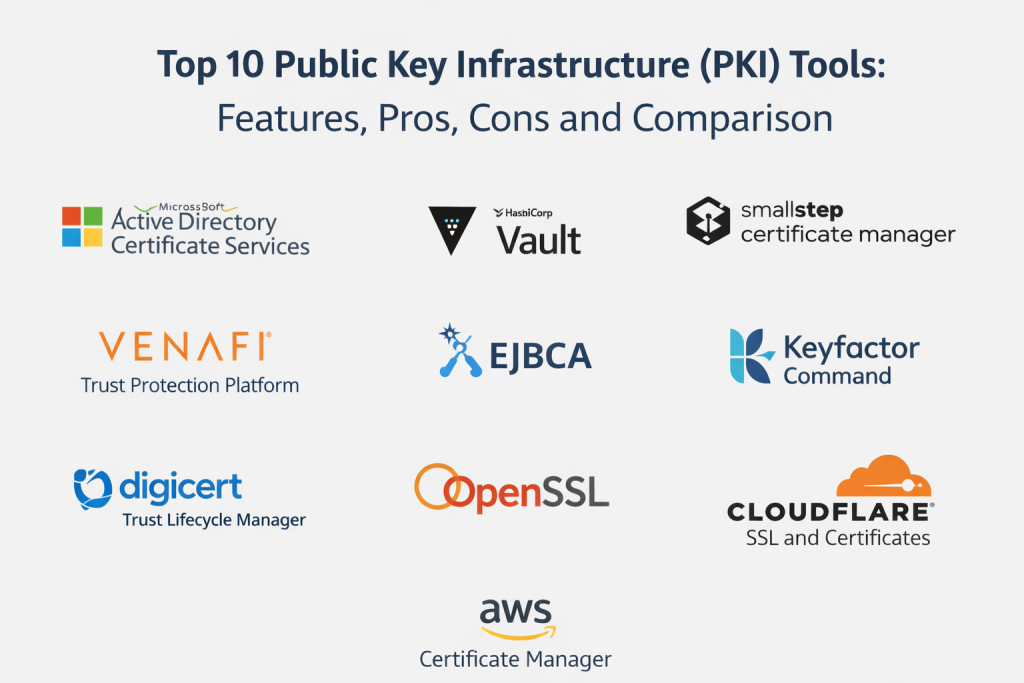
Introduction
Public Key Infrastructure tools help organizations create, issue, manage, and revoke digital certificates that prove identity and enable secure communication. PKI is the backbone of TLS for websites, mutual TLS between services, device identity in zero trust networks, secure email signing, code signing, and many compliance driven security programs. While encryption protects data, PKI ensures the right parties can trust each other through verified certificates and controlled certificate lifecycles.
Real world use cases include securing internal service to service traffic with mutual TLS, issuing certificates for employee and device authentication, automating certificate rotation for Kubernetes and microservices, enabling secure VPN and WiFi authentication, signing software releases, and managing certificate revocation and audit trails. When selecting PKI tools, buyers should evaluate certificate lifecycle automation, policy and template flexibility, integration with identity systems, support for ACME and modern protocols, scalability, high availability, audit logging, role separation, recovery procedures, and ease of operation.
Best for
Security teams, platform engineering teams, DevOps teams, and IT administrators managing certificates for web services, internal applications, devices, and secure network access.
Not ideal for
Very small environments that only need a few public website certificates managed by a hosting provider, or teams that cannot maintain governance over certificate issuance and private key protection.
Key Trends in PKI Tools
- Rapid growth of certificate automation and short lived certificates to reduce breach impact
- Higher adoption of ACME for automated issuance and renewal in internal environments
- More focus on certificate discovery to eliminate unknown or expired certificates
- Greater use of mutual TLS to secure internal APIs and microservices
- Stronger integration between PKI and identity access systems for zero trust
- Increased need for device identity and workload identity in cloud native platforms
- More emphasis on audit readiness for certificate issuance and revocation actions
- More policy based templates to prevent weak key usage and insecure certificates
- Expanded use of code signing and artifact signing for supply chain security
- Increased demand for centralized visibility across hybrid and multi cloud PKI estates
How We Selected These Tools (Methodology)
- Selected widely used PKI tools covering enterprise, cloud native, and open source needs
- Prioritized tools with strong certificate lifecycle management and automation support
- Considered integration breadth with identity systems, directories, and DevOps platforms
- Included options for issuing private certificates and managing public certificate needs
- Looked for scalability, policy control, and operational reliability patterns
- Focused on tools that support modern protocols and automation workflows
- Avoided claiming certifications, ratings, or features not clearly known
- Balanced tools that serve IT managed PKI and developer oriented service PKI
Top 10 Public Key Infrastructure Tools
1 — Microsoft Active Directory Certificate Services
Enterprise PKI capability used to issue and manage certificates within Windows based environments. Commonly used for device and user certificates, internal TLS, and enterprise authentication scenarios.
Key Features
- Certificate authority services for enterprise certificate issuance
- Templates and policies for different certificate types
- Integration with Active Directory for identity and access
- Support for auto enrollment in managed environments
- Revocation mechanisms and certificate status workflows
- Management tools for issuing and renewing certificates
- Works well for Windows device and user certificate needs
Pros
- Strong fit for Windows enterprise environments
- Integrates closely with directory based identity workflows
- Useful for device certificates and internal authentication
Cons
- Less developer friendly for cloud native automation by default
- Operations can be complex at scale without strong processes
- Integration outside Windows ecosystems can require extra work
Platforms and Deployment
Windows, Self hosted, Hybrid
Security and Compliance
Access control and audit expectations exist in enterprise PKI; certifications: Not publicly stated.
Integrations and Ecosystem
Often used with Windows endpoints, directory services, VPN and WiFi authentication, and internal enterprise applications that rely on certificate based identity.
- Integrates with Windows domain identity workflows
- Supports device and user certificate auto enrollment
- Works with VPN, WiFi, and internal authentication services
- Can feed logs into security monitoring systems
Support and Community
Broad enterprise familiarity and documentation. Support depends on Microsoft agreements: Varies / Not publicly stated.
2 — HashiCorp Vault
Secrets and encryption platform that also supports PKI as a service for issuing and managing internal certificates. Frequently used by platform teams to automate certificate issuance for applications and services.
Key Features
- PKI engine for issuing internal certificates
- Short lived certificates for reduced risk exposure
- Role based issuance policies and constraints
- API driven automation for DevOps workflows
- Audit logging for issuance and access events
- Integration with identity systems for auth methods
- Supports secure secret and key handling workflows
Pros
- Strong for automation and cloud native service PKI
- Supports short lived certificates and strong policy controls
- Fits modern DevOps and platform engineering workflows
Cons
- Requires operational ownership and careful architecture
- PKI design must be planned to avoid complexity
- High availability setups require strong infrastructure maturity
Platforms and Deployment
Windows, macOS, Linux, Cloud, Self hosted, Hybrid
Security and Compliance
Encryption and audit logs are core; certifications: Not publicly stated.
Integrations and Ecosystem
Vault commonly integrates into Kubernetes, CI pipelines, and microservice runtimes where certificates must be issued and rotated automatically.
- APIs for certificate issuance and renewal workflows
- Integrations with Kubernetes and service discovery
- Works with identity systems for access control
- Logs integrated into monitoring and audit pipelines
Support and Community
Strong community usage and documentation. Enterprise support tiers: Varies / Not publicly stated.
3 — Smallstep Certificate Manager
PKI tool designed for modern certificate automation, often used for internal TLS and device identity. It is commonly chosen by teams that want developer friendly PKI with strong automation patterns.
Key Features
- Automated certificate issuance and renewal workflows
- Support for ACME style automation patterns
- Policy control for certificate issuance constraints
- Integration with identity providers for authentication
- Supports mutual TLS and workload identity patterns
- Certificate authority operations and lifecycle tooling
- Visibility into issued certificates and expiration management
Pros
- Strong for modern automation and developer workflows
- Helps reduce expired certificates through automation
- Good fit for internal service PKI and device identity
Cons
- Requires planning for CA hierarchy and trust distribution
- Enterprise governance features depend on deployment choices
- Migration from legacy PKI requires careful change management
Platforms and Deployment
Windows, macOS, Linux, Cloud, Self hosted, Hybrid
Security and Compliance
Standard PKI controls expected; certifications: Not publicly stated.
Integrations and Ecosystem
Often used with Kubernetes, service meshes, internal APIs, and device fleets where automated certificate issuance and rotation are needed.
- ACME based automation and client integrations
- Works with identity providers for issuance authorization
- Integrates with service meshes for mutual TLS
- Supports monitoring workflows for certificate expiration
Support and Community
Documentation is generally strong for implementers. Support tiers: Varies / Not publicly stated.
4 — Venafi Trust Protection Platform
Enterprise certificate lifecycle management platform used to discover, manage, and automate certificates across large environments. Often used by organizations that have many certificates and need governance and visibility.
Key Features
- Certificate discovery across enterprise environments
- Central inventory and lifecycle management
- Policy enforcement for certificate issuance and renewal
- Automation for renewals to reduce outages
- Governance controls and role based administration
- Reporting and audit visibility for certificate operations
- Integrations with enterprise systems and CAs
Pros
- Strong for large scale certificate governance and visibility
- Helps prevent outages caused by expired certificates
- Useful for compliance driven certificate programs
Cons
- Typically heavier and more expensive than smaller tools
- Requires operational maturity to get full value
- Setup complexity depends on environment diversity
Platforms and Deployment
Web, Cloud, Self hosted, Hybrid
Security and Compliance
Access controls and audit features expected; certifications: Not publicly stated.
Integrations and Ecosystem
Often integrated with multiple certificate authorities, load balancers, web servers, and enterprise platforms to centralize lifecycle controls and reporting.
- Integrates with many CAs and certificate sources
- Connects to network and application infrastructure
- Supports automation across diverse environments
- Reporting integrations for audit and compliance workflows
Support and Community
Enterprise support model. Documentation and services: Varies / Not publicly stated.
5 — EJBCA
Enterprise oriented certificate authority and PKI system used to build private PKI, often used in regulated or high assurance environments and in device identity programs.
Key Features
- Certificate authority platform for private PKI
- Flexible certificate profiles and issuance policies
- Support for hierarchical CA structures
- Revocation mechanisms and status services
- Supports device identity and authentication scenarios
- Management interfaces for PKI operations
- Integrations for enterprise workflows depending on setup
Pros
- Strong foundation for building private PKI programs
- Flexible policy and profile configuration
- Useful for device identity and enterprise authentication
Cons
- Requires PKI expertise for secure operation
- Operational complexity can be high at scale
- Governance and monitoring must be designed carefully
Platforms and Deployment
Linux, Cloud, Self hosted, Hybrid
Security and Compliance
PKI governance controls expected; certifications: Not publicly stated.
Integrations and Ecosystem
Often integrated with identity systems, device fleets, and authentication platforms where organizations need full control over certificate issuance and lifecycle.
- Integrates with identity and directory systems
- Supports device identity and authentication workflows
- Connects to applications needing internal TLS certificates
- Can export logs and events into monitoring systems
Support and Community
Community usage exists with enterprise support options depending on vendor. Exact details: Varies / Not publicly stated.
6 — Keyfactor Command
Certificate lifecycle and PKI management platform used to centralize certificates, automate renewals, and enforce governance across enterprise environments.
Key Features
- Central certificate inventory and lifecycle management
- Automation for renewals and certificate deployment
- Policy controls and role based administration
- Integrations with certificate authorities and infrastructure
- Reporting and audit trails for certificate operations
- Supports device identity and IoT certificate programs
- Tools for managing issuance workflows and approvals
Pros
- Strong fit for enterprise certificate lifecycle management
- Reduces outage risk through automation
- Useful for governance across many certificate sources
Cons
- Typically requires enterprise deployment planning
- Integration work depends on environment diversity
- Feature scope varies by licensing and modules
Platforms and Deployment
Web, Cloud, Self hosted, Hybrid
Security and Compliance
Role controls and audit logs expected; certifications: Not publicly stated.
Integrations and Ecosystem
Keyfactor Command is often used to connect many certificate authorities and automate certificate management across infrastructure and devices.
- Integrates with multiple CAs and issuance systems
- Connects to load balancers, servers, and gateways
- Supports device and IoT certificate lifecycle needs
- Exports reporting data for audit workflows
Support and Community
Enterprise support model. Exact details: Varies / Not publicly stated.
7 — DigiCert Trust Lifecycle Manager
Enterprise certificate lifecycle management platform focused on visibility, policy enforcement, and automation for certificates across organizations.
Key Features
- Central certificate inventory and lifecycle workflows
- Discovery and monitoring of certificate usage
- Automation for renewals and deployment
- Policy controls for issuance and governance
- Reporting and audit evidence for compliance needs
- Integrations with infrastructure and security tools
- Helps standardize certificate operations across teams
Pros
- Strong for central visibility and lifecycle automation
- Helps reduce certificate outage risks
- Useful for governance and audit readiness
Cons
- Often targeted at enterprise programs
- Requires integration effort to cover all environments
- Costs and modules vary by organization needs
Platforms and Deployment
Web, Cloud, Self hosted, Hybrid
Security and Compliance
Standard enterprise controls expected; certifications: Not publicly stated.
Integrations and Ecosystem
Typically integrates with certificate authorities, load balancers, web servers, and enterprise security monitoring to centralize certificate lifecycle control.
- Integrates with CA sources and certificate issuers
- Connects to network and application infrastructure
- Supports automation for deployment and renewal
- Reporting integrations for audit and security teams
Support and Community
Enterprise support and services are typical. Exact details: Varies / Not publicly stated.
8 — OpenSSL
Widely used cryptographic toolkit for key generation, certificate creation, and certificate management workflows. Often used for scripting, automation, and building certificate pipelines.
Key Features
- Key generation and certificate request creation
- Certificate signing and verification utilities
- Supports TLS and common cryptographic operations
- Useful for scripting certificate lifecycle tasks
- Works across many platforms and environments
- Common foundation for many PKI workflows
- Helps troubleshoot TLS and certificate issues
Pros
- Flexible and widely understood toolkit
- Strong for automation and low level PKI operations
- Useful for troubleshooting and verification tasks
Cons
- Not a centralized PKI management platform by itself
- Easy to misconfigure without strong expertise
- Governance and audit controls require external systems
Platforms and Deployment
Windows, macOS, Linux, Self hosted
Security and Compliance
Cryptographic functions are core; certifications: Not publicly stated.
Integrations and Ecosystem
OpenSSL is commonly used in DevOps and IT automation for certificate operations, often paired with centralized PKI tools for governance and visibility.
- Used in CI workflows for certificate operations
- Supports scripts for key and certificate management
- Commonly paired with PKI management platforms
- Widely used for TLS troubleshooting procedures
Support and Community
Large community support and broad documentation. Enterprise support: Varies / Not publicly stated.
9 — Cloudflare SSL and Certificates
Certificate management capabilities used to secure web traffic and manage TLS certificates for sites and services running through Cloudflare.
Key Features
- TLS certificate issuance and management workflows
- Automated renewal and lifecycle handling
- Configuration options for secure web traffic
- Helps reduce outages from expired certificates
- Works well for sites behind Cloudflare services
- Simplifies TLS setup and operations
- Visibility into certificate related settings for web apps
Pros
- Strong for simplifying web TLS operations
- Reduces manual work through automation
- Useful for teams operating websites at scale
Cons
- Primarily focused on web and edge use cases
- Deep PKI governance features are limited compared to enterprise PKI tools
- Best fit when traffic flows through Cloudflare
Platforms and Deployment
Web, Cloud
Security and Compliance
TLS and access control features vary by plan; certifications: Not publicly stated.
Integrations and Ecosystem
Commonly integrated with web infrastructure, DNS, and edge security setups where Cloudflare terminates or manages TLS and certificate renewal operations.
- Integrates with web traffic and edge delivery workflows
- Works with DNS and application security configurations
- Supports automated certificate lifecycle handling
- Fits web operations and security team workflows
Support and Community
Support varies by plan. Documentation is widely used: Varies / Not publicly stated.
10 — AWS Certificate Manager
Managed certificate service used to provision and manage certificates for AWS services. Often used to simplify TLS certificate handling for load balancers, APIs, and cloud hosted services.
Key Features
- Managed certificate provisioning and renewal
- Integration with AWS load balancing and API services
- Simplifies TLS operations for cloud workloads
- Reduces risk of expired certificates
- Supports centralized certificate visibility for AWS services
- Works with cloud identity and governance models
- Helps standardize TLS deployments across teams
Pros
- Strong for AWS hosted services needing TLS
- Reduces manual certificate renewal work
- Easy integration within AWS environment
Cons
- Primarily focused on AWS service integrations
- Not a full enterprise PKI governance platform
- Multi cloud visibility requires additional tooling
Platforms and Deployment
Web, Cloud
Security and Compliance
Standard cloud security controls expected; certifications: Not publicly stated.
Integrations and Ecosystem
Typically used with load balancers, API gateways, and AWS hosted services to automate TLS certificate management and reduce operational risks.
- Integrates with AWS networking and API services
- Supports centralized TLS certificate management in AWS
- Works with monitoring and logging pipelines
- Fits cloud security operations and platform teams
Support and Community
Support depends on AWS support plan. Documentation is strong: Varies / Not publicly stated.
Comparison Table
| Tool Name | Best For | Platform(s) Supported | Deployment | Standout Feature | Public Rating |
|---|---|---|---|---|---|
| Microsoft Active Directory Certificate Services | Enterprise PKI in Windows environments | Windows | Self hosted, Hybrid | Directory integrated certificate issuance and templates | N/A |
| HashiCorp Vault | Automated internal service PKI | Windows, macOS, Linux | Cloud, Self hosted, Hybrid | PKI as a service with policy driven issuance | N/A |
| Smallstep Certificate Manager | Modern certificate automation | Windows, macOS, Linux | Cloud, Self hosted, Hybrid | Strong automation and ACME workflows | N/A |
| Venafi Trust Protection Platform | Enterprise certificate governance | Web | Cloud, Self hosted, Hybrid | Discovery and lifecycle management at scale | N/A |
| EJBCA | Building private PKI programs | Linux | Cloud, Self hosted, Hybrid | Flexible CA profiles and policy control | N/A |
| Keyfactor Command | Central certificate lifecycle management | Web | Cloud, Self hosted, Hybrid | Automation for renewals and deployments | N/A |
| DigiCert Trust Lifecycle Manager | Enterprise certificate visibility and automation | Web | Cloud, Self hosted, Hybrid | Central inventory with policy enforcement | N/A |
| OpenSSL | Certificate utilities and automation | Windows, macOS, Linux | Self hosted | Flexible toolkit for keys and certificates | N/A |
| Cloudflare SSL and Certificates | Web TLS certificate management | Web | Cloud | Automated TLS certificate lifecycle for sites | N/A |
| AWS Certificate Manager | TLS certificates for AWS services | Web | Cloud | Tight integration with AWS services for TLS | N/A |
Evaluation and Scoring of PKI Tools
The scores below compare PKI tools across common selection criteria. A higher weighted total suggests a stronger overall balance, but the best tool depends on whether you need enterprise certificate governance, developer focused automation, device identity, or cloud managed TLS. Use these scores to shortlist options, then validate certificate templates, rotation workflows, trust distribution, and revocation readiness in a pilot. Scoring is comparative and should be interpreted alongside your operational constraints and risk profile.
Weights used: Core 25 percent, Ease 15 percent, Integrations 15 percent, Security 10 percent, Performance 10 percent, Support 10 percent, Value 15 percent.
| Tool Name | Core (25%) | Ease (15%) | Integrations (15%) | Security (10%) | Performance (10%) | Support (10%) | Value (15%) | Weighted Total |
|---|---|---|---|---|---|---|---|---|
| Microsoft Active Directory Certificate Services | 8 | 7 | 8 | 8 | 8 | 7 | 8 | 7.80 |
| HashiCorp Vault | 9 | 7 | 9 | 8 | 8 | 7 | 7 | 8.05 |
| Smallstep Certificate Manager | 8 | 8 | 8 | 7 | 8 | 7 | 8 | 7.85 |
| Venafi Trust Protection Platform | 9 | 6 | 9 | 8 | 8 | 8 | 6 | 7.75 |
| EJBCA | 8 | 6 | 7 | 8 | 7 | 7 | 8 | 7.20 |
| Keyfactor Command | 9 | 7 | 9 | 8 | 8 | 8 | 6 | 7.90 |
| DigiCert Trust Lifecycle Manager | 9 | 7 | 9 | 8 | 8 | 8 | 6 | 7.90 |
| OpenSSL | 6 | 5 | 6 | 7 | 7 | 6 | 9 | 6.35 |
| Cloudflare SSL and Certificates | 7 | 9 | 7 | 7 | 8 | 7 | 8 | 7.60 |
| AWS Certificate Manager | 7 | 9 | 8 | 7 | 8 | 7 | 9 | 7.95 |
Which PKI Tool Is Right for You
Solo / Freelancer
If you are managing certificates for a small number of services, a toolkit like OpenSSL can help with generating keys, signing requests, and troubleshooting TLS issues, but it requires careful handling. If your services run primarily on AWS and need simple TLS management, AWS Certificate Manager can reduce operational burden. If you need internal certificates for apps and automation, Smallstep Certificate Manager is often easier to operate than building a full enterprise PKI.
SMB
SMBs should prioritize automation and visibility to avoid outages from expired certificates. Smallstep Certificate Manager is a good fit for internal TLS and mutual TLS automation. HashiCorp Vault is useful when certificates are part of a broader secrets and platform security program. If you are primarily focused on public facing web TLS behind Cloudflare, Cloudflare SSL and Certificates can simplify renewal and reduce manual work.
Mid Market
Mid market organizations often need both automation and governance. HashiCorp Vault can provide automated internal PKI for services while also handling secrets. Smallstep Certificate Manager can cover modern certificate automation needs. If certificate count is high and governance is needed across teams, Keyfactor Command or DigiCert Trust Lifecycle Manager can centralize lifecycle controls and reduce outage risks.
Enterprise
Enterprises usually need discovery, governance, audit evidence, and standardization across many platforms. Venafi Trust Protection Platform is often used for large scale certificate governance. Keyfactor Command and DigiCert Trust Lifecycle Manager also align with enterprise lifecycle management. Microsoft Active Directory Certificate Services remains relevant in Windows heavy environments for user and device certificates. For cloud hosted services, AWS Certificate Manager can still be used for TLS but often sits inside a broader governance layer.
Budget vs Premium
Budget approaches often rely on cloud managed certificate services and toolkits, but these can create governance gaps at scale. Premium solutions focus on discovery, policy enforcement, lifecycle automation, and audit evidence across complex environments, where enterprise certificate management platforms typically provide the strongest value.
Feature Depth vs Ease of Use
If ease of use is the priority, cloud managed certificate services and automation focused tools reduce operational work. If feature depth is needed for discovery, governance, and multi platform policy enforcement, enterprise lifecycle tools are a better match but require planning and ownership.
Integrations and Scalability
Scalable PKI depends on integration quality, especially for load balancers, service meshes, container platforms, and device identity. HashiCorp Vault and Smallstep Certificate Manager fit modern DevOps workflows well. Venafi, Keyfactor, and DigiCert tools fit best when you need central visibility across many certificate sources and automated deployment at scale.
Security and Compliance Needs
Security depends on protecting private keys, controlling issuance, limiting certificate lifetimes, enforcing strong templates, and having a reliable revocation process. Compliance programs often require audit trails showing who issued certificates, why they were issued, and how lifecycle events are handled. The most common failures are expired certificates, uncontrolled issuance, and weak governance rather than weak cryptography.
Frequently Asked Questions
1. What is PKI used for in an organization?
PKI is used to establish trust using certificates, enabling secure connections, identity authentication, and digital signing. It powers TLS, mutual TLS, device identity, and code signing.
2. What is the difference between a certificate authority and certificate lifecycle management?
A certificate authority issues certificates, while lifecycle management handles discovery, renewals, policy enforcement, and deployment across infrastructure. Many organizations use both to avoid outages and governance gaps.
3. Why do certificates expire and how do we avoid outages?
Certificates expire to limit long term risk if keys are compromised. Avoid outages by automating renewals, monitoring expiration, and using a central inventory with alerts and policy controls.
4. What is mutual TLS and why is it growing?
Mutual TLS requires both client and server certificates, improving trust between services. It is growing because microservices and zero trust designs need stronger service identity.
5. What is ACME and why does it matter for PKI tools?
ACME is a protocol that automates certificate issuance and renewal. It matters because automation reduces outages, manual work, and certificate management errors.
6. How do we distribute trust for internal certificates?
You must deploy root and intermediate trust stores to systems and clients in a controlled way. This is often done through device management, configuration management, or platform tooling.
7. What is certificate revocation and when is it required?
Revocation invalidates a certificate before it expires, usually due to compromise or policy change. It is required when a private key is suspected to be exposed or a certificate was issued incorrectly.
8. Can PKI tools support device identity and IoT certificates?
Yes. Many PKI tools issue certificates for devices and workloads. The key challenges are secure provisioning, rotation, inventory tracking, and revocation processes for large fleets.
9. How should we protect certificate private keys?
Use strong access controls, isolate signing keys, and consider hardware backed protection for high assurance needs. Also enforce good rotation and limit who can export or use keys.
10. How do we choose the right PKI tool?
Start by mapping your certificate types, volumes, and environments, then decide whether you need a CA, lifecycle governance, or both. Pilot the tool with real issuance and renewal workflows, validate integrations, and test revocation and recovery procedures.
Conclusion
PKI tools are essential for building trust across modern systems, from websites and APIs to devices and service to service communication. The right choice depends on whether you need a certificate authority for issuing private certificates, a lifecycle management platform to discover and automate renewals, or a developer friendly automation tool for cloud native environments. Smaller teams often prioritize automation and simplicity to avoid certificate outages, while larger organizations need discovery, governance, and consistent policy enforcement across many platforms. A practical next step is to shortlist two or three tools that match your certificate volumes and environments, run a pilot focusing on issuance, renewal automation, trust distribution, and revocation readiness, then expand once operations and governance are stable.

Best Cardiac Hospitals Near You
Discover top heart hospitals, cardiology centers & cardiac care services by city.
Advanced Heart Care • Trusted Hospitals • Expert Teams
View Best Hospitals