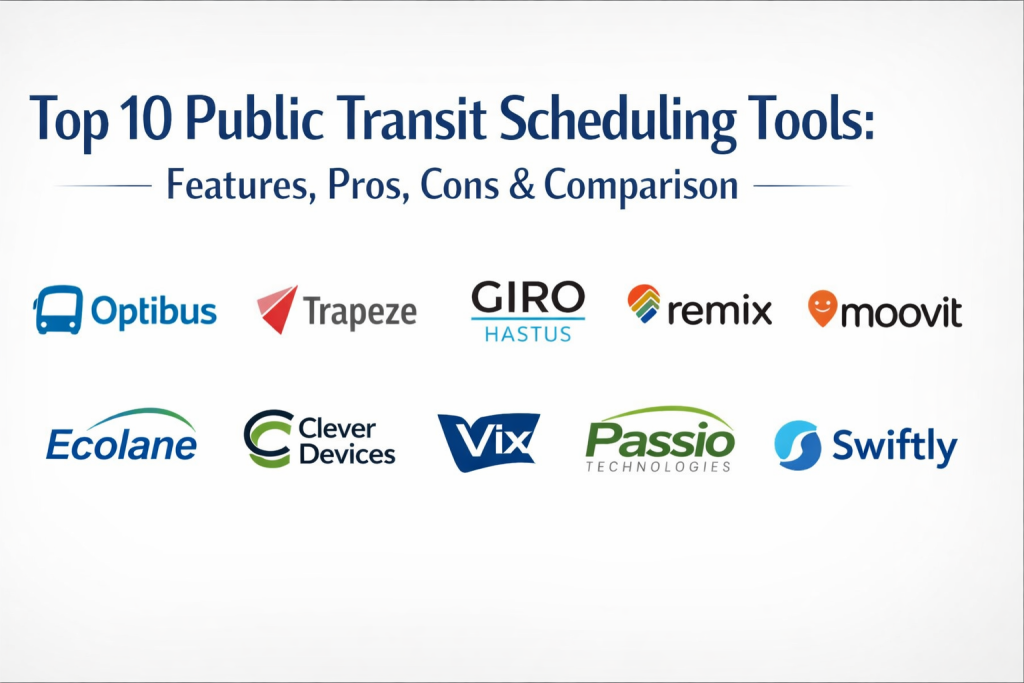
Introduction
Public Transit Scheduling Tools are sophisticated enterprise platforms designed to manage the intricate logistics of moving people across urban and regional environments. These systems coordinate vehicle routes, driver shifts, and passenger demand to ensure that bus, rail, and tram networks operate with maximum efficiency. In a world focused on reducing urban congestion and carbon emissions, these tools have become essential for transit agencies to optimize their resources and improve the reliability of public transportation.
When evaluating these platforms, buyers must consider the complexity of their network, the flexibility of the scheduling algorithms, and how well the tool integrates with real-time tracking and payroll systems. Effective scheduling directly translates to reduced wait times for passengers and lower operational costs for agencies. Whether managing a small municipal bus fleet or a massive multi-modal metropolitan authority, selecting the right software is a foundational step toward sustainable urban mobility.
Best for: Municipal transit agencies, regional transport authorities, private bus operators, and metropolitan planning organizations looking to modernize their scheduling and workforce management.
Not ideal for: Ride-sharing startups or very small taxi services that rely on on-demand dispatching rather than fixed-route, scheduled services.
Key Trends in Public Transit Scheduling Tools
- AI-Powered Demand Prediction: Modern tools utilize machine learning to analyze historical ridership and predict future demand patterns, allowing for more precise scheduling.
- Seamless Multi-Modal Integration: Systems are increasingly designed to coordinate schedules across different modes of transport, such as buses, light rail, and ferries, in a single interface.
- Dynamic Microtransit Hybridization: The rise of flexible routing for “last-mile” connectivity is being integrated directly into fixed-route scheduling software.
- Driver Preference and Wellbeing Algorithms: Newer systems prioritize driver satisfaction by incorporating shift preferences and fatigue management into the automated rostering process.
- Real-time Schedule Adherence: Integration with GPS data allows schedulers to adjust future timetables based on actual traffic conditions and historical delays.
- Electric Vehicle (EV) Charging Management: Scheduling logic now includes charging requirements and battery range constraints for transit agencies transitioning to electric fleets.
- Standardized Data Formats: Wide adoption of GTFS and GTFS-Realtime ensures that schedules can be easily shared with passenger-facing applications.
How We Selected These Tools (Methodology)
- Market Adoption and Proven Reliability: We prioritized tools used by major global transit agencies with a track record of stability.
- Feature Completeness: Evaluation was based on the presence of core modules like blocking, run-cutting, and rostering.
- Ease of Use and Interface Design: We looked for platforms that simplify complex data entry and visualization.
- Integration Ecosystem: Assessment focused on the ability to connect with CAD/AVL systems, ERPs, and payroll platforms.
- Optimization Power: We evaluated the efficiency of the underlying mathematical algorithms used for vehicle and crew scheduling.
- Scalability and Flexibility: The tools were checked for their ability to handle both small fleets and massive, multi-tiered networks.
Top 10 Public Transit Scheduling Tools
1.Optibus
Optibus is a cloud-native platform that uses high-speed optimization algorithms to transform how transit networks are planned and scheduled.
Key Features
- High-speed optimization for vehicle and crew scheduling.
- Impact analysis for “what-if” scenario testing.
- Integrated electric vehicle scheduling and charging management.
- Real-time collaboration tools for planning teams.
- Advanced analytics for service reliability and cost.
Pros
- Extremely fast calculation times compared to legacy systems.
- Modern, intuitive user interface that reduces training time.
- Excellent support for sustainability and EV transition goals.
Cons
- Higher price point compared to some basic scheduling options.
- Deep feature set may be overkill for very small agencies.
Platforms / Deployment
- Web
- Cloud
Security & Compliance
- SSO, MFA, RBAC, Encryption.
- ISO 27001.
Integrations & Ecosystem
Leverages modern APIs to connect with various transit data standards.
- GTFS-Realtime
- SAP ERP
- Various CAD/AVL providers
- Payroll systems
Support & Community
Provides a robust knowledge base, active user webinars, and dedicated customer success teams for enterprise clients.
2.Trapeze Group
Trapeze Group offers one of the most comprehensive and long-standing suites for transit management, covering everything from scheduling to workforce management.
Key Features
- Comprehensive vehicle blocking and run-cutting modules.
- Advanced workforce management and bidding systems.
- Integrated yard management and daily dispatch.
- Support for fixed-route and demand-response services.
- Extensive reporting and regulatory compliance tools.
Pros
- Highly mature platform with deep functionality for large agencies.
- Excellent ability to handle complex union and labor rules.
- Single-vendor solution for almost all transit operational needs.
Cons
- Can be complex to implement and configure initially.
- User interface is very powerful but has a steeper learning curve.
Platforms / Deployment
- Web / Windows
- Cloud / Self-hosted
Security & Compliance
- SSO/SAML, Audit Logs, MFA.
- SOC 2, GDPR.
Integrations & Ecosystem
Strong integration with its own vast ecosystem of transit modules.
- Oracle
- Microsoft Dynamics
- GTFS Feed Management
- SCADA systems
Support & Community
Large global presence with regional support centers and annual user conferences.
3.GIRO Hastus
Hastus is a globally recognized software solution for planning and scheduling, known for its powerful mathematical optimization engines.
Key Features
- High-performance algorithms for vehicle and crew scheduling.
- Multi-modal planning across bus, rail, and tram.
- Sophisticated rostering for complex labor agreements.
- Daily operations management and service adjustment tools.
- Passenger information and timetable production.
Pros
- Unmatched optimization capabilities that drive significant cost savings.
- Extremely flexible in handling highly specific local regulations.
- Trusted by some of the largest transit authorities in the world.
Cons
- Requires specialized training to master the optimization parameters.
- Implementation projects are typically large-scale and long-term.
Platforms / Deployment
- Windows
- Self-hosted / Hybrid
Security & Compliance
- RBAC, Encryption, Audit Logs.
- Varies / Not publicly stated.
Integrations & Ecosystem
Integrates with all major operational and signaling technologies.
- SAP
- Microsoft Azure
- Various RTPI (Real-Time Passenger Information) systems
- Specialized GIS tools
Support & Community
Elite technical support and a strong, dedicated community of expert users globally.
4.Remix
Owned by Via, Remix is a planning-first platform that helps agencies design routes and understand the demographic impact of their schedules.
Key Features
- Rapid route design and demographic analysis.
- Cost estimation based on proposed service levels.
- Collaborative planning tools for public engagement.
- Integrated transit network visualization.
- Easy export to scheduling systems via GTFS.
Pros
- Best-in-class visualization for route planning and equity analysis.
- Very easy to use for non-technical planners.
- Encourages community-focused transit design.
Cons
- Historically stronger on planning than on deep crew optimization.
- May require a separate tool for detailed daily dispatching.
Platforms / Deployment
- Web
- Cloud
Security & Compliance
- SSO, MFA, RBAC.
- SOC 2.
Integrations & Ecosystem
Focuses on data portability and open standards.
- GTFS / GTFS-RT
- ESRI ArcGIS
- Various scheduling software exports
- Census data integration
Support & Community
Strong emphasis on customer success and a very active community of city planners.
5.Moovit
Moovit, an Intel company, provides a MaaS (Mobility as a Service) platform that includes powerful tools for transit agencies to manage their networks.
Key Features
- Real-time transit data management.
- Demand-responsive transport (DRT) scheduling.
- Integrated passenger apps with real-time updates.
- Advanced analytics for urban mobility patterns.
- Automated service alerts and notifications.
Pros
- Leverages massive amounts of crowd-sourced data for insights.
- Excellent for agencies looking to bridge the gap with passengers.
- Strong focus on modern, mobile-first mobility solutions.
Cons
- Traditional fixed-route scheduling is less of a core focus than MaaS features.
- Integration with legacy hardware can be variable.
Platforms / Deployment
- Web / iOS / Android
- Cloud
Security & Compliance
- SSO, Encryption, MFA.
- ISO 27001, GDPR.
Integrations & Ecosystem
Heavy focus on data sharing and passenger information.
- Google Maps / Apple Maps
- Various ticketing platforms
- GTFS-RT
- Uber / Lyft integrations
Support & Community
Global support with a focus on data accuracy and passenger experience.
6.Ecolane
Ecolane specializes in demand-response and paratransit scheduling, offering real-time optimization for flexible transit services.
Key Features
- Real-time, continuous optimization for demand-response.
- Integrated mobile app for riders and drivers.
- Automated eligibility and funding verification.
- Comprehensive reporting for paratransit compliance.
- Dynamic dispatching for changing daily conditions.
Pros
- Superior for managing the unpredictability of paratransit.
- Helps agencies improve service while reducing “deadhead” miles.
- Very strong automation that reduces the need for manual dispatch.
Cons
- Not primarily designed for fixed-route bus scheduling.
- May require integration with other tools for a full-agency view.
Platforms / Deployment
- Web / iOS / Android
- Cloud
Security & Compliance
- SSO, RBAC, Encryption.
- HIPAA (where applicable), ISO 27001.
Integrations & Ecosystem
Specialized for paratransit and medical transport ecosystems.
- Medicaid billing systems
- NEMT (Non-Emergency Medical Transport) platforms
- Fleet management software
- Digital payment gateways
Support & Community
Highly specialized support for agencies managing paratransit and flexible services.
7.Clever Devices
Clever Devices provides a range of transit technology solutions, including scheduling and real-time operational control tools.
Key Features
- Integrated CAD/AVL with scheduling data.
- Real-time service monitoring and management.
- Yard management and pull-out coordination.
- Passenger information and announcement systems.
- Detailed fleet maintenance and performance tracking.
Pros
- Excellent hardware-to-software integration on the vehicle.
- Strong real-time control room capabilities.
- Reliable data for reporting and analytics.
Cons
- Can be hardware-intensive to get the most out of the software.
- User interface can feel more technical than modern SaaS competitors.
Platforms / Deployment
- Windows / Web
- Self-hosted / Hybrid
Security & Compliance
- RBAC, Audit Logs, Encryption.
- Not publicly stated.
Integrations & Ecosystem
Designed to be the center of a hardware-heavy transit environment.
- Various engine diagnostic tools
- GTFS-RT
- Digital signage hardware
- Automated Passenger Counters (APC)
Support & Community
Extensive field service support and technical engineering teams.
8.Vix Technology
Vix offers intelligent transport systems that focus on ticketing, passenger information, and network monitoring.
Key Features
- Integrated ticketing and fare management.
- Real-time passenger information (RTPI).
- Service monitoring and schedule adherence tracking.
- Business intelligence and ridership analytics.
- Support for account-based ticketing.
Pros
- Unified platform for fare collection and service monitoring.
- Strong focus on the passenger experience and convenience.
- Scalable for large multi-modal transport networks.
Cons
- Scheduling modules are often part of a wider ticketing-led ecosystem.
- May not offer the same depth of crew optimization as Hastus or Optibus.
Platforms / Deployment
- Web / Windows
- Cloud / Hybrid
Security & Compliance
- PCI-DSS, SSO, RBAC, Encryption.
- SOC 2.
Integrations & Ecosystem
Deeply integrated into the payment and hardware landscape.
- Visa / Mastercard / Amex
- Various terminal and validator hardware
- Cloud data warehouses
- GTFS providers
Support & Community
Global support footprint with dedicated professional services for large projects.
9.Passio Technologies
Passio provides a suite of transit management tools aimed at colleges, municipalities, and corporate campuses.
Key Features
- Right-sized scheduling for smaller agencies.
- Real-time vehicle tracking and passenger apps.
- Automated passenger counting and reporting.
- Digital passenger feedback systems.
- Simple route management and adjustment tools.
Pros
- Excellent value for small to mid-sized transit operations.
- Very easy to deploy and manage without a large IT team.
- High visibility for both managers and passengers.
Cons
- Lacks the extreme optimization power needed for massive city networks.
- Not designed for complex rail or tram scheduling.
Platforms / Deployment
- Web / iOS / Android
- Cloud
Security & Compliance
- SSO, MFA, RBAC.
- Not publicly stated.
Integrations & Ecosystem
Focuses on simple, effective data connections.
- GTFS
- Slack / Microsoft Teams (Alerts)
- Basic ERP connectors
- Passenger app integrations
Support & Community
Responsive customer support tailored to smaller organizations and university departments.
10.Swiftly
Swiftly specializes in using data to improve transit reliability, offering tools that refine schedules based on actual road performance.
Key Features
- Schedule refinement based on historical travel times.
- Real-time GPS tracking and service monitoring.
- Automated passenger information accuracy tools.
- Performance analytics for speed and reliability.
- Dynamic detour and incident management.
Pros
- Significant improvements in schedule accuracy and reliability.
- Very fast implementation as it is purely software-based.
- Easy-to-understand visualizations for performance data.
Cons
- Not a “blank-slate” scheduler; works best when refining existing schedules.
- Focuses more on reliability data than on crew/payroll optimization.
Platforms / Deployment
- Web
- Cloud
Security & Compliance
- SSO, MFA, RBAC, Encryption.
- SOC 2.
Integrations & Ecosystem
Built to enhance existing transit technology stacks.
- All major CAD/AVL providers
- GTFS-Realtime
- Digital signage vendors
- Various scheduling software exports
Support & Community
Passionate customer success team with a strong focus on transit advocacy and data literacy.
Comparison Table (Top 10)
| Tool Name | Best For | Platform(s) Supported | Deployment | Standout Feature | Public Rating |
|---|---|---|---|---|---|
| Optibus | Cloud Optimization | Web | Cloud | AI Schedule Optimization | N/A |
| Trapeze Group | Large Transit Agencies | Web, Windows | Cloud, On-prem | Workforce Management | N/A |
| GIRO Hastus | Complex Optimization | Windows | On-prem, Hybrid | Mathematical Algorithms | N/A |
| Remix | Strategic Planning | Web | Cloud | Demographic Equity Mapping | N/A |
| Moovit | MaaS & Passenger Info | Web, iOS, Android | Cloud | Real-time Data Accuracy | N/A |
| Ecolane | Paratransit & DRT | Web, iOS, Android | Cloud | Continuous Optimization | N/A |
| Clever Devices | Hardware-Software Sync | Windows, Web | On-prem, Hybrid | CAD/AVL Integration | N/A |
| Vix Technology | Ticketing & Monitoring | Web, Windows | Cloud, Hybrid | Account-Based Ticketing | N/A |
| Passio Technologies | Small Agencies & Unis | Web, iOS, Android | Cloud | Passenger Feedback Sync | N/A |
| Swiftly | Reliability & Data | Web | Cloud | Travel Time Refinement | N/A |
Evaluation & Scoring of Public Transit Scheduling Tools
| Tool Name | Core (25%) | Ease (15%) | Integrations (15%) | Security (10%) | Perf (10%) | Support (10%) | Value (15%) | Weighted Total |
|---|---|---|---|---|---|---|---|---|
| Optibus | 9 | 9 | 9 | 8 | 9 | 8 | 8 | 8.70 |
| Trapeze Group | 10 | 6 | 8 | 9 | 9 | 8 | 7 | 8.35 |
| GIRO Hastus | 10 | 5 | 8 | 8 | 10 | 9 | 7 | 8.20 |
| Remix | 7 | 10 | 8 | 8 | 8 | 9 | 8 | 8.10 |
| Moovit | 7 | 9 | 9 | 9 | 8 | 8 | 8 | 8.10 |
| Ecolane | 8 | 8 | 7 | 8 | 9 | 8 | 8 | 8.00 |
| Clever Devices | 8 | 6 | 7 | 8 | 9 | 8 | 7 | 7.50 |
| Vix Technology | 7 | 7 | 8 | 9 | 8 | 8 | 7 | 7.45 |
| Passio Technologies | 6 | 9 | 7 | 7 | 7 | 9 | 9 | 7.50 |
| Swiftly | 7 | 9 | 9 | 8 | 9 | 8 | 8 | 8.20 |
Scoring Interpretation: These scores are comparative based on industry research and typical user feedback for these specific categories. A high score in “Core” reflects the depth of scheduling logic, while “Ease” measures the intuitiveness of the interface. Organizations should weight these scores according to their own internal priorities, such as valuing ease of use over extreme optimization if they have a smaller, less complex network.
Which Public Transit Scheduling Tool Is Right for You?
Solo / Freelancer
Individual transit consultants or freelance planners typically need a flexible planning tool rather than a full agency operations suite. Remix is often the best choice here because it allows for rapid visualization and impact analysis without needing deep integration into vehicle hardware.
SMB
Small to mid-sized agencies or private bus contractors often find the most value in Passio Technologies or Swiftly. These tools offer high visibility and reliability improvements without the massive implementation overhead required by enterprise suites.
Mid-Market
Medium-sized cities or regional transport authorities often seek a modern, cloud-first approach to compete with larger cities. Optibus is a prime candidate for this segment, offering powerful optimization that is easy to manage via a web-based platform.
Enterprise
Large-scale metropolitan authorities with thousands of vehicles and complex labor rules require the depth of Trapeze Group or GIRO Hastus. These platforms can handle the massive complexity of multi-modal networks and the rigid requirements of unionized workforces.
Budget vs Premium
Agencies on a budget should look at modular, software-only solutions like Swiftly to improve existing operations. Those with significant capital to invest in a total digital transformation should consider the premium offerings from Trapeze or Siemens Mobility to unify their entire technology stack.
Feature Depth vs Ease of Use
If your agency needs to save every possible penny through mathematical efficiency, the learning curve of Hastus is worth the investment. However, if you have high staff turnover and need something that new planners can learn in days, Optibus or Remix are better alternatives.
Integrations & Scalability
For agencies looking to build a truly integrated “Smart City” ecosystem, Moovit and Optibus provide the most modern APIs and cloud-native architectures to scale and connect with future mobility services.
Security & Compliance Needs
Organizations with high security requirements, particularly those handling sensitive passenger data or fare collection, should prioritize vendors like Vix Technology or Trapeze Group, who have long histories of meeting stringent enterprise security standards.
Frequently Asked Questions (FAQs)
What is the primary benefit of automated transit scheduling?
Automated scheduling reduces the time it takes to create complex timetables and duty rosters. It uses optimization to minimize empty vehicle miles and ensure that driver shifts comply with all legal and union regulations, leading to significant operational savings.
How does this software help with driver shortages?
Modern scheduling tools can create more attractive rosters that respect driver preferences and provide better work-life balance. By optimizing shifts, agencies can often cover more service with fewer drivers, helping to mitigate the impact of staffing gaps.
Can these tools manage electric bus fleets?
Yes, modern platforms like Optibus and Trapeze have specific modules for EVs. They account for battery range, charging times, and the location of chargers to ensure that electric buses don’t run out of power during their scheduled shifts.
Is it hard to move data from a legacy system to a new tool?
While it can be challenging, most modern vendors use standardized formats like GTFS for easy data ingestion. The complexity usually lies in cleaning up old data and ensuring that complex local rules are correctly programmed into the new system.
How do these tools improve the passenger experience?
By creating more accurate and reliable schedules, these tools reduce wait times and missed connections. When integrated with real-time tracking, they provide passengers with accurate “countdown” times at stops and on mobile apps.
What is the difference between planning and scheduling software?
Planning software (like Remix) is used for high-level decisions like where new routes should go. Scheduling software (like Hastus) takes those routes and turns them into specific vehicle trips and driver shifts for daily execution.
Do these tools support demand-response or “Dial-a-Ride” services?
Many enterprise tools now include “Microtransit” or paratransit modules. Specialized tools like Ecolane are specifically built for these flexible services, which don’t follow a fixed route but still need efficient scheduling.
Can scheduling software help reduce a transit agency’s carbon footprint?
Yes, by optimizing routes to reduce “deadhead” (empty) miles and facilitating the transition to electric vehicles, these tools directly help transit agencies achieve their sustainability and emissions reduction targets.
How often should a transit agency update its schedules?
While many agencies do large “service changes” two or three times a year, modern data-driven tools allow for more frequent, smaller adjustments to respond to changing traffic patterns or ridership trends.
What should I look for in a scheduling tool for a small agency?
Smaller agencies should prioritize ease of use, low IT maintenance requirements (SaaS/Cloud), and the ability to easily export data to passenger apps. “Right-sized” tools like Passio or Swiftly are often more effective than complex enterprise suites.
Conclusion
Modernizing public transit scheduling is a critical step for any agency looking to remain relevant and efficient in an evolving urban landscape. The “best” tool is the one that aligns with your specific operational complexity, labor requirements, and technological readiness. Whether you prioritize the raw mathematical power of a legacy system or the agile, cloud-native approach of a newer platform, the goal remains the same: a more reliable, sustainable, and passenger-friendly transport network. We suggest identifying your top three pain points—such as driver retention, cost reduction, or EV integration—and requesting a demonstration from the vendors that score highest in those specific areas. A successful pilot program can quickly demonstrate the potential ROI and help build a case for a full-scale upgrade.

Best Cardiac Hospitals Near You
Discover top heart hospitals, cardiology centers & cardiac care services by city.
Advanced Heart Care • Trusted Hospitals • Expert Teams
View Best Hospitals