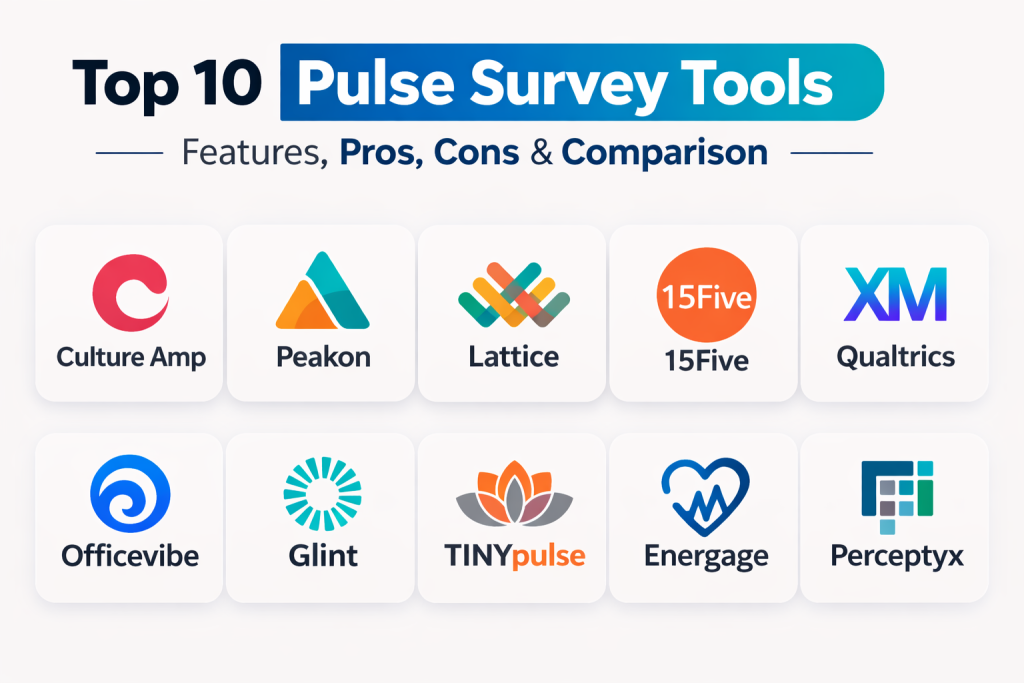
Introduction
Pulse survey tools are specialized software platforms designed to capture frequent, quick, and actionable employee feedback to monitor organizational health in real-time. Unlike traditional annual engagement surveys, which are often long and retrospective, pulse surveys consist of short sets of questions delivered at regular intervals—weekly, bi-weekly, or monthly. These tools provide leadership with a continuous “pulse” on employee sentiment, enabling them to identify burnout, cultural shifts, or management issues before they escalate into high turnover rates.
In a professional landscape defined by remote work and rapid digital transformation, the ability to maintain a feedback loop is a core operational necessity. Modern pulse survey tools leverage artificial intelligence to perform sentiment analysis on open-ended comments and offer benchmarking against industry standards. For an organization to succeed, these tools must integrate seamlessly into existing communication workflows like Slack or Microsoft Teams. Evaluating a provider requires looking at their data anonymity protections, the scientific validity of their question banks, and the intuitiveness of their executive dashboards.
Best for: Human resources leaders, department heads, and people operations teams in growing companies that want to build a culture of transparency and continuous improvement.
Not ideal for: Organizations with fewer than ten employees where direct conversation is more effective, or companies that lack the capacity to actually act on the feedback they receive.
Key Trends in Pulse Survey Tools
- AI-Driven Sentiment Analysis: Modern platforms now automatically categorize thousands of open-ended text responses into emotional themes, highlighting specific areas of concern like “work-life balance” or “managerial support.”
- Hyper-Integration with Chat Apps: To maximize response rates, surveys are increasingly delivered and completed directly within communication tools without requiring users to log into a separate portal.
- Predictive Attrition Modeling: Advanced tools use historical feedback patterns to flag specific teams or departments that are at a higher risk of high turnover in the coming months.
- Passive Feedback Collection: Some enterprise tools now supplement active surveys with “passive” signals, such as meeting frequency or email volume, to provide a more holistic view of employee well-being.
- Micro-Action Planning: Rather than just providing data, platforms are now offering specific, bite-sized recommendations to managers on how to improve their team’s score based on specific feedback.
- DEI-Focused Analytics: There is a heavy shift toward specialized survey modules that track diversity, equity, and inclusion metrics to ensure equitable experiences across all demographic groups.
How We Selected These Tools (Methodology)
- Scientific Rigor: We prioritized tools that provide research-backed question libraries designed by organizational psychologists.
- Ease of Participation: A major factor was how little friction a tool introduces for the employee; high response rates are essential for data accuracy.
- Reporting Granularity: We looked for platforms that allow for deep-dive reporting into specific departments, regions, or tenures while protecting individual anonymity.
- Actionable Insights: The ability for the tool to translate “data” into “action plans” for middle management was a critical selection criterion.
- Security & Anonymity: We evaluated the strength of anonymity thresholds, ensuring that individual responses cannot be traced back to the user in small team settings.
- Ecosystem Compatibility: Selected tools must offer robust integrations with common HRIS and productivity suites.
Top 10 Pulse Survey Tools
1. Culture Amp
Culture Amp is a leader in the employee experience space, known for its deep focus on data science and organizational psychology. It offers a sophisticated platform that balances ease of use with powerful analytics for large-scale enterprises.
Key Features
- Research-backed survey templates created by data scientists.
- Text analytics to surface themes from qualitative feedback.
- Benchmarking against thousands of global companies.
- Specialized modules for DEI and onboarding feedback.
- Manager learning tools tied directly to survey results.
Pros
- Exceptional depth in scientific reporting and benchmarking.
- High levels of customization for complex organizational structures.
Cons
- Can be more expensive than basic survey tools.
- The interface might feel overwhelming for very small teams.
Platforms / Deployment
- Web / iOS / Android
- Cloud
Security & Compliance
- SOC 2 Type II, GDPR, and HIPAA.
- Strict anonymity thresholds and encryption.
Integrations & Ecosystem
Strong connectivity with HR and communication stacks.
- Slack
- Microsoft Teams
- Workday
- BambooHR
Support & Community
Features a massive “People Geek” community and a library of professional development resources.
2. Peakon (by Workday)
Now a part of the Workday suite, Peakon is an intelligent platform that uses machine learning to provide real-time insights into employee engagement and productivity.
Key Features
- Intelligent questioning that adapts based on previous answers.
- Automated segments for comparing data by tenure or department.
- Real-time dashboard for every manager in the organization.
- Advanced comment analysis with “hot topic” detection.
- Translation into over 50 languages for global teams.
Pros
- Superior automated data visualization and trend tracking.
- Integrates perfectly for existing Workday customers.
Cons
- Setup can be complex for those not using the Workday ecosystem.
- Pricing is positioned for mid-to-large enterprises.
Platforms / Deployment
- Web / iOS / Android
- Cloud
Security & Compliance
- ISO 27001, SOC 2, and GDPR.
- Highly secure data isolation and access controls.
Integrations & Ecosystem
- Workday
- Slack
- Microsoft Teams
- Various HRIS systems via API.
Support & Community
High-tier enterprise support and extensive professional services for implementation.
3. Lattice
Lattice is an all-in-one people management platform that combines performance reviews, goals, and pulse surveys into a single, cohesive experience for the employee.
Key Features
- Unified view of performance data and engagement scores.
- Weekly “check-ins” that act as continuous pulse feedback.
- Action plans that managers can track within the platform.
- eNPS (Employee Net Promoter Score) tracking.
- Visual heatmaps to identify cultural outliers.
Pros
- Excellent for keeping all HR activities in one place.
- Very modern and intuitive user interface.
Cons
- Pulse surveys are most effective when purchased as part of the full suite.
- May lack some of the deep scientific rigor of Culture Amp.
Platforms / Deployment
- Web / iOS / Android
- Cloud
Security & Compliance
- SOC 2 Type II and GDPR compliant.
Integrations & Ecosystem
Well-connected to modern tech stacks.
- Slack
- Microsoft Teams
- Gusto
- Rippling
Support & Community
Active “Resources for Humans” community and strong customer success support.
4. 15Five
15Five is built on the philosophy that a 15-minute update and a 5-minute review can transform communication. It is heavily focused on the manager-employee relationship.
Key Features
- High-frequency check-ins that facilitate two-way feedback.
- “High Fives” for peer-to-peer recognition.
- Objective and Key Results (OKR) tracking.
- Manager coaching tools based on pulse data.
- Engagement surveys with built-in actionability.
Pros
- Best-in-class for fostering regular manager communication.
- Simple and effective for remote and hybrid teams.
Cons
- Not primarily a “deep” data analytics tool for massive corporations.
- Can feel repetitive if not managed with a clear strategy.
Platforms / Deployment
- Web / iOS / Android
- Cloud
Security & Compliance
- SOC 2 and GDPR.
- Strong focus on psychological safety and anonymity.
Integrations & Ecosystem
- Slack
- Microsoft Teams
- Salesforce
- Various HRIS tools.
Support & Community
Excellent onboarding and a focus on “Transformative HR” education.
5. Qualtrics EmployeeXM
Qualtrics is a powerhouse in the “Experience Management” space, providing enterprise-grade tools that can handle the most complex data needs of global organizations.
Key Features
- Predictive intelligence that flags attrition risks.
- Cross-experience analytics (linking customer and employee data).
- Highly customizable survey logic and branding.
- Automated closed-loop actioning for managers.
- Global benchmarking across every major industry.
Pros
- Infinite scalability for the world’s largest companies.
- Unmatched data processing and visualization power.
Cons
- Higher cost and significant technical setup required.
- Likely overkill for companies with fewer than 500 people.
Platforms / Deployment
- Web / iOS / Android
- Cloud
Security & Compliance
- FedRAMP, ISO 27001, SOC 2, and HIPAA.
- Enterprise-level data sovereignty controls.
Integrations & Ecosystem
- SAP SuccessFactors
- Salesforce
- ServiceNow
- Slack
Support & Community
Global professional services network and 24/7 enterprise support.
6. Officevibe
Officevibe is a straightforward and accessible pulse survey tool that prioritizes anonymity to encourage honest and frequent feedback from teams of all sizes.
Key Features
- 10 core metrics for engagement tracked automatically.
- Anonymous feedback messaging between managers and staff.
- Regular “vibe” checks delivered via chat or email.
- Simple, visually appealing team reports.
- Feedback prompts based on specific low scores.
Pros
- One of the easiest tools to set up and start using immediately.
- Very effective for teams focused on anonymous honesty.
Cons
- Less feature-rich for complex performance management.
- Limited deep-dive data manipulation for large-scale HR teams.
Platforms / Deployment
- Web / iOS / Android
- Cloud
Security & Compliance
- GDPR compliant and SOC 2.
- Industry-standard anonymity thresholds.
Integrations & Ecosystem
- Slack
- Microsoft Teams
- Google Workspace
- Office 365
Support & Community
Solid library of guides on how to improve team culture.
7. Glint (by Microsoft/LinkedIn)
Glint, now integrated into the Microsoft Viva suite, combines employee feedback with LinkedIn’s organizational data to provide unique insights into talent health.
Key Features
- AI-driven “Glint People Science” methodology.
- Integration with Microsoft Viva Insights for productivity data.
- Narrative intelligence that analyzes thousands of comments.
- Manager-led action planning modules.
- Dynamic heatmaps and trend analysis.
Pros
- Deep integration with the Microsoft ecosystem.
- Leverages LinkedIn’s massive data sets for benchmarking.
Cons
- Primarily targeted at very large enterprise environments.
- Best used by those already committed to Microsoft 365.
Platforms / Deployment
- Web / Microsoft Teams
- Cloud
Security & Compliance
- Microsoft Azure-level security, GDPR, and ISO.
Integrations & Ecosystem
- Microsoft Teams
- Outlook
- LinkedIn Learning
- Viva Insights
Support & Community
Backed by Microsoft’s global support network.
8. TINYpulse
TINYpulse focuses on “short, frequent, and anonymous” surveys that help leaders understand the day-to-day morale of their workforce.
Key Features
- “Cheers for Peers” system to boost recognition.
- Anonymous suggestion box for ongoing feedback.
- Flexible survey scheduling (weekly, monthly, custom).
- Onboarding and exit survey modules.
- Real-time employee sentiment dashboard.
Pros
- Very high engagement rates due to the brevity of questions.
- Excellent for quick cultural check-ins.
Cons
- Analytics are less robust than the major enterprise players.
- May lack some advanced performance management features.
Platforms / Deployment
- Web / iOS / Android
- Cloud
Security & Compliance
- SOC 2 and GDPR compliant.
Integrations & Ecosystem
- Slack
- Microsoft Teams
- Google Workspace
Support & Community
Helpful customer success team and plenty of “engagement” playbooks.
9. Energage
Energage is widely known for its “Top Workplaces” program, and its software is built to help companies reach that benchmark of organizational excellence.
Key Features
- Benchmarking against “Top Workplace” winners.
- Focus on organizational “alignment” and “connection.”
- Action-oriented insights for senior leadership.
- Simple, clear dashboards for executive review.
- Year-over-year growth tracking.
Pros
- Unique focus on external brand perception and recruitment.
- Very clear and uncluttered reporting for executives.
Cons
- Less focus on day-to-day manager/employee interaction.
- Can feel more like a “once-a-month” tool than a “real-time” tool.
Platforms / Deployment
- Web
- Cloud
Security & Compliance
- Data privacy and security standards compliant with US regulations.
Integrations & Ecosystem
- Various HRIS via custom API.
Support & Community
High-level strategic support for companies looking to win culture awards.
10. Perceptyx
Perceptyx is an enterprise-grade listening platform that focuses on the entire employee lifecycle, from recruitment to retirement.
Key Features
- Multi-channel listening (surveys, email, passive data).
- Deep behavioral science integration.
- Advanced “what-if” modeling for attrition.
- Highly customizable dashboards for large global regions.
- Built-in action tracking for thousands of managers.
Pros
- Extremely powerful for massive, multi-national organizations.
- Combines surveys with other organizational data points.
Cons
- Not suitable for smaller companies or those without a data team.
- Significant time investment required for full deployment.
Platforms / Deployment
- Web / iOS / Android
- Cloud
Security & Compliance
- ISO 27001, SOC 2, and GDPR.
- Highly sophisticated data masking and security features.
Integrations & Ecosystem
- Major HRIS systems like SAP and Workday.
- Microsoft Teams and Slack.
Support & Community
Dedicated customer success managers and organizational psychologists on staff.
Comparison Table
| Tool Name | Best For | Platform(s) Supported | Deployment | Standout Feature | Public Rating |
| 1. Culture Amp | Enterprise Data | Win, Mac, Mobile | Cloud | Scientific Benchmarking | N/A |
| 2. Peakon | Automated Trends | Win, Mac, Mobile | Cloud | Machine Learning Insights | N/A |
| 3. Lattice | Performance + Pulse | Win, Mac, Mobile | Cloud | Unified HR Experience | N/A |
| 4. 15Five | Manager Relations | Win, Mac, Mobile | Cloud | Weekly Check-ins | N/A |
| 5. Qualtrics | Global Scale | Win, Mac, Mobile | Cloud | Predictive Attrition | N/A |
| 6. Officevibe | Small/Mid Teams | Win, Mac, Mobile | Cloud | Anonymous Messaging | N/A |
| 7. Glint | Microsoft Users | Win, Mac, Mobile | Cloud | LinkedIn Data Integration | N/A |
| 8. TINYpulse | High Frequency | Win, Mac, Mobile | Cloud | Peer Recognition | N/A |
| 9. Energage | Employer Branding | Win, Mac | Cloud | Top Workplace Benchmarks | N/A |
| 10. Perceptyx | Lifecycle Data | Win, Mac, Mobile | Cloud | Multi-channel Listening | N/A |
Evaluation & Scoring of Pulse Survey Tools
| Tool Name | Core (25%) | Ease (15%) | Integrations (15%) | Security (10%) | Performance (10%) | Support (10%) | Value (15%) | Weighted Total |
| 1. Culture Amp | 10 | 7 | 9 | 10 | 9 | 9 | 7 | 8.70 |
| 2. Peakon | 9 | 7 | 8 | 10 | 10 | 8 | 7 | 8.40 |
| 3. Lattice | 8 | 9 | 9 | 8 | 8 | 9 | 9 | 8.55 |
| 4. 15Five | 7 | 10 | 9 | 8 | 8 | 9 | 9 | 8.20 |
| 5. Qualtrics | 10 | 4 | 10 | 10 | 10 | 10 | 6 | 8.10 |
| 6. Officevibe | 6 | 10 | 8 | 8 | 8 | 8 | 9 | 7.75 |
| 7. Glint | 9 | 6 | 10 | 9 | 9 | 8 | 7 | 8.15 |
| 8. TINYpulse | 7 | 9 | 8 | 8 | 8 | 8 | 8 | 7.75 |
| 9. Energage | 7 | 8 | 6 | 8 | 8 | 8 | 7 | 7.25 |
| 10. Perceptyx | 10 | 5 | 9 | 10 | 10 | 9 | 7 | 8.15 |
The scoring indicates that Culture Amp and Lattice lead for overall versatility and user experience. While Qualtrics and Perceptyx offer the most technical depth, they lose points on “Ease of Use” for generalist HR teams. Officevibe and 15Five remain the top choices for value and immediate adoption.
Which Pulse Survey Tool Is Right for You?
Solo / Freelancer
Pulse survey tools are generally designed for teams of 10 or more. For freelancers or very small startups, simple free forms or direct qualitative feedback are usually more efficient.
SMB
Small to medium businesses should prioritize Officevibe or TINYpulse. These tools are affordable, easy to launch, and provide the core metrics needed to keep a healthy culture without needing a full-time data analyst.
Mid-Market
For companies with 100–500 employees, Lattice and 15Five offer the best balance. These tools integrate pulse feedback with performance management, making the data more actionable for managers.
Enterprise
Large-scale global organizations should look at Culture Amp, Qualtrics, or Peakon. These platforms handle high volumes of data and offer the complex anonymity and security controls required by enterprise legal teams.
Budget vs Premium
Officevibe offers the most value for those on a tight budget. Premium suites like Culture Amp and Qualtrics require a significant investment but provide a much deeper level of research and scientific validity.
Feature Depth vs Ease of Use
If you want deep scientific data, choose Culture Amp. If you want a tool that your managers will actually use every single day without training, choose Officevibe.
Integrations & Scalability
Glint and Qualtrics are the winners for scalability, as they are designed to live within the largest tech ecosystems on the planet (Microsoft and SAP/Salesforce).
Security & Compliance Needs
For organizations with high security requirements (e.g., Finance or Healthcare), Qualtrics and Perceptyx offer the most robust data isolation and compliance certifications.
Frequently Asked Questions
What is a pulse survey?
It is a short, frequent set of questions designed to track employee sentiment and engagement in real-time, typically delivered weekly or monthly.
How do pulse surveys differ from annual surveys?
Annual surveys are long and retrospective, whereas pulse surveys are quick, forward-looking, and allow leadership to react to issues immediately.
Are pulse surveys really anonymous?
Most professional tools use “anonymity thresholds,” meaning a manager can only see aggregated data if more than 3 or 5 people have responded, protecting individuals.
What is a good response rate for a pulse survey?
In most industries, a response rate between 70% and 85% is considered excellent for a short pulse survey.
How often should we send pulse surveys?
Bi-weekly or monthly is the standard. Weekly can lead to “survey fatigue” if the organization does not act on the feedback quickly enough.
What is eNPS?
Employee Net Promoter Score (eNPS) is a single metric that measures how likely employees are to recommend your company as a great place to work.
Do these tools help with employee retention?
Yes, by identifying the early signs of burnout or disengagement, these tools allow HR to intervene before employees decide to leave the company.
Can pulse surveys be integrated into Slack or Teams?
Almost all modern tools (like Officevibe or Lattice) allow employees to answer the survey directly within their chat app without logging into another site.
How long does it take to see results?
Most platforms provide real-time dashboards that update as soon as the responses come in, allowing for instant analysis.
What should we do if our scores are low?
The most important step is to acknowledge the feedback to the staff and share a specific “Action Plan” of how leadership intends to address the concerns.
Conclusion
Implementing a pulse survey tool is a foundational step toward creating a data-driven culture that prioritizes employee well-being and organizational health. In a world where talent is a primary competitive advantage, the cost of not knowing your team’s sentiment far outweighs the investment in a professional feedback platform. Whether you choose a high-end scientific suite like Culture Amp or a management-centric tool like 15Five, the key to success lies in transparency and action. The data is only as good as the changes it inspires. To move forward, it is recommended to shortlist two tools that fit your current team size, run a one-month pilot with a single department, and evaluate the quality of the insights generated before a company-wide rollout.

Best Cardiac Hospitals Near You
Discover top heart hospitals, cardiology centers & cardiac care services by city.
Advanced Heart Care • Trusted Hospitals • Expert Teams
View Best Hospitals