Introduction
Quote-to-Cash (Q2C) refers to the end-to-end business process that spans from the moment a sales representative configures a quote for a prospect to the point where the company recognizes revenue and collects cash. It is the connective tissue between the front-office Customer Relationship Management (CRM) and the back-office Enterprise Resource Planning (ERP). Q2C has evolved from a simple sequence of manual steps into a hyper-automated, AI-driven lifecycle that ensures pricing accuracy, contract compliance, and rapid payment collection.
In a global economy where subscription models and usage-based pricing are the norms, managing the complexity of “the deal” is a critical competitive advantage. A broken Q2C process leads to “revenue leakage”—errors in billing, missed renewals, or delayed payments that directly impact the bottom line. Modern platforms solve this by unifying sales, finance, and legal teams into a single source of truth, ensuring that what was promised in the quote is exactly what is invoiced and collected.
Real-World Use Cases
- SaaS Subscription Management: Automating complex monthly, annual, and tiered billing structures with automatic upgrades and prorated charges.
- Large-Scale Manufacturing: Configuring complex products with thousands of dependencies and ensuring accurate engineering-to-order pricing.
- Professional Services: Managing statements of work, milestone-based billing, and resource allocation within a single contract flow.
- Global E-commerce: Handling multi-currency, multi-jurisdictional tax compliance and automated international payment reconciliation.
- Telecom and Utilities: Managing high-volume, usage-based consumption data and converting it into accurate monthly statements.
Evaluation Criteria for Buyers
- Pricing Engine Flexibility: Can the tool handle tiered, volume-based, and consumption-based pricing models?
- Contract Lifecycle Management (CLM): Does it include built-in redlining, e-signatures, and automated legal approvals?
- Integration Maturity: How seamlessly does it bridge the gap between your specific CRM (like Salesforce) and your ERP (like NetSuite)?
- AI and Automation: Are there features for automated deal scoring, discount recommendations, or payment retry logic?
- User Adoption: Is the interface intuitive enough for sales reps to use daily without extensive technical support?
- Global Compliance: Does it support international accounting standards (ASC 606/IFRS 15) and regional tax requirements?
Best for: Mid-to-large enterprises with complex product catalogs, multi-year contracts, and high-growth SaaS companies that need to eliminate manual billing and reconciliation errors.
Not ideal for: Small businesses with simple, static pricing or firms that handle fewer than five transactions per month where manual invoicing is still efficient.
Key Trends in Quote-to-Cash Software
- Agentic Revenue Workflows: AI agents now proactively manage the “to-cash” portion by identifying at-risk payments and autonomously negotiating payment plans based on historical customer behavior.
- Contract Intelligence: Natural Language Processing (NLP) is used to read signed documents, automatically extracting terms and feeding them into billing engines to ensure zero-gap accuracy.
- Real-Time Revenue Visibility: Shift from “month-end” reporting to “live” revenue dashboards that track Daily Sales Outstanding (DSO) and Monthly Recurring Revenue (MRR) in real-time.
- Frictionless “Deal Rooms”: Interactive, web-based proposal pages where buyers can select options, sign contracts, and pay in a single digital experience.
- Usage-Based Scaling: Platforms are now built to ingest billions of usage events (API calls, data storage, etc.) and convert them into line items instantly without system lag.
- Global E-Invoicing Compliance: Automatic submission of digital invoices to government tax portals in regions with strict digital reporting mandates.
- Automated Dunning & Collections: Intelligent retry logic and personalized communication sequences that reduce involuntary churn without human intervention.
- Unified Revenue Architecture: The merging of CPQ, Billing, and Revenue Recognition into a single codebase to prevent data synchronization failures.
How We Selected These Tools
- Market Leadership & Trust: We prioritized platforms that are the verified standards for Fortune 500 companies and high-growth tech unicorns.
- End-to-End Capability: Only tools that cover the full spectrum—from quoting and contracting to billing and cash collection—were considered.
- Scalability & Performance: Preference was given to systems that maintain high performance even as transaction volumes and product complexity increase.
- Compliance Rigor: Evaluation of the software’s ability to adhere to strict global financial standards and security protocols.
- Ecosystem Connectivity: We looked for platforms with robust APIs and pre-built connectors to the most common enterprise tech stacks.
- Innovation Velocity: Priority was given to vendors who have successfully integrated AI and real-time automation into their core offerings.
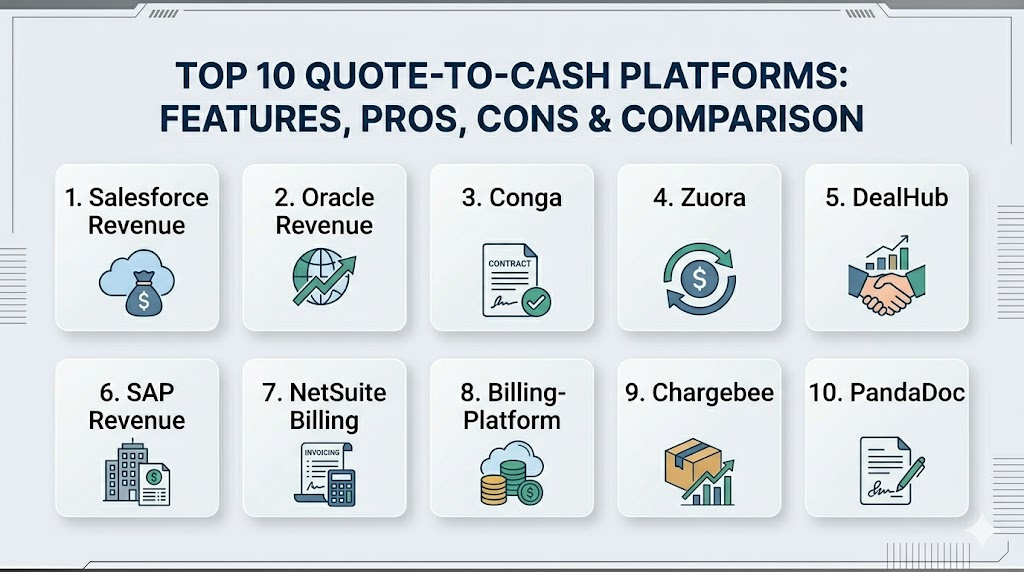
Top 10 Quote-to-Cash Platforms
1. Salesforce Revenue Cloud
This is a comprehensive, native suite that combines Salesforce CPQ and Billing into a single platform. It is designed for companies already invested in the Salesforce ecosystem who want to bridge the gap between their sales and finance departments seamlessly.
Key Features
- Advanced product bundles and guided selling for sales reps.
- Automated subscription management and usage-based billing.
- Built-in revenue recognition aligned with global accounting standards.
- Multi-tier approval workflows for complex deal structures.
- Deep integration with the broader Salesforce AI and data ecosystem.
Pros
- Eliminates data silos between sales and finance.
- Extremely scalable for global organizations with complex hierarchies.
Cons
- Implementation requires significant administrative effort and expertise.
- Can become very expensive as additional modules and seats are added.
Platforms / Deployment
Web / Cloud
Hybrid
Security & Compliance
SSO/SAML, MFA, and SOC 2 Type II compliant.
ISO 27001 and GDPR ready.
Integrations & Ecosystem
As part of the Salesforce platform, it integrates natively with Sales Cloud, Service Cloud, and thousands of third-party apps via the AppExchange. It is often paired with ERPs like SAP and Oracle.
Support & Community
One of the largest global communities in software. Access to extensive documentation, official certifications, and a massive network of implementation partners.
2. Oracle Revenue Management Cloud
Built for giant global enterprises, this platform excels at handling massive amounts of data and strict accounting rules. It is the go-to for organizations that need a highly secure, “big-business” solution for revenue lifecycle management.
Key Features
- High-scale revenue recognition and automated contract liability.
- Deep integration with Oracle Fusion Cloud ERP.
- Advanced deal analysis and margin protection tools.
- Multi-currency and multi-language support for international operations.
- AI-driven deal insights to optimize pricing and discount levels.
Pros
- Unmatched capability for high-volume, global financial reporting.
- Extremely robust security and compliance features.
Cons
- The interface can feel more technical and less “sales-friendly.”
- Best suited only for those already within the Oracle infrastructure.
Platforms / Deployment
Web / Cloud
Hybrid
Security & Compliance
FedRAMP, HIPAA, SOC 1, and SOC 2 compliant.
Military-grade encryption and comprehensive audit trails.
Integrations & Ecosystem
Strongest integration is with Oracle’s own suite of ERP and HCM tools. It also offers robust APIs for connecting to third-party CRMs.
Support & Community
Standard enterprise support tiers with dedicated account managers and a vast global network of consultants.
3. Conga Revenue Lifecycle Cloud
Conga is a leader in companies that have legal-heavy contracts. It combines powerful document generation and Contract Lifecycle Management (CLM) with robust quoting and billing features.
Key Features
- Industry-leading document automation for proposals and contracts.
- Full-featured CLM with redlining and negotiation workflows.
- Flexible CPQ that supports complex product dependencies.
- Automated renewal management to protect recurring revenue.
- Native Salesforce integration for a unified sales experience.
Pros
- Exceptional for document-intensive and legally complex sales cycles.
- Strong stability and a long history of serving enterprise clients.
Cons
- Can be complex to set up for simpler sales processes.
- Requires careful management of the document template library.
Platforms / Deployment
Web / Cloud
Hybrid
Security & Compliance
SOC 2 Type II compliant and GDPR ready.
Secure document storage with detailed audit trails.
Integrations & Ecosystem
Primarily built for Salesforce, but offers flexible connectivity for other CRMs and ERPs through its modern cloud architecture.
Support & Community
Responsive customer support and a focused onboarding process through “Conga University.”
4. Zuora Revenue
Zuora was built from the ground up for the subscription economy. It is the premier choice for businesses where recurring charges, consumption metering, and hybrid pricing models are central to the strategy.
Key Features
- Specialized engine for recurring and usage-based billing.
- Automated revenue recognition for subscription and hybrid deals.
- Real-time subscription analytics (MRR, churn, expansion).
- Flexible pricing model management without needing code.
- Global payment gateway integrations for automated collection.
Pros
- The most flexible tool for innovative subscription pricing models.
- Strong focus on “revenue growth” metrics rather than just accounting.
Cons
- Not designed for traditional “one-time” hardware or product sales.
- Can be overkill for companies with very simple subscription needs.
Platforms / Deployment
Web / Cloud
Cloud-Native
Security & Compliance
PCI DSS Level 1 and SOC 2 Type II compliant.
GDPR and HIPAA ready.
Integrations & Ecosystem
Integrates deeply with Salesforce, HubSpot, NetSuite, and Workday. It acts as the “sub-ledger” for the finance department.
Support & Community
Active community of “Subscribed” professionals and a robust documentation portal.
5. DealHub
DealHub offers a modern, no-code approach to Q2C. It is known for its “DealRoom”—a digital space where buyers and sellers collaborate on quotes, contracts, and signatures in one place.
Key Features
- Unified CPQ, CLM, and billing on a single no-code platform.
- Interactive “Digital DealRooms” for a modern buyer experience.
- Automated approval workflows to speed up deal velocity.
- Real-time forecasting based on live deal room engagement.
- Rapid implementation and deployment cycles.
Pros
- Extremely easy for sales teams to adopt and use.
- Unified experience means no integration friction between modules.
Cons
- May lack some of the extreme edge-case accounting features of Oracle or SAP.
- Best suited for B2B SaaS rather than complex industrial manufacturing.
Platforms / Deployment
Web / Cloud
Cloud-Native
Security & Compliance
SOC 2 Type II compliant and GDPR ready.
Secure data encryption for all deal documents.
Integrations & Ecosystem
Native bidirectional sync with Salesforce, HubSpot, and Microsoft Dynamics. Also integrates with major payment gateways like Stripe.
Support & Community
Highly rated for its responsive customer success team and streamlined onboarding.
6. SAP Revenue Cloud
A powerhouse for multinational organizations that need to standardize their pricing and sales processes across many regions while keeping a tight link to their ERP.
Key Features
- Advanced product configuration for customized goods.
- Seamless integration with SAP ERP and S/4HANA.
- Multi-language and multi-currency support for global trade.
- Rule-based pricing optimization for large-scale deals.
- Compliance-ready invoicing and tax handling.
Pros
- Essential for companies already running their business on SAP.
- Excellent at managing complex, global supply chain dependencies.
Cons
- Implementation can be a massive, multi-year undertaking.
- High total cost of ownership compared to cloud-native alternatives.
Platforms / Deployment
Web / Windows
Hybrid
Security & Compliance
ISO 27001, SOC 1, and SOC 2 compliant.
Global regulatory compliance for e-invoicing.
Integrations & Ecosystem
The core of the SAP ecosystem, connecting sales to finance, supply chain, and manufacturing modules.
Support & Community
Enterprise-level global support with massive community resources and professional consultants in every region.
7. NetSuite SuiteBilling
For companies using NetSuite, this is the built-in way to handle the Q2C process. It provides a unified view of the customer from the initial quote to the final payment within a single database.
Key Features
- Native integration with NetSuite CRM and ERP.
- Flexible billing for subscriptions, projects, and products.
- Automated renewals and upsell tracking.
- Real-time visibility into account aging and cash flow.
- Integrated revenue recognition and financial reporting.
Pros
- Zero integration required if you already use NetSuite.
- Provides a single, clean source of truth for the entire company.
Cons
- Quoting interface is not as modern or “flashy” as standalone CPQ tools.
- Customization can be difficult without specialized NetSuite developers.
Platforms / Deployment
Web / Cloud
Cloud-Native
Security & Compliance
SOC 1, SOC 2, ISO 27001, and HIPAA compliant.
Strong role-based security and audit logging.
Integrations & Ecosystem
Part of the massive Oracle NetSuite ecosystem. Connects easily to e-commerce and payroll modules.
Support & Community
Large global user community and tiered support options from basic help to premium assistance.
8. BillingPlatform
This platform is designed for the highest levels of billing complexity. It is built for companies that need to monetize anything—from simple subscriptions to complex multi-variable usage models.
Key Features
- Hyper-flexible billing engine for any monetization model.
- Automated revenue recognition and financial management.
- High-volume data ingestion for usage-based tracking.
- Global tax management and multi-entity support.
- Modern API-first architecture for custom integrations.
Pros
- Can handle complex billing scenarios that break other platforms.
- Excellent for companies with massive transaction volumes.
Cons
- Focus is more on the “cash” side than the “quote” side.
- Requires a clear data strategy to manage high-volume usage events.
Platforms / Deployment
Web / Cloud
Cloud-Native
Security & Compliance
PCI DSS Level 1, SOC 1, SOC 2, and GDPR compliant.
Secure cloud hosting and data protection.
Integrations & Ecosystem
Integrates with all major CRMs and acts as a central monetization engine for the enterprise.
Support & Community
Responsive professional services and growing technical documentation for developers.
9. Chargebee
Chargebee is a favorite for fast-growing SaaS companies. It focuses on making the subscription and billing part of the Q2C process as painless as possible for small-to-midmarket teams.
Key Features
- Automated subscription and usage billing.
- Self-service customer portals for plan changes.
- Smart dunning and collections management.
- Built-in revenue analytics and forecasting.
- Robust tax and compliance handling across regions.
Pros
- Very fast to implement and highly user-friendly.
- Excellent automation for reducing involuntary churn.
Cons
- Not built for complex physical product configuration.
- As you scale to very large enterprise needs, some reporting can feel limited.
Platforms / Deployment
Web / Cloud
Cloud-Native
Security & Compliance
PCI DSS Level 1 and SOC 2 compliant.
GDPR and privacy focused.
Integrations & Ecosystem
Excellent connectors for HubSpot, Salesforce, Stripe, and major accounting tools like QuickBooks and Xero.
Support & Community
Known for highly responsive chat support and helpful “how-to” content for SaaS founders.
10. PandaDoc CPQ
While starting as a document tool, PandaDoc has grown into a powerful CPQ and Q2C solution for small-to-midmarket teams who want simplicity and speed over enterprise complexity.
Key Features
- Intuitive quote and proposal automation with e-signatures.
- Interactive pricing tables that buyers can adjust.
- Automated approval workflows for discounts.
- Real-time tracking of when buyers open and interact with quotes.
- Native CRM integrations for a seamless sales workflow.
Pros
- The best user experience for both the salesperson and the buyer.
- Very affordable and fast to get running.
Cons
- Lacks the deep revenue recognition features of Zuora or Salesforce.
- Not ideal for companies with thousands of complex product dependencies.
Platforms / Deployment
Web / iOS / Android
Cloud-Native
Security & Compliance
SOC 2 Type II compliant and HIPAA ready.
Secure document encryption and audit trails.
Integrations & Ecosystem
Integrates natively with HubSpot, Pipedrive, and Salesforce. Also connects with Stripe and PayPal for instant payments.
Support & Community
Large community of sales professionals and high-quality 24/7 support via email and chat.
Comparison Table
| Tool Name | Best For | Platform(s) Supported | Deployment | Standout Feature | Public Rating |
| 1. Salesforce Revenue | Salesforce Users | Web | Hybrid | Deep CRM Synergy | N/A |
| 2. Oracle Revenue | Global Enterprises | Web | Hybrid | High-Scale Accounting | N/A |
| 3. Conga | Contract-Heavy Deals | Web | Hybrid | Document Automation | N/A |
| 4. Zuora | Subscription SaaS | Web | Cloud | Flexible Monetization | N/A |
| 5. DealHub | Sales Velocity | Web | Cloud | Digital DealRooms | N/A |
| 6. SAP Revenue | Multinational Trade | Web, Windows | Hybrid | Supply Chain Link | N/A |
| 7. NetSuite Billing | NetSuite Users | Web | Cloud | Unified Database | N/A |
| 8. BillingPlatform | Extreme Complexity | Web | Cloud | Usage-Based Engine | N/A |
| 9. Chargebee | High-Growth SaaS | Web | Cloud | Involuntary Churn Tools | N/A |
| 10. PandaDoc | Mid-Market Teams | Web, Mobile | Cloud | Buyer Interaction | N/A |
Evaluation & Scoring
| Tool Name | Core (25%) | Ease (15%) | Integrations (15%) | Security (10%) | Perf (10%) | Support (10%) | Value (15%) | Total |
| 1. Salesforce Revenue | 10 | 4 | 10 | 9 | 8 | 9 | 6 | 8.25 |
| 2. Oracle Revenue | 10 | 3 | 9 | 10 | 10 | 8 | 5 | 7.80 |
| 3. Conga | 9 | 6 | 9 | 8 | 8 | 8 | 7 | 7.95 |
| 4. Zuora | 9 | 6 | 9 | 9 | 9 | 8 | 7 | 8.20 |
| 5. DealHub | 8 | 10 | 8 | 7 | 9 | 9 | 9 | 8.45 |
| 6. SAP Revenue | 9 | 3 | 9 | 10 | 10 | 8 | 5 | 7.55 |
| 7. NetSuite Billing | 8 | 6 | 10 | 9 | 8 | 8 | 8 | 8.05 |
| 8. BillingPlatform | 10 | 5 | 8 | 9 | 10 | 7 | 7 | 7.95 |
| 9. Chargebee | 7 | 9 | 9 | 8 | 9 | 9 | 9 | 8.25 |
| 10. PandaDoc | 6 | 10 | 8 | 7 | 8 | 9 | 10 | 7.85 |
The scoring above is based on a relative professional assessment. A high score in “Core Features” reflects a tool’s ability to handle the absolute most complex logic, while “Ease of Use” reflects how quickly a sales team can become productive. For example, DealHub scores very high because it provides professional-grade features with a modern, no-code interface that drastically reduces implementation time. Meanwhile, Oracle and SAP receive perfect scores for Security and Performance because they are designed to manage the world’s largest corporate datasets with zero failure.
Which Quote-to-Cash Platform Is Right for You?
Solo / Freelancer
If you are operating as a solo professional, PandaDoc is the superior choice. It provides the most polished client-facing experience and handles e-signatures and simple payments without requiring a full-time system administrator.
SMB
Small businesses that are focused on growth should look toward Chargebee or PandaDoc. These tools allow you to professionalize your sales process quickly and ensure that invoices are sent and collected without manual tracking in spreadsheets.
Mid-Market
For companies scaling rapidly (the $10M–$100M ARR range), DealHub and Zuora are the front-runners. They provide the depth needed for complex subscription models and contract negotiations while maintaining a level of agility that enterprise legacy tools often lack.
Enterprise
Global organizations with thousands of employees and strict regulatory needs must choose between Salesforce Revenue Cloud, Oracle, or SAP. These platforms provide the necessary “financial plumbing” to handle multi-entity, multi-currency operations across the world.
Budget vs Premium
- Budget: PandaDoc and Chargebee offer the highest value-to-cost ratio for smaller teams.
- Premium: Salesforce Revenue Cloud and Zuora are significant investments but are necessary for managing millions in recurring revenue with precision.
Feature Depth vs Ease of Use
If your team is non-technical, DealHub is the winner for its no-code interface. If your finance team needs to track every penny across fifty countries with different tax laws, BillingPlatform or Oracle will provide the required depth.
Integrations & Scalability
If you are already committed to Salesforce or NetSuite, the native options are almost always the best choice due to the lack of integration friction. For companies using a mix of best-of-breed tools, Zuora and BillingPlatform offer the most flexible API-first architectures.
Security & Compliance Needs
For companies in highly regulated sectors like finance or healthcare, Oracle and Salesforce provide the most documented security certifications. If you need SOC 2 or HIPAA compliance out of the box, these enterprise incumbents are the safest bets.
Frequently Asked Questions (FAQs)
1. What is the difference between CPQ and Q2C?
CPQ (Configure, Price, Quote) is only one part of the process—the “quote” side. Q2C (Quote-to-Cash) is the entire lifecycle, including the contract, the billing, and the final cash collection.
2. Can Q2C software really reduce my DSO (Daily Sales Outstanding)?
Yes, by automating payment reminders and offering “one-click” payment links in digital deal rooms, companies often see their cash collection speed up by 20% to 30%.
3. Does Q2C software replace my accounting team?
No, it empowers them. It removes the manual data entry and “spreadsheet gymnastics” they currently do, allowing them to focus on high-level financial strategy and auditing.
4. How long does a typical implementation take?
Cloud-native tools like DealHub or PandaDoc can be live in weeks. Enterprise suites like Salesforce or Oracle typically require 3 to 9 months for a full, custom implementation.
5. Is Q2C software only for SaaS businesses?
While very popular in SaaS, it is equally important for manufacturing, services, and telecom companies that deal with complex pricing rules and large contract volumes.
6. What is “Revenue Leakage”?
It is the loss of money due to manual errors, like failing to bill for an extra user, forgetting to apply a price increase at renewal, or missing a payment follow-up.
7. Do these tools handle international taxes automatically?
Most leading platforms integrate with tax engines like Avalara to automatically calculate and apply the correct regional taxes based on the buyer’s location.
8. Can I manage contract renewals automatically?
Yes, most Q2C platforms track contract end dates and can automatically generate a renewal quote or notify the account manager 90 days in advance.
9. What is ASC 606 compliance?
It is a global accounting standard for revenue recognition. Modern Q2C tools automate this by allocating revenue over the life of a contract, ensuring your books are audit-ready.
10. Do I need to use the same brand for CRM and Q2C?
It is not required, but it is easier. However, many “best-of-breed” tools like Zuora or Conga are designed to work flawlessly inside other CRMs like Salesforce.
Conclusion
Selecting a Quote-to-Cash platform is one of the most significant strategic decisions a revenue leader can make. It is the foundation upon which your company’s financial health and sales velocity are built. By moving away from manual, disconnected processes and embracing a unified Q2C architecture, you eliminate the friction that costs businesses millions in lost revenue every year. Whether you prioritize the speed of a no-code solution or the deep security of an enterprise suite, the goal remains the same: ensuring that every deal signed is a deal accurately paid. As we move further into a data-driven economy, the companies that can automate the entire lifecycle from the first quote to the final cash deposit will be the ones that scale with the most agility and precision.

Best Cardiac Hospitals Near You
Discover top heart hospitals, cardiology centers & cardiac care services by city.
Advanced Heart Care • Trusted Hospitals • Expert Teams
View Best Hospitals