Introduction
A Radiology Information System (RIS) is a specialized software platform that serves as the administrative and operational heart of an imaging department. In plain English, while a PACS (Picture Archiving and Communication System) stores the actual X-ray or MRI images, the RIS manages the data and workflow around those images. It handles patient registration, appointment scheduling, result distribution, and medical billing. By digitizing the “paper trail” of a radiology study, an RIS ensures that a patient moves smoothly from the front desk to the scanning room and finally to the radiologist’s report.
The importance of a robust RIS has reached a critical point. Imaging centers are facing higher patient volumes than ever before, combined with a global shortage of specialized radiologists. A modern RIS acts as a digital co-pilot, using automation to prioritize urgent cases and reduce the administrative burden on clinical staff. Beyond simple scheduling, today’s systems are essential for maintaining regulatory compliance, managing complex insurance claims, and providing patients with instant digital access to their diagnostic results.
Real-World Use Cases
- Automating patient scheduling across multiple imaging locations to prevent equipment downtime and overbooking.
- Managing the entire “order-to-report” lifecycle, ensuring that referring physicians receive validated results as soon as they are signed.
- Tracking the productivity of technologists and radiologists through real-time operational dashboards and KPIs.
- Facilitating teleradiology by allowing off-site specialists to access worklists and patient history from any secure web browser.
- Streamlining the financial side of radiology by capturing charges automatically and managing complex TPA or insurance billing.
Evaluation Criteria for Buyers
- The efficiency of the workflow orchestration and how well it handles sub-specialty routing.
- The depth of integration with existing Electronic Health Records (EHR) and various PACS vendors.
- The quality of the user interface for both the administrative staff and the clinical reporting team.
- Advanced security features including role-based access control and detailed audit trails.
- Compliance with local and international data standards such as HL7, DICOM, and FHIR.
- The availability of a patient portal for self-service scheduling and result retrieval.
- The total cost of ownership, considering initial implementation, training, and ongoing support.
Best for: Hospital radiology departments, standalone diagnostic imaging centers, teleradiology groups, and large multi-specialty healthcare networks.
Not ideal for: General practitioner clinics that do not perform on-site imaging, or very small dental practices that only require basic image storage without workflow management.
Key Trends in Radiology Information Systems
- The deep embedding of artificial intelligence to assist in worklist prioritization, flagging urgent abnormalities like fractures or hemorrhages for immediate review.
- A decisive move toward cloud-native architectures that allow for elastic scaling and “read-from-anywhere” flexibility without heavy on-site servers.
- Increased focus on “Invisible AI,” where algorithms run in the background to automate repetitive tasks like lesion measurement and draft report generation.
- The expansion of patient engagement tools, including automated WhatsApp or SMS notifications for appointment reminders and secure report delivery.
- Adoption of universal platform strategies that combine RIS, PACS, and billing into a single-pane-of-glass experience for the user.
- Growth in teleradiology-specific features that support distributed reading across different time zones and hospital networks.
- The shift toward value-based reimbursement models, where RIS analytics are used to prove quality and efficiency to insurance providers.
- Enhanced cybersecurity measures designed to protect high-value medical imaging data from increasingly sophisticated digital threats.
How We Selected These Tools
The selection of these top ten systems is based on their market presence and their ability to handle modern production demands. We focused on platforms that have successfully integrated AI-driven workflows and cloud capabilities to meet the needs of contemporary imaging centers. Reliability and performance were key factors, as an RIS must function flawlessly during peak hours in high-volume environments. We also evaluated the strength of the vendor’s support ecosystem and their commitment to security and compliance. This list represents a balance of globally recognized enterprise leaders and innovative, specialized solutions that cater to specific market segments.
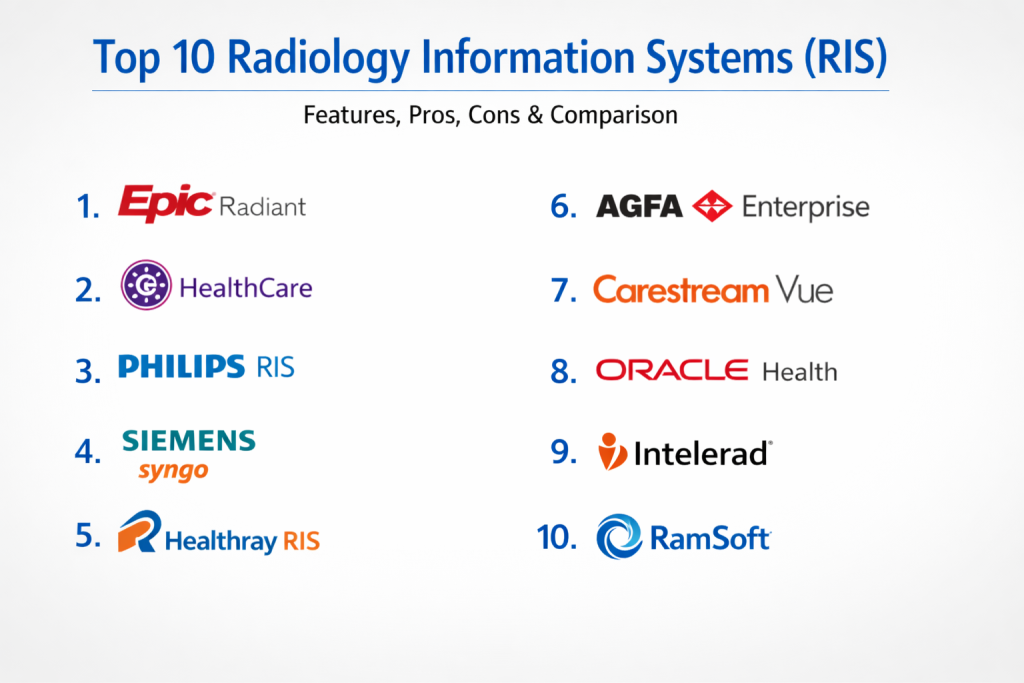
Top 10 Radiology Information Systems (RIS) Tools
1. Epic Radiant
Epic Radiant is a dominant force in the enterprise healthcare market. It is designed specifically to work within the broader Epic ecosystem, allowing for a truly unified patient record. Because it shares a single database with the main hospital system, it eliminates the data silos that often plague radiology departments.
Key Features
- Seamless integration with the Epic EHR for a comprehensive view of patient history.
- Advanced “Order-to-Report” workflow tracking that keeps referring doctors informed.
- Embedded clinical decision support to ensure the most appropriate imaging is performed.
- Powerful patient engagement tools through the MyChart portal.
- Robust analytics for tracking modality utilization and department performance.
Pros
- Eliminates the need for complex interfaces between the hospital and the radiology department.
- Unrivaled for large hospital networks that require a single source of truth.
Cons
- Only practical for organizations that are already using or planning to use Epic.
- Implementation is a massive undertaking requiring significant time and resources.
Platforms / Deployment
Web / Windows — Hybrid
Security & Compliance
Enterprise-grade security with full HIPAA, GDPR, and SOC 2 compliance.
Integrations & Ecosystem
As part of the Epic suite, it has native integration with almost every clinical module. It also supports industry-standard links to third-party PACS and advanced visualization tools.
Support & Community
One of the strongest support networks in healthcare, featuring extensive user groups and 24/7 dedicated technical assistance.
2. GE HealthCare RIS (Centricity)
GE HealthCare provides a robust, high-volume RIS that is a staple in many of the world’s largest imaging centers. Known for its stability and deep clinical tools, it is built to handle the most demanding multi-site workflows.
Key Features
- Intelligent scheduling and workflow orchestration designed for high-throughput environments.
- Deep integration with GE’s advanced imaging and PACS solutions.
- AI-ready workflows that can host and manage third-party diagnostic algorithms.
- Comprehensive financial management and billing modules.
- Scalable architecture that supports growth from single sites to national networks.
Pros
- Extremely stable and reliable, even under the heaviest production loads.
- Excellent clinical tools for sub-specialties like cardiology and oncology.
Cons
- The interface can feel more traditional compared to newer cloud-native competitors.
- Pricing is generally geared toward the premium/enterprise end of the market.
Platforms / Deployment
Web / Windows — Cloud / On-premise
Security & Compliance
ISO 27001 and SOC 2 compliant with advanced encryption for data at rest and in transit.
Integrations & Ecosystem
Strongest when paired with the GE Centricity PACS, but maintains vendor-neutral capabilities for integration with other enterprise systems.
Support & Community
A global leader with local support teams in almost every region and a vast library of professional training resources.
3. Philips HealthCare RIS
Philips offers a modular and web-based RIS that focuses on improving the user experience and reducing the complexity of radiology workflows. It is highly regarded for its “zero-footprint” approach, which simplifies IT maintenance.
Key Features
- A modern, web-based interface that allows for access from any secure device.
- Modular design that allows organizations to choose only the features they need.
- Integrated reporting and analytics dashboards for real-time decision support.
- Smart load balancing to distribute cases evenly across the radiologist pool.
- Enhanced patient communication tools for reminders and result sharing.
Pros
- Very intuitive and easy for new staff to learn quickly.
- Simplifies IT management by removing the need for heavy local software installations.
Cons
- Customization of complex rules can require significant initial setup time.
- Deepest benefits are often realized when integrated into the full Philips imaging ecosystem.
Platforms / Deployment
Web / macOS / Windows — Cloud / Hybrid
Security & Compliance
Strict adherence to international data privacy standards including HIPAA and GDPR.
Integrations & Ecosystem
Features excellent interoperability through HL7 and FHIR, and connects seamlessly to Philips’ enterprise imaging platforms.
Support & Community
Provides extensive 24/7 support and a robust online knowledge base for users.
4. Siemens Healthineers (Syngo Workflow)
Siemens provides an RIS that emphasizes security and clinical precision. Their Syngo Workflow is designed to act as the “brain” of a radiology department, coordinating everything from initial booking to the final billing statement.
Key Features
- The syngo Security Package for advanced data protection and audit trails.
- Automated clinical protocoling to ensure the correct scan parameters are used.
- Integrated workload management that prioritizes urgent and emergency cases.
- Enterprise-scale analytics for monitoring department efficiency.
- Strong multi-site support with remote management capabilities.
Pros
- Highly regarded for its focus on cybersecurity and data integrity.
- Seamless workflow between the RIS and the imaging modality.
Cons
- Subscription costs can be high for smaller, independent centers.
- Requires powerful hardware to fully utilize all the integrated clinical features.
Platforms / Deployment
Web / Windows — On-premise / Cloud
Security & Compliance
Features the specialized syngo Security Package; fully HIPAA and ISO compliant.
Integrations & Ecosystem
Works best within the Siemens imaging environment but supports all standard vendor-neutral interfaces for third-party PACS.
Support & Community
Backed by a global service network with a strong reputation for long-term reliability and onsite support.
5. Healthray RIS
Healthray has emerged as a top choice for hospitals and labs looking for an AI-powered, radiology-first design. It is particularly effective for those needing to manage high volumes and multi-branch operations with a focus on speed and efficiency.
Key Features
- AI-assisted triage that automatically prioritizes emergency cases in the worklist.
- Dynamic load balancing across multiple locations to prevent radiologist burnout.
- Automated patient flow optimization with WhatsApp and SMS integration.
- Sub-specialty routing that sends specific cases to the appropriate experts automatically.
- Comprehensive financial and GST-ready billing modules built into the workflow.
Pros
- Very fast implementation and an intuitive interface that requires minimal training.
- Excellent support that acts as an extension of the internal IT team.
Cons
- Primarily focused on high-growth and mid-market sectors rather than legacy mega-hospitals.
- The vast array of AI features can be overwhelming if not configured properly at the start.
Platforms / Deployment
Web / Android / iOS — Cloud / Hybrid
Security & Compliance
Fully compliant with ABDM/ABHA standards, HIPAA, and local data protection acts.
Integrations & Ecosystem
Boasts deep RIS-PACS integration and supports teleradiology solutions for global collaboration.
Support & Community
Known for proactive and reactive local support with dedicated teams for implementation and ongoing training.
6. Agfa HealthCare Enterprise Imaging RIS
Agfa provides an enterprise imaging platform that treats the RIS as a core component of a larger visual ecosystem. It is favored by imaging centers that want a vendor-neutral approach to managing their data and workflows.
Key Features
- A unified platform that manages both clinical data and medical images in one place.
- Workflow automation that significantly reduces manual data entry.
- Advanced scheduling rules to optimize equipment and room utilization.
- Integrated voice recognition for faster report turnaround times.
- Robust billing and revenue cycle management tools.
Pros
- Strong vendor-neutral capabilities allow it to work with almost any PACS.
- Highly scalable for growing organizations with multiple imaging sites.
Cons
- The initial setup and integration with legacy systems can be complex.
- Users may find the feature set too extensive for very small, single-site operations.
Platforms / Deployment
Web / Windows — Cloud / On-premise
Security & Compliance
Compliant with HIPAA, GDPR, and features advanced RBAC (Role-Based Access Control).
Integrations & Ecosystem
A leader in interoperability, supporting a wide range of APIs and industry-standard protocols.
Support & Community
Provides professional consulting and implementation services along with 24/7 technical support.
7. Carestream Vue RIS
Carestream offers a highly flexible RIS known for its “paperless” workflow. It is a favorite for administrators who want to redesign their screens and workflows on the fly to meet changing operational needs.
Key Features
- A completely paperless workflow that significantly reduces administrative waste.
- An exceptionally flexible rules engine for scheduling and patient management.
- Integrated operational analytics for real-time tracking of KPIs.
- Web-based result distribution for referring physicians and patients.
- Advanced tools for managing mammography and other specialized screening programs.
Pros
- High degree of configurability allows the software to adapt to the clinic’s unique needs.
- Strong focus on administrative efficiency and reducing manual paperwork.
Cons
- The power of the rules engine can make the initial configuration quite complex.
- Smaller market share can occasionally mean fewer community-made third-party add-ons.
Platforms / Deployment
Web / Windows — Hybrid / Cloud
Security & Compliance
HIPAA and GDPR compliant with secure, encrypted data transmission.
Integrations & Ecosystem
Integrates deeply with Carestream Vue PACS and supports standard HL7 interfaces for hospital EHRs.
Support & Community
Strong customer satisfaction ratings with a focus on comprehensive onboarding and training programs.
8. Oracle Health (Cerner) Radiology
Oracle Health provides a radiology solution that leverages the massive cloud infrastructure of Oracle. It is designed for hospital systems that prioritize clinical integration and the ability to scale globally on a secure cloud.
Key Features
- Customizable dashboards for radiologists and administrative managers.
- Integration with Oracle’s world-class cloud security and data management.
- Automated scheduling and order management tied directly to the hospital EHR.
- AI-enabled analytics for long-term operational planning.
- Strong teleradiology features for distributed hospital networks.
Pros
- Benefits from Oracle’s massive investment in cloud security and infrastructure.
- Provides a seamless workflow for hospitals already within the Oracle Health/Cerner ecosystem.
Cons
- Can be a very expensive solution for independent or smaller imaging groups.
- Post-acquisition support can vary significantly depending on the region.
Platforms / Deployment
Web — Cloud-native
Security & Compliance
FedRAMP, HIPAA, and GDPR compliant; utilizes high-end enterprise encryption.
Integrations & Ecosystem
Strongest within the Oracle Health ecosystem but maintains open integration standards for other medical systems.
Support & Community
Provides 24/7 global support and extensive professional service teams for large-scale implementations.
9. Intelerad RIS
Intelerad is a specialist in the medical imaging space, known for providing a cloud-based environment that focuses on collaboration and rapid image sharing. Their RIS is a core part of their “distributed radiology” philosophy.
Key Features
- Cloud-based image sharing that allows for instant collaboration between sites.
- An intuitive, modern interface that minimizes the training time for new staff.
- Integrated worklist management designed specifically for teleradiology.
- Automated result distribution to referring doctors and patient portals.
- Detailed tracking of radiologist performance and turnaround times.
Pros
- Excellent for teleradiology and organizations with remote reading needs.
- Fast, browser-based access with no local software requirements.
Cons
- The focus is primarily on imaging workflows, so general hospital modules may be thinner.
- Advanced features often require being fully within the Intelerad ecosystem.
Platforms / Deployment
Web — Cloud-native
Security & Compliance
ISO 27001 and SOC 2 Type II compliant; full HIPAA and GDPR adherence.
Integrations & Ecosystem
Works seamlessly with the IntelePACS system and offers strong API support for external integrations.
Support & Community
Highly rated for its “Trust Center” transparency and its focused training and onboarding programs.
10. RamSoft OmegaAI
RamSoft offers a next-generation, cloud-native RIS/PACS solution that uses “Progressive Loading” technology. This allows radiologists and staff to access even the largest studies instantly through a standard web browser.
Key Features
- Progressive Loading technology for zero-latency access to large 3D imaging studies.
- A unified “OmegaAI” platform that combines RIS, PACS, and billing into one screen.
- Advanced AI for case prioritization and automated labeling.
- A native patient portal that allows for self-scheduling and result downloads.
- Automated billing and revenue cycle management built on Microsoft Azure.
Pros
- Incredibly fast performance for a web-based system.
- Simplifies the IT stack by replacing multiple legacy systems with one unified tool.
Cons
- Early adopters have noted occasional bugs during major feature rollouts.
- The “all-in-one” approach may not suit facilities that only want to replace their RIS.
Platforms / Deployment
Web — Cloud-native (Azure)
Security & Compliance
HIPAA and GDPR compliant with AES-256 encryption.
Integrations & Ecosystem
Built on an open API architecture, making it highly extensible and easy to connect to other healthcare tools.
Support & Community
Responsive support team and an active knowledge base that is frequently updated.
Comparison Table (Top 10)
| Tool Name | Best For | Platform(s) Supported | Deployment | Standout Feature | Public Rating |
| 1. Epic Radiant | Epic-based Hospitals | Web, Windows | Hybrid | Unified EHR Database | 4.4/5 |
| 2. GE HealthCare | Large Multi-site | Web, Windows | Cloud/On-prem | Enterprise Scalability | 4.3/5 |
| 3. Philips RIS | Web-based Flexibility | Web, macOS, Win | Cloud/Hybrid | Modular Web Design | 4.5/5 |
| 4. Siemens Syngo | Security-Conscious | Web, Windows | On-prem/Cloud | Syngo Security Package | 4.6/5 |
| 5. Healthray RIS | High-Growth Centers | Web, Android, iOS | Cloud/Hybrid | AI-Assisted Triage | 4.7/5 |
| 6. Agfa Enterprise | Vendor Neutrality | Web, Windows | Cloud/On-prem | Unified Visual Stack | 4.2/5 |
| 7. Carestream Vue | Paperless Efficiency | Web, Windows | Hybrid | Rules-Engine Flexibility | 4.4/5 |
| 8. Oracle Health | Cloud Infrastructure | Web | Cloud | Oracle Cloud Security | 4.1/5 |
| 9. Intelerad RIS | Teleradiology | Web | Cloud | Distributed Reading | 4.5/5 |
| 10. RamSoft | Speed & Consolidation | Web | Cloud | Progressive Loading | 4.2/5 |
Evaluation & Scoring of Radiology Information Systems (RIS)
| Tool Name | Core (25%) | Ease (15%) | Integrations (15%) | Security (10%) | Perf (10%) | Support (10%) | Value (15%) | Total |
| Epic Radiant | 10 | 3 | 10 | 10 | 9 | 10 | 4 | 8.1 |
| Healthray RIS | 9 | 9 | 8 | 8 | 9 | 9 | 9 | 8.8 |
| Siemens Syngo | 9 | 5 | 8 | 10 | 8 | 9 | 6 | 7.7 |
| GE Centricity | 9 | 4 | 9 | 9 | 9 | 9 | 5 | 7.6 |
| Philips RIS | 8 | 9 | 8 | 8 | 8 | 8 | 7 | 8.1 |
| Intelerad | 8 | 8 | 8 | 8 | 9 | 8 | 7 | 8.0 |
| Carestream | 8 | 6 | 7 | 8 | 8 | 8 | 7 | 7.3 |
| RamSoft | 7 | 7 | 9 | 8 | 10 | 7 | 8 | 7.7 |
| Agfa | 8 | 5 | 9 | 8 | 8 | 8 | 6 | 7.3 |
| Oracle Health | 8 | 4 | 8 | 10 | 9 | 8 | 5 | 7.1 |
Scoring is comparative based on current industry standards. A high score in core features reflects the software’s ability to manage a complete radiology department. Ease of use scores indicate how quickly staff can be trained, while high performance scores reflect speed in handling large imaging data over the web.
Which Radiology Information Software Tool Is Right for You?
Solo / Freelancer
For an independent radiologist or small boutique group, Healthray or Intelerad are excellent because they offer a low administrative overhead and high performance in a cloud environment without requiring expensive on-site servers.
SMB (Small to Medium Business)
Medium-sized imaging centers benefit most from Philips RIS or RamSoft. These tools offer a good balance of professional features and modern web accessibility, allowing the business to grow without the complexity of an enterprise-level hospital system.
Mid-Market
Organizations in this category should look at Carestream Vue or Agfa HealthCare. These platforms offer the configurability and vendor neutrality needed to manage multiple sites with different types of scanners and existing IT systems.
Enterprise
For massive hospital networks, Epic Radiant and GE HealthCare are the standard. They provide the deep integration and extreme scalability required to manage hundreds of thousands of studies a year across dozens of locations.
Budget vs Premium
If budget is the main concern, Healthray provides a high-value AI-powered solution with transparent pricing. For those where budget is less of a concern than absolute clinical integration, Epic or Siemens offer premium, high-end experiences.
Feature Depth vs Ease of Use
Siemens Syngo and GE Centricity offer the deepest clinical features but require more training. Philips and Healthray prioritize ease of use, allowing staff to be productive almost immediately.
Integrations & Scalability
Agfa and Carestream lead in vendor-neutral integration, making them the easiest to plug into a varied environment. Oracle Health and Epic offer the best long-term scalability for organizations that want a single, unified IT ecosystem.
Security & Compliance Needs
Hospitals with extreme security requirements, such as those working with government or research data, will find the Siemens Syngo Security Package and Oracle Health’s cloud infrastructure to be the most robust options.
Frequently Asked Questions (FAQs)
1. What is the main difference between an RIS and a PACS?
The RIS manages the patient data, scheduling, and workflow, while the PACS is responsible for the storage, retrieval, and viewing of the actual medical images.
2. Can an RIS work without an EHR?
Yes, an RIS can function independently to manage an imaging center, but it is much more effective when it is integrated with the main hospital Electronic Health Record.
3. Is cloud-based RIS better than on-premise?
Cloud-based systems are generally easier to maintain and offer better remote access, while on-premise systems offer more local control over hardware and data.
4. How does AI help in a Radiology Information System?
AI is used to automatically prioritize urgent cases, draft reports, and automate administrative tasks like appointment reminders and data entry.
5. What is a “Zero-Footprint” viewer?
It is a web-based tool that allows staff to view images and data through a standard browser without installing any software on their local computer.
6. Do these systems handle medical billing?
Yes, most modern RIS platforms include comprehensive billing modules that handle insurance claims, TPAs, and patient payments.
7. How long does it take to implement a new RIS?
Depending on the size of the facility and the complexity of the integration, it can take anywhere from a few weeks for a cloud system to several months for an enterprise hospital suite.
8. Are these systems compliant with data privacy laws?
All top-tier systems are designed to be fully compliant with international standards like HIPAA and GDPR, as well as local health data missions.
9. Can patients see their own results in the RIS?
Yes, most systems now include a secure patient portal where individuals can book appointments and download their reports and images.
10. What kind of training is required for the staff?
Administrative staff need training on scheduling and billing, while technologists and radiologists need to learn the clinical workflow and reporting tools.
Conclusion
Choosing the right Radiology Information System is a strategic decision that fundamentally shapes the efficiency and quality of care in an imaging department. As we move into an era dominated by high-volume data and AI-driven diagnostics, the ability to manage workflows intelligently has become more important than ever. Whether you choose the massive scale of an enterprise leader like Epic or the innovative agility of a cloud-native platform like Healthray, the goal remains the same: reducing administrative friction so that clinical teams can focus on accurate diagnosis and patient care. A well-selected RIS does not just organize a department; it empowers it to thrive in a demanding digital environment. I recommend shortlisting two or three systems that fit your organizational size and requesting a live demo. Focus particularly on how the software handles your most common “peak hour” workflows and its ease of integration with your existing PACS and billing protocols.

Best Cardiac Hospitals Near You
Discover top heart hospitals, cardiology centers & cardiac care services by city.
Advanced Heart Care • Trusted Hospitals • Expert Teams
View Best Hospitals