Introduction
Property management software is a specialized digital ecosystem designed to centralize and automate the complex operations involved in owning and overseeing real estate assets. At its core, these platforms serve as a single source of truth for everything from financial accounting and lease administration to tenant communication and maintenance coordination. By replacing fragmented spreadsheets and manual paperwork, the software enables property managers to operate with a level of precision and speed that was previously impossible.
In the current real estate climate, the shift toward these platforms is driven by a fundamental change in stakeholder expectations. Modern tenants demand high-speed digital interactions, such as instant rent payments and mobile-first maintenance requests, while property owners expect real-time transparency into their portfolio’s financial health. Furthermore, the rising complexity of regulatory compliance and the need for data-driven decision-making have made professional-grade management software a non-negotiable requirement for anyone looking to scale their real estate business effectively.
- Best for: Professional property managers, real estate investment firms, and self-managed landlords who oversee residential, commercial, or community association portfolios and require centralized operational control.
- Not ideal for: One-time vacation rental hosts with single properties, casual sub-letters, or users looking for a simple contact list without integrated financial and legal workflows.
Key Trends in Property Management Software
- AI-Powered Virtual Assistants: The integration of large language models is allowing platforms to handle up to 80% of routine tenant communication and maintenance troubleshooting autonomously.
- IoT and Smart Building Integration: Modern suites are connecting directly to smart locks, thermostats, and leak detectors to reduce utility costs and prevent emergency damage.
- Real-Time Financial Intelligence: The move toward “always-on” accounting means bank feeds are reconciled in real-time, providing an up-to-the-minute view of cash positions.
- Predictive Maintenance Modeling: Using historical data and sensor feedback to schedule repairs before equipment failure occurs, significantly extending asset lifespan.
- Fintech Integration: Platforms are increasingly acting as financial hubs, offering integrated credit reporting for tenants and instant payment rails for vendors.
- Sustainability and ESG Reporting: New modules are emerging to track energy consumption and carbon footprints, meeting the demands of institutional investors and environmental regulations.
- Automated Lease Abstraction: AI tools can now read and summarize thousands of pages of complex commercial leases in minutes, highlighting key dates and escalation clauses.
- Mobile-First Field Operations: Maintenance crews are moving entirely to mobile apps for inventory tracking, photo documentation, and signature collection in the field.
How We Selected These Tools
- Market Leadership and Reliability: We focused on tools with a proven track record of stability in the high-stakes real estate industry.
- Feature Comprehensiveness: Preference was given to “all-in-one” platforms that eliminate the need for secondary accounting or marketing software.
- Technological Innovation: We prioritized vendors who are actively investing in artificial intelligence and mobile-first user experiences.
- User Feedback and Adoption: Evaluation of professional reviews and adoption rates across different market segments, from DIY landlords to global enterprises.
- Integration Capabilities: We looked for platforms that offer an open ecosystem, allowing for seamless data flow between the core software and specialized third-party apps.
- Enterprise-Grade Security: A critical factor was the inclusion of robust security measures like data encryption, multi-factor authentication, and compliance certifications.
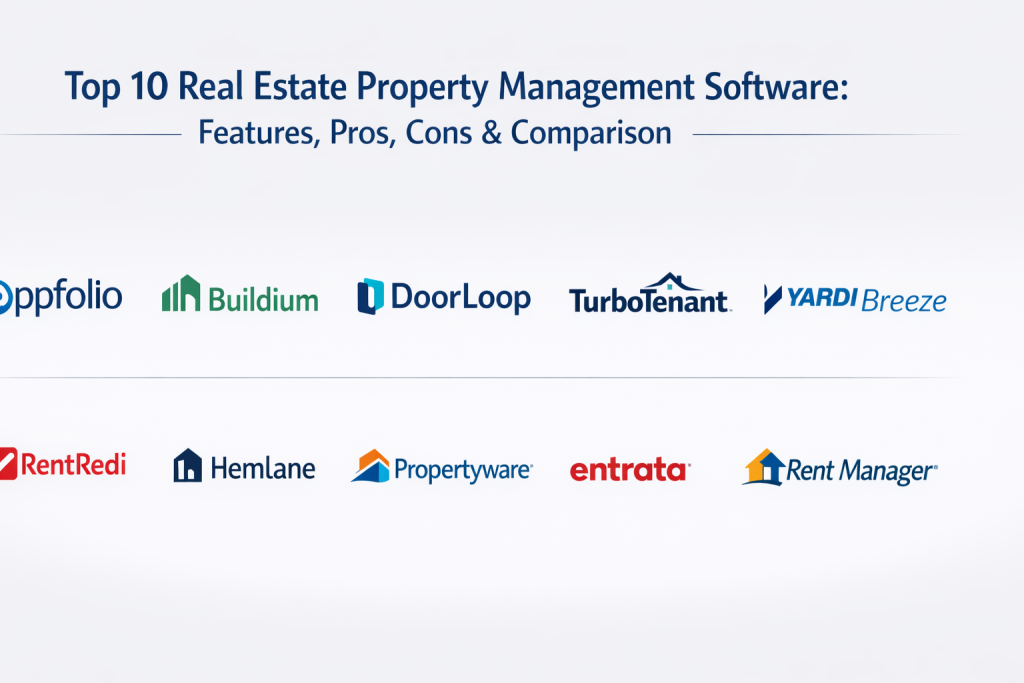
Top 10 Property Management Software Tools
1. AppFolio
This platform is widely recognized as the market leader for modern, growth-oriented property management firms. It excels by offering a sleek, cloud-native interface combined with powerful automation that handles everything from communication to complex trust accounting.
Key Features
- Realm-X AI Assistant: An intelligent interface that automates tasks and generates insights through natural language commands.
- Unified Accounting: Professional-grade financial tools supporting residential, commercial, and community association needs.
- Mobile-First Experience: Fully functional apps for managers, tenants, and owners with high user ratings.
- Automated Leasing: AI-driven lead tracking and one-click listing syndication to dozens of sites.
- Smart Maintenance: Intelligent routing and tracking for work orders with integrated vendor bill-pay.
Pros
- Exceptional user interface that reduces training time for new staff.
- Highly innovative feature set with the most advanced AI in the industry.
Cons
- Minimum unit requirements may make it inaccessible for very small landlords.
- The premium feature set comes with a higher price point than basic competitors.
Platforms / Deployment
Web / iOS / Android
Cloud
Security & Compliance
SOC 2 Type II compliant with AES-256 data encryption and MFA support.
ISO 27001 and GDPR ready.
Integrations & Ecosystem
AppFolio offers a robust API and a curated marketplace of partners. It integrates seamlessly with major background check services, payment gateways, and property marketing platforms.
Support & Community
Industry-leading support including dedicated account managers for larger firms and an extensive online university for self-paced learning.
2. Buildium
A comprehensive solution that strikes a perfect balance between power and ease of use. It is particularly strong for residential and association managers who need professional accounting without the complexity of an enterprise-only suite.
Key Features
- Resident Center: A top-rated portal for tenants to pay rent, submit requests, and communicate with management.
- Association Management: Specialized tools for tracking dues, violations, and board communications.
- Buildium Academy: A structured training program to help teams master the software quickly.
- Electronic Leasing: Completely paperless workflows from application to the final signed lease.
- Standard Accounting: Strong double-entry accounting with built-in 1099 filing and reporting.
Pros
- No minimum unit count makes it ideal for growing small businesses.
- Very stable platform with a predictable and transparent pricing model.
Cons
- The interface, while functional, feels slightly more traditional than newer cloud-first startups.
- Advanced features like phone support are often gated behind higher-tier plans.
Platforms / Deployment
Web / iOS / Android
Cloud
Security & Compliance
PCI DSS Level 1 compliant for secure payment processing.
SSAE 16 (SOC 1) certified.
Integrations & Ecosystem
Includes deep integrations with TransUnion for screening and RevSpring for mail services. It offers a well-documented API for custom data connections.
Support & Community
Known for having an active user community and a responsive help desk. The knowledge base is exceptionally detailed and updated frequently.
3. DoorLoop
This tool has gained rapid popularity due to its extreme speed and versatility. It is designed to manage any property type—from residential and commercial to affordable housing and student rentals—with a lightning-fast user experience.
Key Features
- Lightning-Fast UI: One of the fastest-loading interfaces in the category, optimized for quick data entry.
- Unlimited Properties: Plans that allow for easy scaling without complex per-unit math.
- Integrated CRM: Powerful tools for tracking prospective tenants and lease renewals.
- Custom Website Builder: Allows management companies to launch professional-branded listing sites in minutes.
- Direct Vendor Payments: Streamlined workflows to pay contractors directly via the platform.
Pros
- Extremely approachable for users moving away from manual spreadsheets.
- Exceptional customer support that is consistently praised for speed and helpfulness.
Cons
- As a younger platform, it may lack some of the very deep niche reporting found in older legacy systems.
- Certain advanced financial automation features are still in active development.
Platforms / Deployment
Web / iOS / Android
Cloud
Security & Compliance
Bank-level security with full encryption and regular third-party audits.
Not publicly stated.
Integrations & Ecosystem
DoorLoop connects with thousands of apps via Zapier and offers native integrations for payments, screening, and professional e-signatures.
Support & Community
Offers some of the best onboarding experiences in the industry with dedicated “success managers” for new accounts.
4. TurboTenant
A specialized platform focused on the needs of independent DIY landlords. It provides professional-grade marketing and screening tools, often at no cost to the landlord, by shifting the fee structure to the applicant.
Key Features
- Free Basic Tier: Includes property listings, rent collection, and applications without a monthly subscription.
- Syndicated Marketing: Pushes listings to major platforms like Zillow, HotPads, and Rent.com instantly.
- State-Specific Leases: Provides lawyer-reviewed lease agreements tailored to local laws.
- Expense Tracking: Simple tools to log receipts and prepare for tax season.
- Tenant Screening: High-quality background and credit reports powered by TransUnion.
Pros
- The most cost-effective option for landlords with small portfolios.
- Very simple to set up; a property can be marketed in under ten minutes.
Cons
- Lacks the complex multi-entity accounting required by professional management firms.
- Not designed for high-volume commercial or industrial property management.
Platforms / Deployment
Web / iOS / Android
Cloud
Security & Compliance
Uses industry-standard encryption for sensitive tenant data.
PCI compliant for all rent transactions.
Integrations & Ecosystem
Focuses on essential integrations like credit bureaus and listing sites. It offers a clean connection to simple accounting exports.
Support & Community
The community is primarily small-scale investors. Support is efficient but lacks the 24/7 live-phone coverage of enterprise platforms.
5. Yardi Breeze
Backed by the massive Yardi ecosystem, Breeze provides a “refreshingly simple” cloud solution for smaller portfolios. It offers the stability of an industry giant with a streamlined interface designed for rapid adoption.
Key Features
- One-Click Reports: Simplified financial reporting that can be emailed directly to owners.
- Commercial Support: Advanced tools for managing CAM reconciliations and commercial leases.
- Integrated Marketing: Automated posting to the Yardi-owned network of listing sites.
- Breeze Premium: An upgraded tier adding AI chatbots and advanced investment tracking.
- Tenant Communication: Built-in texting and email history tracking for every resident.
Pros
- Leverages the most trusted name in real estate accounting.
- Transparent per-unit pricing makes it easy to forecast software costs.
Cons
- The “Breeze” version is more restricted than the full Yardi Voyager enterprise suite.
- Initial setup can take slightly longer due to the depth of the underlying accounting structure.
Platforms / Deployment
Web / iOS / Android
Cloud
Security & Compliance
SOC 1 and SOC 2 Type II compliant.
Operates within globally recognized data security standards.
Integrations & Ecosystem
Access to the broad Yardi ecosystem, including specialized tools for screening, insurance, and energy management.
Support & Community
Extensive corporate backing provides a deep knowledge base and reliable technical support. The user community is vast and spans decades of real estate experience.
6. RentRedi
A mobile-first solution that is particularly popular with tech-savvy landlords. It focuses on providing a seamless app experience for both the property owner and the tenant, emphasizing ease of use on the go.
Key Features
- Mobile-First Tenant App: Allows residents to pay rent and submit video-based maintenance requests.
- Pre-Screening Tools: Automated questionnaires that filter out unqualified leads before a showing is scheduled.
- Rent Reporting: Enables tenants to report on-time payments to credit bureaus, increasing their scores.
- Latchel Partnership: Integrated 24/7 maintenance troubleshooting and coordination.
- Team Permissions: Allows owners to add partners or staff with specific access levels.
Pros
- Highly affordable flat-fee pricing regardless of the number of units.
- The “video maintenance” feature drastically reduces unnecessary site visits for managers.
Cons
- The accounting tools are basic and usually require an integration with external software for full books.
- Less suitable for large-scale institutional portfolios with complex reporting needs.
Platforms / Deployment
iOS / Android / Web
Cloud
Security & Compliance
Encryption and secure storage for all personal and financial data.
Not publicly stated.
Integrations & Ecosystem
Strong integrations with QuickBooks and Plaid for financial data syncing. It also connects with major listing and screening partners.
Support & Community
Known for a friendly, approachable support team and a focus on educating new landlords through webinars and guides.
7. Hemlane
This platform offers a unique “hybrid” management model. It provides the software to manage properties but also connects owners with a network of local leasing agents and maintenance professionals for a fee.
Key Features
- Local Agent Network: Connects out-of-state owners with local professionals for showings and inspections.
- Maintenance Coordination: A professional team handles calls and dispatches repair crews 24/7.
- Automated Rent Collection: Smart late-fee enforcement and direct-to-bank deposits.
- Financial Dashboards: Clear views of income and expenses per property or across the whole portfolio.
- Lease Management: Automated reminders for renewals and storage for all legal documents.
Pros
- The only platform that helps with the physical work of property management.
- Perfect for “hands-off” investors who want to avoid hiring a full-time management company.
Cons
- The per-unit cost can be higher if you utilize the “human” management services.
- Not intended for professional management companies that already have their own staff.
Platforms / Deployment
Web / iOS / Android
Cloud
Security & Compliance
Secure data handling with a focus on tenant privacy and legal compliance.
Not publicly stated.
Integrations & Ecosystem
Integrates with established financial and screening tools to ensure data accuracy.
Support & Community
Excellent for remote investors. The support team acts almost like a partner in the property’s success.
8. Propertyware
A powerhouse designed specifically for high-volume single-family residential managers. It offers a level of customization and “industrial-strength” accounting that smaller tools cannot match.
Key Features
- Deep Customization: Nearly every field, report, and workflow can be tailored to the business’s specific needs.
- Advanced Accounting: Supports multi-entity businesses with complex fund tracking and audit trails.
- Integrated Contact Center: A 24/7 maintenance and leasing center to handle high call volumes.
- Lead Tracking: Comprehensive marketing analytics to see which listing sites are providing the best ROI.
- Professional Portals: Highly detailed interfaces for owners to track every penny spent on their assets.
Pros
- The most flexible platform for companies with unique or complex workflows.
- Exceptional audit trails make it a favorite for large, regulated professional firms.
Cons
- The interface has a steeper learning curve than most modern cloud platforms.
- Can feel “overbuilt” and too complex for managers with simple residential needs.
Platforms / Deployment
Web / iOS / Android
Cloud
Security & Compliance
SSAE 16 (SOC 1) certified with enterprise-grade security protocols.
Not publicly stated.
Integrations & Ecosystem
Offers a deep API and a huge marketplace of integrations for everything from digital locks to advanced tax software.
Support & Community
Professional-level support for high-volume users. The community is focused on the business side of large-scale residential management.
9. Entrata
This platform is a dominant force in the multifamily and student housing sectors. It provides a unified system that covers everything from the initial marketing website to the final resident move-out.
Key Features
- Smart Leasing AI: An intelligent assistant that helps move prospective tenants through the leasing funnel.
- Resident Social Portals: Tools to build a sense of community within large apartment complexes.
- Unified Facilities Management: Advanced tools for tracking amenities, parking, and building-wide maintenance.
- Reputation Management: Integrated tools to monitor and respond to online property reviews.
- Utility Billing: Automated systems to calculate and bill residents for their specific energy and water usage.
Pros
- Provides the most “hotel-like” digital experience for high-end residential tenants.
- Unbeatable for managers who operate large buildings with shared amenities.
Cons
- Pricing is enterprise-level and often requires a custom quote based on scale.
- Too heavy for managers who handle dispersed single-family homes.
Platforms / Deployment
Web / iOS / Android
Cloud
Security & Compliance
Enterprise-grade data security with full compliance for the multifamily housing industry.
Not publicly stated.
Integrations & Ecosystem
An open API platform that encourages third-party developers to build specialized tools on top of the core software.
Support & Community
Focuses on the “multifamily” professional world. They offer high-level consulting and implementation support for large portfolios.
10. Rent Manager
Known as the most customizable platform for “unusual” real estate needs. It is used for everything from standard residential to manufactured housing, RV parks, and commercial spaces.
Key Features
- Scripting and Automation: Allows advanced users to write custom scripts to automate unique business tasks.
- Rent Manager Express: A full-featured mobile app that brings the entire desktop experience to the field.
- Integrated VOIP: A built-in phone system that logs every call directly into the tenant’s record.
- Work Order Inventory: Tracks the specific parts and supplies used in every repair for accurate billing.
- Dashboard Customization: Every staff member can have a unique view optimized for their specific job role.
Pros
- The ultimate “Swiss Army Knife” for property managers with mixed or unusual portfolios.
- Very stable software that has been refined over decades of real-world use.
Cons
- The vast array of options can make the initial setup feel overwhelming.
- Requires a more technical staff member to truly unlock the power of its customization.
Platforms / Deployment
Web / Windows / iOS / Android
Cloud / Self-hosted
Security & Compliance
Flexible deployment models allow for high-security local installations or secure cloud hosting.
Not publicly stated.
Integrations & Ecosystem
Offers a massive library of pre-built integrations and a robust developer program for custom connections.
Support & Community
Excellent training programs and a highly loyal community of long-term users in niche real estate sectors.
Comparison Table
| Tool Name | Best For | Platform(s) Supported | Deployment | Standout Feature | Public Rating |
| 1. AppFolio | Growth-Minded Firms | Web, iOS, Android | Cloud | Realm-X AI | N/A |
| 2. Buildium | Residential/HOA | Web, iOS, Android | Cloud | Buildium Academy | N/A |
| 3. DoorLoop | Growing Portfolios | Web, iOS, Android | Cloud | Lightning-Fast UI | N/A |
| 4. TurboTenant | DIY Landlords | Web, iOS, Android | Cloud | Free Basic Tier | N/A |
| 5. Yardi Breeze | Small to Mid Portfolios | Web, iOS, Android | Cloud | Yardi Ecosystem | N/A |
| 6. RentRedi | Mobile-First Owners | iOS, Android, Web | Cloud | Video Maintenance | N/A |
| 7. Hemlane | Remote Investors | Web, iOS, Android | Cloud | Agent Network | N/A |
| 8. Propertyware | Single-Family Focus | Web, iOS, Android | Cloud | Deep Customization | N/A |
| 9. Entrata | Multifamily/Student | Web, iOS, Android | Cloud | Resident Experience | N/A |
| 10. Rent Manager | Mixed/Niche Assets | Web, Windows, Mobile | Hybrid | Custom Scripting | N/A |
Evaluation & Scoring
| Tool Name | Core (25%) | Ease (15%) | Integrations (15%) | Security (10%) | Perf (10%) | Support (10%) | Value (15%) | Total |
| 1. AppFolio | 10 | 9 | 9 | 9 | 10 | 9 | 7 | 9.15 |
| 2. Buildium | 9 | 8 | 8 | 9 | 9 | 8 | 8 | 8.55 |
| 3. DoorLoop | 8 | 10 | 9 | 8 | 10 | 10 | 8 | 8.85 |
| 4. TurboTenant | 6 | 10 | 7 | 8 | 9 | 7 | 10 | 7.85 |
| 5. Yardi Breeze | 9 | 8 | 9 | 10 | 9 | 8 | 7 | 8.55 |
| 6. RentRedi | 7 | 9 | 8 | 8 | 9 | 8 | 9 | 8.15 |
| 7. Hemlane | 7 | 9 | 7 | 8 | 9 | 9 | 8 | 8.10 |
| 8. Propertyware | 10 | 5 | 9 | 9 | 9 | 8 | 7 | 8.15 |
| 9. Entrata | 9 | 7 | 9 | 9 | 10 | 8 | 6 | 8.20 |
| 10. Rent Manager | 10 | 4 | 9 | 9 | 10 | 8 | 7 | 8.05 |
The evaluation scores provide a relative look at how these platforms serve the current real estate market. A higher total score generally highlights a platform that has successfully balanced advanced technical features with a modern, approachable user experience. For instance, AppFolio and DoorLoop lead due to their combination of performance and ease of use. Specialized tools like Rent Manager or Propertyware may have lower ease-of-use scores but remain the superior choices for technical users who require extreme customization to manage complex, non-standard portfolios.
Which Property Management Software Tool Is Right for You?
Solo / Freelancer
If you manage a handful of properties yourself, TurboTenant or Innago are the best starting points. They provide the professional appearance of a larger management firm without the monthly overhead. For those who prioritize a mobile-only workflow, RentRedi offers an unbeatable price-to-performance ratio for small-scale landlords.
SMB
Small to medium businesses that need full double-entry accounting and owner reporting should look toward Buildium or DoorLoop. These tools offer the professional infrastructure needed to impress clients and handle rapid growth without requiring an internal IT department to manage the software.
Mid-Market
For companies managing between 50 and 500 units, AppFolio and Yardi Breeze are the standard recommendations. They provide a high level of automation and advanced financial tools that save hundreds of hours in administrative labor, directly impacting the company’s bottom line as it scales.
Enterprise
Institutional-grade portfolios and massive apartment complexes require the depth of Entrata or Yardi Voyager. These platforms offer the security, layered approvals, and deep data analytics necessary for managing large teams and meeting the reporting requirements of international investors.
Budget vs Premium
- Budget: TurboTenant and RentRedi offer essential features for low or no monthly fees.
- Premium: AppFolio and Entrata provide high-end AI and automation that justifies their higher cost through massive efficiency gains.
Feature Depth vs Ease of Use
- Depth: Rent Manager and Propertyware allow for infinite control and custom data fields but require significant training.
- Ease of Use: DoorLoop and Buildium are designed for immediate adoption with intuitive, modern interfaces.
Integrations & Scalability
For portfolios that include a mix of property types (residential, commercial, retail), Yardi Breeze and Rent Manager offer the best cross-asset scalability. If your strategy involves connecting many different third-party apps, AppFolio’s modern API provides the most reliable connection point.
Security & Compliance Needs
For professional management firms handling large volumes of sensitive financial data, choosing a platform like AppFolio or Buildium—which have dedicated security teams and industry-standard compliance certifications—is the only way to mitigate the risk of data breaches and legal complications.
Frequently Asked Questions (FAQs)
1. Is property management software worth the cost for just one property?
While you can manage one property manually, even basic software like TurboTenant provides free marketing and secure rent collection that professionalizes your business and reduces late payments from day one.
2. Can I use these tools for both residential and commercial properties?
Yes, several platforms like Yardi Breeze and AppFolio have specialized modules designed specifically to handle the different lease structures and accounting needs of commercial real estate.
3. Does the software handle tenant screening automatically?
Most professional platforms have integrated screening tools that allow you to request credit, criminal, and eviction reports with a single click, with the costs usually paid directly by the applicant.
4. How does the software help with my taxes at the end of the year?
By logging all income and expenses throughout the year, these tools allow you to generate 1099s and professional tax reports instantly, significantly reducing your accountant’s workload.
5. Is my data safe in the cloud?
Professional-grade software uses the same level of encryption as major banks. Choosing a vendor with SOC 2 or PCI compliance ensures that your data is handled under strict security protocols.
6. Can tenants pay rent through their mobile phones?
Yes, almost all modern property management tools provide a dedicated tenant app where residents can set up recurring ACH or credit card payments, drastically increasing on-time collection rates.
7. How long does it take to move my data from spreadsheets into a new system?
Most platforms offer bulk-upload tools or dedicated onboarding teams that can help you migrate your data in a few days to a few weeks, depending on the complexity of your portfolio.
8. Can I manage maintenance requests through these apps?
Absolutely. Tenants can upload photos and descriptions of issues, which you can then convert into work orders and assign to your preferred vendors directly within the dashboard.
9. What is the difference between property management and an association tool?
Association tools like Buildium include specialized features for tracking board meetings, common area violations, and HOA dues, which are not typically found in standard residential software.
10. Do I need to be an accountant to use the financial features?
While the software automates much of the math, having a basic understanding of bookkeeping is helpful. Most tools are designed to guide you through the process, but professional accounting support is still recommended for large portfolios.
Conclusion
Selecting the right property management software is a strategic decision that fundamentally determines the scalability and profitability of your real estate business. In the modern era, the “best” tool is no longer just about tracking rent; it is about providing a seamless digital experience for tenants while giving owners the high-level financial intelligence they need to thrive. Whether you are a solo landlord seeking simplicity or a large firm requiring complex AI-driven automation, the platforms on this list offer the specialized tools necessary to modernize your operations. By choosing a system that aligns with your current portfolio and your long-term growth goals, you can move away from administrative chaos and focus on the high-value strategic work of growing your assets.

Best Cardiac Hospitals Near You
Discover top heart hospitals, cardiology centers & cardiac care services by city.
Advanced Heart Care • Trusted Hospitals • Expert Teams
View Best Hospitals