Introduction
Regulatory submission management involves the technical orchestration of life sciences data and documentation to meet the rigorous standards of global health authorities. These platforms, often categorized under Regulatory Information Management (RIM), serve as the critical bridge between a company’s research and the legal authorization to market a product. In the modern landscape, the shift toward electronic Common Technical Documents (eCTD) v4.0 and the increasing demand for IDMP (Identification of Medicinal Products) compliance have made these tools indispensable. They are no longer just storage repositories; they are sophisticated engines that automate document rendering, track global registration statuses, and ensure every hyperlink in a 100,000-page dossier is mathematically perfect.
The complexity of managing global variations and post-market commitments has reached an all-time high. Health authorities now expect data-first submissions rather than just document-heavy files. This requires a toolset that can synchronize across clinical, quality, and safety departments to ensure that a manufacturing change in one region is instantly reflected in the regulatory strategy for another. For organizations, the choice of a submission management tool is a high-stakes decision that directly impacts “time-to-market” and the risk of a “Refusal to File” (RTF) letter.
Best for: Pharmaceutical companies, medical device manufacturers, and Contract Research Organizations (CROs) that must manage high volumes of global filings and maintain constant compliance with FDA, EMA, and other regional health authorities.
Not ideal for: Early-stage startups with only a single product in local development, or industries outside of the strictly regulated life sciences and healthcare sectors where simplified document management suffices.
Key Trends in Regulatory Submission Management Tools
- AI-Driven Content Planning: Systems now use machine learning to suggest submission content based on previous successful filings and current country-specific requirements.
- eCTD v4.0 Readiness: The industry is fully transitioning to the newest electronic submission standard, which allows for better document lifecycle management and bidirectional communication with regulators.
- Automation of IDMP Data: Tools are increasingly automating the extraction and mapping of medicinal product data to meet stringent international standards for data consistency.
- Real-Time Health Authority Integration: Modern platforms provide direct gateways to health authority portals, allowing for instant submission and real-time tracking of review statuses.
- Unified R&D Foundations: There is a strong movement toward unifying RIM with Quality Management Systems (QMS) and Clinical Trial Management Systems (CTMS) to eliminate data silos.
- Continuous Publishing Models: Instead of a “big bang” compilation at the end of a project, tools now allow for incremental publishing as documents become ready.
- Automated Validation Engines: High-end tools include built-in validators that check dossiers against thousands of regional rules in real-time before the final submission.
- Cloud-Native Collaborative Authoring: Multi-user editing environments allow global teams to co-author complex summaries and labels without versioning conflicts.
How We Selected These Tools
- Regulatory Agency Trust: We prioritized tools that are often used by the health authorities themselves for reviewing incoming dossiers.
- Compliance with Global Standards: Each tool was evaluated for its support of eCTD, NeeS, and regional paper formats.
- End-to-End Lifecycle Support: We looked for platforms that manage the entire lifecycle from initial planning and authoring to archiving and variation tracking.
- Technical Scalability: The selection includes tools capable of handling massive dossiers with hundreds of thousands of documents for global pharmaceutical launches.
- Security and Data Integrity: We prioritized systems that meet 21 CFR Part 11 requirements and maintain rigorous audit trails.
- Integration Capabilities: Priority was given to software that can easily pull data from existing clinical and quality systems.
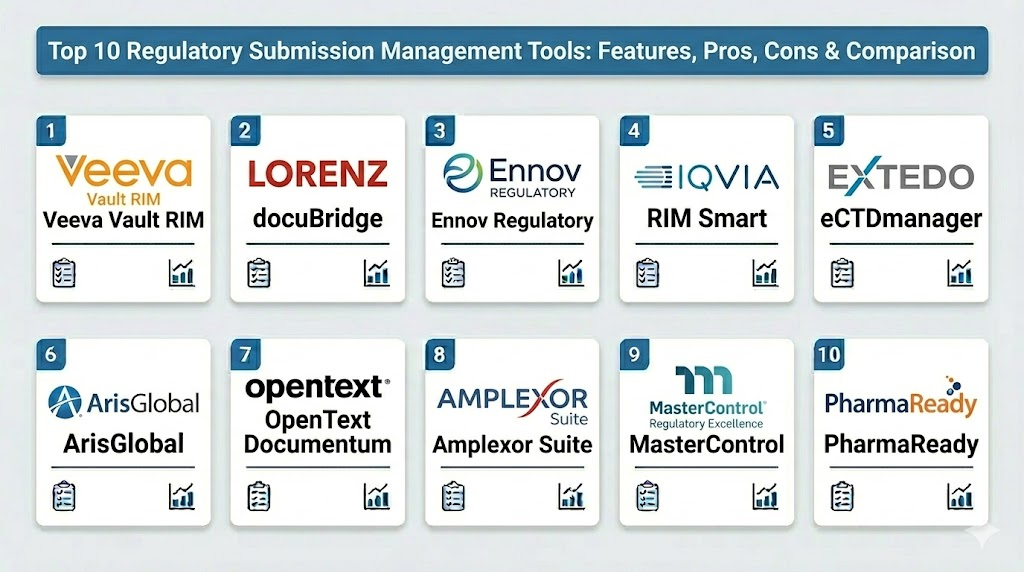
Top 10 Regulatory Submission Management Tools
1. Veeva Vault RIM
Veeva has established itself as the modern leader in cloud-native regulatory management. Its Vault RIM suite unifies submissions, registrations, and archiving on a single platform, allowing for unprecedented visibility across global operations.
Key Features
- Unified platform architecture that shares data across clinical and quality modules.
- Continuous publishing engine that builds the dossier incrementally during development.
- Automated rendering of submission-ready PDFs with bookmarks and hyperlinks.
- Global registration management to track product status in every market.
- Deep support for IDMP data standards and automated reporting.
Pros
- Eliminates the need for manual data reconciliation between disparate systems.
- Frequent, automated cloud updates ensure the system is always compliant with new rules.
Cons
- Higher cost of ownership compared to niche, on-premises solutions.
- Requires a significant organizational shift to fully utilize the unified data model.
Platforms / Deployment
Web / Windows / macOS / iOS
Cloud (SaaS)
Security & Compliance
21 CFR Part 11, GAMP 5, and SOC 2 Type II compliant.
SSO/SAML, MFA, and comprehensive audit trails.
Integrations & Ecosystem
As part of the larger Veeva Vault ecosystem, it integrates natively with Vault Quality and Vault Clinical. It also provides a robust API for connecting to external ERP and supply chain systems.
Support & Community
Industry-leading support with a vast global user community. They offer extensive certification programs and a dedicated customer success manager for enterprise accounts.
2. LORENZ docuBridge
Trusted by many of the world’s leading health authorities, LORENZ is the specialist’s choice for technical submission publishing. It is renowned for its powerful validation engine and its ability to handle extremely complex submission sequences.
Key Features
- Comprehensive validation against all major global regional requirements.
- Advanced lifecycle management for maintaining long-running submission sequences.
- Powerful document re-use and cloning features for multi-country filings.
- Support for eCTD v4.0 and all legacy electronic formats.
- High-speed rendering engine for massive dossiers.
Pros
- Extremely high reliability; if it passes LORENZ validation, the agency will likely accept it.
- Used by regulators themselves, ensuring perfect alignment with their review tools.
Cons
- The user interface is technical and has a steeper learning curve for non-publishers.
- Can be slower to implement due to its deep configuration options.
Platforms / Deployment
Windows / Web
Cloud / Self-hosted / Hybrid
Security & Compliance
Full 21 CFR Part 11 and Annex 11 compliance.
ISO 27001 certified data centers for cloud deployments.
Integrations & Ecosystem
It offers specialized connectors to various document management systems and can be integrated into custom pharmaceutical pipelines via a well-documented SDK.
Support & Community
Excellent technical support with twice-yearly major releases. They maintain a strong presence in the regulatory community through frequent workshops and user groups.
3. Ennov Regulatory Suite
Ennov offers a user-friendly and highly integrated RIM platform that is particularly popular in the European market. It strikes a balance between advanced functionality and a clean, intuitive user experience.
Key Features
- Centralized repository for product registrations and health authority correspondence.
- Integrated eCTD publishing and validation in a single interface.
- Visual dashboards for tracking submission timelines and overdue tasks.
- Automated XEVMPD and IDMP submission workflows.
- Configurable data models that can be tailored to specific organizational needs.
Pros
- Highly praised for its ease of use and minimal training requirements.
- Provides a very strong value-to-performance ratio for mid-market companies.
Cons
- Smaller presence in the North American market compared to Veeva.
- Certain advanced AI features are still in the early stages of rollout.
Platforms / Deployment
Web / Windows
Cloud / Self-hosted
Security & Compliance
21 CFR Part 11 and GDPR compliant.
Standard audit logging and role-based access controls.
Integrations & Ecosystem
The suite is designed to work seamlessly with Ennov’s clinical and quality modules, providing a unified source of truth for life sciences data.
Support & Community
Responsive localized support teams and a growing online knowledge base. They are known for a collaborative approach to customer feedback and feature requests.
4. IQVIA RIM Smart
IQVIA leverages its massive global regulatory intelligence database to power RIM Smart. This tool is unique because it provides “intelligence-led” submission planning, helping users navigate the specific rules of over 100 countries.
Key Features
- Embedded regulatory intelligence covering country-specific filing requirements.
- AI-powered content planning to optimize submission strategies.
- Integrated eCTD publishing with multi-region support.
- Automated IDMP data extraction and management.
- Real-time monitoring of global registration commitments.
Pros
- Unbeatable for companies operating in emerging or highly complex global markets.
- Reduces the need for external regulatory consultants by providing built-in rules.
Cons
- Can be complex to navigate due to the sheer volume of integrated data.
- Pricing can be high for companies that only need basic publishing features.
Platforms / Deployment
Web / Windows
Cloud (SaaS)
Security & Compliance
SOC 2, ISO 27001, and HIPAA compliant.
Advanced encryption and secure data handling protocols.
Integrations & Ecosystem
Integrates deeply with IQVIA’s clinical and safety platforms, providing an end-to-end “Molecule to Market” solution.
Support & Community
Backed by IQVIA’s global scale, offering deep domain expertise and consulting services alongside the software.
5. EXTEDO eCTDmanager
EXTEDO is a veteran in the field, providing a comprehensive RIMS solution that focuses on the entire regulatory value chain. Their tools are known for being robust, reliable, and technically precise.
Key Features
- Full support for over 40 global health authority formats.
- Integrated EXTEDOvalidator, which is widely recognized as an industry benchmark.
- Advanced PDF manipulation, hyperlinking, and bookmarking.
- Lifecycle management for eCTD, NeeS, and vNeeS submissions.
- Collaborative compilation tools for globally distributed teams.
Pros
- Proven track record with over two decades of experience in the industry.
- Extremely precise validation that reduces the risk of technical rejection.
Cons
- The interface can feel slightly dated compared to modern cloud-only rivals.
- Initial setup and template configuration can be time-consuming.
Platforms / Deployment
Windows / Web
Cloud / Self-hosted
Security & Compliance
21 CFR Part 11 and GAMP 5 compliant.
Secure license management and data encryption.
Integrations & Ecosystem
Offers a modular approach, allowing companies to start with publishing and add registration tracking or safety modules later.
Support & Community
Excellent technical documentation and a very high customer retention rate. They host regular training sessions and an annual user forum.
6. ArisGlobal LifeSphere Regulatory
LifeSphere is an AI-first platform that aims to automate the heavy lifting of regulatory operations. It is designed for large-scale enterprises that need a unified ecosystem for regulatory, safety, and clinical data.
Key Features
- AI-driven automated IDMP data collection and reporting.
- Unified RIM, Safety, and Quality modules on a single data architecture.
- Advanced eCTD publishing with global validation engines.
- Real-time tracking of health authority interactions and commitments.
- Predictive analytics for submission performance and timelines.
Pros
- Strongest choice for organizations looking to apply AI to regulatory automation.
- Seamless data flow between safety reporting and regulatory updates.
Cons
- Complexity of the platform requires a dedicated internal admin team.
- The transformation to the AI-driven model can be a multi-year journey.
Platforms / Deployment
Web / Windows
Cloud (SaaS)
Security & Compliance
ISO 27001 and SOC 2 compliant.
Rigorous 21 CFR Part 11 support.
Integrations & Ecosystem
Part of the broader LifeSphere ecosystem, which is one of the most comprehensive R&D platforms available.
Support & Community
Enterprise-grade support with a focus on large-scale digital transformation and change management.
7. OpenText Documentum for Life Sciences
A foundational player in enterprise content management, OpenText provides a highly scalable and secure environment specifically tailored for regulated life sciences documentation and submissions.
Key Features
- Centralized, secure vault for all regulatory documents and correspondence.
- Flexible workflows for document authoring, review, and approval.
- Dedicated module for submission storage and viewing across the organization.
- Advanced search and metadata management for rapid document retrieval.
- Integration with third-party publishing engines like LORENZ or EXTEDO.
Pros
- Unrivaled security and scalability for the world’s largest pharmaceutical companies.
- Extremely mature platform with a long history of compliance success.
Cons
- Is primarily a document management system; full RIM requires additional modules or integrations.
- Can be perceived as less agile than newer, pure-SaaS competitors.
Platforms / Deployment
Web / Windows / macOS / Mobile
Cloud / Self-hosted / Hybrid
Security & Compliance
SOC 2, ISO 27001, and HIPAA compliant.
Meets the highest global standards for data privacy and integrity.
Integrations & Ecosystem
Integrates with almost every major enterprise tool, including SAP and Salesforce, as well as specialized regulatory publishing tools.
Support & Community
Global reach with localized support in every major market. They offer a deep library of resources and professional services for complex implementations.
8. Amplexor Life Sciences Suite
Now part of Acolad, Amplexor offers a comprehensive RIM platform that excels in centralized data management and labeling automation, making it a favorite for global manufacturers.
Key Features
- Centralized labeling management with automated change tracking.
- Full eCTD publishing suite with support for all major regions.
- Integrated document and data management in a unified repository.
- Workflow automation for managing complex global submission sequences.
- Advanced analytics to monitor the performance of the regulatory team.
Pros
- Particularly strong in managing global labeling and translation workflows.
- Scalable architecture that grows with the organization’s needs.
Cons
- The transition during the acquisition has caused some shifts in the product roadmap.
- Pricing models can be complex and less transparent than pure SaaS rivals.
Platforms / Deployment
Web / Windows
Cloud / Hybrid
Security & Compliance
ISO 27001 and GDPR compliant.
Standard 21 CFR Part 11 audit trails and signatures.
Integrations & Ecosystem
Strongest integration is with translation and content globalization tools, which is critical for multi-region filings.
Support & Community
Global localized support teams with a focus on the European and North American markets.
9. MasterControl Regulatory Excellence
MasterControl is a leading provider of quality management software that has expanded into the regulatory space. Its strength lies in the direct connection between quality events and regulatory filings.
Key Features
- Direct link between quality changes (CAPA, Change Control) and regulatory submissions.
- Automated collection of submission content from the QMS.
- Simplified eCTD publishing specifically for IND and NDA filings.
- Tracking of post-market surveillance and labeling updates.
- Unified platform for documents, training, quality, and regulatory affairs.
Pros
- Best choice for medical device companies where Quality and Regulatory are tightly linked.
- Simplifies the “readiness” process by ensuring documents are always the latest approved version.
Cons
- RIM features are not as deep as specialized platforms like LORENZ or Veeva.
- Not ideal for large pharma companies with highly complex, global publishing needs.
Platforms / Deployment
Web / Windows / iOS / Android
Cloud (SaaS)
Security & Compliance
21 CFR Part 11 and GAMP 5 compliant.
Meets international standards for data security and privacy.
Integrations & Ecosystem
Seamlessly integrated with MasterControl’s Quality and Manufacturing modules, creating a complete product lifecycle loop.
Support & Community
Very active user community and excellent training through “MasterControl University.”
10. PharmaReady (Navitas Life Sciences)
PharmaReady is a cost-effective, fully integrated solution designed for small to mid-sized biotech companies. It provides all the essential tools for regulatory compliance without the enterprise price tag.
Key Features
- Fully integrated Document Management, eCTD, and SPL modules.
- Simplified workflows for rapid dossier compilation and validation.
- Built-in templates for various global submission types.
- User-friendly interface designed for small regulatory teams.
- Integrated training module to ensure staff are compliant with procedures.
Pros
- Excellent entry-level pricing for startups and small biotech firms.
- Rapid deployment model allows companies to go live in weeks, not months.
Cons
- Lacks the advanced AI and predictive analytics of enterprise rivals.
- May struggle to manage the complexity of a massive, global pharmaceutical portfolio.
Platforms / Deployment
Web / Windows
Cloud / Self-hosted
Security & Compliance
21 CFR Part 11 and HIPAA compliant.
Full audit trails and electronic signature support.
Integrations & Ecosystem
A modular suite that allows companies to add features as they grow from research into commercialization.
Support & Community
Dedicated 24/7 support for their client base and a community portal for sharing best practices.
Comparison Table
| Tool Name | Best For | Platform(s) Supported | Deployment | Standout Feature | Public Rating |
| 1. Veeva Vault RIM | Unified R&D | Win, macOS, iOS | Cloud | Continuous Publishing | N/A |
| 2. LORENZ docuBridge | Technical Publishing | Win, Web | Hybrid | Agency-Grade Validation | N/A |
| 3. Ennov Regulatory | Mid-Market Pharma | Win, Web | Cloud | Intuitive User Interface | N/A |
| 4. IQVIA RIM Smart | Global Intelligence | Win, Web | Cloud | Built-in Country Rules | N/A |
| 5. EXTEDO eCTDmanager | Global Compliance | Win, Web | Hybrid | 40+ Regional Formats | N/A |
| 6. ArisGlobal | AI Automation | Win, Web | Cloud | AI Data Extraction | N/A |
| 7. OpenText Documentum | Enterprise Content | Win, macOS, Mobile | Hybrid | Extreme Scalability | N/A |
| 8. Amplexor Suite | Global Labeling | Win, Web | Hybrid | Labeling Automation | N/A |
| 9. MasterControl | Quality Integration | Win, Mobile | Cloud | QMS-to-Reg Connection | N/A |
| 10. PharmaReady | Small Biotech | Win, Web | Cloud | Low Cost / Fast Setup | N/A |
Evaluation & Scoring
| Tool Name | Core (25%) | Ease (15%) | Integrations (15%) | Security (10%) | Perf (10%) | Support (10%) | Value (15%) | Total |
| 1. Veeva Vault RIM | 10 | 6 | 10 | 10 | 9 | 9 | 5 | 8.60 |
| 2. LORENZ docuBridge | 10 | 4 | 8 | 10 | 10 | 9 | 6 | 8.15 |
| 3. Ennov Regulatory | 8 | 9 | 8 | 9 | 8 | 8 | 8 | 8.15 |
| 4. IQVIA RIM Smart | 9 | 6 | 9 | 9 | 9 | 8 | 6 | 7.85 |
| 5. EXTEDO eCTDmanager | 9 | 6 | 8 | 9 | 9 | 9 | 7 | 8.00 |
| 6. ArisGlobal | 10 | 5 | 9 | 9 | 9 | 8 | 6 | 7.95 |
| 7. OpenText | 8 | 6 | 9 | 10 | 10 | 8 | 6 | 7.85 |
| 8. Amplexor Suite | 9 | 7 | 8 | 9 | 8 | 8 | 7 | 8.00 |
| 9. MasterControl | 7 | 8 | 10 | 10 | 8 | 8 | 7 | 8.00 |
| 10. PharmaReady | 6 | 9 | 6 | 9 | 7 | 8 | 10 | 7.50 |
The scoring model highlights that while Veeva leads in overall integration and modern cloud capabilities, tools like LORENZ remain at the top for raw publishing performance and agency-level accuracy. The “Value” score is particularly high for PharmaReady and Ennov, making them attractive for smaller firms, while MasterControl dominates the “Integration” score for those prioritizing a quality-first approach. These weighted totals are meant to guide your shortlist based on whether your primary pain point is technical validation, cost, or cross-departmental data flow.
Which Regulatory Submission Management Tool Is Right for You?
Solo / Freelancer
If you are a regulatory consultant working solo, PharmaReady or a basic seat of Ennov is the most sensible choice. These tools provide the necessary validation and publishing features without requiring a massive IT infrastructure or a six-figure annual budget.
SMB
Small to mid-sized biotech firms should prioritize Ennov Regulatory or PharmaReady. These platforms offer a lower total cost of ownership and are designed for rapid deployment, allowing a small team to remain compliant as they move toward their first major filing.
Mid-Market
Growing pharmaceutical companies with multiple products in the pipeline will benefit most from EXTEDO or IQVIA RIM Smart. These tools provide the global reach and intelligence needed to expand into new markets without the extreme complexity of a full enterprise transformation.
Enterprise
For global pharmaceutical giants, Veeva Vault RIM and ArisGlobal LifeSphere are the leading contenders. The ability to unify data across thousands of users and dozens of countries is worth the premium price and implementation effort.
Budget vs Premium
- Budget: PharmaReady and Ennov provide essential compliance at a reasonable price.
- Premium: Veeva Vault RIM and LORENZ docuBridge are the high-end investments for those who cannot afford even a single day of delay in their submission timelines.
Feature Depth vs Ease of Use
- Depth: LORENZ docuBridge and Houdini (in the context of VFX) are often the deepest but hardest to master.
- Ease of Use: MasterControl and Ennov are built to be intuitive for non-technical users.
Integrations & Scalability
Veeva and MasterControl offer the best integration into broader R&D and Quality ecosystems. For pure scalability of document storage, OpenText Documentum remains a foundational choice.
Security & Compliance Needs
All tools on this list meet the basic requirements of 21 CFR Part 11. However, for companies handling extremely sensitive global data, OpenText and Veeva offer the most robust enterprise security frameworks and audit capabilities.
Frequently Asked Questions (FAQs)
1. What is an eCTD submission?
An electronic Common Technical Document is the standard format required by global health authorities for the transfer of pharmaceutical marketing applications.
2. Why do I need specialized software for regulatory submissions?
Standard document tools cannot handle the complex hyperlinking, life-cycle tracking, and regional validation rules required for legal acceptance by health agencies.
3. Is cloud or on-premises better for RIM?
Most organizations are moving to the cloud (SaaS) for faster updates and easier global collaboration, though some large firms still prefer on-premises for extreme control over their data.
4. What does IDMP compliance mean?
IDMP is a set of international standards for the identification of medicinal products, requiring companies to manage highly structured data about their products for safety monitoring.
5. How long does it take to implement a new RIM tool?
Simple cloud solutions can be live in 4 to 8 weeks, while large enterprise transformations can take 6 to 18 months depending on data migration needs.
6. Can these tools help with medical device submissions?
Yes, most platforms now have specialized modules for medical devices, supporting technical files and STED (Summary Technical Document) formats.
7. What is a “Refusal to File” letter?
It is a formal rejection from a health authority stating that a submission is technically or scientifically incomplete and will not be reviewed.
8. Do these tools handle labeling and translations?
Some enterprise tools like Amplexor and Veeva have dedicated modules to manage the complex workflow of global labels and their various translations.
9. Can I migrate data from an old system to a new RIM?
Yes, most vendors offer migration services, though it is a complex process that requires careful data mapping and validation to maintain integrity.
10. Do I need a dedicated person to manage these systems?
For enterprise tools like Veeva or ArisGlobal, a dedicated administrator is usually required to manage configurations, users, and health authority gateways.
Conclusion
Selecting a regulatory submission management tool is a strategic decision that dictates the speed and security of your product’s journey to the market. The move toward data-driven compliance and AI-enhanced automation has made it clear that manual processes are no longer viable. Whether you prioritize a unified cloud ecosystem like Veeva, the technical precision of LORENZ, or the quality-integrated approach of MasterControl, the goal remains the same: ensuring high-quality, compliant dossiers that stand up to agency scrutiny. By choosing a tool that aligns with your organizational scale and technical maturity, you can transform regulatory affairs from a bottleneck into a competitive advantage.

Best Cardiac Hospitals Near You
Discover top heart hospitals, cardiology centers & cardiac care services by city.
Advanced Heart Care • Trusted Hospitals • Expert Teams
View Best Hospitals