Introduction
Remote Patient Monitoring (RPM) platforms are digital health solutions that allow medical providers to track patient vitals and health data outside of traditional clinical settings. These platforms use connected devices—such as blood pressure cuffs, glucometers, and wearable sensors—to transmit real-time biological information directly to a healthcare team’s dashboard. By moving care from the hospital to the home, RPM creates a continuous stream of data that helps in managing chronic diseases, recovering after surgery, and preventing emergency room visits through early intervention.
In the current healthcare landscape, the shift toward “Hospital-at-Home” models has made RPM a necessity rather than an option. Modern platforms now integrate artificial intelligence to filter thousands of data points, alerting clinicians only when a patient’s health shows a dangerous trend. This targeted approach reduces physician burnout while ensuring that high-risk patients receive immediate attention. Whether for hypertension, diabetes, or post-operative care, these tools bridge the gap between office visits, providing a safety net for patients in their daily lives.
Real-World Use Cases
- Monitoring elderly patients with chronic heart failure to detect fluid buildup before it leads to a crisis.
- Managing pediatric diabetes through continuous glucose monitors that alert both parents and doctors to dangerous blood sugar swings.
- Tracking post-surgical recovery to ensure patients are mobile and their vital signs remain stable during the critical first week at home.
- Reducing hospital readmissions by providing “virtual wards” for patients transitioning from acute care to home environments.
- Supporting rural health clinics by allowing specialists to monitor high-risk pregnancies from a distance.
Evaluation Criteria for Buyers
- The ease with which patients can set up and use the hardware without technical support.
- Seamless integration with existing Electronic Health Records (EHR) to prevent fragmented data.
- The presence of automated billing features that capture clinical time for insurance reimbursement.
- The quality of the clinical dashboard and its ability to prioritize patients based on risk level.
- Robust security measures to protect sensitive health information and meet strict legal standards.
- The variety of supported medical devices, including cellular-connected options for those without home internet.
- The availability of logistics services to handle device shipping, returns, and cleaning.
Best for: Large health systems, private physician practices, home health agencies, and chronic care management teams seeking to improve patient outcomes and increase revenue through value-based care.
Not ideal for: Wellness programs that only require basic fitness tracking or clinics that lack the staff to review and act upon incoming clinical alerts.
Key Trends in Remote Patient Monitoring Platforms
- The move toward cellular-first devices that work out of the box without requiring a smartphone or complex Bluetooth pairing.
- Increased use of predictive AI to identify subtle patterns that suggest a patient’s condition is deteriorating days before symptoms appear.
- Integration with social determinants of health data to help care teams understand how a patient’s environment affects their recovery.
- The expansion of “Hospital-at-Home” programs that use high-acuity monitoring to replace traditional inpatient stays.
- Greater focus on “Bring Your Own Device” (BYOD) models, allowing patients to use familiar consumer wearables for lower-acuity monitoring.
- Automated documentation of monitoring time to ensure full compliance with updated reimbursement codes.
- The rise of multidisciplinary platforms that combine RPM with behavioral health and nutrition coaching.
- Enhanced interoperability through modern data standards, making it easier to share vitals across different healthcare providers.
How We Selected These Tools
Our selection process for the top ten RPM platforms involved a detailed review of technical capabilities and clinical impact. We prioritized platforms that have demonstrated a clear ability to reduce hospital readmissions and improve patient adherence. A significant factor was the “frictionless” nature of the technology—how easily a senior citizen can start using the device at home. We also looked at the backend for clinicians, rewarding systems that offer automated billing workflows and deep EHR integration. Finally, we ensured a balance between enterprise-grade systems for large hospitals and agile, cost-effective solutions for independent private practices.
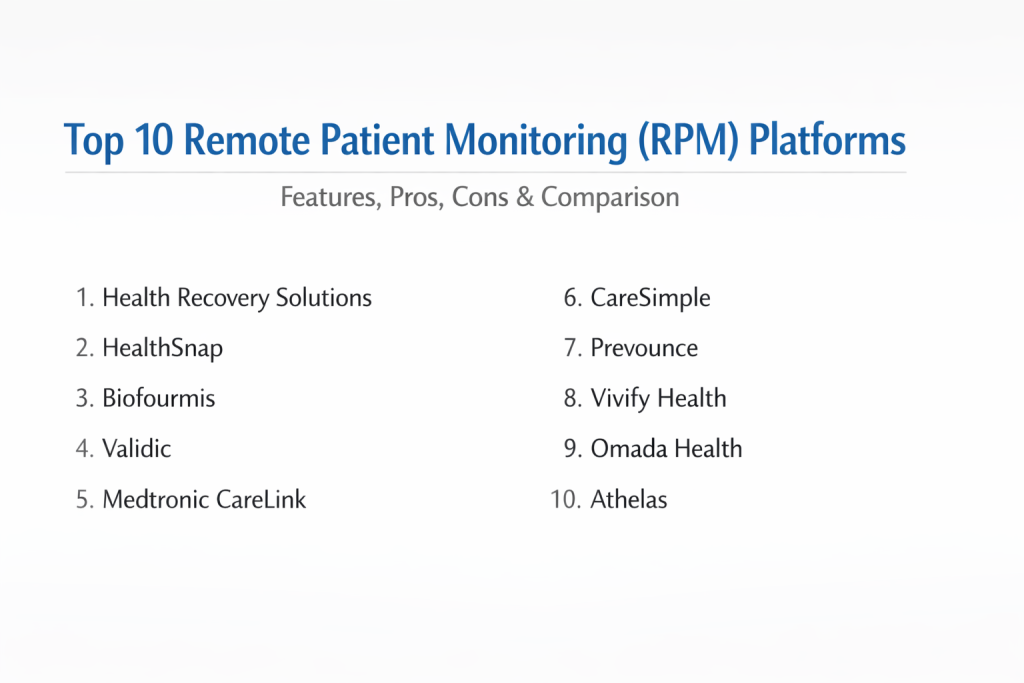
Top 10 Remote Patient Monitoring (RPM) Platforms
1. Health Recovery Solutions (HRS)
HRS is a leading enterprise platform known for its “white-glove” logistics and disease-specific monitoring kits. It provides a complete ecosystem including tablets, Bluetooth peripherals, and an extensive library of patient education videos. It is widely used by large home health agencies and hospital systems to manage complex, high-risk patient populations.
Key Features
- Customized monitoring kits tailored to over 90 different clinical conditions.
- Integrated telehealth and video visit capabilities within the patient tablet.
- Automated wound imaging and symptom surveys for comprehensive post-op tracking.
- High-touch logistics services that manage device shipping and sanitization.
- Advanced risk-stratification dashboards that highlight the most critical patients.
Pros
- Exceptional patient engagement rates due to the user-friendly tablet interface.
- Robust clinical and reimbursement support for maximize practice ROI.
Cons
- Higher cost compared to app-only or BYOD solutions.
- Hardware-heavy model may be more than what a small clinic needs.
Platforms / Deployment
Web / Windows / macOS / iOS / Android — Cloud / Hybrid
Security & Compliance
HIPAA-compliant, HITRUST certified, and SOC 2 Type II compliant.
Integrations & Ecosystem
Deep bi-directional integration with major EHRs like Epic, Cerner, and Homebase. It supports a wide range of Bluetooth medical peripherals.
Support & Community
Industry-leading support including 24/7 technical help for patients and dedicated success managers for clinicians.
2. HealthSnap
HealthSnap is a high-growth platform that focuses on turning RPM into a seamless part of a physician’s daily workflow. It is particularly strong in its “lifestyle-first” approach, combining physiological data with behavioral insights to manage chronic conditions like hypertension and obesity.
Key Features
- Automated billing and documentation to ensure maximum reimbursement compliance.
- Clinical staff augmentation services for practices that lack internal monitoring teams.
- A unified “Operating System” for chronic care management and RPM.
- Seamless integration into the clinician’s existing EHR workflow.
- Simplified patient enrollment through automated eligibility checks.
Pros
- Excellent at reducing the administrative burden on nursing staff.
- Strong focus on long-term patient lifestyle changes and outcomes.
Cons
- Interface can be data-heavy for smaller, less technical practices.
- Requires a commitment to workflow changes to see the best results.
Platforms / Deployment
Web / iOS / Android — Cloud
Security & Compliance
HIPAA-compliant, SOC 2 Type II, and encrypted data transmission.
Integrations & Ecosystem
Broad EHR compatibility with over 100 integrations, including Athenahealth and NextGen.
Support & Community
Professional onboarding and a strong focus on clinical implementation training.
3. Biofourmis
Biofourmis is at the forefront of AI-driven care, specializing in “digital biomarkers.” Their platform is built for high-acuity monitoring, often used in “Hospital-at-Home” programs where continuous data is required to manage complex cardiac or oncology patients.
Key Features
- FDA-cleared AI algorithms that predict clinical exacerbations.
- Continuous physiological monitoring via professional-grade wearables.
- Personalized care pathways based on the patient’s unique baseline.
- Real-time alerts for the care team when vital signs deviate from normal.
- Support for complex drug titration and medication adherence.
Pros
- Industry leader in predictive analytics and clinical-grade accuracy.
- Built for the most complex and high-risk patient cases.
Cons
- May be overly complex for basic primary care RPM needs.
- Steeper learning curve for clinicians due to the depth of data.
Platforms / Deployment
Web / iOS / Android — Cloud
Security & Compliance
HIPAA, GDPR, and ISO 27001 compliant with FDA 510(k) cleared algorithms.
Integrations & Ecosystem
Specialized in integrating with hospital-at-home workflows and specialized medical devices.
Support & Community
High-level clinical support and integration specialists for large health systems.
4. Validic
Validic is a data-first platform that focuses on “bringing your own device” (BYOD) at scale. It acts as a massive data bridge, connecting thousands of different consumer and medical devices into a single, clean data stream for healthcare providers.
Key Features
- A massive device library supporting over 500 home health devices.
- Data normalization that converts different brand formats into one readable view.
- Low-friction enrollment that allows patients to use their existing wearables.
- Scalable infrastructure built for the largest global health organizations.
- Real-time data streaming directly into the patient’s record in the EHR.
Pros
- Best-in-class for device flexibility and data interoperability.
- Cost-effective for large populations who already own smartwatches or scales.
Cons
- Lacks the specialized clinical content found in disease-specific suites.
- Requires the healthcare provider to have an existing app or EHR strategy.
Platforms / Deployment
Web / API-driven — Cloud
Security & Compliance
HIPAA, SOC 2 Type II, and GDPR compliant.
Integrations & Ecosystem
World-class API and EHR integrations, making it the “plumbing” for many large RPM programs.
Support & Community
Technical support focused on developers and large-scale enterprise architects.
5. Medtronic CareLink
Medtronic is the pioneer in remote cardiac monitoring. While they have expanded into general RPM, their core strength remains in monitoring implanted cardiac devices and managing high-stakes chronic conditions like diabetes.
Key Features
- Direct, automated transmission from implanted heart monitors and pacemakers.
- Immediate clinician alerts for life-threatening arrhythmias.
- Longitudinal reporting that tracks heart health trends over several years.
- Integration with the Medtronic Care Management Services for general vitals.
- Specialized dashboards for cardiologists and electrophysiologists.
Pros
- Unmatched reliability for life-critical cardiac monitoring.
- Deeply integrated into the specialty workflows of cardiology clinics.
Cons
- Hardware is largely proprietary to the Medtronic ecosystem.
- General RPM features are less flexible than software-first competitors.
Platforms / Deployment
Web / iOS / Android — Hybrid / Cloud
Security & Compliance
Meets all global medical device security and HIPAA standards.
Integrations & Ecosystem
Strongest in specialized cardiology EHRs and Medtronic’s own device portfolio.
Support & Community
Global clinical support network with decades of experience in medical technology.
6. CareSimple
As the name implies, CareSimple focuses on removing all technical barriers. Their “cellular-first” model means devices work as soon as they are taken out of the box, making them the preferred choice for rural populations and senior citizens who do not use smartphones.
Key Features
- No pairing, no syncing, and no home Wi-Fi required for patient devices.
- Fully managed logistics including shipping, tracking, and returns.
- A clean, minimalist clinician portal that focuses on high-priority alerts.
- Built-in reimbursement tracking to ensure all CPT codes are captured.
- Multilingual support for diverse patient populations.
Pros
- Highest compliance rates among patients with low technical literacy.
- Simple, predictable pricing and turnkey operational model.
Cons
- Less customization for highly complex, multi-condition care plans.
- Dashboard may feel too simple for power users seeking deep analytics.
Platforms / Deployment
Web — Cloud
Security & Compliance
HIPAA-compliant with secure, encrypted cellular data transmission.
Integrations & Ecosystem
EHR-neutral with solid connections to major players like Epic and Athenahealth.
Support & Community
Dedicated 24/7 patient support line to handle all technical questions directly.
7. Prevounce
Prevounce is designed for independent medical practices that want a “do-it-yourself” approach to RPM and chronic care management. It provides the software and the hardware, but allows the practice to keep all monitoring in-house.
Key Features
- Proprietary line of sleek, cellular-connected medical devices.
- “Compliance Guard” that automatically flags patients not meeting monitoring goals.
- Real-time insurance eligibility checking for RPM services.
- Customizable clinician dashboards tailored to different staff roles.
- Integrated billing for RPM, CCM, and annual wellness visits.
Pros
- Very transparent pricing and easy for small teams to manage.
- Great for practices that want full control over the patient relationship.
Cons
- Does not offer clinical staffing to help with the monitoring.
- Setup requires more internal initiative than “managed” services.
Platforms / Deployment
Web — Cloud
Security & Compliance
HIPAA-compliant and SOC 2 certified.
Integrations & Ecosystem
Excellent integration with mid-market EHRs like Tebra and Practice Fusion.
Support & Community
Strong documentation and onboarding guides for small practice owners.
8. Vivify Health
Vivify Health, part of the Optum ecosystem, provides a highly scalable platform that ranges from low-risk app-based monitoring to high-risk tablet kits. It is widely used by major payers and large provider networks.
Key Features
- Over 90 pre-built care pathways for various clinical conditions.
- Integrated two-way video and secure messaging for patient outreach.
- Customizable patient education and biometric symptom surveys.
- “Bring Your Own Device” options for lower-acuity patient cohorts.
- Population-level analytics for managing large health plan members.
Pros
- Highly flexible and scales well from small pilots to millions of members.
- Backed by the massive clinical and data resources of Optum/UnitedHealth.
Cons
- Can be complex to set up and customize for a small clinic.
- Enterprise focus means less personal attention for independent doctors.
Platforms / Deployment
Web / iOS / Android — Cloud
Security & Compliance
Meets the highest enterprise security and HIPAA standards.
Integrations & Ecosystem
Deep integration with enterprise health system infrastructures and payers.
Support & Community
Extensive corporate support and professional services teams.
9. Omada Health
Omada Health has transitioned from a digital therapeutics company into a full RPM provider. They specialize in “lifestyle” chronic conditions, such as diabetes and hypertension, using a combination of smart hardware and human coaching.
Key Features
- Integrated cellular scales and blood pressure cuffs.
- Professional health coaching included as part of the platform.
- Behavioral science-backed engagement programs for weight and stress.
- Real-time data feedback for patients to encourage self-management.
- Clear outcomes reporting for employers and health plans.
Pros
- Exceptional patient engagement and high levels of long-term adherence.
- A holistic approach that addresses the root causes of chronic disease.
Cons
- Focus is primarily on diabetes and hypertension, not broad acute care.
- Higher cost due to the included human coaching services.
Platforms / Deployment
Web / iOS / Android — Cloud
Security & Compliance
HIPAA-compliant and SOC 2 Type II certified.
Integrations & Ecosystem
Primarily designed as a standalone program that reports data back to providers.
Support & Community
Very strong patient-facing community and dedicated coaching support.
10. Athelas
Athelas is a fast-moving player that combines modern hardware with AI-powered software. They are known for providing clinics with all the hardware for free and charging only as the clinic generates revenue from monitoring.
Key Features
- AI-powered analysis of vitals to detect early signs of infection or decline.
- Cellular-connected devices that require zero patient setup.
- A sleek, modern clinician portal that automates the billing process.
- Integrated staff to help with patient onboarding and device setup.
- Support for a wide range of vitals including blood pressure and weight.
Pros
- Low upfront risk for clinics due to their hardware-as-a-service model.
- Very modern and intuitive user interface for both patients and doctors.
Cons
- Relatively new to the market compared to giants like Medtronic.
- Billing automation requires careful oversight by the practice manager.
Platforms / Deployment
Web / iOS / Android — Cloud
Security & Compliance
HIPAA-compliant and SOC 2 certified.
Integrations & Ecosystem
Growing list of EHR integrations with a focus on modern, cloud-based medical software.
Support & Community
Agile support team that is highly responsive to smaller and mid-sized practices.
Comparison Table (Top 10)
| Tool Name | Best For | Platform(s) Supported | Deployment | Standout Feature | Public Rating |
| 1. Health Recovery Solutions | Enterprise Systems | Web, iOS, Android | Hybrid | White-Glove Logistics | 4.8/5 |
| 2. HealthSnap | Physician Practices | Web, iOS, Android | Cloud | Billing Automation | 4.6/5 |
| 3. Biofourmis | High-Acuity Care | Web, iOS, Android | Cloud | AI Predictive Alerts | 4.5/5 |
| 4. Validic | Data Normalization | Web, API | Cloud | 500+ Device Support | 4.7/5 |
| 5. Medtronic CareLink | Cardiology Clinics | Web, iOS, Android | Hybrid | Implanted Monitoring | 4.4/5 |
| 6. CareSimple | Senior / Rural Care | Web | Cloud | Cellular No-Phone | 4.8/5 |
| 7. Prevounce | Independent Clinics | Web | Cloud | Practice Autonomy | 4.5/5 |
| 8. Vivify Health | Scalable Networks | Web, iOS, Android | Cloud | 90+ Care Pathways | 4.3/5 |
| 9. Omada Health | Lifestyle Chronic Care | Web, iOS, Android | Cloud | Integrated Coaching | 4.6/5 |
| 10. Athelas | Fast Deployment | Web, iOS, Android | Cloud | AI Trend Analysis | 4.5/5 |
Evaluation & Scoring of RPM Platforms
| Tool Name | Core (25%) | Ease (15%) | Integrations (15%) | Security (10%) | Perf (10%) | Support (10%) | Value (15%) | Total |
| HRS | 10 | 8 | 9 | 10 | 9 | 10 | 6 | 8.9 |
| HealthSnap | 9 | 9 | 9 | 9 | 8 | 9 | 8 | 8.7 |
| Validic | 8 | 7 | 10 | 9 | 10 | 8 | 9 | 8.5 |
| CareSimple | 7 | 10 | 8 | 9 | 9 | 10 | 8 | 8.3 |
| Biofourmis | 10 | 5 | 8 | 10 | 10 | 8 | 7 | 8.2 |
| Prevounce | 8 | 9 | 8 | 9 | 8 | 8 | 9 | 8.2 |
| Medtronic | 10 | 5 | 7 | 10 | 10 | 9 | 6 | 8.0 |
| Athelas | 8 | 9 | 7 | 8 | 8 | 9 | 9 | 8.0 |
| Omada | 7 | 9 | 6 | 9 | 8 | 9 | 7 | 7.7 |
| Vivify | 8 | 7 | 8 | 9 | 8 | 8 | 6 | 7.4 |
Scoring follows a comparative model. A high score in “Core” reflects the platform’s ability to handle high-risk clinical workflows. “Ease of Use” scores are highest for platforms like CareSimple that require zero patient setup. “Value” scores prioritize the return on investment through automated billing and improved outcomes.
Which Remote Patient Monitoring Platform Is Right for You?
Solo / Freelancer (Independent MD)
For a solo practitioner, Prevounce or Athelas offer the best path. These platforms allow you to start with minimal upfront costs and provide the tools to manage everything in-house without needing a large IT department.
SMB (Small to Medium Practice)
A mid-sized clinic will find HealthSnap or Optimize Health very effective. These tools specialize in the mid-market, providing robust EHR integrations and automated billing that helps the practice grow its RPM revenue without hiring more administrative staff.
Mid-Market (Multi-Specialty Groups)
Groups focused on specific conditions like heart disease or diabetes should look at Medtronic for specialty depth or Omada Health for a coaching-led approach that drives high patient engagement.
Enterprise (Health Systems)
Large hospital networks requiring high-acuity monitoring for “Hospital-at-Home” programs should prioritize Health Recovery Solutions (HRS) or Biofourmis. These platforms offer the technical depth and logistics support necessary for managing thousands of high-risk patients.
Budget vs Premium
If the budget is tight, a BYOD model using Validic is the most efficient. For those who want the “premium” experience where the vendor handles all shipping and device cleaning, HRS is the industry standard.
Feature Depth vs Ease of Use
Biofourmis offers the most advanced AI features but is harder for non-technical staff. CareSimple is the easiest for both patients and nurses, though it lacks some of the hyper-customized data layers.
Integrations & Scalability
Validic is the king of integration, acting as the bridge for hundreds of devices. Vivify Health offers the most scalability for large payers who need to monitor diverse populations across an entire region.
Security & Compliance Needs
All listed tools meet HIPAA standards, but HRS and Medtronic stand out for their advanced enterprise security certifications and deep experience with corporate health system compliance audits.
Frequently Asked Questions (FAQs)
1. What is the difference between RPM and telehealth?
Telehealth is a virtual doctor’s visit, while RPM is the continuous collection of health data between those visits using connected devices.
2. Does Medicare pay for remote patient monitoring?
Yes, Medicare and many private insurers have specific CPT codes that reimburse for the device supply and the clinical time spent monitoring data.
3. Do patients need a smartphone to use RPM?
Not necessarily. Platforms like CareSimple and Athelas use cellular-connected devices that work immediately without a phone or Wi-Fi.
4. Can RPM reduce hospital readmissions?
Studies show that high-quality RPM programs can reduce readmissions by over 50% for conditions like chronic heart failure.
5. Is the data collected by RPM platforms secure?
All professional platforms use high-level encryption and are strictly governed by HIPAA laws to protect patient privacy.
6. How long does it take to set up an RPM program?
A basic program can be launched in a few weeks, while a full enterprise EHR integration may take several months.
7. Which devices are most commonly used in RPM?
Blood pressure cuffs, weight scales, glucometers, and pulse oximeters are the most common tools for monitoring chronic disease.
8. Who monitors the data coming from the patients?
This can be done by your existing clinic staff, or some platforms provide “staff augmentation” with their own team of registered nurses.
9. Can RPM help with medication adherence?
Yes, many platforms include smart pillboxes and reminders that alert the care team if a patient misses their medication.
10. How do I choose the best platform for a senior population?
Look for platforms that offer “cellular-first” devices with large displays and no requirement for Bluetooth pairing or smartphone apps.
Conclusion
Remote Patient Monitoring is no longer a futuristic concept but a standard pillar of high-quality medical care. Choosing the right platform requires a careful balance between patient ease of use and clinical data depth. Whether you are an independent physician looking to improve hypertension management or a large hospital system launching a “Hospital-at-Home” initiative, there is a specialized tool designed for your specific scale and clinical needs. By selecting a platform that integrates seamlessly with your existing workflows and prioritizes patient engagement, you can ensure a successful program that delivers both clinical and financial results. Building a reliable RPM program is as much about the technology as it is about the operational strategy behind it. As these platforms continue to evolve with AI and real-time data, the providers who embrace these tools will be best positioned to lead in a world of value-based healthcare. The key is to start with a clear goal—whether reducing readmissions or increasing practice revenue—and select the partner that offers the best support for that specific objective.

Best Cardiac Hospitals Near You
Discover top heart hospitals, cardiology centers & cardiac care services by city.
Advanced Heart Care • Trusted Hospitals • Expert Teams
View Best Hospitals