Introduction
Revenue Operations, or RevOps, is the strategic integration of sales, marketing, and customer success operations to drive predictable revenue and break down departmental silos. In the current business environment, fragmented data and disconnected tools are the primary enemies of growth. RevOps platforms serve as a centralized operating system that unifies these functions, providing a single source of truth for the entire customer lifecycle. By aligning teams under a shared set of data and goals, organizations can move from reactive troubleshooting to proactive, data-driven strategy.
The shift toward RevOps platforms has become essential as customer journeys become increasingly non-linear. Today’s buyers interact with multiple digital touchpoints before ever speaking to a sales representative, and they expect a seamless transition from the point of purchase to long-term support. Modern platforms leverage sophisticated automation and predictive intelligence to ensure that no lead is dropped and every expansion opportunity is identified. This holistic approach ensures that every operational decision is directly tied to a measurable revenue outcome.
Best for: B2B companies with complex sales cycles, high-growth SaaS organizations, and enterprise firms looking to eliminate data silos between marketing, sales, and finance teams.
Not ideal for: Early-stage startups with very low lead volume, businesses with simple transactional models, or teams that lack a dedicated operations function to manage a centralized platform.
Key Trends in Revenue Operations Platforms
- Transition to Autonomous GTM: Platforms are moving beyond simple automation toward autonomous systems that can identify, qualify, and route opportunities without human intervention.
- Consolidation of Point Solutions: Companies are moving away from maintaining dozens of specialized tools in favor of unified platforms that handle everything from lead routing to forecasting.
- AI-Powered Predictive Forecasting: Static spreadsheets are being replaced by dynamic models that use historical data and real-time signals to predict revenue with over 95% accuracy.
- Direct Revenue Intelligence: Call and email analysis is now a standard feature, allowing operations teams to see exactly which talk patterns and behaviors lead to closed deals.
- Governance and AI Readiness: RevOps is now the primary owner of data hygiene, ensuring that information is clean and structured enough for AI models to be effective.
- Account-Based Everything: The focus has shifted from individual leads to holistic account hierarchies, allowing teams to track engagement across entire buying committees.
- Real-Time Pipeline Inspection: Managers can now view the health of every deal in a pipeline instantly, identifying “stuck” deals before they impact the quarterly target.
- Integration of Usage Data: For subscription models, platforms are increasingly pulling in product usage data to signal churn risk or expansion potential automatically.
How We Selected These Tools
- End-to-End Visibility: We prioritized platforms that provide a complete view of the revenue funnel, from initial marketing touch to final customer renewal.
- Data Unification Capabilities: Evaluation focused on how effectively a tool can act as a single source of truth and its ability to resolve data conflicts.
- Predictive Power: A key criterion was the sophistication of the platform’s AI and its ability to provide actionable insights rather than just raw data.
- Enterprise-Grade Security: We selected tools that meet the rigorous compliance standards required for handling sensitive financial and customer data.
- Ecosystem Extensibility: The ability to integrate seamlessly with standard CRMs and financial tools was essential for inclusion on this list.
- User Adoption and Logic: We looked for platforms that enhance the daily workflow of reps and managers rather than adding administrative burden.
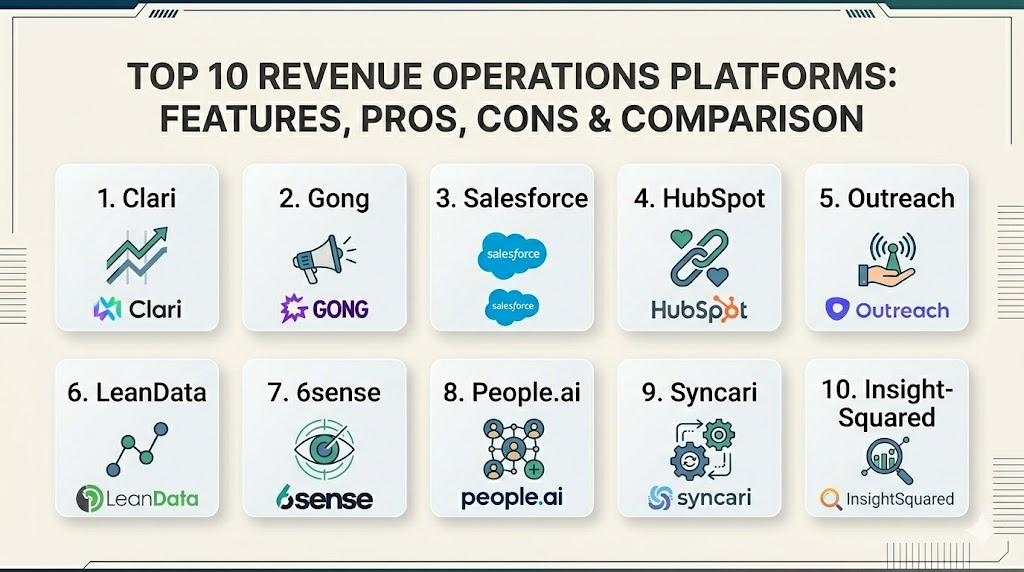
Top 10 Revenue Operations Platforms
1. Clari
Clari is a purpose-built revenue platform designed for high-performance forecasting and pipeline management. It specializes in converting scattered signals from your CRM, email, and calendar into a predictable revenue engine.
Key Features
- AI-driven revenue forecasting with high-confidence scoring.
- Automated activity capture that logs all customer interactions without rep input.
- Pipeline inspection tools to visualize deal health and momentum.
- Mutual action plans to keep buyers and sellers aligned on deal milestones.
- Sophisticated revenue analytics that highlight where slippage is occurring.
Pros
- Exceptional accuracy in predicting end-of-quarter revenue results.
- Reduces manual data entry for sales reps significantly.
Cons
- Setup and configuration can be complex for smaller organizations.
- Premium pricing makes it a significant investment for mid-market teams.
Platforms / Deployment
Web / iOS / Android
Cloud
Security & Compliance
SOC 2 Type II and ISO 27001 certified.
SSO/SAML and advanced audit logging.
Integrations & Ecosystem
Strongest integration with Salesforce and Microsoft Dynamics. It connects deeply with conversational intelligence tools and major email providers to pull in engagement signals.
Support & Community
Provides dedicated “Revenue Success” managers for enterprise clients and has a robust library of best-practice playbooks for RevOps leaders.
2. Gong
Originally known for conversation intelligence, Gong has evolved into a full revenue platform that uses AI to analyze every customer interaction to provide deal visibility and team coaching.
Key Features
- AI-powered transcription and analysis of every call, meeting, and email.
- Deal intelligence that identifies risks and suggests next best actions.
- Market intelligence to track how competitors and trends are mentioned in deals.
- Coaching scorecards based on real-world talk patterns of top performers.
- Forecasting features tied directly to real engagement data from calls.
Pros
- Provides the most honest look at what is actually happening in a deal.
- Very high user adoption because it provides immediate value to reps.
Cons
- Can be expensive when scaled across a large global organization.
- Requires consistent CRM data hygiene to maximize its predictive features.
Platforms / Deployment
Web / iOS / Android
Cloud
Security & Compliance
SOC 2 Type II, GDPR, and HIPAA compliant.
Strong encryption and customizable data retention policies.
Integrations & Ecosystem
Integrates with all major CRM, dialer, and video conferencing tools. It also has a robust API for exporting conversation data into BI tools.
Support & Community
Excellent onboarding resources and a highly active community of sales and operations professionals.
3. Salesforce Revenue Cloud
Part of the broader Salesforce ecosystem, Revenue Cloud unifies CPQ, billing, and partner relationship management to give finance and operations teams a single view of the revenue cycle.
Key Features
- Advanced CPQ with guided selling and complex approval workflows.
- Unified billing and revenue recognition for subscription and one-time models.
- Partner relationship management for indirect sales channels.
- Einstein AI for predictive lead scoring and opportunity insights.
- Deep integration with the Salesforce Data Cloud for unified customer profiles.
Pros
- The most extensible and customizable platform on the market.
- Seamless connection between the sales process and final financial reporting.
Cons
- Requires specialized administrators to manage and maintain.
- Implementation projects can be long and resource-intensive.
Platforms / Deployment
Web / Windows / macOS / iOS / Android
Cloud
Security & Compliance
Highest level of enterprise compliance including SOC, ISO, and global privacy standards.
Granular RBAC and comprehensive audit trails.
Integrations & Ecosystem
The largest ecosystem in the world via the AppExchange. It can connect to virtually any other business tool through native integrations or APIs.
Support & Community
Unrivaled community support through the Trailhead platform and a global network of specialized consultants.
4. HubSpot Operations Hub
Operations Hub is designed to help RevOps teams clean data, automate processes, and sync apps more effectively within the HubSpot platform, focusing on ease of use and rapid setup.
Key Features
- Data quality automation that formats and cleanses information automatically.
- Programmable automation allowing for custom-coded workflow actions.
- Bi-directional data sync with hundreds of third-party applications.
- Unified reporting that pulls data from across marketing, sales, and service.
- Snowflake integration for advanced data warehousing and analysis.
Pros
- Extremely intuitive and easy to set up without technical engineering.
- All-in-one nature reduces the need for multiple disparate tools.
Cons
- May lack the extreme depth of customization required by giant global enterprises.
- Advanced programmable features require some knowledge of JavaScript.
Platforms / Deployment
Web / iOS / Android
Cloud
Security & Compliance
SOC 2 Type II, GDPR, and ISO 27001 certified.
standard SSO and two-factor authentication.
Integrations & Ecosystem
Excellent native integrations with the entire HubSpot suite and a growing marketplace of third-party connectors.
Support & Community
Very strong community forums and the HubSpot Academy, which provides extensive free training for operations professionals.
5. Outreach
Outreach is a sales execution platform that has expanded into RevOps by offering pipeline management, forecasting, and deal health insights alongside its core engagement tools.
Key Features
- Multi-channel sales sequences across email, phone, and social media.
- AI-driven deal health scores based on engagement frequency and quality.
- Integrated forecasting that rolls up rep commits into a centralized view.
- Kaia real-time AI assistant for live coaching during sales calls.
- Pipeline move analytics to see how deals are progressing through stages.
Pros
- Combines top-of-funnel engagement with bottom-of-funnel forecasting.
- Excellent for standardizing sales playbooks across a large team.
Cons
- Can lead to “tool overlap” if you already have a dedicated forecasting tool.
- The interface can be busy for users who only need simple engagement.
Platforms / Deployment
Web / Windows / macOS
Cloud
Security & Compliance
SOC 2 Type II and GDPR compliant.
Standard enterprise security protocols for data handling.
Integrations & Ecosystem
Deep bi-directional sync with Salesforce and Microsoft Dynamics. It also integrates with most major data enrichment providers.
Support & Community
Strong professional support and a well-regarded community for sales operations and enablement.
6. LeanData
LeanData is a specialized RevOps platform focused on lead-to-account matching and intelligent routing, ensuring that every revenue opportunity is delivered to the right person instantly.
Key Features
- Visual drag-and-drop builder for complex lead and account routing logic.
- Sophisticated lead-to-account matching using fuzzy logic to prevent duplicates.
- Routing audit trails that show exactly why a lead was assigned to a specific rep.
- Multi-touch attribution modeling to see which marketing efforts drive revenue.
- Salesforce-native architecture that runs entirely within the CRM environment.
Pros
- The industry standard for complex routing and lead management.
- Being Salesforce-native means no data leaves your core CRM environment.
Cons
- It is a specialized tool that focuses mainly on the routing stage of RevOps.
- Requires a Salesforce-centric infrastructure to function.
Platforms / Deployment
Web (Salesforce Native)
Cloud
Security & Compliance
Inherits the security posture of Salesforce.
SOC 2 Type II compliant.
Integrations & Ecosystem
Tightest possible integration with Salesforce. It also connects to major marketing automation platforms like Marketo and HubSpot.
Support & Community
Highly specialized support team and a strong reputation for help with complex go-to-market logic.
7. 6sense
6sense uses AI and big data to provide RevOps teams with buyer intent signals, identifying which accounts are in-market before they even fill out a form.
Key Features
- Anonymous website visitor identification to uncover hidden pipeline.
- Predictive account scoring based on historical winning patterns.
- Buying stage prediction to tell teams exactly where a prospect is in their journey.
- Orchestration tools for multi-channel ABM campaigns.
- Integration of intent data directly into the sales and marketing workflow.
Pros
- Unrivaled for identifying “dark social” and hidden intent.
- Helps marketing and sales align on the same high-value accounts.
Cons
- High entry cost targeted at enterprise-level organizations.
- Requires a high volume of data to reach its full predictive potential.
Platforms / Deployment
Web
Cloud
Security & Compliance
SOC 2 Type II and GDPR compliant.
Standard enterprise data privacy protections.
Integrations & Ecosystem
Integrates with all major CRM and marketing automation platforms. It also has a strong connection to advertising networks for targeted outreach.
Support & Community
Excellent strategic support for teams building account-based revenue motions.
8. People.ai
People.ai is a revenue intelligence platform that focuses on activity capture and relationship mapping, helping RevOps teams see the “who” and the “how” behind every deal.
Key Features
- Automated capture of all sales, marketing, and success activities.
- Intelligent relationship mapping that identifies all stakeholders in an account.
- Pipeline health scoring based on the depth of engagement with key personas.
- Opportunity management that highlights missing activity in critical deals.
- Benchmarking tools to compare rep performance across the organization.
Pros
- Provides deep visibility into the actual level of effort in a deal.
- Excellent for mapping the complex buying committees found in enterprise sales.
Cons
- Can feel intrusive to some reps if not positioned correctly during rollout.
- Best suited for long-cycle, complex B2B sales rather than simple motions.
Platforms / Deployment
Web
Cloud
Security & Compliance
SOC 2 Type II and GDPR compliant.
Comprehensive audit logs and secure data transmission.
Integrations & Ecosystem
Strongest with Salesforce, Oracle, and Microsoft Dynamics. It also connects deeply to enterprise email and calendar systems.
Support & Community
High-touch professional services for enterprise implementations.
9. Syncari
Syncari is a unified data and workflow automation platform designed specifically for RevOps to maintain data consistency across the entire revenue tech stack.
Key Features
- Multi-directional data synchronization across dozens of business apps.
- Distributed data authority to manage which system is the “source of truth.”
- No-code data orchestration for cleaning and normalizing information.
- Cross-system reporting that stays consistent even as tools are swapped.
- Automated data governance to prevent dirty data from spreading.
Pros
- Solves the fundamental RevOps problem of data fragmentation.
- Allows teams to swap point solutions without losing historical data context.
Cons
- Requires a strong understanding of data architecture to set up.
- More of an “under-the-hood” tool than a platform for end-user reps.
Platforms / Deployment
Web
Cloud
Security & Compliance
SOC 2 Type II compliant.
Enterprise-level encryption and secure API management.
Integrations & Ecosystem
Extensive library of connectors for CRM, marketing automation, finance, and support tools.
Support & Community
Specialized support for data operations professionals and architects.
10. InsightSquared
InsightSquared provides deep revenue intelligence and forecasting dashboards, helping teams turn raw data into a visual understanding of their revenue performance.
Key Features
- Interactive dashboards for pipeline velocity and conversion tracking.
- AI-driven forecasting with drill-down capabilities for setiap deal.
- Rep performance analytics to identify coaching opportunities.
- Historical trend analysis to see how the business is evolving over time.
- Data quality scorecards to identify missing fields in the CRM.
Pros
- Very strong visualization and reporting capabilities.
- Helps teams move beyond basic CRM reports to deep behavioral insights.
Cons
- Now part of a larger suite, which may affect standalone availability.
- Requires a solid data foundation in the CRM to be effective.
Platforms / Deployment
Web
Cloud
Security & Compliance
SOC 2 Type II compliant.
Standard enterprise security and access controls.
Integrations & Ecosystem
Primarily focused on Salesforce integration but can pull data from other revenue-related systems.
Support & Community
Known for strong customer success and professional training for RevOps managers.
Comparison Table
| Tool Name | Best For | Platform(s) Supported | Deployment | Standout Feature | Public Rating |
| 1. Clari | Forecasting | Web, iOS, Android | Cloud | Predictive AI | N/A |
| 2. Gong | Revenue AI | Web, iOS, Android | Cloud | Call Analysis | N/A |
| 3. Salesforce | Enterprise GTM | Web, Win, Mac, Mobile | Cloud | CPQ & Billing | N/A |
| 4. HubSpot | SMB / Mid-Market | Web, iOS, Android | Cloud | Data Cleaning | N/A |
| 5. Outreach | Sales Execution | Web, Win, Mac | Cloud | Sequences | N/A |
| 6. LeanData | Lead Routing | Salesforce Native | Cloud | Visual Router | N/A |
| 7. 6sense | Intent / ABM | Web | Cloud | Dark Funnel | N/A |
| 8. People.ai | Relationships | Web | Cloud | Activity Capture | N/A |
| 9. Syncari | Data Unification | Web | Cloud | Multi-Sync | N/A |
| 10. InsightSquared | Visual Reporting | Web | Cloud | Performance Drills | N/A |
Evaluation & Scoring
| Tool Name | Core (25%) | Ease (15%) | Integrations (15%) | Security (10%) | Perf (10%) | Support (10%) | Value (15%) | Total |
| 1. Clari | 10 | 5 | 9 | 10 | 9 | 9 | 6 | 8.20 |
| 2. Gong | 9 | 8 | 9 | 9 | 10 | 9 | 7 | 8.60 |
| 3. Salesforce | 10 | 3 | 10 | 10 | 8 | 8 | 6 | 7.75 |
| 4. HubSpot | 7 | 10 | 9 | 8 | 9 | 9 | 9 | 8.55 |
| 5. Outreach | 8 | 7 | 8 | 8 | 9 | 8 | 7 | 7.75 |
| 6. LeanData | 9 | 7 | 9 | 9 | 9 | 8 | 7 | 8.15 |
| 7. 6sense | 9 | 5 | 8 | 9 | 10 | 8 | 6 | 7.55 |
| 8. People.ai | 8 | 6 | 9 | 9 | 9 | 7 | 6 | 7.55 |
| 9. Syncari | 9 | 4 | 10 | 9 | 9 | 8 | 8 | 7.85 |
| 10. InsightSquared | 8 | 7 | 8 | 8 | 9 | 8 | 7 | 7.75 |
The scoring above is based on how these platforms function as a holistic RevOps solution. Gong and HubSpot score highly due to their high user adoption and broad feature sets that cover multiple stages of the funnel. Clari remains the leader in the core “Core Features” category for its unmatched forecasting depth. It is important to remember that a lower total score often simply reflects a tool’s specialized nature—for example, Syncari is an elite data management tool but is naturally more difficult to use than a standard engagement platform.
Which Revenue Operations Platform Is Right for You?
Solo / Freelancer
At this stage, you likely do not need a full RevOps platform. Focus instead on an all-in-one CRM like HubSpot that provides basic automation and reporting without requiring a specialized operations team to manage it.
SMB
Small to medium businesses should prioritize ease of setup and time-to-value. HubSpot Operations Hub or a combined stack of Outreach and a basic CRM are the best choices for growing teams that need professional tools without enterprise complexity.
Mid-Market
For companies with 50-200 reps, the focus shifts to predictability. This is where Gong or LeanData become essential to ensure that deals are being handled correctly and routing logic is keeping pace with growth.
Enterprise
Large organizations with global teams and complex data models need the heavy lifting of Clari for forecasting and Salesforce Revenue Cloud for financial alignment. People.ai is also critical here for mapping complex buying committees across thousands of accounts.
Budget vs Premium
If budget is the primary concern, start with the native operations features of your CRM. For premium needs where revenue predictability is worth the investment, Clari and 6sense provide the highest strategic returns.
Feature Depth vs Ease of Use
HubSpot and Gong lead the market in ease of use and adoption. If your priority is technical depth and the ability to build custom logical workflows, Salesforce and Syncari are the preferred options.
Integrations & Scalability
If your tech stack is constantly evolving, Syncari offers the best long-term scalability by keeping your data unified across tools. For teams locked into a single ecosystem, Salesforce provides the most robust native integration path.
Security & Compliance Needs
All enterprise tools on this list meet standard security requirements. However, if you have specific regional data sovereignty or industry-specific compliance needs, Salesforce and Adobe/HubSpot provide the most documented and tested frameworks.
Frequently Asked Questions (FAQs)
1. What is the main difference between Sales Ops and RevOps?
Sales Ops focuses purely on the sales team’s efficiency, while RevOps aligns sales, marketing, and customer success under one operational umbrella to manage the entire revenue lifecycle.
2. Can these platforms replace my CRM?
No, most of these platforms are designed to sit on top of or integrate deeply with your CRM, enhancing its data and providing advanced analytics and automation that the CRM cannot do alone.
3. How does AI help in Revenue Operations?
AI is used to automate data entry, predict which deals are most likely to close, identify churn risks, and provide real-time coaching tips during customer calls.
4. Is a RevOps platform necessary for a small team?
While a full platform may be overkill, small teams should still use the operations features of their CRM to ensure data is clean and leads are routed correctly from the start.
5. How long does it take to implement a platform like Clari or Gong?
Basic implementation can happen in a few weeks, but fully optimizing the logic and training the team to use the insights effectively typically takes three to six months.
6. Do these tools help with customer retention?
Yes, by pulling in engagement and usage data, these platforms can flag accounts that have gone quiet, allowing customer success teams to intervene before a renewal is at risk.
7. What is “Dark Funnel” or hidden intent?
This refers to research potential buyers do anonymously on third-party sites or via social media. Platforms like 6sense use AI to identify this activity and link it to specific accounts.
8. Can I use multiple RevOps tools together?
Most successful teams use a “stack” approach—for example, using Salesforce for the core data, LeanData for routing, and Gong for conversation intelligence.
9. How do these platforms improve forecasting accuracy?
They move away from rep “gut feelings” and use real-time signals like email frequency, meeting attendance, and sentiment analysis to provide a data-driven prediction.
10. What is lead-to-account matching?
It is the process of automatically linking a new individual lead to their existing company record in the CRM, ensuring the sales team sees the full history of that account.
Conclusion
Navigating the transition to a unified revenue engine requires more than just a change in strategy—it requires the right technological foundation. The platforms featured in this guide represent the current peak of operational excellence, offering the tools necessary to turn fragmented data into a predictable growth machine. Whether you are focused on tightening your forecast, improving team alignment, or uncovering hidden buyer intent, the right platform will act as a force multiplier for your entire go-to-market team. As the landscape continues to shift toward autonomous execution and AI-driven intelligence, investing in a robust revenue operations platform is no longer optional for organizations that want to compete at scale.

Best Cardiac Hospitals Near You
Discover top heart hospitals, cardiology centers & cardiac care services by city.
Advanced Heart Care • Trusted Hospitals • Expert Teams
View Best Hospitals