Introduction
A Risk Management Information System (RMIS) is a specialized digital platform designed to aggregate risk, claims, and insurance data into a single, cohesive repository. Unlike general business intelligence tools, an RMIS is purpose-built to handle the complexities of the insurance lifecycle, including policy management, exposure tracking, and incident reporting. The role of RMIS has evolved from a simple “system of record” to a proactive intelligence hub. Organizations now face a fragmented data environment where information is scattered across HR, finance, third-party administrators (TPAs), and various legal entities. A modern RMIS bridges these silos, allowing leadership to visualize the total cost of risk (TCOR) in real time.
In the current professional climate, the value of an RMIS lies in its ability to transform raw data into defensible strategies. Whether it is preparing for an insurance renewal, managing a high volume of workers’ compensation claims, or conducting a global property valuation, these systems provide the quantitative evidence required for informed decision-making. As regulatory scrutiny increases and insurance markets harden, having a “single source of truth” is no longer a luxury but a fundamental requirement for organizational resilience.
Real-World Use Cases
- Claims Administration: Streamlining the intake and tracking of workplace injuries, auto accidents, or general liability incidents from the moment they occur until they are closed.
- Insurance Renewals: Consolidating global asset values and loss histories to provide brokers with accurate data, often resulting in more favorable premium negotiations.
- Safety and Inspection: Using mobile-first forms to conduct on-site safety audits and identifying trends that lead to frequent incidents.
- Exposure Management: Mapping physical locations, employees, and digital assets against global threat feeds like natural disasters or geopolitical unrest.
- Third-Party Oversight: Tracking certificates of insurance (COI) and compliance statuses for thousands of vendors to ensure the organization is not assuming unnecessary liability.
Evaluation Criteria for Buyers
- Data Ingestion: How effectively can the system automate the import of “loss runs” from various insurers and TPAs?
- Configurability: Can the internal users modify forms and workflows without needing to submit a ticket to the vendor’s engineering team?
- Analytics and Reporting: Does the platform offer “board-ready” visualizations and predictive modeling for future loss trends?
- Security and Privacy: Is the data encrypted at rest and in transit, and does the system support global privacy mandates like GDPR or CCPA?
- User Experience: Is the interface intuitive enough for front-line employees to report incidents quickly, or does it require extensive training?
- Integration Capabilities: Does it connect with existing enterprise systems like HRIS (e.g., Workday) or Financial systems (e.g., SAP)?
- Mobile Accessibility: Can safety inspectors or claims adjusters enter data directly from the field via a tablet or smartphone?
- Total Cost of Ownership: Beyond the annual subscription, what are the costs for implementation, data storage, and additional modules?
- Vendor Reputation: Does the provider have a history of stability and high-quality customer support in your specific industry?
- Scalability: Can the system handle a massive increase in data points as your organization expands globally or through acquisitions?
Best for: Large multi-entity organizations, insurance managers, safety officers, and finance executives who need to centralize high-volume claims and exposure data for strategic decision-making.
Not ideal for: Small businesses with minimal insurance complexity or organizations that only need to track a handful of risks that can be managed in a simple spreadsheet.
Key Trends in Risk Management Information Systems (RMIS)
- AI-First Predictive Analytics: The shift from retrospective reporting to “predictive risk,” where AI models forecast potential claim spikes based on historical patterns and external data.
- Automated Loss Run Ingestion: Advanced OCR and machine learning are now used to instantly “read” and standardize fragmented loss reports from dozens of different insurance carriers.
- Real-Time Global Threat Feeds: Integration of live weather, seismic, and geopolitical data that automatically alerts risk managers when an asset is in the path of a potential disruption.
- Unified GRC-RMIS Pipelines: A growing trend of merging traditional RMIS data (claims/insurance) with broader GRC data (audit/compliance) to provide a 360-degree view of risk.
- Mobile-Centric Incident Reporting: “Zero-login” reporting links that allow any employee to snap a photo and report a hazard or injury instantly, increasing the volume of early-warning data.
- ESG Integration: New modules specifically designed to track environmental, social, and governance metrics, as these factors increasingly influence insurance capacity and pricing.
- Zero-Trust Security Models: Implementation of strict identity-centric security to protect sensitive claimant information and financial data from internal and external threats.
- Low-Code/No-Code Workflows: Empowering risk teams to build their own automated escalation paths and notifications without relying on the IT department.
How We Selected These Tools
- Breadth of Risk Coverage: We prioritized tools that handle the full spectrum of risk, from claims and safety to property and certificates of insurance.
- Market Presence: Preference was given to established leaders with a proven track record of serving Fortune 500 and large-scale public entities.
- Technological Sophistication: Each tool was evaluated on its adoption of modern features like AI-driven analytics, mobile accessibility, and cloud-native architecture.
- Integration Strength: We looked for platforms that offer robust APIs and have a history of successful connections with major HR and financial systems.
- Configurability & Ease of Use: The selection includes systems that balance professional-grade power with an interface that does not alienate the average business user.
- Security & Compliance Signaling: Only vendors demonstrating a high commitment to data protection and global compliance standards were included in the top ten.
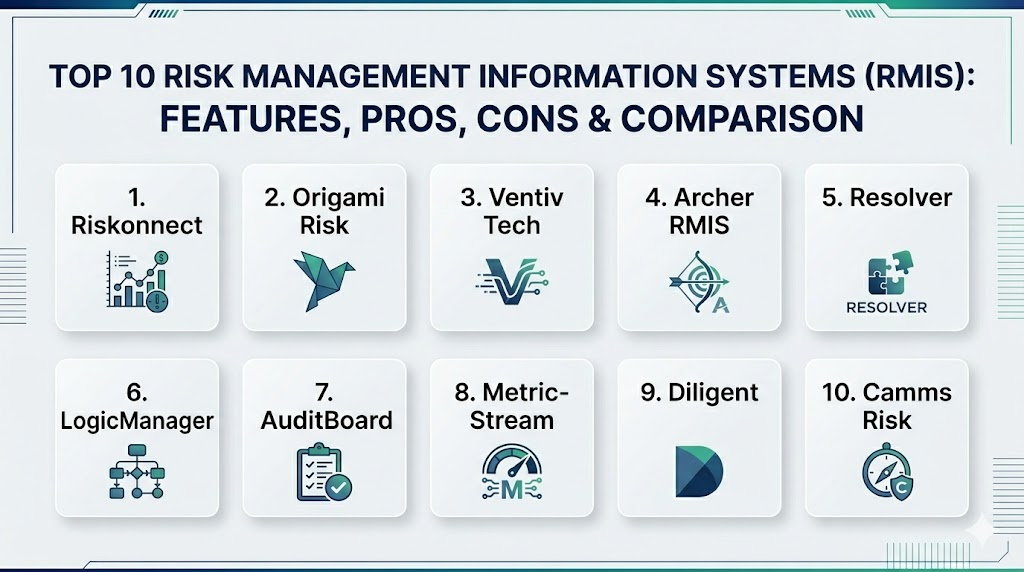
Top 10 Risk Management Information Systems (RMIS) Tools
1. Riskonnect
As a dominant player in the integrated risk management space, this platform is built on the Salesforce architecture, providing unparalleled scalability and a massive ecosystem of pre-built integrations. It is designed for large enterprises that want to connect insurance data with broader operational and strategic risks.
Key Features
- Comprehensive claims and incident management with automated TPA data feeds.
- Advanced health and safety modules for tracking workplace injuries and OSHA compliance.
- Robust property and exposure management with global mapping capabilities.
- Certificate of insurance (COI) tracking to manage third-party liability.
- Executive dashboards providing a real-time view of the Total Cost of Risk.
Pros
- Extremely scalable and highly configurable for complex global organizations.
- Strongest ecosystem of integrations due to its foundation on the Salesforce platform.
Cons
- The high degree of customization can lead to long and expensive implementation cycles.
- The interface can be overwhelming for users who only need simple incident reporting.
Platforms / Deployment
Windows / macOS / iOS / Android
Cloud
Security & Compliance
SSO/SAML, MFA, and comprehensive audit logs.
SOC 2, ISO 27001, and GDPR compliant.
Integrations & Ecosystem
Built natively on Salesforce, it integrates seamlessly with any application in the Salesforce AppExchange. It also provides robust APIs for connecting to external ERP and HRIS systems like Workday and Oracle.
Support & Community
A highly professional support structure with dedicated customer success managers for enterprise clients. The community is large, benefiting from the broader Salesforce professional network.
2. Origami Risk
This platform is frequently cited for its exceptional user experience and the speed with which it can be configured. It is a cloud-native solution that serves a wide variety of industries, from healthcare to construction.
Key Features
- Unified platform for risk, safety, and claims management in a single database.
- Advanced “Smart Forms” that adapt based on user input for faster data entry.
- Powerful automated workflow engine for task assignments and escalations.
- Built-in “AI Risk and Control Explorer” for framework-aligned risk identification.
- Comprehensive mobile app for field-based safety inspections and reporting.
Pros
- Widely regarded as having one of the most intuitive interfaces in the RMIS market.
- Exceptional speed for configuration changes without needing technical support.
Cons
- The pricing structure can be opaque and varies significantly by module.
- Can be complex for smaller organizations that do not have a dedicated system administrator.
Platforms / Deployment
Web / Windows / macOS / iOS / Android
Cloud
Security & Compliance
SSO, MFA, and automated data encryption at rest.
SOC 1, SOC 2, and HIPAA compliant.
Integrations & Ecosystem
Strong native API connectivity ensuring data remains current across the tech stack. It integrates with major insurers, TPAs, and standard business applications.
Support & Community
Excellent technical support with a focus on client self-sufficiency. Provides extensive help guides and a vibrant user community for sharing best practices.
3. Ventiv Technology
Specializing in both RMIS and claims administration, this platform is a favorite for global organizations with complex insurance structures. It excels at providing deep analytics for renewals and policy management.
Key Features
- End-to-end insurance lifecycle management from policy to claims.
- Advanced data visualization and executive-level heat maps for exposure.
- Predictive modeling tools to identify future high-cost claims.
- Automated ingestion of loss runs from global insurance carriers.
- Configurable data models that support multi-currency and multi-language reporting.
Pros
- Deep expertise in the “insurance” side of risk management and claims.
- Strong reporting capabilities that are ideal for high-pressure renewal seasons.
Cons
- Some users report that the software can occasionally experience minor technical “glitches.”
- Implementation can be resource-heavy for organizations with very large datasets.
Platforms / Deployment
Web / Windows / macOS / iOS / Android
Cloud / Hybrid
Security & Compliance
SSO/SAML support and rigorous audit trails.
SOC 2 compliant.
Integrations & Ecosystem
Serves as a robust system of record that integrates claim feeds from third-party vendors and exports data directly to finance tools.
Support & Community
A customer-centric approach with a strong helpdesk and dedicated customer service managers for larger accounts.
4. Archer RMIS
Originally a leader in the GRC space, the RMIS module offers a simplified and AI-powered approach to incident and loss capabilities. It is ideal for organizations that want a risk-first approach to insurance management.
Key Features
- AI-powered analytics to optimize renewal workflows and policy data.
- Centralized incident and claims management for enterprise-wide visibility.
- Risk-to-task linking that visualizes the impact of incidents on objectives.
- Automated supplier and vendor risk assessment workflows.
- Regulatory mapping to align risk activities with international standards.
Pros
- Excellent for organizations that want to integrate RMIS into a wider GRC program.
- Powerful AI features for generating risk reports and identifying threats.
Cons
- The platform can be very technical and requires a steep learning curve.
- May be more complex than needed for teams solely focused on simple claims.
Platforms / Deployment
Windows / macOS / Linux
Local / Cloud
Security & Compliance
Enterprise-grade security with support for major global frameworks.
ISO 27001, NIST, and SOC 2 compliant.
Integrations & Ecosystem
Connects seamlessly with other modules in the Archer suite and supports data ingestion from external security and threat feeds.
Support & Community
Supported by a highly technical community and professional consulting services. The Archer Community portal provides deep resources for technical users.
5. Resolver
This platform focuses heavily on incident management and investigative workflows. It is often used by security and risk teams who need to track event data and identify patterns across the organization.
Key Features
- Comprehensive incident management for security, safety, and process failures.
- Risk assessments and scoring with real-time heat maps.
- Security operations tools for managing investigations from start to finish.
- Audit and investigative workflows with centralized record storage.
- Automated notification engine for immediate incident response.
Pros
- Strongest focus on “incident-to-investigation” workflows in the top ten.
- Modern, clean interface that promotes high user adoption for reporting.
Cons
- Does not offer the same level of automated compliance as some other tools.
- Custom dashboard setup can be time-consuming for newer teams.
Platforms / Deployment
Web / Windows / macOS / iOS / Android
Cloud
Security & Compliance
Standard identity management and secure data handling protocols.
Not publicly stated.
Integrations & Ecosystem
Integrates with identity providers and exports data to enterprise BI tools for cross-functional reporting.
Support & Community
Provides structured documentation and responsive support teams. The focus is on ensuring a smooth investigative experience for users.
6. LogicManager
This tool is a leader in Enterprise Risk Management (ERM) that provides a centralized hub for all risk activities. It is well-regarded for its “no-surprise” pricing and expert advisory support.
Key Features
- Centralized risk register that unifies risks, controls, and policies.
- AI-powered “Checkpoint” assistant for streamlining risk assessments.
- Built-in Risk Maturity Model to help organizations improve their posture.
- Zero-code configuration allowing for rapid internal adjustments.
- Integrated threat library for comprehensive risk identification.
Pros
- The “unlimited license” model provides excellent value for growing teams.
- Implementation focus is on strategic content rather than technical coding.
Cons
- The interface can feel slightly less “modern” than some cloud-native competitors.
- Specialized insurance-specific features are not as deep as pure-play RMIS tools.
Platforms / Deployment
Web / Windows / macOS
Cloud
Security & Compliance
TLS 1.2 and 256-bit encryption for all connections.
SOC 2 compliant.
Integrations & Ecosystem
A flexible reporting engine allows data to be exported to various formats and integrated with broader enterprise systems.
Support & Community
Known for providing “Expert Advisory Support” that acts as an extension of the client’s internal risk team.
7. AuditBoard
This platform is rapidly expanding its risk offering, focusing on breaking down silos between audit, compliance, and operational risk teams. It is a cloud-based solution built for modern enterprise resilience.
Key Features
- Connected risk register that standardizes language across all departments.
- AI-driven risk intelligence for surfacing critical threats Confidently.
- Scenario planning tools using Monte Carlo modeling and bow-tie analysis.
- Automated third-party and IT risk management modules.
- Dynamic dashboards that link risk data directly to audit and remediation.
Pros
- Incredibly simple for “risk owners” at all levels to engage with and update.
- The best choice for organizations where internal audit drives the risk agenda.
Cons
- While growing, its “RMIS” specific claims features are newer than industry veterans.
- Can be expensive if multiple modules (Audit, Compliance, Risk) are required.
Platforms / Deployment
Web / Windows / macOS / iOS / Android
Cloud
Security & Compliance
Enterprise-grade identity management and audit readiness features.
SOC 2 and ISO 27001 compliant.
Integrations & Ecosystem
Excellent integration with standard business apps and collaboration tools, making it a natural fit for distributed teams.
Support & Community
Highly rated for its customer success culture and a strong online learning portal.
8. MetricStream
This is a heavyweight in the GRC and RMIS space, offering an “AI-first” approach to risk management. It is designed for large, highly regulated global organizations with complex compliance needs.
Key Features
- AI-powered cyber risk assessment and vulnerability management.
- Continuous compliance tracking for global mandates like GDPR and HIPAA.
- Quantified risk insights that estimate the financial impact of threats.
- Integrated third-party risk management with real-time scoring.
- Unified risk repository that centralizes all assets and threats in one place.
Pros
- Deep regulatory alignment with built-in templates for international standards.
- Powerful enough to handle the most complex multi-national risk environments.
Cons
- The technical nature of the platform makes it costly to implement and configure.
- The user interface can feel complex and requires significant administrative expertise.
Platforms / Deployment
Web / Windows / Linux
Cloud
Security & Compliance
Rigorous enterprise security and global compliance alignment.
SOC 2 and ISO 27001 compliant.
Integrations & Ecosystem
Extensive capabilities for integrating with existing tech stacks, including SIEM tools and cloud platforms.
Support & Community
Provides broad platform coverage and professional support for large-scale enterprise rollouts.
9. Diligent (HighBond)
A global leader in governance and risk, Diligent offers the HighBond platform to help professionals automate auditing and risk assessments. It provides a real-time overview of potential risks for executive boards.
Key Features
- Triggered workflow remediation for flagged incidents or data anomalies.
- Centralized dashboard providing a holistic view of the “risk balance sheet.”
- Automated data “robots” that monitor systems for compliance issues.
- Pre-built analysis scripts and risk frameworks for rapid deployment.
- Mobile access for managing assessments and investigations on the go.
Pros
- Excellent for board-level reporting and executive visibility.
- Strong automation capabilities for repetitive compliance tasks.
Cons
- Linking risks and controls can sometimes feel cumbersome to new users.
- The pricing can scale quickly as more users and entities are added.
Platforms / Deployment
Web / Windows / macOS / iOS / Android
Cloud
Security & Compliance
SSO/SAML, MFA, and SOC 2 / ISO 27001 compliance.
FedRAMP authorized for public sector use.
Integrations & Ecosystem
Connects with virtually any data source, facilitating the synchronization of risk data across global enterprise systems.
Support & Community
Offers a global community of users and a rich knowledge base of pre-built risk analysis scripts.
10. Camms Risk
An out-of-the-box solution recognized for its simplicity and alignment with major international frameworks. It is designed to be implemented quickly while providing high visibility across all organizational levels.
Key Features
- Pre-configured templates for risk, incident, and hazard management.
- Easy-to-read dashboards that simplify executive oversight.
- Built-in compliance monitoring for ISO 31000 and COSO frameworks.
- Inspection management tools for field safety and quality control.
- Automated alerts and notifications for critical risk thresholds.
Pros
- A “budget-friendly” solution suitable for growing organizations.
- Simple user interface that drives high adoption among front-line staff.
Cons
- Less in-depth audit capabilities compared to the top-tier “heavyweight” suites.
- Limited configurability can be a barrier for highly specialized workflows.
Platforms / Deployment
Web / Windows / iOS / Android
Cloud
Security & Compliance
Standard identity protection and role-based access controls.
ISO 31000 and COSO compliant.
Integrations & Ecosystem
Provides a solid range of reporting options and standard connectors for incident management and GRC needs.
Support & Community
Strong implementation support and a growing community focused on “Risk, Safety, and Wellbeing.”
Comparison Table
| Tool Name | Best For | Platform(s) Supported | Deployment | Standout Feature | Public Rating |
| 1. Riskonnect | Large Enterprises | Win, macOS, iOS, Android | Cloud | Salesforce Native | N/A |
| 2. Origami Risk | Flexibility & Speed | Win, macOS, iOS, Android | Cloud | Smart Forms | N/A |
| 3. Ventiv Tech | Insurance Analytics | Win, macOS, iOS, Android | Hybrid | Ingestion Engine | N/A |
| 4. Archer RMIS | Risk-First Teams | Win, macOS, Linux | Hybrid | AI Risk Explorer | N/A |
| 5. Resolver | Investigations | Win, macOS, iOS, Android | Cloud | Event Tracking | N/A |
| 6. LogicManager | Mid-Market ERM | Win, macOS | Cloud | Maturity Model | N/A |
| 7. AuditBoard | Connected Audit | Win, macOS, iOS, Android | Cloud | Scenario Planning | N/A |
| 8. MetricStream | Regulated Global | Win, Linux | Cloud | AI Compliance | N/A |
| 9. Diligent | Executive Boards | Win, macOS, iOS, Android | Cloud | Risk Balance Sheet | N/A |
| 10. Camms Risk | Fast Deployment | Win, iOS, Android | Cloud | Pre-set Templates | N/A |
Evaluation & Scoring
| Tool Name | Core (25%) | Ease (15%) | Integrations (15%) | Security (10%) | Perf (10%) | Support (10%) | Value (15%) | Total |
| 1. Riskonnect | 10 | 5 | 10 | 9 | 9 | 8 | 6 | 8.20 |
| 2. Origami Risk | 9 | 9 | 9 | 9 | 9 | 8 | 7 | 8.60 |
| 3. Ventiv Tech | 10 | 6 | 8 | 8 | 9 | 7 | 6 | 7.80 |
| 4. Archer RMIS | 9 | 4 | 9 | 10 | 8 | 8 | 5 | 7.40 |
| 5. Resolver | 8 | 8 | 7 | 8 | 9 | 7 | 8 | 7.75 |
| 6. LogicManager | 7 | 8 | 7 | 8 | 8 | 10 | 9 | 7.85 |
| 7. AuditBoard | 8 | 9 | 9 | 9 | 8 | 9 | 7 | 8.35 |
| 8. MetricStream | 10 | 3 | 9 | 10 | 9 | 8 | 5 | 7.60 |
| 9. Diligent | 8 | 7 | 9 | 9 | 8 | 8 | 7 | 7.90 |
| 10. Camms Risk | 6 | 9 | 6 | 7 | 8 | 7 | 10 | 7.55 |
The scoring indicates that Origami Risk leads the market for teams prioritizing ease of use and rapid internal adjustments. Riskonnect remains the premier choice for organizations that need the absolute deepest level of integration and scalability. Meanwhile, LogicManager and Camms Risk provide exceptional value for mid-market firms and organizations looking for a faster, less complex implementation path. It is important to remember that a “perfect” score in one category, like Houdini’s or MetricStream’s power, often comes with a trade-off in user simplicity.
Which Risk Management Information System (RMIS) Tool Is Right for You?
Solo / Freelancer
While true RMIS is rarely needed for solo operators, a tool like Camms Risk or LogicManager provides the best balance of cost and functionality if you are managing the risk profile for a small portfolio of assets.
SMB
Small to medium businesses should prioritize Origami Risk or LogicManager. These platforms allow you to grow your risk program without requiring a massive IT team to manage the software’s backend.
Mid-Market
For organizations with several hundred employees and multiple locations, AuditBoard or Resolver offer the best path toward connecting daily incidents with broader strategic risk and audit requirements.
Enterprise
The enterprise market is best served by Riskonnect or MetricStream. These tools are built to handle the complexity of global operations, multi-currency reporting, and thousands of concurrent users across different continents.
Budget vs Premium
If budget is the primary constraint, Camms Risk is an excellent entry point. For those willing to invest in a “premium” experience with dedicated support and unlimited modules, Riskonnect or AuditBoard are the superior choices.
Feature Depth vs Ease of Use
Teams needing deep character-driven risk analysis should look toward Ventiv or MetricStream. If your priority is ensuring every employee can easily report a safety hazard, Origami Risk is the winner.
Integrations & Scalability
Riskonnect is the undisputed leader for scalability due to its Salesforce foundation. For organizations that are already heavily invested in the Adobe or Microsoft ecosystems, Diligent and AuditBoard offer very natural connection points.
Security & Compliance Needs
For highly regulated industries like banking or healthcare, MetricStream and Archer provide the most rigorous alignment with international security standards and compliance frameworks.
Frequently Asked Questions (FAQs)
1. What is the primary difference between a GRC and an RMIS?
A GRC platform focuses on governance, compliance, and internal audit, while an RMIS is specifically optimized for insurance-related data, claims administration, and loss tracking.
2. Can an RMIS reduce my insurance premiums?
Yes, by providing insurers with high-quality, standardized data during the renewal process, you can demonstrate better control over your risks, which often leads to more competitive pricing.
3. How long does a typical RMIS implementation take?
Depending on the complexity and volume of historical data, implementation can range from 3 months for a simplified system like Camms to over a year for a global Riskonnect deployment.
4. Do these systems support workers’ compensation tracking?
Most leading RMIS tools are built specifically to handle workers’ compensation, including tracking medical costs, indemnity payments, and return-to-work timelines.
5. Can I integrate my HR system with an RMIS?
Yes, the best tools connect directly to systems like Workday or SAP to ensure that employee data and location information are always accurate for reporting.
6. Is it possible to manage certificates of insurance (COI) in these tools?
Many of the top tools, including Riskonnect and Origami Risk, have dedicated modules to track vendor COIs and send automated alerts when coverage expires.
7. Does an RMIS work for global property tracking?
Absolutely. Advanced systems allow you to map every physical asset globally and track values, construction types, and exposure to natural hazards like floods or earthquakes.
8. Is mobile access really necessary for risk management?
Mobile access is critical for safety inspections and immediate incident reporting, as it allows data to be captured at the source rather than being delayed by paperwork.
9. Can I automate reports for my executive board?
Yes, modern platforms allow you to schedule “board-ready” PDF reports that visualize the Total Cost of Risk and key risk indicators (KRIs) on a recurring basis.
10. Do I need to be a programmer to configure these systems?
Most current systems are “low-code” or “no-code,” meaning a risk manager can adjust forms and workflows without needing to write software code.
Conclusion
Navigating the complex world of risk management system that is as dynamic as the threats organizations face. Whether you are managing a global insurance portfolio or tracking high-frequency claims, the right RMIS acts as a critical strategic asset. By centralizing disparate data points into a single hub, these platforms empower leadership to move from a reactive posture to one of proactive resilience. The key is to select a tool that matches your organizational maturity and integrates seamlessly with your existing technology, ensuring that risk insights are always at the center of every major business decision.

Best Cardiac Hospitals Near You
Discover top heart hospitals, cardiology centers & cardiac care services by city.
Advanced Heart Care • Trusted Hospitals • Expert Teams
View Best Hospitals