Introduction
Sales & Operations Planning (S&OP) Software is an integrated business management process that enables companies to achieve focus, alignment, and continuity across all functions of the organization. By linking strategic high-level business plans with day-to-end operational execution, these platforms ensure that supply, demand, and financial goals are synchronized. In an increasingly complex global trade environment, S&OP software acts as the “glue” that prevents departments from working in silos, allowing leadership to make decisions based on a single, unified set of data.
Modern S&OP solutions are evaluated based on their ability to perform multi-dimensional scenario planning, their integration with both financial and operational systems, and the quality of their collaborative workflows. The goal is to create a consensus plan that balances customer service levels with inventory investment and production capabilities. Whether managing a rapid growth phase or navigating supply chain disruptions, the right S&OP tool provides the executive visibility needed to maintain profitability and operational excellence.
Best for: Executive leadership, supply chain directors, and financial controllers in mid-to-large enterprises who need to align corporate strategy with operational reality.
Not ideal for: Small startups with very limited product portfolios or businesses where supply and demand are so stable that they do not require cross-functional reconciliation.
Key Trends in Sales & Operations Planning Software
- Integrated Business Planning (IBP) Evolution: S&OP is maturing into IBP, which places a heavier emphasis on financial integration and long-term strategic alignment.
- Cognitive AI Decision Support: Platforms are using machine learning to recommend the best course of action during supply-demand imbalances rather than just flagging the issue.
- Real-Time Digital Twins: The use of virtual supply chain models to test the impact of decisions across the entire network instantly.
- Collaboration Hubs: Move toward “social” style communication within the platform to document the assumptions behind the consensus plan.
- Advanced “What-If” Analysis: The ability to run complex simulations in seconds to compare the margin impact of different operational strategies.
- Cloud-Native Scalability: Ensuring that massive global datasets can be recalculated in real-time to support rapid executive decision-making.
- Sustainability Integration: Including carbon footprint and ESG metrics as core constraints within the S&OP balancing process.
How We Selected These Tools (Methodology)
- Cross-Functional Integration: Prioritizing tools that can effectively pull data from Finance, Sales, and Supply Chain.
- Scenario Modeling Depth: Evaluating the ease and speed of creating and comparing multiple business scenarios.
- User Interface and Adoption: Assessing how easily non-technical executives can navigate and understand the data.
- Algorithmic Accuracy: Checking the quality of the underlying demand and supply balancing engines.
- Global Support and Scalability: Ensuring the vendor can support large-scale, multi-national implementations.
- Financial Alignment: Looking for tools that translate operational units into financial value (revenue, margin, and cash flow).
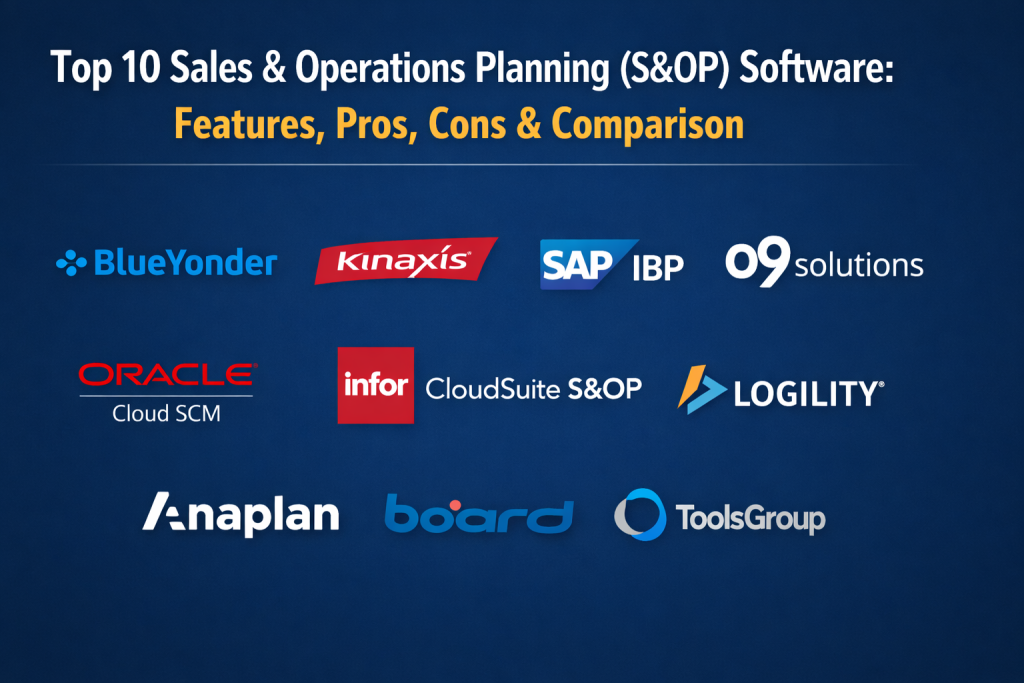
Top 10 Sales & Operations Planning (S&OP) Software
1.Blue Yonder
Blue Yonder offers a leading-edge S&OP solution within its Luminate platform, focusing on cognitive capabilities to align supply and demand.
Key Features
- AI-driven demand and supply balancing.
- Real-time executive dashboards for “one-number” planning.
- Advanced scenario modeling with financial impact analysis.
- Collaborative workflows for consensus-building meetings.
- Integrated business planning for long-term strategic alignment.
- Seamless integration with the broader Luminate execution suite.
Pros
- Strongest machine learning capabilities for predictive insights.
- Excellent at handling complex, global enterprise structures.
- High level of visibility into financial trade-offs.
Cons
- Requires significant technical expertise for initial configuration.
- Implementation cost and timeline are at the high end of the market.
Platforms / Deployment
- Web
- Cloud
Security & Compliance
- SSO, MFA, RBAC, Encryption.
- SOC 2, ISO 27001.
Integrations & Ecosystem
Integrates deeply with Microsoft Azure and major ERP systems.
- Microsoft Dynamics 365
- SAP S/4HANA
- Oracle ERP
- Various BI tools
Support & Community
Global enterprise support with specialized consultants and a massive annual user conference.
2.Kinaxis
Kinaxis is a pioneer in concurrent planning, allowing S&OP teams to see the ripple effect of any change across the entire chain instantly.
Key Features
- RapidResponse technology for real-time synchronization.
- Side-by-side scenario comparisons for executive review.
- Integrated demand, supply, and inventory planning.
- Automated exception detection and resolution recommendations.
- Collaborative dashboards for consensus S&OP meetings.
- High-speed “what-if” simulations without data extraction.
Pros
- Unmatched speed in recalculating plans after a change.
- Highly intuitive visualization of supply-demand gaps.
- Proven track record in high-tech and pharmaceutical sectors.
Cons
- Pricing is strictly enterprise-level.
- Requires a high degree of internal data cleanliness to maximize value.
Platforms / Deployment
- Web
- Cloud
Security & Compliance
- SSO, MFA, Audit Logs.
- SOC 2 Type II, ISO 27001.
Integrations & Ecosystem
Broad connectivity with ERP and specialized execution systems.
- SAP
- Oracle
- Salesforce
- Custom MES integrations
Support & Community
Large community of certified RapidResponse authors and a robust knowledge network.
3.SAP IBP (Integrated Business Planning)
SAP IBP is the evolution of SAP APO, offering a modern, cloud-native S&OP module that is essential for SAP-heavy organizations.
Key Features
- Unified interface for S&OP, demand, and supply planning.
- Native integration with SAP S/4HANA and financial systems.
- Advanced analytics with SAP Analytics Cloud integration.
- Collaborative planning with SAP Jam/Work Zone features.
- Strategic simulation for long-term capacity planning.
- Real-time KPI tracking against business goals.
Pros
- Perfect synchronization for organizations already on the SAP stack.
- Robust security and global reliability.
- Strong focus on financial integration and IBP.
Cons
- Implementation can be complex and slow for non-SAP data sources.
- Can be more expensive than standalone specialized solutions.
Platforms / Deployment
- Web / Windows
- Cloud
Security & Compliance
- SSO, MFA, RBAC.
- SAP Global Security Standards, SOC 1/2.
Integrations & Ecosystem
The backbone of the world’s largest enterprise software ecosystem.
- SAP S/4HANA
- SAP Ariba
- SuccessFactors
- Third-party market feeds
Support & Community
Vast network of global partners and comprehensive official training paths.
4.o9 Solutions
o9 Solutions provides a “Digital Brain” that uses graph technology to manage the complex interdependencies of modern S&OP.
Key Features
- Knowledge Graph technology for modeling business relationships.
- AI-powered demand sensing and supply constraints.
- High-performance scenario planning for executive decisions.
- Integrated financial, sales, and operational planning.
- Collaborative platform for supplier and customer engagement.
- Modular “apps” that can be deployed iteratively.
Pros
- Very modern, flexible architecture that adapts to unique logic.
- Exceptional at identifying the financial root causes of variances.
- Fast processing of massive, multi-dimensional datasets.
Cons
- Sophisticated features require a high level of user maturity.
- Newer vendor with a smaller legacy support footprint.
Platforms / Deployment
- Web
- Cloud
Security & Compliance
- SSO, MFA, RBAC.
- SOC 2, ISO 27001.
Integrations & Ecosystem
Modern API-first connectivity for a variety of data environments.
- Snowflake
- SAP
- Oracle
- Microsoft Power BI
Support & Community
Rapidly expanding global presence with a focus on supply chain innovation.
5.Oracle Cloud SCM (S&OP)
Oracle offers a comprehensive S&OP module within its SCM Cloud, providing a data-rich environment for integrated planning.
Key Features
- Automated consensus forecasting and planning.
- Integrated business planning with financial alignment.
- Real-time monitoring of supply chain performance.
- Collaborative planning via built-in social tools.
- Advanced analytics for margin and profitability analysis.
- Mobile-responsive dashboards for executive sign-offs.
Pros
- Excellent data management and reporting capabilities.
- Fully integrated with Oracle’s financial and ERP cloud suites.
- Highly reliable and secure infrastructure for global firms.
Cons
- User interface is functional but can feel less agile than startups.
- Best ROI is achieved only when using the full Oracle stack.
Platforms / Deployment
- Web / Windows
- Cloud
Security & Compliance
- SSO, MFA, RBAC.
- Oracle Cloud Security, SOC 1/2/3.
Integrations & Ecosystem
Naturally integrated into the Oracle Cloud infrastructure.
- Oracle ERP Cloud
- Oracle CX
- IoT Fleet Management
- Third-party data via OIC
Support & Community
Global enterprise-grade support and a vast network of certified implementers.
6.Infor CloudSuite S&OP
Infor provides an S&OP solution that is highly tailored for manufacturing and distribution industries with complex supply chains.
Key Features
- Industry-specific S&OP templates and workflows.
- Integrated demand and supply balancing.
- Collaborative consensus planning for multi-tier organizations.
- Advanced analytics for service level and inventory tradeoffs.
- Integrated financial impact modeling for operational plans.
- Dashboard visibility into executive KPIs.
Pros
- Deep industry-specific functionality out of the box.
- Strong focus on the needs of manufacturing-heavy enterprises.
- Good balance between advanced features and ease of use.
Cons
- Smaller third-party developer ecosystem than SAP or Oracle.
- Best value is achieved as part of the broader Infor ecosystem.
Platforms / Deployment
- Web
- Cloud
Security & Compliance
- SSO, RBAC, Encryption.
- SOC 2, GDPR.
Integrations & Ecosystem
Integrates with major ERPs and Infor’s enterprise applications.
- Infor M3 / LN
- SAP
- Oracle
- Various warehouse management systems
Support & Community
Global support centers with deep expertise in manufacturing logistics.
7.Logility
Logility offers a digital supply chain platform that simplifies the S&OP process through automation and advanced analytics.
Key Features
- Automated consensus planning and reconciliation.
- AI-driven demand and supply balancing.
- Integrated multi-echelon inventory optimization.
- Advanced product lifecycle management visibility.
- Collaborative planning for internal and external stakeholders.
- Comprehensive performance reporting on plan adherence.
Pros
- Excellent at bridging the gap between planning and execution.
- Highly automated system that reduces the manual work of planners.
- Strong reputation for customer service and successful deployment.
Cons
- User interface is efficient but lacks some modern aesthetic polish.
- Not as widely recognized in the general ERP market as large giants.
Platforms / Deployment
- Web / Windows
- Cloud / On-premise
Security & Compliance
- SSO, MFA, RBAC.
- SOC 2.
Integrations & Ecosystem
Flexible connectivity options for diverse IT environments.
- Microsoft Dynamics
- SAP
- Oracle
- Legacy ERP systems
Support & Community
Proactive customer support and a dedicated community of supply chain experts.
8.Anaplan
Anaplan is a highly flexible “Connected Planning” platform that allows organizations to build custom S&OP models from the ground up.
Key Features
- Hyperblock technology for high-speed calculation.
- Completely customizable modeling for unique business rules.
- Real-time collaboration across Finance, HR, and Supply Chain.
- Dynamic scenario modeling and “what-if” analysis.
- Extensive library of pre-built S&OP app templates.
- Mobile-first design for executive engagement.
Pros
- Unmatched flexibility to model any business process.
- Strongest alignment between S&OP and Financial FP&A.
- Modern, user-friendly interface that encourages adoption.
Cons
- “Build-your-own” nature requires significant internal modeling skill.
- Lacks some of the out-of-the-box supply chain logic of specialized tools.
Platforms / Deployment
- Web / iOS / Android
- Cloud
Security & Compliance
- SSO, MFA, Audit Logs.
- SOC 1/2, ISO 27001.
Integrations & Ecosystem
Connects with a wide variety of data sources and BI tools.
- Salesforce
- Workday
- SAP S/4HANA
- Tableau
Support & Community
Very active community (Anaplan Community) and a massive ecosystem of “Anaplanners.”
9.Board
Board is an all-in-one Decision Making Platform that combines BI, Corporate Performance Management, and S&OP.
Key Features
- Unified environment for planning and reporting.
- Drag-and-drop modeling for S&OP workflows.
- Integrated financial planning and analysis.
- Real-time data entry and calculation.
- Advanced predictive analytics and simulation.
- Personalized executive “cockpits” for decision making.
Pros
- Excellent for companies wanting to combine BI and S&OP in one tool.
- Very user-friendly for non-technical business users.
- Fast time-to-value compared to traditional enterprise suites.
Cons
- May lack some of the deep supply chain optimization of specialized tools.
- Scalability for extremely massive global datasets can be a factor.
Platforms / Deployment
- Web / Windows
- Cloud / On-premise
Security & Compliance
- SSO, RBAC, Encryption.
- ISO 27001.
Integrations & Ecosystem
Versatile connectivity for mid-market and enterprise data.
- Microsoft SQL Server
- SAP
- Salesforce
- Oracle
Support & Community
Solid global support with a strong focus on mid-market business intelligence.
10.ToolsGroup
ToolsGroup specializes in “service-driven” S&OP, focusing on managing uncertainty and maximizing customer service levels.
Key Features
- Probabilistic demand and supply balancing.
- Integrated multi-echelon inventory optimization.
- Automated exception management for S&OP deviations.
- Collaborative consensus planning for promotional events.
- Advanced analytics for service level optimization.
- Integrated lifecycle planning for new and obsolete items.
Pros
- Exceptional at handling “lumpy” demand and supply uncertainty.
- Strong focus on the link between S&OP and inventory health.
- High levels of automation that allow for “management by exception.”
Cons
- Probabilistic modeling requires a higher level of user education.
- Interface is more technical compared to general planning tools.
Platforms / Deployment
- Web
- Cloud / On-premise
Security & Compliance
- SSO, MFA, RBAC.
- SOC 2.
Integrations & Ecosystem
Integrates with core supply chain and enterprise systems.
- SAP
- Oracle
- Microsoft Dynamics
- Various specialized WMS
Support & Community
Global support with deep expertise in parts, retail, and distribution logistics.
Comparison Table (Top 10)
| Tool Name | Best For | Platform(s) Supported | Deployment | Standout Feature | Public Rating |
|---|---|---|---|---|---|
| Blue Yonder | Cognitive S&OP | Web | Cloud | AI Luminate Orchestration | N/A |
| Kinaxis | Concurrent Synchronization | Web | Cloud | RapidResponse Real-time Sync | N/A |
| SAP IBP | SAP-Centric IBP | Web, Windows | Cloud | Native SAP S/4HANA Sync | N/A |
| o9 Solutions | Graph-Based Modeling | Web | Cloud | Digital Brain Architecture | N/A |
| Oracle Cloud SCM | Enterprise Database Ops | Web, Windows | Cloud | Integrated Financial Suite | N/A |
| Infor CloudSuite S&OP | Industry-Specific Needs | Web | Cloud | Manufacturing Templates | N/A |
| Logility | Automated Optimization | Web, Windows | Cloud, On-prem | AI-Driven Auto-Balancing | N/A |
| Anaplan | Flexible Connected Planning | Web, Mobile | Cloud | Hyperblock Calculation | N/A |
| Board | BI & Planning Combo | Web, Windows | Cloud, On-prem | Unified BI/Planning Env | N/A |
| ToolsGroup | Service-Level Driven | Web | Cloud, On-prem | Probabilistic Balancing | N/A |
Evaluation & Scoring of Sales & Operations Planning Software
| Tool Name | Core (25%) | Ease (15%) | Integrations (15%) | Security (10%) | Perf (10%) | Support (10%) | Value (15%) | Weighted Total |
|---|---|---|---|---|---|---|---|---|
| Blue Yonder | 10 | 7 | 9 | 9 | 9 | 9 | 8 | 8.80 |
| Kinaxis | 9 | 8 | 9 | 9 | 10 | 9 | 8 | 8.85 |
| SAP IBP | 9 | 7 | 10 | 10 | 8 | 9 | 7 | 8.50 |
| o9 Solutions | 10 | 8 | 9 | 8 | 10 | 8 | 8 | 8.80 |
| Oracle Cloud SCM | 9 | 7 | 10 | 10 | 9 | 9 | 7 | 8.70 |
| Infor CloudSuite S&OP | 8 | 8 | 8 | 9 | 8 | 8 | 8 | 8.10 |
| Logility | 9 | 8 | 8 | 9 | 9 | 9 | 8 | 8.55 |
| Anaplan | 8 | 9 | 9 | 9 | 10 | 8 | 8 | 8.75 |
| Board | 7 | 9 | 8 | 8 | 8 | 8 | 9 | 8.00 |
| ToolsGroup | 9 | 7 | 8 | 9 | 9 | 8 | 8 | 8.25 |
Scoring Interpretation: Scores reflect a blend of market stability, technological innovation, and enterprise-readiness. A high “Core” score indicates a platform’s depth in multi-enterprise S&OP orchestration. “Ease” evaluates the user experience for executive stakeholders. Organizations should weigh “Integrations” more heavily if they are already locked into a specific ERP ecosystem.
Which S&OP Software Is Right for You?
Solo / Freelancer
Individual supply chain consultants generally do not purchase these platforms, but mastering Anaplan or Kinaxis is highly recommended for freelancers. These platforms have high demand for certified modelers and authors who can help enterprises build their custom S&OP logic.
SMB
Small-to-mid-sized businesses should prioritize time-to-value and ease of use. Board or Logility are excellent choices here because they offer modern interfaces and relatively faster implementation cycles without requiring a massive internal IT infrastructure.
Mid-Market
Growing companies that need to align their financials with their operations should consider Anaplan. Its flexibility allows you to start with simple S&OP and expand into full Corporate Performance Management as your organizational complexity increases.
Enterprise
For global multinationals with extreme complexity, Blue Yonder, Kinaxis, or o9 Solutions are the top contenders. These platforms provide the cognitive power and “Concurrent” speed needed to manage global supply chains that span multiple continents and tiers.
Budget vs Premium
Board offers a “budget-friendly” path by combining BI and planning in a single license. Kinaxis and Blue Yonder are “Premium” investments that provide the highest levels of technological sophistication and predictive accuracy for high-stakes environments.
Feature Depth vs Ease of Use
If you need deep, probabilistic math to manage extreme uncertainty, ToolsGroup is the depth leader. If you need a platform that your Sales and Marketing teams will actually enjoy using every month, Anaplan or Board are much more intuitive.
Integrations & Scalability
Organizations already using SAP S/4HANA or Oracle ERP Cloud should naturally look at SAP IBP or Oracle Cloud SCM first. These platforms offer the most seamless data synchronization, which is often the biggest hurdle in successful S&OP.
Security & Compliance Needs
Multinational firms in regulated industries (Defense, Pharma) should lean toward SAP, Oracle, or One Network Enterprises (if listed), as these vendors have the most established global security certifications and data residency options.
Frequently Asked Questions (FAQs)
What is the main goal of S&OP software?
The primary goal is to align all departments (Sales, Marketing, Finance, and Operations) around a single consensus plan that balances demand with supply and ensures the company meets its financial targets.
How is S&OP different from Demand Planning?
Demand Planning is one component of S&OP. While Demand Planning focuses on what the customer will buy, S&OP takes that forecast and reconciles it with what the company can actually make, buy, and afford to store.
Does S&OP software replace my ERP?
No. S&OP software sits on top of your ERP. It pulls data from the ERP to analyze it and run simulations, then pushes the finalized consensus plan back into the ERP for execution.
What is “Integrated Business Planning” (IBP)?
IBP is essentially “S&OP 2.0.” It includes a much heavier focus on financial alignment, product portfolio management, and strategic long-term goals rather than just short-term supply and demand balancing.
Can S&OP software handle “What-If” scenarios?
Yes, this is one of the most critical features. It allows you to simulate the impact of things like a factory shutdown, a sudden spike in raw material costs, or a new competitor entering the market.
How often do companies run the S&OP process?
Typically, the S&OP cycle is a monthly process. However, modern “Concurrent” software like Kinaxis allows companies to move toward “Continuous S&OP” where the plan is adjusted in real-time as data changes.
Do I need clean data for S&OP software to work?
While clean data is best, many modern platforms use AI to help identify and “clean” data anomalies. However, the quality of your consensus plan will always be tied to the accuracy of your underlying data inputs.
Who is responsible for the S&OP process?
While it involves many departments, the S&OP process is typically led by a dedicated S&OP Manager or Director of Supply Chain, but it requires active participation and sign-off from the executive leadership team (CEO/CFO).
How long does an S&OP implementation take?
A standard enterprise rollout usually takes between 6 and 12 months. This includes data integration, defining business rules, and training the various departmental teams on the new collaborative workflow.
What is the ROI of S&OP software?
ROI typically comes from reduced inventory holding costs (10-20%), improved customer service levels (fewer stockouts), higher profit margins through better production planning, and reduced expediting freight costs.
Conclusion
The implementation of Sales & Operations Planning software marks the transition from a reactive company to a proactive enterprise. By creating a “one-number” plan, organizations can eliminate departmental friction and ensure that every dollar spent is aligned with the overall corporate strategy. When selecting your platform, prioritize “Financial Alignment” and “Scenario Speed.” The ability to quickly see the margin impact of an operational decision is what empowers executives to lead with confidence. We recommend starting with a clear process definition before selecting a tool, ensuring the software supports your specific business maturity and goals.

Best Cardiac Hospitals Near You
Discover top heart hospitals, cardiology centers & cardiac care services by city.
Advanced Heart Care • Trusted Hospitals • Expert Teams
View Best Hospitals