Introduction
Search indexing pipelines are the architectural engines that transform raw, unstructured data into searchable, organized information. In a digital world where data is generated at an astronomical rate, simply having a database is no longer enough. An indexing pipeline acts as a sophisticated processing factory—ingesting data from various sources, cleaning it, enriching it through natural language processing, and finally placing it into a specialized search index. This allows users to retrieve precise information in milliseconds, whether they are searching through millions of e-commerce products or terabytes of internal corporate documents.
As we move deeper into the era of AI-driven discovery, the role of the indexing pipeline has shifted from simple keyword matching to understanding intent. Modern pipelines now incorporate vector embeddings and machine learning models to enable semantic search, allowing systems to understand “what the user meant” rather than just “what the user typed.” For enterprises, a robust pipeline is the difference between a frustrating user experience and a powerful, data-driven competitive advantage.
Best for: Data engineers, search architects, and DevOps professionals who need to manage high-volume data ingestion for enterprise search, e-commerce platforms, or real-time log analysis.
Not ideal for: Small websites with static content, or organizations with very low data volatility where a simple database “LIKE” query is sufficient for their needs.
Key Trends in Search Indexing Pipelines
- Vector Ingestion for Semantic Search: Pipelines are increasingly converting text, images, and video into high-dimensional vectors to support AI-powered search experiences.
- Real-Time “Freshness”: The shift from batch processing to streaming ingestion ensures that new data is searchable within seconds of its creation.
- Serverless Indexing: The rise of managed, auto-scaling pipelines that allow teams to focus on data logic rather than managing the underlying server infrastructure.
- AI-Driven Enrichment: Automated tagging, sentiment analysis, and entity recognition are being performed “in-flight” as data moves through the pipeline.
- Hybrid Search Integration: Pipelines are now designed to feed data into systems that support both traditional keyword search and modern vector-based retrieval simultaneously.
- Data Lakehouse Connectivity: Direct indexing from unified storage layers like Iceberg or Delta Lake is becoming a standard for big data environments.
- Zero-ETL Patterns: Emerging technologies are reducing the need for complex transform logic by allowing direct, federated indexing from source databases.
- Privacy-First Processing: Enhanced PII (Personally Identifiable Information) masking and encryption during the indexing stage to meet global data protection standards.
How We Selected These Tools
- Ingestion Versatility: We looked for pipelines capable of handling diverse data formats, including JSON, PDF, SQL, and NoSQL streams.
- Throughput and Scalability: Priority was given to tools that can scale horizontally to handle millions of documents per hour.
- Extensibility: We selected platforms that allow for custom code or plugins to perform specialized data enrichment and cleaning.
- Reliability and Fault Tolerance: Evaluation was based on the tool’s ability to recover from ingestion failures without data loss.
- Ecosystem Compatibility: Each tool was checked for its ability to push data into major search engines like Elasticsearch, OpenSearch, or Pinecone.
- Modern Feature Support: We prioritized pipelines that natively support vector embedding generation and AI model integration.
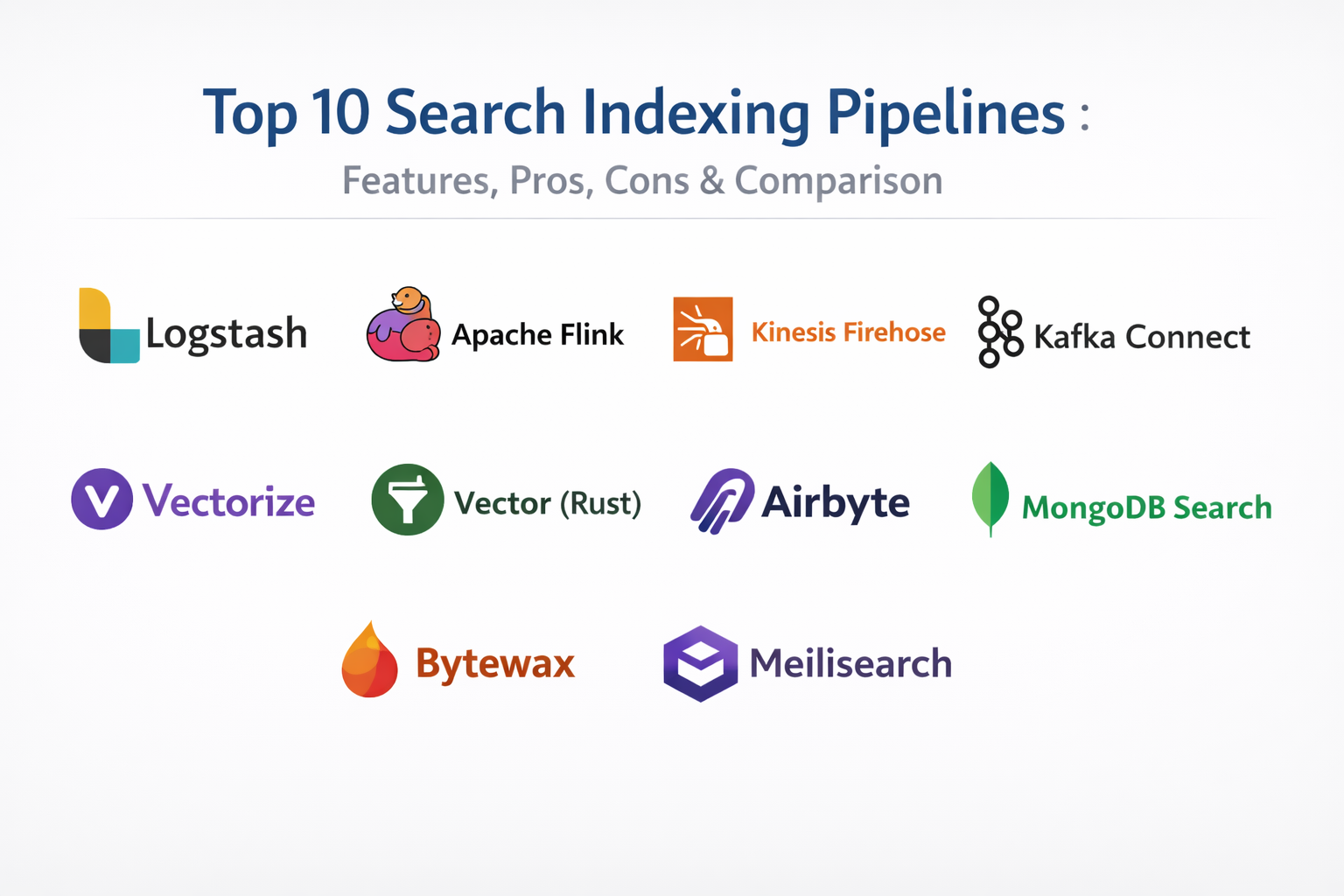
Top 10 Search Indexing Pipeline Tools
1. Logstash (Elastic Stack)
Part of the famous ELK stack, Logstash is a server-side data processing pipeline that ingests data from multiple sources simultaneously, transforms it, and then sends it to your “stash”—most commonly Elasticsearch.
Key Features
- Robust library of over 200 plugins for input, filter, and output stages.
- Powerful “Grok” filter for parsing unstructured log data into structured formats.
- Persistent queues to prevent data loss during spikes in ingestion volume.
- Conditional logic support for complex data routing and transformation.
- Native integration with the entire Elastic security and monitoring ecosystem.
Pros
- Extremely flexible and capable of handling almost any data format.
- Massive community support and thousands of pre-built configurations.
Cons
- Can be heavy on system resources (JVM-based) compared to lighter alternatives.
- Configuration syntax can be difficult for beginners to troubleshoot.
Platforms / Deployment
Windows / Linux / macOS / Docker
Self-hosted / Cloud
Security & Compliance
SSL/TLS encryption, integration with LDAP/Active Directory.
Not publicly stated.
Integrations & Ecosystem
Deeply tied to Elasticsearch and Kibana, but also supports outputs to S3, Kafka, and various databases.
Support & Community
Professional support via Elastic Co. and one of the largest open-source communities in the data engineering space.
2. Apache Flink
Flink is a framework and distributed processing engine for stateful computations over data streams. It is the gold standard for high-performance, real-time search indexing at a massive scale.
Key Features
- True stream processing with sub-second latency for real-time index updates.
- State management that ensures data consistency even after system failures.
- Complex Event Processing (CEP) for identifying patterns in data as it is indexed.
- Native connectors for Kafka, Kinesis, and Elasticsearch.
- High-throughput performance capable of handling trillions of events per day.
Pros
- Unbeatable performance for real-time, large-scale indexing requirements.
- Excellent fault tolerance with “exactly-once” processing guarantees.
Cons
- Steep learning curve requiring strong Java or Scala programming skills.
- Operational complexity is high for smaller teams.
Platforms / Deployment
Linux / Docker / Kubernetes
Self-hosted / Managed Cloud
Security & Compliance
Kerberos authentication and encrypted state backends.
Not publicly stated.
Integrations & Ecosystem
Integrates with the Hadoop ecosystem, Kafka, and all major cloud-native data services.
Support & Community
Strong backing from the Apache Foundation and significant corporate adoption at companies like Uber and Netflix.
3. Amazon Kinesis Data Firehose
A fully managed service for delivering real-time streaming data to destinations such as OpenSearch, S3, and Redshift. It is the go-to for teams looking for a “set and forget” indexing pipeline.
Key Features
- Serverless architecture that scales automatically without manual intervention.
- Built-in data transformation using AWS Lambda functions.
- Automatic buffering and compression to optimize storage and search performance.
- Native integration with Amazon OpenSearch Service.
- Detailed monitoring and logging via CloudWatch.
Pros
- Zero management overhead; AWS handles all scaling and patching.
- Predictable pricing based on the volume of data processed.
Cons
- Limited to the AWS ecosystem for the best experience.
- Transformation logic is restricted by Lambda’s execution limits.
Platforms / Deployment
AWS Cloud
Managed Service
Security & Compliance
IAM roles, KMS encryption, and VPC endpoint support.
SOC 1/2/3, ISO 27001, HIPAA, GDPR compliant.
Integrations & Ecosystem
Deeply integrated with the entire AWS data stack and various third-party analytics tools.
Support & Community
Enterprise-grade support from AWS and a vast library of documentation.
4. Confluent / Apache Kafka Connect
Kafka Connect is a tool for scalably and reliably streaming data between Apache Kafka and other systems. It is the primary way to move data from databases into search indexes.
Key Features
- Distributed and standalone modes for flexible scaling.
- Massive ecosystem of “Source” and “Sink” connectors.
- Schema Registry integration to ensure data quality throughout the pipeline.
- Single Message Transforms (SMTs) for lightweight data manipulation.
- Dead Letter Queues for handling problematic records without stopping the pipeline.
Pros
- The industry standard for event-driven data architectures.
- Decouples data sources from search engines, increasing system resilience.
Cons
- Requires a running Kafka cluster, which adds significant infrastructure overhead.
- Managing many connectors can become an administrative challenge.
Platforms / Deployment
Linux / Docker / Kubernetes
Self-hosted / Managed Cloud
Security & Compliance
SASL/SSL authentication and RBAC via Confluent Cloud.
SOC 2 / ISO 27001 (Confluent).
Integrations & Ecosystem
Connects virtually every modern database (MongoDB, PostgreSQL) to every major search engine.
Support & Community
Professional support from Confluent and a massive open-source community.
5. MongoDB Atlas Search / Triggers
For users already within the MongoDB ecosystem, Atlas Search provides a built-in indexing pipeline that eliminates the need for external ETL tools.
Key Features
- Automatic synchronization between the database and the search index.
- Database Triggers for real-time data enrichment before indexing.
- Built-in support for Lucene-based full-text search.
- Serverless functions (Atlas Functions) for custom transformation logic.
- Visual index builder for easy configuration.
Pros
- Eliminates the complexity of managing a separate indexing pipeline.
- Reduced latency since data stays within the same platform.
Cons
- Locked into the MongoDB Atlas platform.
- Less flexible for ingesting data from non-MongoDB sources.
Platforms / Deployment
Multi-cloud (AWS, Azure, GCP)
Managed Service
Security & Compliance
End-to-end encryption and VPC peering.
SOC 2, ISO 27001, HIPAA, PCI-DSS compliant.
Integrations & Ecosystem
Works seamlessly with the MongoDB application data platform and cloud-native triggers.
Support & Community
High-quality documentation and professional support tiers from MongoDB Inc.
6. Vectorize
A modern, AI-first indexing pipeline specifically designed to manage the complexities of vector embeddings and RAG (Retrieval-Augmented Generation) architectures.
Key Features
- Native integration with LLMs for automated embedding generation.
- Specialized connectors for unstructured data like PDFs, Notion, and Slack.
- Automated chunking and metadata extraction for optimized search.
- Built-in experimentation tools to test different embedding models.
- Real-time synchronization between data sources and vector databases.
Pros
- Drastically simplifies the creation of AI-powered search apps.
- Purpose-built for the modern “AI Stack.”
Cons
- A newer tool with a smaller community compared to Apache projects.
- Focused specifically on vector search rather than traditional log analysis.
Platforms / Deployment
Cloud
Managed Service
Security & Compliance
Secure API management and data encryption at rest.
Not publicly stated.
Integrations & Ecosystem
Works with Pinecone, Weaviate, Milvus, and major LLM providers like OpenAI.
Support & Community
Direct support for early adopters and growing technical documentation.
7. Vector (by Datadog)
Vector is a high-performance, observability data pipeline that excels at collecting, transforming, and routing logs and metrics with incredible efficiency.
Key Features
- Written in Rust, providing unmatched speed and memory safety.
- “Remap” language for safe, high-performance data transformations.
- End-to-end acknowledgement system to guarantee data delivery.
- Lighter footprint than Logstash, making it ideal for sidecar deployments.
- Visual topology view to understand data flow through the pipeline.
Pros
- Extremely low CPU and memory usage even at high throughput.
- Developer-friendly configuration and powerful unit testing for transformations.
Cons
- Smaller plugin library than Logstash.
- Requires learning a specific transformation language (VRL).
Platforms / Deployment
Linux / macOS / Windows / Docker
Local / Hybrid
Security & Compliance
Encrypted transit and secure credential management.
Not publicly stated.
Integrations & Ecosystem
Supports over 100 integrations, including Elasticsearch, ClickHouse, and AWS services.
Support & Community
Backed by Datadog with a very active and helpful open-source community.
8. Airbyte
While primarily an ELT tool, Airbyte has become a popular engine for search indexing due to its massive library of connectors and specialized support for vector databases.
Key Features
- Over 300 pre-built connectors for SaaS apps, databases, and files.
- Native “Vector Database” destination that handles embedding generation automatically.
- No-code connector builder for custom API integrations.
- Standardized data schemas across all sources.
- Support for both full-refresh and incremental sync modes.
Pros
- Easiest way to pull data from obscure SaaS tools into a search index.
- Rapidly growing library of open-source connectors.
Cons
- Designed more for batch processing than sub-second real-time streaming.
- Self-hosting can be resource-intensive for large setups.
Platforms / Deployment
Linux / Docker / Kubernetes
Self-hosted / Cloud
Security & Compliance
Encrypted connections and secrets management.
SOC 2 compliant (Cloud).
Integrations & Ecosystem
Connects to almost any data source and outputs to OpenSearch, Pinecone, and Weaviate.
Support & Community
Excellent Slack community and professional support for cloud customers.
9. Bytewax
Bytewax is a Python-based stream processing framework that allows developers to build complex indexing pipelines using the language they know best.
Key Features
- Python-native API, making it ideal for integrating machine learning models.
- Parallel execution for high-throughput data processing.
- Stateful processing support for windowing and aggregations.
- Simple deployment that doesn’t require a heavy JVM environment.
- Connectors for Kafka, Redpanda, and various search engines.
Pros
- Perfect for teams that want to avoid Java/Scala complexity.
- Seamlessly integrates with Python’s AI and data science libraries.
Cons
- Performance, while good, may not match Flink for massive-scale raw data.
- Smaller ecosystem of pre-built source/sink connectors.
Platforms / Deployment
Linux / macOS / Windows / Docker
Local / Hybrid
Security & Compliance
Depends on the local environment and Python security practices.
Not publicly stated.
Integrations & Ecosystem
Works well with the modern Python data stack (Pandas, PyTorch) and Kafka.
Support & Community
Growing community and active support from the project maintainers.
10. Meilisearch Indexing / Webhooks
Meilisearch provides a streamlined, developer-first indexing experience designed specifically for lightning-fast user-facing search.
Key Features
- Asynchronous task queue for managing large indexing jobs.
- Simplified JSON API for pushing data directly into the index.
- Automatic language detection and typo tolerance.
- Webhook support for triggering actions based on indexing status.
- Seamless integration with frontend frameworks.
Pros
- The fastest “time-to-search” for developers building web apps.
- Requires almost zero configuration for high-quality search results.
Cons
- Not designed for massive-scale log analytics or high-complexity VFX data.
- Index size can be larger than some competitors.
Platforms / Deployment
Linux / macOS / Windows / Docker
Self-hosted / Cloud
Security & Compliance
API key management and secure cloud hosting.
Not publicly stated.
Comparison Table
| Tool Name | Best For | Platform(s) Supported | Deployment | Standout Feature | Public Rating |
| 1. Logstash | ELK Stack Users | Win, Mac, Linux | Hybrid | 200+ Plugins | N/A |
| 2. Apache Flink | Real-Time Scaling | Linux, Docker | Hybrid | Exactly-Once Processing | N/A |
| 3. Kinesis Firehose | AWS Enthusiasts | AWS Cloud | Managed | Serverless Scaling | N/A |
| 4. Kafka Connect | Event Architectures | Linux, Docker | Hybrid | Connector Ecosystem | N/A |
| 5. MongoDB Search | MongoDB Users | Multi-cloud | Managed | Native Database Sync | N/A |
| 6. Vectorize | RAG / AI Search | Cloud | Managed | AI Model Integration | N/A |
| 7. Vector (Rust) | High Performance | Win, Mac, Linux | Local | Rust-Based Speed | N/A |
| 8. Airbyte | SaaS Connectivity | Linux, Docker | Hybrid | 300+ Connectors | N/A |
| 9. Bytewax | Python Developers | Win, Mac, Linux | Local | Python-Native API | N/A |
| 10. Meilisearch | Web Developers | Win, Mac, Linux | Hybrid | Instant Search API | N/A |
Evaluation & Scoring
| Tool Name | Core (25%) | Ease (15%) | Integrations (15%) | Security (10%) | Perf (10%) | Support (10%) | Value (15%) | Total |
| 1. Logstash | 9 | 7 | 10 | 8 | 7 | 9 | 8 | 8.45 |
| 2. Flink | 10 | 3 | 9 | 9 | 10 | 8 | 7 | 8.10 |
| 3. Firehose | 8 | 10 | 8 | 10 | 9 | 9 | 8 | 8.60 |
| 4. Kafka Connect | 9 | 5 | 10 | 9 | 10 | 9 | 7 | 8.30 |
| 5. MongoDB Search | 7 | 9 | 7 | 10 | 8 | 8 | 8 | 7.85 |
| 6. Vectorize | 9 | 8 | 8 | 7 | 8 | 7 | 7 | 7.85 |
| 7. Vector (Rust) | 8 | 8 | 9 | 8 | 10 | 8 | 9 | 8.55 |
| 8. Airbyte | 8 | 9 | 10 | 8 | 7 | 8 | 8 | 8.30 |
| 9. Bytewax | 7 | 8 | 7 | 7 | 8 | 7 | 8 | 7.35 |
| 10. Meilisearch | 7 | 10 | 7 | 7 | 9 | 7 | 8 | 7.90 |
The scores above are designed to show that there is no single “perfect” pipeline. A tool like Flink scores lower on “Ease” but is the highest for “Performance,” making it the choice for massive enterprises. Conversely, Kinesis Firehose and Meilisearch score high on “Ease,” making them ideal for teams that need to ship features quickly without managing servers. Your choice should be weighted based on your team’s specific technical skills and the volume of data you expect to process.
Which Search Indexing Pipeline Tool Is Right for You?
Solo / Freelancer
For small projects, Meilisearch or MongoDB Atlas Search are the winners. They require minimal setup and allow you to provide high-quality search to your users without needing a degree in data engineering.
SMB
Medium-sized teams should look at Airbyte or Vector (Rust). These tools offer a great balance of connectivity and performance while being relatively easy to manage within a standard Docker-based environment.
Mid-Market
For companies with more complex needs, Logstash remains the standard if you are already using Elasticsearch. If you are building modern AI applications, Vectorize is specifically designed to handle the nuances of vector search.
Enterprise
At the highest level, Apache Flink and Kafka Connect are the industry leaders. They provide the “exactly-once” delivery and high-availability features required for mission-critical search infrastructure.
Budget vs Premium
Vector (Rust) and Blender (in the 3D world, but here we look at Vector) offer incredible performance for free. Managed services like Kinesis Firehose are premium options that trade money for saved engineering time.
Feature Depth vs Ease of Use
Flink represents maximum depth with a steep learning curve. Firehose represents maximum ease with some limitations on how much you can customize the data flow.
Integrations & Scalability
If your data is scattered across 50 different SaaS tools, Airbyte is the best for integration. If you need to index millions of logs per second, Vector (Rust) or Flink are the most scalable.
Security & Compliance Needs
Organizations in regulated sectors should prioritize Kinesis Firehose or MongoDB Atlas Search, as these managed services come with built-in compliance certifications (HIPAA, SOC 2) that are difficult to achieve with self-hosted tools.
Frequently Asked Questions (FAQs)
1. What is the difference between a search engine and an indexing pipeline?
A search engine (like Elasticsearch) stores and retrieves data, while the indexing pipeline (like Logstash) is the set of steps that collects and prepares data to be put into that search engine.
2. Why can’t I just search my primary database?
Standard databases are designed for transactions, not for fast, flexible text searching. Specialized search indexes allow for features like typo tolerance, ranking, and millisecond response times.
3. What is “Vector Indexing”?
It is a process where text or images are turned into numbers (vectors) so that an AI can find “similar” concepts even if the exact words don’t match.
4. How does “Real-Time Indexing” work?
It uses stream processing to ingest data as soon as it is created, rather than waiting for a “batch” (like at the end of the day) to update the search results.
5. What is data enrichment in a pipeline?
Enrichment is the process of adding extra information to data as it passes through, such as adding a geographic location based on an IP address or identifying the language of a document.
6. Do I need a pipeline if I have very little data?
Probably not. If you have a few thousand rows of data, most standard databases can handle search quite well without the need for an extra layer of software.
7. What is a “Connector” in an indexing pipeline?
A connector is a pre-written piece of code that allows the pipeline to talk to a specific source (like a SQL database) or a specific destination (like a search engine).
8. Can one pipeline send data to multiple search engines?
Yes, tools like Logstash and Flink are designed to “fork” the data stream, allowing you to send the same data to a search engine for users and a data lake for long-term storage.
9. What happens if the pipeline fails?
Professional tools use “persistent queues” or “checkpoints” to remember where they left off, ensuring that no data is lost when the system restarts.
10. How do I measure the performance of my pipeline?
Most teams track “Indexing Latency” (how long it takes for a new item to appear in search) and “Throughput” (how many documents the system can handle per second).
Conclusion
A search indexing pipeline is the silent workhorse behind every successful data discovery experience. The choice of pipeline is no longer just about moving text; it is about how effectively you can integrate AI, handle real-time streams, and maintain data integrity across complex environments. Whether you prioritize the raw speed of a Rust-based tool like Vector, the established ecosystem of the Elastic Stack, or the AI-ready features of new vector-first platforms, the goal is to build a system that turns data into immediate, actionable knowledge. By selecting the right architecture today, you ensure that your users can find exactly what they need, exactly when they need it.

Best Cardiac Hospitals Near You
Discover top heart hospitals, cardiology centers & cardiac care services by city.
Advanced Heart Care • Trusted Hospitals • Expert Teams
View Best Hospitals