Introduction
Software Composition Analysis (SCA) tools help teams understand and control the open-source and third-party components inside their software. They scan dependency manifests and build outputs to identify known vulnerabilities, license risks, outdated packages, and supply chain concerns. In simple terms, SCA tells you what you are shipping, whether it is safe, and whether it is allowed.
This category matters now because most applications depend heavily on open-source libraries, containers, and transitive dependencies. Modern attacks often target the supply chain, and many organizations have strict policies about licenses and component approvals. SCA also supports faster patching by showing where a vulnerable library is used and what version upgrades are needed.
Common real-world use cases include blocking vulnerable dependencies before merge, enforcing license compliance rules, finding risky transitive dependencies, generating SBOM-style inventories for audits, and tracking remediation progress across many repositories and teams.
When evaluating SCA tools, buyers should focus on:
- Vulnerability coverage and update speed for advisories
- Accuracy for transitive dependencies and dependency graphs
- License detection, policy enforcement, and reporting
- CI and pull request integration for fast feedback
- Prioritization, triage, and remediation guidance quality
- Support for languages and package ecosystems you use
- Container and artifact scanning capabilities if required
- Governance, audit trails, and organization dashboards
- Developer workflow experience and noise control
- Cost, scalability, and operational overhead
Best for: development teams, DevOps teams, application security teams, and organizations that rely on open-source libraries and need consistent vulnerability and license controls.
Not ideal for: very small projects with few dependencies, air-gapped environments without a plan for vulnerability database updates, or teams that cannot integrate any scanning into build and CI workflows.
Key Trends in SCA Tools
- Higher demand for supply chain visibility and dependency provenance
- More focus on license policy enforcement and approval workflows
- Better prioritization to reduce alert fatigue from transitive issues
- Stronger integration into pull requests and merge gates
- Increased adoption of SBOM-style reporting for audits and governance
- More container and artifact scanning support alongside dependency scanning
- Better remediation guidance, including upgrade paths and safer alternatives
- More centralized dashboards for multi-repo organizations
- More automation for dependency updates and patch workflows
- Stronger expectations for enterprise access control and audit reporting
How We Selected These Tools
- Widely recognized SCA offerings with strong adoption signals
- Coverage across common languages and package ecosystems
- Practical vulnerability and license policy features
- CI and code review integration patterns for fast feedback
- Governance features for multi-team and enterprise environments
- Scalability for large repo fleets and monorepos
- Quality of triage, prioritization, and remediation guidance
- Balance of developer-first and enterprise program tools
- Support strength and documentation maturity signals
- Long-term viability and fit for modern secure SDLC workflows
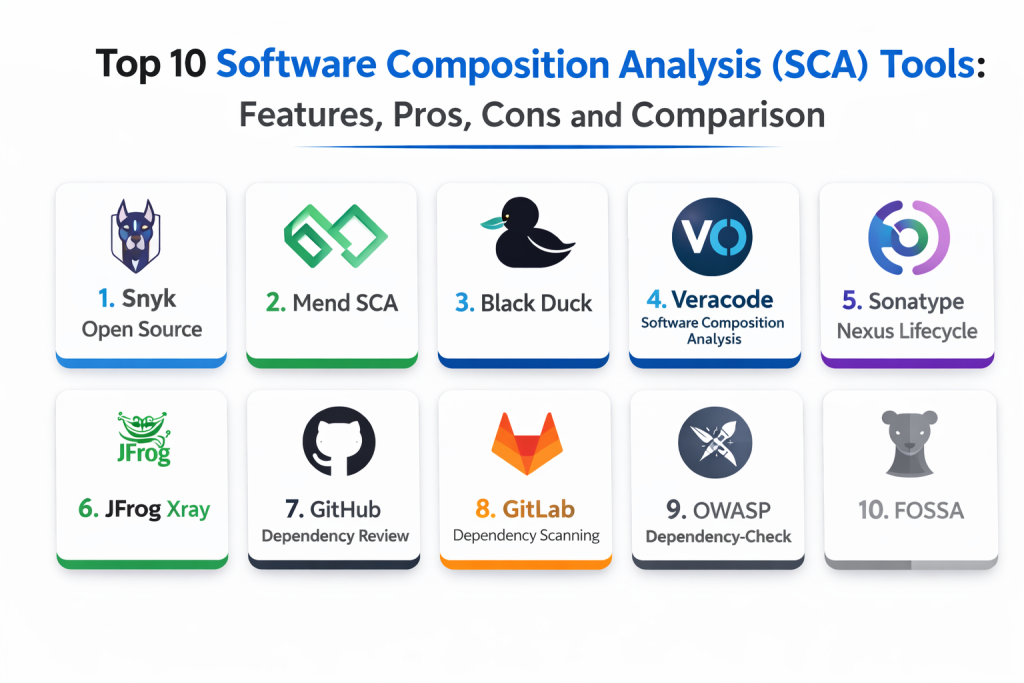
Top 10 Software Composition Analysis (SCA) Tools
1 — Snyk Open Source
Snyk Open Source focuses on finding vulnerable and risky open-source dependencies and helping developers fix them quickly. It fits teams that want developer-friendly workflows, strong remediation guidance, and integrations into daily pipelines.
Key Features
- Scans manifests and dependencies for known vulnerabilities
- Prioritization to focus on high-impact issues
- Remediation guidance including upgrade recommendations
- Supports many languages and package ecosystems
- CI and pull request workflows through integrations
- Policy controls for vulnerability and license handling
- Dashboards for org-wide visibility and tracking
Pros
- Developer-friendly remediation guidance
- Strong ecosystem support for many package managers
- Good fit for fast-moving teams and CI integration
Cons
- Policy tuning is needed to manage noise at scale
- Some advanced governance features depend on plan
- Best results come with consistent developer adoption
Platforms / Deployment
- Web
- Cloud
Security and Compliance
- SSO/MFA/RBAC/audit controls: Varies by plan and configuration
- Compliance certifications: Not publicly stated
Integrations and Ecosystem
Designed to fit developer workflows where dependency issues should be fixed early.
- Works with CI pipelines and merge gating patterns
- Integrates into pull request review feedback
- Supports policy enforcement across repos
- Works with common build and package ecosystems
- Integrates with ticketing workflows via setup
Support and Community
Strong adoption and documentation. Support varies by plan.
2 — Mend SCA
Mend SCA provides vulnerability and license risk management for open-source components, with enterprise governance features. It fits organizations that need centralized controls and reporting across many repositories.
Key Features
- Open-source vulnerability detection and alerts
- License detection and policy enforcement workflows
- Central dashboards for org-wide visibility
- Remediation guidance and fix tracking
- Supports many package ecosystems
- CI integration for policy gating
- Governance features for enterprise programs
Pros
- Strong license compliance and governance features
- Good fit for large orgs with many repos
- Central visibility for security and compliance teams
Cons
- Configuration and policy design require effort
- Noise management needs tuning and ownership
- Rollout is easier with a structured security program
Platforms / Deployment
- Web
- Cloud / Hybrid
Security and Compliance
- RBAC/audit controls: Varies by configuration
- Compliance certifications: Not publicly stated
Integrations and Ecosystem
Fits teams that need centralized governance without losing developer workflow support.
- Integrates with CI scanning and gating
- Works with PR workflows through reporting
- Supports ticketing and remediation tracking via setup
- Covers common dependency ecosystems
- Supports enterprise policy management patterns
Support and Community
Vendor support is typically important. Documentation supports enterprise rollout.
3 — Black Duck
Black Duck is designed for enterprise-scale open-source risk management, focusing on vulnerabilities, license compliance, and governance reporting. It fits organizations that need deep compliance workflows and auditable visibility.
Key Features
- Vulnerability detection across open-source components
- License compliance scanning and policy enforcement
- Strong governance and audit-friendly reporting
- Component inventory visibility across many projects
- Supports complex enterprise environments and workflows
- Integrates into CI and release processes via setup
- Triage workflows to manage findings and ownership
Pros
- Strong for compliance and governance reporting
- Good fit for regulated environments
- Central inventory and policy controls
Cons
- Setup and administration can be heavy
- Best value comes with mature processes and ownership
- Developer workflow adoption may require change management
Platforms / Deployment
- Web / Linux
- Cloud / Self-hosted / Hybrid
Security and Compliance
- RBAC and audit controls: Varies by configuration
- Compliance certifications: Not publicly stated
Integrations and Ecosystem
Best for organizations that treat open-source risk as a formal program.
- Integrates with build and release pipelines through setup
- Supports approval workflows and policy enforcement
- Works with enterprise identity systems via configuration
- Helps create audit evidence through reporting
- Fits large org governance models
Support and Community
Vendor support is usually critical. Documentation supports enterprise governance use.
4 — Veracode Software Composition Analysis
Veracode Software Composition Analysis provides dependency vulnerability and license risk management with program-level visibility. It fits security teams that want centralized tracking and governance across multiple applications.
Key Features
- Scans dependencies for known vulnerabilities
- License risk detection and policy control
- Dashboards for program visibility and progress tracking
- Triage workflows to reduce noise and prioritize risk
- Integrates with CI and development workflows through setup
- Supports multiple languages and ecosystems
- Helps track remediation over time
Pros
- Strong for centralized security program oversight
- Useful triage and reporting workflows
- Scales well for organizations with many applications
Cons
- Setup and rollout require structured program planning
- Noise control depends on policy tuning
- Value depends on adoption across teams
Platforms / Deployment
- Web
- Cloud
Security and Compliance
- Enterprise controls and auditing: Varies by configuration
- Compliance certifications: Not publicly stated
Integrations and Ecosystem
Fits teams that want governance plus practical remediation workflows.
- Integrates into CI gates and PR feedback patterns
- Works with ticketing and remediation tracking through setup
- Supports policy enforcement across teams
- Integrates with identity systems via configuration
- Useful for portfolio-level reporting
Support and Community
Vendor support is a key factor. Documentation supports enterprise usage.
5 — Sonatype Nexus Lifecycle
Sonatype Nexus Lifecycle helps manage open-source component risk by enforcing policies for vulnerabilities and licenses across the software lifecycle. It fits organizations that need strong policy controls around component usage.
Key Features
- Dependency and component vulnerability analysis
- License risk detection and policy enforcement
- Policy gates for builds and releases
- Dashboards for organization visibility and trends
- Supports developer workflows through integrated feedback
- Helps manage component approval and usage policies
- Triage support for prioritization and remediation planning
Pros
- Strong policy gating for builds and releases
- Useful license and component governance controls
- Fits organizations with formal component approval needs
Cons
- Requires policy design and ongoing governance
- Can be noisy if policies are too strict early
- Works best with standardized build workflows
Platforms / Deployment
- Web
- Cloud / Self-hosted / Hybrid
Security and Compliance
- RBAC and auditing: Varies by configuration
- Compliance certifications: Not publicly stated
Integrations and Ecosystem
Best for organizations that need consistent policy enforcement across CI and releases.
- Integrates into build pipelines for policy gates
- Works with repository workflows through setup
- Supports approval and governance processes
- Integrates with developer feedback loops
- Fits portfolio-level component visibility needs
Support and Community
Vendor support and documentation are strong in enterprise environments.
6 — JFrog Xray
JFrog Xray scans artifacts, containers, and dependencies for vulnerabilities and license risk. It fits organizations that want SCA tied closely to artifact repositories and release pipelines.
Key Features
- Vulnerability scanning for dependencies and build artifacts
- Container image scanning support through integration
- License compliance checks and policies
- Works well with artifact repository workflows
- Policy gates for promotion and releases
- Central reporting across artifacts and builds
- Supports governance and audit-friendly reporting
Pros
- Strong fit when artifact management is central
- Useful policy gates for artifact promotion
- Covers containers and artifacts alongside dependencies
Cons
- Best value depends on adoption of artifact workflows
- Configuration and policy tuning take effort
- Developer workflow feedback depends on integration quality
Platforms / Deployment
- Web / Linux
- Cloud / Self-hosted / Hybrid
Security and Compliance
- RBAC and auditing: Varies by configuration
- Compliance certifications: Not publicly stated
Integrations and Ecosystem
Fits teams that want SCA embedded into artifact and release processes.
- Integrates with build pipelines and artifact promotion gates
- Works with container scanning workflows via setup
- Supports governance and release readiness checks
- Integrates with ticketing and remediation flows through setup
- Fits multi-team artifact visibility needs
Support and Community
Vendor support is common for enterprise deployments. Documentation supports rollout.
7 — GitHub Dependency Review
GitHub Dependency Review helps teams review dependency changes in pull requests and detect vulnerable dependencies before merge. It fits teams already using GitHub workflows and wanting simple, integrated checks.
Key Features
- Highlights dependency changes inside pull requests
- Flags known vulnerable dependencies for review
- Supports gating via checks in review workflows
- Works naturally with PR-based collaboration
- Helps enforce basic dependency hygiene
- Useful for reducing risk from version bumps
- Supports developer feedback at review time
Pros
- Simple integration in GitHub-based workflows
- Helpful visibility into dependency changes
- Useful early warning before merge
Cons
- Feature depth depends on workflow configuration
- Not a full enterprise SCA program platform by itself
- Advanced license workflows may require additional tooling
Platforms / Deployment
- Web
- Cloud / Hybrid
Security and Compliance
- Access controls and auditing: Varies by plan and configuration
- Compliance certifications: Not publicly stated
Integrations and Ecosystem
Best used as part of a broader PR gating and CI validation approach.
- Works in pull request review process
- Integrates with CI checks and merge policies
- Supports ecosystem workflows via setup
- Useful for fast feedback loops
- Complements deeper scanning tools if needed
Support and Community
Large developer community. Support depends on plan.
8 — GitLab Dependency Scanning
GitLab Dependency Scanning provides dependency vulnerability detection integrated into GitLab workflows. It fits teams that use GitLab CI and want dependency scanning results visible directly in their pipelines and merge requests.
Key Features
- Dependency scanning integrated into CI pipelines
- Findings visible in merge request workflows
- Supports policy controls and gating via configuration
- Works across many projects in group structures
- Helps enforce dependency hygiene consistently
- Integrates with developer workflows inside GitLab
- Supports program visibility through dashboards
Pros
- Strong workflow integration inside GitLab
- Good fit for standardized CI-driven scanning
- Helpful MR-level visibility for dependency risk
Cons
- Best experience is inside GitLab ecosystem
- Governance depth depends on edition and setup
- Noise control depends on configuration and policies
Platforms / Deployment
- Web / Linux
- Cloud / Self-hosted / Hybrid
Security and Compliance
- RBAC and audit controls: Varies by configuration
- Compliance certifications: Not publicly stated
Integrations and Ecosystem
Fits teams that want SCA inside CI pipelines and merge workflows.
- Integrates with CI pipelines and MR reporting
- Supports policy gates based on findings
- Works with issue and remediation workflows through setup
- Fits multi-team governance via groups and projects
- Useful for centralized visibility within GitLab
Support and Community
Strong documentation. Support varies by edition.
9 — OWASP Dependency-Check
OWASP Dependency-Check is a commonly used tool for identifying known vulnerable dependencies, often used in CI pipelines. It fits teams that want a straightforward scanning tool and can manage integration and reporting themselves. OWASP
Key Features
- Detects vulnerable components based on known advisories
- Works in CI pipelines through integration
- Supports common build systems via configuration
- Produces reports that can be archived for traceability
- Useful baseline scanning for many projects
- Helps teams catch known risky dependency versions
- Often used as a building block in security pipelines
Pros
- Practical baseline scanning approach
- Works well in automated pipelines
- Useful for teams that want control of setup and reporting
Cons
- Requires effort to integrate well into developer workflows
- Reporting and governance features are limited by default
- Update and false positive management require ownership
Platforms / Deployment
- Windows / macOS / Linux
- Self-hosted / CI-based workflows
Security and Compliance
- Compliance certifications: Not publicly stated
- Security posture depends on environment and update management
Integrations and Ecosystem
Best for teams that want a scanning building block they can embed into pipelines.
- Integrates with CI and build tools via setup
- Supports report generation for audit trails
- Works as part of a multi-tool security pipeline
- Can be standardized across repos through templates
- Requires disciplined update management
Support and Community
Strong community usage and documentation in security-focused teams.
10 — FOSSA
FOSSA focuses on open-source dependency and license compliance, helping teams enforce license policies and track open-source usage. It fits organizations where license governance is a priority alongside vulnerability awareness.
Key Features
- License detection and policy enforcement workflows
- Dependency inventory and risk visibility
- Policy gates and approval workflows for compliance
- Supports multiple ecosystems and languages
- Reporting suitable for compliance evidence needs
- Integrates into CI for enforcement and visibility
- Helps track remediation and policy exceptions over time
Pros
- Strong license compliance focus
- Useful policy workflows for regulated environments
- Good for organizations needing consistent open-source governance
Cons
- Vulnerability depth and prioritization depend on setup
- Policy design requires careful planning
- Value depends on adoption across repos and teams
Platforms / Deployment
- Web
- Cloud
Security and Compliance
- RBAC and auditing: Varies by plan and configuration
- Compliance certifications: Not publicly stated
Integrations and Ecosystem
Fits teams that want compliance governance integrated into build and release processes.
- Integrates with CI pipelines for policy gating
- Works with developer workflows through reporting
- Supports organization-level policy management
- Integrates with ticketing flows through setup
- Useful for consistent license governance
Support and Community
Vendor support is typically central. Documentation supports compliance workflows.
Comparison Table
| Tool Name | Best For | Platform(s) Supported | Deployment | Standout Feature | Public Rating |
|---|---|---|---|---|---|
| Snyk Open Source | Developer-friendly vulnerability remediation | Web | Cloud | Strong fix guidance | N/A |
| Mend SCA | Enterprise license and vulnerability governance | Web | Cloud, Hybrid | Strong compliance workflows | N/A |
| Black Duck | Deep compliance and audit-ready reporting | Web, Linux | Cloud, Self-hosted, Hybrid | Enterprise governance reporting | N/A |
| Veracode Software Composition Analysis | Program-level tracking and triage | Web | Cloud | Central dashboards and triage | N/A |
| Sonatype Nexus Lifecycle | Policy gates and component governance | Web | Cloud, Self-hosted, Hybrid | Strong policy enforcement | N/A |
| JFrog Xray | Artifact and container focused SCA | Web, Linux | Cloud, Self-hosted, Hybrid | Artifact promotion gating | N/A |
| GitHub Dependency Review | PR-level dependency change visibility | Web | Cloud, Hybrid | Review-time dependency insight | N/A |
| GitLab Dependency Scanning | CI-integrated scanning inside GitLab | Web, Linux | Cloud, Self-hosted, Hybrid | MR-level scanning visibility | N/A |
| OWASP Dependency-Check | Baseline dependency vulnerability scanning | Windows, macOS, Linux | Self-hosted, CI-based | Pipeline-friendly scanning | N/A |
| FOSSA | License compliance governance | Web | Cloud | License policy enforcement | N/A |
Evaluation and Scoring of Software Composition Analysis (SCA) Tools
Scoring uses a 1–10 scale per criterion, then a weighted total using these weights: Core features 25%, Ease of use 15%, Integrations and ecosystem 15%, Security and compliance 10%, Performance and reliability 10%, Support and community 10%, Price and value 15%. Scores are comparative estimates based on typical strengths and common usage patterns, not absolute measurements.
| Tool Name | Core (25%) | Ease (15%) | Integrations (15%) | Security (10%) | Performance (10%) | Support (10%) | Value (15%) | Weighted Total |
|---|---|---|---|---|---|---|---|---|
| Snyk Open Source | 9 | 8 | 9 | 8 | 8 | 8 | 7 | 8.20 |
| Mend SCA | 8 | 7 | 8 | 9 | 8 | 7 | 6 | 7.65 |
| Black Duck | 8 | 6 | 7 | 9 | 7 | 7 | 5 | 7.05 |
| Veracode Software Composition Analysis | 8 | 7 | 8 | 9 | 7 | 7 | 6 | 7.55 |
| Sonatype Nexus Lifecycle | 8 | 6 | 8 | 9 | 8 | 7 | 6 | 7.35 |
| JFrog Xray | 8 | 6 | 8 | 8 | 8 | 7 | 6 | 7.20 |
| GitHub Dependency Review | 6 | 9 | 7 | 7 | 9 | 9 | 8 | 7.40 |
| GitLab Dependency Scanning | 7 | 7 | 7 | 8 | 8 | 7 | 7 | 7.20 |
| OWASP Dependency-Check | 6 | 6 | 6 | 7 | 8 | 8 | 10 | 6.85 |
| FOSSA | 7 | 7 | 7 | 8 | 8 | 7 | 6 | 7.05 |
How to interpret the scores:
- Higher Core favors vulnerability + license coverage, dashboards, and policy controls
- Higher Ease favors simple setup, quick onboarding, and low operational friction
- Higher Integrations favors CI, PR workflows, and ecosystem compatibility
- Security and compliance reflects policy depth, governance, and reporting readiness
- Weighted Total supports shortlisting, but you should validate with a pilot on real repos
Which Software Composition Analysis (SCA) Tool Is Right for You
Solo / Freelancer
If you want fast feedback with minimal overhead, GitHub Dependency Review can help spot risky dependency changes during reviews. OWASP Dependency-Check can work as a pipeline step if you control your own CI. If you want more guided remediation, Snyk Open Source can be a strong option if you prefer a developer-friendly workflow.
SMB
SMBs typically want quick adoption and manageable noise. Snyk Open Source is often attractive for remediation guidance and fast integration. GitLab Dependency Scanning fits well if your CI is already standardized in GitLab. Sonatype Nexus Lifecycle can be valuable if you want policy gating and more structured component governance.
Mid-Market
Mid-market teams often need central visibility plus developer feedback loops. Mend SCA and Veracode Software Composition Analysis provide program-level dashboards and tracking. Snyk Open Source remains strong for developer adoption and fast fixes. JFrog Xray fits well if artifact management and release promotion are central to your delivery pipeline.
Enterprise
Enterprises often need strong governance, audit evidence, and license compliance controls. Black Duck is commonly aligned with compliance-heavy environments. Mend SCA and Sonatype Nexus Lifecycle can support policy-driven programs with approval workflows. Veracode Software Composition Analysis fits when security teams want centralized oversight and consistent remediation tracking. JFrog Xray becomes important when scanning must cover artifacts, containers, and release promotion gates.
Budget vs Premium
For tight budgets, OWASP Dependency-Check and built-in platform features can provide baseline coverage, but they require more internal ownership. Premium tools become valuable when you need dashboards, triage workflows, license governance, and organization-wide enforcement across many repos.
Feature Depth vs Ease of Use
If ease matters most, GitHub Dependency Review and GitLab Dependency Scanning are simple because they fit existing workflows. If you want deeper enterprise governance, tools like Black Duck, Mend SCA, Sonatype Nexus Lifecycle, and Veracode SCA offer more controls but require more planning and tuning.
Integrations and Scalability
For broad integrations, Snyk Open Source and enterprise platforms can integrate into CI and PR workflows at scale with governance. GitHub and GitLab integrated scanning scales best inside their own ecosystems. JFrog Xray scales well when artifact repositories are central and scanning must happen at multiple pipeline stages.
Security and Compliance Needs
If compliance is critical, prioritize license policy enforcement, audit-ready reporting, and consistent merge gating. Define clear ownership for fixing issues, and set realistic timelines for remediation. Combine SCA with protected branches and CI checks so risky components cannot be introduced without review.
Frequently Asked Questions
- What does an SCA tool actually scan?
It scans dependency manifests and build artifacts to identify third-party components, then checks for known vulnerabilities and license risks. - What is the difference between SCA and static code analysis?
Static analysis checks your own source code for issues. SCA focuses on third-party libraries and open-source components you depend on. - Why do transitive dependencies matter?
Transitive dependencies are pulled in indirectly and can contain vulnerabilities or license risks you did not choose directly. SCA tools help reveal them. - How do SCA tools reduce alert fatigue?
Good tools prioritize issues based on exploitability, reachability, and upgrade paths, and they allow policy tuning to reduce noise. - Should SCA run in pull requests or only on main branches?
Many teams run lightweight checks in pull requests and deeper scans on main branches or scheduled pipelines, depending on build time and impact. - Do SCA tools handle license compliance well?
Many do, but depth varies. If license governance is a key requirement, prioritize tools with strong policy enforcement and reporting workflows. - Can SCA tools generate inventories for audits?
Yes. Many tools can produce component inventories and reports that support audits. The exact format and detail depend on the tool. - How do teams typically fix SCA findings?
Most fixes are upgrades or dependency replacements. Teams often set policies, track remediation, and automate updates where safe. - Is SCA enough for supply chain security?
No. It is a critical piece, but supply chain security also includes build hardening, signing, CI controls, and secure review practices. - How should a team choose an SCA tool?
Shortlist two or three tools, run them on real repos, compare noise levels, remediation guidance, license policies, and integration effort, then pilot before scaling.
Conclusion
SCA tools are essential for modern software because most applications depend on open-source and third-party libraries. These tools help you identify what components you ship, detect known vulnerabilities, manage license compliance, and enforce policies before risky dependencies reach production. The best choice depends on your language ecosystems, governance needs, and how deeply you want to integrate scanning into CI and code review. Developer-first tools like Snyk Open Source can drive fast remediation, while enterprise platforms like Mend SCA, Black Duck, Veracode Software Composition Analysis, and Sonatype Nexus Lifecycle support broader governance and audit reporting. JFrog Xray fits well when artifact and container scanning must be part of release promotion. A practical next step is to shortlist two or three tools, run a pilot on key repositories, tune policies to reduce noise, and then enforce merge gates gradually so security improves without slowing delivery.

Best Cardiac Hospitals Near You
Discover top heart hospitals, cardiology centers & cardiac care services by city.
Advanced Heart Care • Trusted Hospitals • Expert Teams
View Best Hospitals