Introduction
Solar asset monitoring software is a specialized category of digital platforms designed to track, analyze, and optimize the performance of photovoltaic systems in real-time. These tools act as the nervous system of a solar installation, collecting data from inverters, sensors, and meters to ensure that energy production meets expected targets. In the current energy landscape, where grid stability and carbon neutrality are paramount, these platforms have evolved beyond simple data logging. They now incorporate sophisticated algorithms to detect faults, predict maintenance needs, and manage the financial health of multi-megawatt portfolios across the globe.
As the industry shifts toward high-density utility scales and complex hybrid storage systems, the role of monitoring software has become even more critical. Operators no longer just look for “is the system on?” but rather “is it performing at its theoretical peak?” Modern solutions utilize satellite weather data and digital twins to benchmark performance with extreme precision. For stakeholders, this means reduced operational risk and higher returns on investment. Selecting the right software requires a deep understanding of hardware compatibility, data granularity, and the specific reporting needs of investors and grid operators.
Best for: Utility-scale plant operators, independent power producers (IPPs), commercial solar installers, and asset managers who oversee large, diverse portfolios of renewable energy systems.
Not ideal for: Small-scale residential hobbyists with single-inverter setups or projects where real-time data and financial reporting are not a business requirement.
Key Trends in Solar Asset Monitoring Software
- AI-Driven Predictive Maintenance: Modern systems use machine learning to identify patterns in inverter behavior that signal a future failure before it actually happens.
- Real-Time Digital Twins: The creation of virtual replicas of solar plants allows operators to simulate different weather scenarios and optimize cleaning schedules for maximum yield.
- Hybrid Storage Integration: With the rise of battery energy storage systems, monitoring tools now provide unified views of both generation and discharge cycles.
- Automated Soiling Detection: Utilizing high-resolution satellite imagery and local sensors, software can now calculate exactly when the cost of cleaning panels will be outweighed by the gain in energy production.
- Cybersecurity for Smart Grids: As solar assets become critical infrastructure, monitoring platforms are implementing advanced encryption and zero-trust architectures to protect against grid-level threats.
- Edge Computing in Inverters: Processing data locally at the site level allows for faster response to grid fluctuations and reduces the bandwidth needed for cloud communication.
- Revenue-Grade Financial Tracking: Modern platforms integrate directly with energy markets and power purchase agreements to track real-time revenue alongside kilowatt-hours.
- Drone-Integrated Inspections: Leading software now supports the direct upload and analysis of thermal imaging from drones to pinpoint cracked cells or faulty wiring.
How We Selected These Tools
- Platform Agnosticism: We prioritized tools that can communicate with a wide variety of inverter brands and hardware types to ensure portfolio flexibility.
- Data Granularity: Only software capable of high-frequency data polling (5 minutes or less) was considered for this top-tier professional list.
- Reporting Sophistication: Evaluation was based on the ability to generate bankable reports that satisfy the requirements of lenders and institutional investors.
- Market Reliability: We looked for established players with a proven track record of uptime and long-term support in the renewable energy sector.
- Security Posture: Preference was given to platforms that demonstrate a commitment to enterprise security standards and data sovereignty.
- Ease of Integration: The selection includes tools that offer robust APIs for connecting with existing ERP and maintenance management systems.
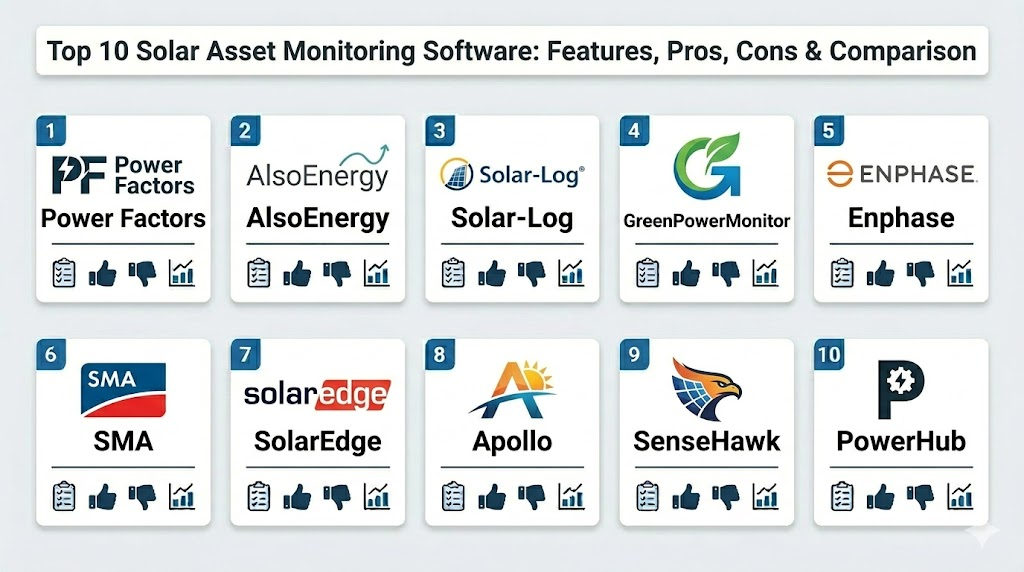
Top 10 Solar Asset Monitoring Software Tools
1. Power Factors Drive
A comprehensive performance and asset management platform designed specifically for utility-scale solar and wind portfolios. It focuses on turning raw data into operational intelligence to maximize revenue.
Key Features
- Advanced loss attribution that pinpoints exactly why a plant is underperforming.
- Automated incident tracking and O&M work order integration.
- Weather-normalized benchmarking using high-fidelity irradiance data.
- Integrated financial and contractual KPI tracking for asset managers.
- Seamless SCADA and data historian connectivity for large-scale sites.
Pros
- Unrivaled depth in “big data” analytics for massive global portfolios.
- Provides highly accurate revenue forecasting based on real-time market data.
Cons
- The interface is highly complex and requires specialized training.
- Cost structure is primarily aimed at large enterprise and utility clients.
Platforms / Deployment
Web / Windows / macOS
Cloud
Security & Compliance
SOC 2 Type II, GDPR, and enterprise-grade audit trails.
Not publicly stated.
Integrations & Ecosystem
Built to serve as the “single source of truth,” it integrates with virtually all major inverter brands, weather services, and maintenance management platforms through a powerful API layer.
Support & Community
Offers white-glove onboarding and dedicated account management for large-scale IPPs. The community is focused on high-level energy engineering and asset management.
2. AlsoEnergy PowerTrack
One of the most widely used platforms in the commercial and industrial sector, known for its flexibility and robust hardware-agnostic approach.
Key Features
- Real-time and historical performance dashboards for entire fleets.
- Customizable reporting engine for varied stakeholder requirements.
- Integrated hardware solutions for site-level data logging.
- Advanced fault detection with automated alert escalation.
- Comprehensive energy yield and performance ratio analysis.
Pros
- Exceptional at managing fleets with a wide variety of hardware brands.
- Very strong customer support with deep technical expertise.
Cons
- User interface can feel slightly dated compared to newer cloud-native competitors.
- Configuration for complex sites can be time-consuming.
Platforms / Deployment
Web / iOS / Android
Cloud
Security & Compliance
Standard cloud security with SSO support and encrypted data streams.
Not publicly stated.
Integrations & Ecosystem
Strong library of direct integrations with inverters, trackers, and meters. It also supports third-party financial and ERP software connections.
Support & Community
Extensive documentation and a large user base in North America. Professional training sessions are regularly available for new O&M teams.
3. Solar-Log WEB Enerest
A pioneer in hardware-independent monitoring, this platform is a favorite for commercial installers who need to manage thousands of small-to-midsize sites.
Key Features
- Universal compatibility with over 100 different inverter manufacturers.
- Smart energy management for local consumption optimization.
- Virtual plant creation to group different logical units together.
- Remote configuration and firmware management for local data loggers.
- Visual “playback” of shadow movement to identify physical obstructions.
Pros
- Excellent for installers who use a mix of different inverter brands.
- Mobile application is very intuitive for field technicians.
Cons
- Data storage limits on lower-tier plans can be restrictive.
- Less focused on high-end utility-scale financial modeling.
Platforms / Deployment
Web / iOS / Android
Hybrid (Hardware loggers + Cloud)
Security & Compliance
Standard encryption for data transmission and secure user access controls.
Not publicly stated.
Integrations & Ecosystem
Highly focused on hardware interoperability, making it the “Swiss Army knife” for commercial solar installers.
Support & Community
Strong presence in Europe and North America with localized technical support and extensive online help centers.
4. GreenPowerMonitor Horizon
An enterprise-level solution owned by DNV, focusing on the scientific accuracy of performance ratios and high-level grid compliance.
Key Features
- Scientifically accurate Performance Ratio (PR) calculations.
- Predictive maintenance insights using advanced asset health models.
- Grid and market data integration for real-time dispatching.
- Multi-user workflows for auditors, owners, and operators.
- High-frequency data acquisition for real-time SCADA views.
Pros
- Considered the most “bankable” software by many institutional investors.
- Exceptional stability and accuracy for large-scale utility projects.
Cons
- High technical barrier to entry for the average operator.
- Premium pricing reflects its high-end scientific capabilities.
Platforms / Deployment
Web / Windows
Cloud / Hybrid
Security & Compliance
Compliant with major utility-scale security standards.
Not publicly stated.
Integrations & Ecosystem
Deeply integrated with industrial SCADA systems and professional weather stations. It supports high-level data exports for third-party auditing.
Support & Community
Expert-level consulting services and deep enterprise training programs are a hallmark of their service.
5. Enphase Enlighten
While it is an OEM tool, its software is so advanced that it is often the primary reason professionals choose Enphase microinverter hardware.
Key Features
- Module-level performance tracking that shows exactly how each panel is producing.
- Logical and physical layout maps for rapid onsite troubleshooting.
- Integrated battery storage and EV charger monitoring.
- Automated alerts for individual microinverter or communication faults.
- Public-facing “Kiosk” mode for displaying production data in lobbies.
Pros
- The gold standard for visibility in residential and small commercial systems.
- Completely free for life with the purchase of the hardware.
Cons
- Strictly limited to systems using Enphase microinverters.
- Not suitable for utility-scale central inverter plants.
Platforms / Deployment
Web / iOS / Android
Cloud
Security & Compliance
High-level cloud security with automated firmware updates and encryption.
Not publicly stated.
Integrations & Ecosystem
Strong integration with smart home ecosystems and its own internal line of batteries and chargers.
Support & Community
Massive consumer and professional community with 24/7 technical support and a wealth of self-help resources.
6. SMA Sunny Portal
A robust platform from one of the world’s leading inverter manufacturers, designed for everything from residential rooftops to massive industrial plants.
Key Features
- Centralized fleet management for thousands of varied sites.
- Energy balance visualizations showing production versus consumption.
- Integration with heat pumps and electric vehicle charging infrastructure.
- Detailed event logs and fault history for long-term diagnostics.
- ennexOS integration for advanced energy management in commercial sectors.
Pros
- Proven reliability with millions of installations worldwide.
- Excellent for commercial sites that need to manage complex energy loads.
Cons
- Best features are primarily optimized for SMA-only hardware.
- The interface can feel heavy and complex for basic users.
Platforms / Deployment
Web / iOS / Android
Cloud
Security & Compliance
Adheres to strict European data privacy and security standards.
Not publicly stated.
Integrations & Ecosystem
Integrates perfectly with the SMA product family and an increasing number of third-party energy appliances.
Support & Community
Excellent global support network and a very high level of professional documentation.
7. SolarEdge Monitoring Platform
A powerful tool that leverages DC power optimizers to provide a level of detail that traditional string inverters cannot match.
Key Features
- Physical map view showing the performance of every single panel on a roof.
- Remote troubleshooting that identifies the exact location of a fault.
- Integrated “Rapid Shutdown” and arc-fault detection monitoring.
- Fleet-level reporting tailored for commercial O&M teams.
- Built-in safety alerts that trigger immediately upon detection of an issue.
Pros
- Eliminates all guesswork in finding faulty panels or wiring.
- Highly effective for complex roofs with multiple orientations or shading.
Cons
- Requires the use of SolarEdge optimizers and inverters.
- Data resolution for third-party meters can sometimes lag.
Platforms / Deployment
Web / iOS / Android
Cloud
Security & Compliance
Standard industry encryption and secure user management.
Not publicly stated.
Integrations & Ecosystem
Works seamlessly with the SolarEdge smart energy suite and various third-party fire safety systems.
Support & Community
Very strong professional community and a highly responsive technical support team.
8. Apollo Energy Analytics
A newer, AI-centric platform designed for owners who want to move from simple monitoring to high-level financial and operational optimization.
Key Features
- AI-powered digital twin that predicts daily energy yield with 99% accuracy.
- Unified view for both solar assets and battery storage health.
- Automated soiling and degradation analysis using satellite data.
- O&M workflow management with integrated technician mobile apps.
- Financial reporting that tracks PPA compliance and grid curtailment.
Pros
- The AI insights are genuinely actionable and prevent downtime.
- Modern, clean interface that is much faster to navigate than legacy tools.
Cons
- Being a newer company, the library of direct hardware drivers is still growing.
- Requires a high volume of historical data to fully “train” its AI models.
Platforms / Deployment
Web / iOS / Android
Cloud
Security & Compliance
Built on modern cloud security standards with SSO and full audit logging.
Not publicly stated.
Integrations & Ecosystem
Strong focus on API connectivity, allowing it to sit on top of multiple legacy monitoring systems.
Support & Community
High-touch implementation and specialized consulting for large fleet owners.
9. SenseHawk
A specialized platform that combines drone-based thermography and GIS data with traditional monitoring to manage the entire lifecycle of a utility plant.
Key Features
- GIS-integrated dashboards showing exact physical locations of faults.
- Direct integration with drone thermal inspection reports.
- Construction-to-operations continuity for seamless plant handovers.
- AI-powered hot-spot detection from aerial imagery.
- Asset documentation and ticket management within a map-based view.
Pros
- The physical map view is superior for large utility-scale maintenance teams.
- Drone integration saves hundreds of man-hours in manual inspections.
Cons
- The platform’s value is heavily tied to having drone data or high-quality GIS files.
- Not necessary or cost-effective for small commercial rooftop projects.
Platforms / Deployment
Web / iOS / Android
Cloud
Security & Compliance
Secure cloud storage with encrypted image processing.
Not publicly stated.
Integrations & Ecosystem
Connects with major SCADA systems and maintenance software. Its focus is on spatial data and asset health.
Support & Community
Provides expert GIS and drone specialists to assist with the initial site digital mapping.
10. PowerHub
A unique asset management platform that focuses on the “soft” side of solar monitoring—contracts, compliance, and financial management.
Key Features
- Centralized document management for PPA contracts, insurance, and land leases.
- Automated billing and invoicing for energy sales.
- Compliance tracking for environmental and grid-interconnection regulations.
- Workflow automation for tax filings and investor reporting.
- Consolidated performance data from multiple different monitoring platforms.
Pros
- The best tool for the financial and legal “office” side of solar management.
- Eliminates the risk of missing critical contract or regulatory deadlines.
Cons
- It is not a technical SCADA tool; it requires a separate source for raw energy data.
- Can be expensive for smaller portfolios without complex legal needs.
Platforms / Deployment
Web
Cloud
Security & Compliance
SOC 2 Type II, enterprise-grade audit trails, and data sovereignty compliance.
Not publicly stated.
Integrations & Ecosystem
Designed to integrate with technical monitoring tools like AlsoEnergy or Power Factors to combine energy data with financial data.
Support & Community
Provides white-glove service for large investment funds and independent power producers.
Comparison Table
| Tool Name | Best For | Platform(s) Supported | Deployment | Standout Feature | Public Rating |
| 1. Power Factors | Utility Portfolios | Web, Windows, macOS | Cloud | Loss Attribution | N/A |
| 2. AlsoEnergy | Large Diverse Fleets | Web, iOS, Android | Cloud | Reporting Engine | N/A |
| 3. Solar-Log | Commercial Mixed Brands | Web, iOS, Android | Hybrid | Multi-Vendor Loggers | N/A |
| 4. GreenPowerMonitor | IPPs & Utilities | Web, Windows | Hybrid | PR Accuracy | N/A |
| 5. Enphase | Residential/Small C&I | Web, iOS, Android | Cloud | Module-Level View | N/A |
| 6. SMA | Commercial Fleets | Web, iOS, Android | Cloud | Energy Management | N/A |
| 7. SolarEdge | Optimizer-based Plants | Web, iOS, Android | Cloud | Physical Layout Map | N/A |
| 8. Apollo | AI-Driven Owners | Web, iOS, Android | Cloud | AI Digital Twins | N/A |
| 9. SenseHawk | GIS & Drone O&M | Web, iOS, Android | Cloud | Aerial Thermal View | N/A |
| 10. PowerHub | Financial Management | Web | Cloud | Contract Compliance | N/A |
Evaluation & Scoring
| Tool Name | Core (25%) | Ease (15%) | Integrations (15%) | Security (10%) | Perf (10%) | Support (10%) | Value (15%) | Total |
| 1. Power Factors | 10 | 4 | 10 | 9 | 10 | 9 | 5 | 8.15 |
| 2. AlsoEnergy | 9 | 7 | 9 | 8 | 9 | 9 | 7 | 8.40 |
| 3. Solar-Log | 8 | 8 | 10 | 7 | 8 | 8 | 8 | 8.10 |
| 4. GreenPowerMonitor | 10 | 5 | 9 | 9 | 10 | 8 | 6 | 8.05 |
| 5. Enphase | 9 | 10 | 6 | 9 | 9 | 9 | 9 | 8.55 |
| 6. SMA | 8 | 7 | 8 | 9 | 9 | 9 | 7 | 7.95 |
| 7. SolarEdge | 9 | 9 | 7 | 8 | 9 | 9 | 8 | 8.45 |
| 8. Apollo | 9 | 8 | 8 | 9 | 10 | 8 | 7 | 8.45 |
| 9. SenseHawk | 8 | 6 | 9 | 8 | 9 | 8 | 6 | 7.40 |
| 10. PowerHub | 7 | 7 | 8 | 10 | 8 | 9 | 6 | 7.40 |
The scoring model highlights a diverse landscape where the “best” tool depends entirely on your specific role. Enphase and SolarEdge score highly due to their incredible ease of use and the sheer depth of data they provide for their specific hardware. On the other hand, platforms like Power Factors and GreenPowerMonitor lead in technical performance and security, which are the most critical factors for utility-scale stakeholders. While a tool like PowerHub has a lower total score, it is practically the only choice for an asset manager focusing on the legal and financial compliance of a massive investment fund.
Which Solar Asset Monitoring Software Tool Is Right for You?
Solo / Freelancer
If you are an independent solar consultant or a small local installer, Solar-Log or OpenSolar (a design/monitoring hybrid) provides the best flexibility without locking you into a single hardware brand.
SMB
Small to medium businesses managing local commercial rooftops should lean toward SMA Sunny Portal or AlsoEnergy. These tools offer a balance of professional reporting and manageable complexity for smaller teams.
Mid-Market
For growing EPC companies managing regional fleets, SolarEdge or Enphase provide the most granular data to keep maintenance costs low. These platforms allow you to diagnose issues before sending a truck to the site.
Enterprise
Utility companies and global IPPs should look exclusively at Power Factors or GreenPowerMonitor. These platforms are built to handle the massive data streams of gigawatt-scale portfolios while meeting strict regulatory and security standards.
Budget vs Premium
Enphase and SolarEdge provide incredible “free” value because the monitoring is included with the hardware. However, for a multi-brand fleet, the “premium” cost of Power Factors is justified by the millions of dollars it can save through optimized performance.
Feature Depth vs Ease of Use
Houdini or Power Factors provide infinite technical depth but require a specialized team. If your primary goal is rapid response and a simple interface for field technicians, Solar-Log is the superior choice.
Integrations & Scalability
For assets that will be part of a larger smart grid or VPP (Virtual Power Plant), Apollo and Omniverse represent the future of highly integrated, scalable energy management.
Security & Compliance Needs
For any asset involving government contracts or grid-level critical infrastructure, PowerHub and GreenPowerMonitor offer the most robust documentation and security frameworks to ensure compliance.
Frequently Asked Questions (FAQs)
1. Is third-party monitoring software better than the software that comes with my inverter?
If you have a fleet with multiple inverter brands, third-party software like AlsoEnergy is much better because it provides a unified view, preventing you from having to check five different apps every morning.
2. Can monitoring software really predict when a panel will fail?
Modern AI-driven tools can analyze slight drops in current or voltage that are invisible to the human eye, signaling a failing cell or a loose connection before it leads to a complete string failure.
3. Does monitoring software work if the internet at the site goes down?
Most professional systems use hardware “data loggers” that can store weeks of information locally and will automatically upload it once the connection is restored.
4. What is the difference between monitoring and asset management?
Monitoring is about the technical health and energy output of the panels. Asset management includes the “office” side, such as insurance, land leases, tax filings, and investor reporting.
5. How much does professional monitoring software cost?
Pricing varies from free (for hardware-bundled tools) to several thousand dollars per megawatt per year for high-end utility platforms like Power Factors.
6. Can I monitor my solar batteries through the same platform?
Most modern platforms (like Enphase and Apollo) now provide a unified view that shows both how much energy is being produced and how much is being stored or discharged from a battery.
7. Does the software account for the weather?
Yes, high-end platforms integrate with satellite weather services and local sensors to tell you if a production drop is due to a cloud or an actual technical fault in the hardware.
8. Can I use these tools for residential solar?
While tools like Enphase and Solar-Log are great for residential, utility-scale platforms like GreenPowerMonitor are far too complex and expensive for a single home system.
9. What is “Performance Ratio” (PR)?
PR is a key metric that compares the actual energy produced to the energy that was theoretically possible based on the amount of sunlight that hit the panels. It is the gold standard for measuring efficiency.
10. How secure is the data in these platforms?
Enterprise tools use the same level of encryption as major banks. For critical sites, data is often kept on secure, private cloud servers to ensure it cannot be accessed by unauthorized parties.
Conclusion
The landscape of solar asset monitoring is defined by a transition from reactive data logging to proactive, AI-driven management. As portfolios grow in size and complexity, the ability to centralize data from disparate hardware brands into a single, secure “source of truth” has become a competitive necessity. Whether you are managing a few commercial rooftops or a global gigawatt-scale portfolio, the right software choice will directly impact your operational efficiency and long-term financial stability. By focusing on data granularity, hardware agnosticism, and security, stakeholders can ensure their renewable assets remain productive for decades to come.

Best Cardiac Hospitals Near You
Discover top heart hospitals, cardiology centers & cardiac care services by city.
Advanced Heart Care • Trusted Hospitals • Expert Teams
View Best Hospitals