Introduction
Source-to-Pay (S2P) software is a comprehensive digital solution that integrates the entire procurement lifecycle into a single, unified workflow. It begins with strategic sourcing—identifying, evaluating, and negotiating with suppliers—and extends through the transactional phases of purchasing, receiving, and final financial settlement. In a modern corporate environment, S2P suites act as the central nervous system for spend management, replacing fragmented spreadsheets and siloed legacy systems with a collaborative platform that ensures every dollar spent is visible, compliant, and optimized for value.
The relevance of these suites has intensified in recent years as global supply chains face increasing volatility and complexity. Moving into the current era, businesses are shifting from simple cost-cutting to building resilient, ethical, and agile supply networks. S2P technology provides the data-driven insights necessary to navigate these challenges, offering a level of transparency that was previously unattainable. By digitizing the end-to-end process, organizations can bridge the gap between procurement strategy and accounts payable execution, ensuring that negotiated savings actually reach the bottom line.
Real-World Use Cases
- Strategic Sourcing and Bidding: Running complex e-auctions and requests for proposals (RFPs) to find the most reliable and cost-effective partners for raw materials or services.
- Contract Lifecycle Management: Centralizing legal agreements in a searchable repository with automated alerts for renewals, expirations, and compliance milestones.
- Guided Buying: Empowering employees to make purchases through a consumer-like interface that automatically directs them to preferred, pre-negotiated suppliers.
- Supplier Risk Management: Monitoring the financial health, sustainability ratings, and performance metrics of vendors in real-time to prevent supply chain disruptions.
- Automated Invoice Reconciliation: Utilizing intelligent matching to compare purchase orders, goods receipts, and invoices, flagging discrepancies without manual intervention.
Evaluation Criteria for Buyers
- End-to-End Integration: Does the suite truly cover the full journey from sourcing to payment, or is it a collection of disconnected modules?
- User Experience and Adoption: Is the interface intuitive enough for non-procurement staff to use without extensive training?
- Supplier Network Depth: How many pre-vetted suppliers are already active on the platform’s network to facilitate quick onboarding?
- AI and Automation Capabilities: To what extent does the software use machine learning for spend classification, anomaly detection, and predictive analytics?
- Regulatory and Tax Compliance: Does the platform support global e-invoicing standards and local tax regulations across different regions?
- Mobile Accessibility: Can managers approve requisitions and view spend dashboards from mobile devices while on the go?
Mandatory Paragraph
- Best for: Global enterprises and mid-market organizations with complex supply chains, high transaction volumes, and a need for rigorous financial compliance across multiple entities.
- Not ideal for: Small startups with minimal purchasing needs, or businesses where procurement is localized and handled through simple, non-integrated accounting software.
Key Trends in Source-to-Pay Software
- Hyper-Automation of Invoicing: The transition toward “touchless” accounts payable, where AI-driven OCR and business rules process the vast majority of invoices without human eyes.
- Predictive Spend Analytics: Moving from historical reporting to forward-looking insights that forecast price fluctuations and supply shortages before they occur.
- Sustainability and ESG Tracking: Integration of Environmental, Social, and Governance (ESG) scores directly into the supplier selection process to meet corporate responsibility goals.
- Agentic AI for Sourcing: The rise of autonomous AI agents that can draft RFPs, communicate with suppliers, and even suggest negotiation tactics based on market data.
- Collaborative Supplier Portals: Shifting from transactional interactions to deep partnership platforms where suppliers can manage their own data and view payment statuses.
- Blockchain for Transparency: Increasing exploration of distributed ledger technology to create immutable records of high-value contracts and sensitive supply chain movements.
- Modular Ecosystems: A trend toward “composable” suites that allow businesses to plug in specialized third-party apps for niche functions like carbon footprint tracking.
- Mobile-First Approval Workflows: Streamlined interfaces designed specifically for senior leadership to maintain operational momentum from any device.
How We Selected These Tools
- Market Presence and Analyst Standing: We focused on suites that are consistently recognized by industry analysts for their innovation and market share.
- Feature Breadth Across the Lifecycle: Priority was given to platforms that demonstrate strong capabilities in both upstream (Sourcing/Contracting) and downstream (Procurement/AP) functions.
- Integration Maturity: Evaluation of how easily these tools connect with major ERP systems like SAP, Oracle, and Microsoft Dynamics.
- Customer Feedback and Adoption Rates: Analysis of user sentiment regarding ease of use and the tangible return on investment reported by diverse organizations.
- AI Roadmap and Innovation: We looked for vendors actively investing in generative AI and advanced automation to solve real-world procurement friction.
- Global Compliance and Scalability: Selection of tools that can handle multi-currency, multi-language, and multi-tax-regime environments for international operations.
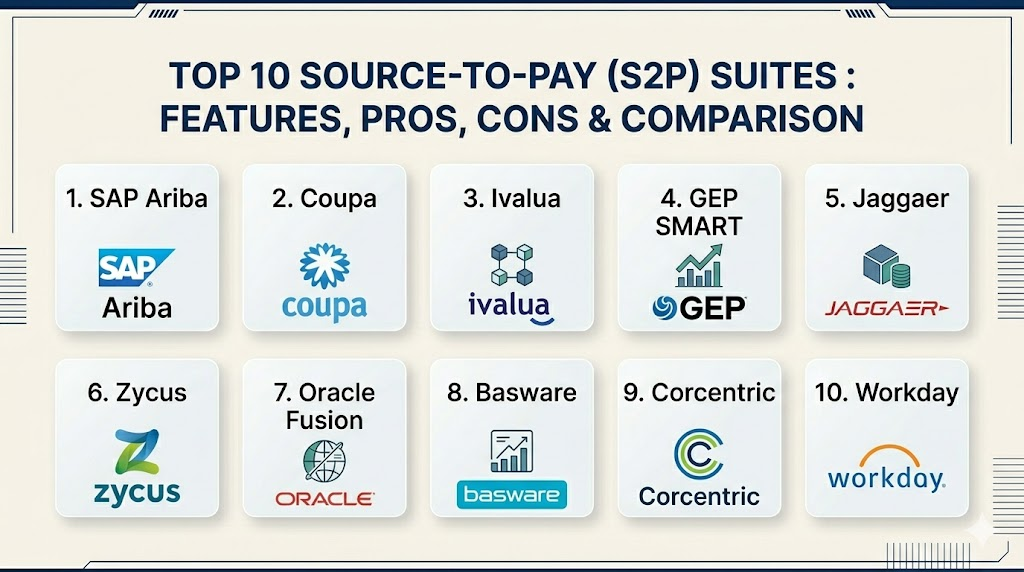
Top 10 Source-to-Pay Software Tools
1. SAP Ariba
This platform is a global leader in the S2P space, known for its massive supplier network and deep integration with the broader SAP ecosystem. It provides a comprehensive suite that scales from simple purchasing to highly complex global sourcing events.
Key Features
- Ariba Network connectivity with millions of active global suppliers.
- Guided Buying interface designed to mirror a consumer shopping experience.
- Advanced spend analysis with automated categorization and visibility.
- Strategic sourcing tools for complex RFI/RFP and e-auction management.
- Robust contract management with pre-approved clause libraries and tracking.
Pros
- Unmatched scalability for the world’s largest and most complex enterprises.
- Seamless synchronization with SAP ERP systems for real-time financial accuracy.
Cons
- Implementation can be long and require specialized consulting resources.
- The depth of the tool can lead to a steep learning curve for occasional users.
Platforms / Deployment
Web / iOS / Android
Cloud
Security & Compliance
ISO 27001, SOC 1, SOC 2, and GDPR compliant with multi-layered encryption.
Not publicly stated.
Integrations & Ecosystem
Native integration with SAP S/4HANA and ECC. It also offers open APIs for connecting to non-SAP financial systems and third-party data providers for risk and sustainability.
Support & Community
Extensive global support network, a dedicated community portal, and a vast ecosystem of certified implementation partners.
2. Coupa
Coupa is widely recognized for its “Business Spend Management” philosophy, emphasizing user adoption and community intelligence to drive savings and compliance across the organization.
Key Features
- Community Intelligence that provides benchmarks based on billions of dollars in anonymized spend.
- Unified platform covering procurement, expenses, payments, and treasury.
- Real-time fraud detection and duplicate invoice prevention.
- Intuitive supplier management portal for seamless onboarding and interaction.
- Mobile-centric design for rapid approvals and requisition tracking.
Pros
- Exceptionally high user adoption rates due to an intuitive, friendly interface.
- Strong focus on continuous innovation and modern AI capabilities.
Cons
- Can be significantly more expensive than mid-market alternatives.
- Advanced features often require additional modules beyond the core suite.
Platforms / Deployment
Web / iOS / Android
Cloud
Security & Compliance
SOC 2 Type II and ISO 27001 certified with comprehensive data privacy controls.
Not publicly stated.
Integrations & Ecosystem
Offers pre-built connectors for a wide range of ERPs including NetSuite, Oracle, and Microsoft. The Coupa App Marketplace allows for easy extension into niche functionalities.
Support & Community
Very strong community focus with regular user groups and an extensive online help center with step-by-step guides.
3. Ivalua
Ivalua stands out for its flexibility and a “single code base” approach, allowing organizations to manage all spend categories and suppliers on a single, highly configurable platform.
Key Features
- Single code base ensuring that all modules share the same data and interface logic.
- Deep capability for managing direct materials and complex bill-of-materials sourcing.
- Advanced supplier risk and performance tracking with third-party data feeds.
- Highly configurable workflows that don’t require custom code for adjustments.
- Integrated project management for strategic sourcing initiatives.
Pros
- Perfect for organizations with unique or highly specialized procurement processes.
- Consistent user experience across every step of the S2P journey.
Cons
- High degree of configurability means implementation requires careful planning.
- Might be more “power-user” focused than some consumer-grade alternatives.
Platforms / Deployment
Web / iOS / Android
Cloud
Security & Compliance
FISMA, SOC 1, and SOC 2 compliance with advanced encryption and access controls.
Not publicly stated.
Integrations & Ecosystem
Extensive API library and pre-built connectors for major ERPs. Known for handling complex data integrations without performance degradation.
Support & Community
Global professional services and a structured training program for both administrators and end-users.
4. GEP SMART
This suite is an AI-first platform that provides a unified experience for both procurement and supply chain professionals, emphasizing digital transformation and mobile productivity.
Key Features
- Unified S2P and Supply Chain Management (SCM) capabilities in one tool.
- AI-powered “Control Tower” for real-time visibility into global operations.
- Advanced savings tracking and financial performance management.
- Intelligent document processing for automated contract and invoice capture.
- Native mobile application that provides full desktop functionality on the go.
Pros
- Excellent for companies looking to bridge the gap between procurement and logistics.
- Strongest native mobile experience in the S2P market.
Cons
- Best suited for very large organizations; may be too robust for smaller firms.
- Pricing and licensing models can be complex.
Platforms / Deployment
Web / iOS / Android
Cloud
Security & Compliance
ISO 27001, SOC 2, and GDPR compliant with robust enterprise security.
Not publicly stated.
Integrations & Ecosystem
Deeply integrated with GEP’s managed services and consulting offerings, providing a holistic approach to procurement transformation.
Support & Community
High-touch customer success model with dedicated account managers and technical support teams available globally.
5. Jaggaer
Jaggaer is renowned for its vertical-specific expertise, particularly in higher education, healthcare, manufacturing, and the public sector, offering specialized modules for these industries.
Key Features
- Specialized catalogs and compliance tools for research and laboratory procurement.
- Advanced e-auction capabilities including Dutch, English, and reverse formats.
- Comprehensive supplier lifecycle management with deep vetting tools.
- Integrated sourcing optimization for large-scale, multi-variable logistics bids.
- Modular architecture allowing companies to start small and expand.
Pros
- Deepest functionality for specialized industries like academia and healthcare.
- Stable and reliable platform with a long history in the procurement space.
Cons
- User interface can feel more traditional compared to newer cloud-native competitors.
- Managing multiple legacy modules can sometimes feel fragmented.
Platforms / Deployment
Web
Cloud
Security & Compliance
SOC 2 and ISO certified with specific public sector compliance standards.
Not publicly stated.
Integrations & Ecosystem
Strong history of integrating with legacy ERP systems and specialized research and inventory management tools.
Support & Community
Excellent industry-specific user groups and a very responsive technical support team.
6. Zycus
Zycus leverages its roots in spend analytics to provide an AI-powered suite that focuses heavily on procurement intelligence and automated decision-making.
Key Features
- Merlin AI Suite for automated spend classification and contract extraction.
- Comprehensive spend analysis with deep “drill-down” reporting capabilities.
- Integrated strategic sourcing with collaborative evaluation tools.
- Automated invoice matching with advanced exception management workflows.
- Centralized supplier portal for risk management and performance scoring.
Pros
- Leading-edge AI capabilities for data cleanup and spend visibility.
- Offers a very strong balance of strategic sourcing and transactional P2P.
Cons
- The user interface has improved but can still feel complex in certain modules.
- Implementation requires a high focus on data quality to get the best results.
Platforms / Deployment
Web / iOS / Android
Cloud
Security & Compliance
ISO 27001 and SOC 2 Type II compliant with high-level data security protocols.
Not publicly stated.
Integrations & Ecosystem
Connects seamlessly with major ERPs and third-party data providers for risk, diversity, and sustainability metrics.
Support & Community
Strong professional services and a dedicated “Zycus Academy” for user training and certification.
7. Oracle Fusion Cloud Procurement
As part of the broader Oracle Cloud ERP, this suite offers unmatched financial integration and is the natural choice for organizations already utilizing Oracle’s business applications.
Key Features
- Deeply integrated sourcing, contracting, and purchasing within the ERP core.
- Automated spend analysis utilizing built-in Oracle Business Intelligence.
- Social collaboration tools for real-time communication between buyers and suppliers.
- Comprehensive self-service procurement for decentralized organizations.
- Integrated supplier risk and qualifications management.
Pros
- Provides a “single source of truth” by sitting directly on the financial ERP.
- Highly scalable for massive global organizations with hundreds of entities.
Cons
- Primarily attractive to existing Oracle customers; less common as a standalone.
- Configuration and upgrades follow a rigid enterprise release cycle.
Platforms / Deployment
Web / iOS / Android
Cloud
Security & Compliance
Top-tier Oracle cloud security with extensive global compliance certifications.
Not publicly stated.
Integrations & Ecosystem
Native integration with Oracle Cloud Financials, HCM, and SCM. Also supports integration with on-premise legacy systems.
Support & Community
Massive global support infrastructure and an extensive library of documentation and training modules.
8. Basware
Basware is a leader in e-invoicing and purchase-to-pay automation, offering the world’s largest open business network for cross-border transactions.
Key Features
- Open network that allows suppliers to connect for free using their preferred format.
- Advanced e-invoice processing with 100% data capture accuracy.
- Global compliance for e-invoicing in over 70 countries.
- Dynamic discounting and early payment programs to optimize cash flow.
- Integrated procurement with guided buying and catalog management.
Pros
- The absolute leader in global e-invoicing compliance and AP automation.
- Open network simplifies the onboarding process for thousands of suppliers.
Cons
- Upstream sourcing and contracting tools are less deep than those in Maya or Ivalua.
- Focus is more heavily weighted toward the “Pay” side of S2P.
Platforms / Deployment
Web / iOS / Android
Cloud
Security & Compliance
ISAE 3402 and ISO 27001 certified with extensive global tax compliance.
Not publicly stated.
Integrations & Ecosystem
Renowned for its ability to connect with multiple different ERP systems across a single global organization.
Support & Community
Expert-led support with a focus on global financial regulations and technical connectivity.
9. Corcentric
Corcentric provides a modular S2P suite combined with managed services, making it an excellent choice for organizations that want to outsource technical or transactional tasks.
Key Features
- Combined software and managed services for sourcing and accounts payable.
- Comprehensive spend analysis with expert-led categorization.
- Integrated fleet and indirect spend management capabilities.
- Strategic sourcing with access to a massive pre-vetted supplier marketplace.
- Flexible P2P workflows with a focus on ease of use.
Pros
- Unique combination of technology and professional services for faster ROI.
- Very strong for mid-market companies that need extra procurement horsepower.
Cons
- The interface, while clean, may lack some of the “bells and whistles” of enterprise giants.
- Some features are more service-dependent than purely software-driven.
Platforms / Deployment
Web
Cloud / Hybrid
Security & Compliance
SOC 1 and SOC 2 Type II compliant with secure data handling practices.
Not publicly stated.
Integrations & Ecosystem
Strong focus on financial system integration and banking connectivity for automated payments.
Support & Community
High-touch support model that functions more as a strategic partner than a software vendor.
10. Workday Strategic Sourcing
Formerly known as Scout RFP, this tool offers a modern, highly intuitive approach to the “Source” side of the equation, integrated within the Workday ecosystem.
Key Features
- Exceptionally simple RFP and RFI creation through a collaborative interface.
- Pipeline management to track all active and upcoming sourcing projects.
- Real-time stakeholder collaboration and scoring for bid evaluations.
- Integrated contract management with Workday Financials.
- Direct intake management to capture and track requests from business units.
Pros
- Easiest to use for strategic sourcing, with high adoption from non-procurement users.
- Seamless experience for existing Workday Finance and HR customers.
Cons
- Historically stronger on the sourcing side than on complex P2P/AP automation.
- Best utilized as part of the broader Workday platform rather than standalone.
Platforms / Deployment
Web / iOS / Android
Cloud
Security & Compliance
Standard Workday enterprise security with comprehensive global certifications.
Not publicly stated.
Integrations & Ecosystem
Native integration with Workday Financial Management and Human Capital Management.
Support & Community
Benefit from the massive Workday community and high-quality professional support tiers.
Comparison Table
| Tool Name | Best For | Platform(s) Supported | Deployment | Standout Feature | Public Rating |
| 1. SAP Ariba | Global Enterprise | Win, macOS, iOS, Android | Cloud | Ariba Network | N/A |
| 2. Coupa | User Adoption | Win, macOS, iOS, Android | Cloud | Community Intelligence | N/A |
| 3. Ivalua | Complex Needs | Win, macOS, iOS, Android | Cloud | Single Code Base | N/A |
| 4. GEP SMART | S2P + Supply Chain | Win, macOS, iOS, Android | Cloud | AI Control Tower | N/A |
| 5. Jaggaer | Higher Ed / Health | Win, macOS | Cloud | Vertical Specialization | N/A |
| 6. Zycus | AI Analytics | Win, macOS, iOS, Android | Cloud | Merlin AI Suite | N/A |
| 7. Oracle Fusion | Oracle ERP Users | Win, macOS, iOS, Android | Cloud | ERP Integration | N/A |
| 8. Basware | Global E-Invoicing | Win, macOS, iOS, Android | Cloud | Open Global Network | N/A |
| 9. Corcentric | Managed Services | Win, macOS | Hybrid | Service-Led Sourcing | N/A |
| 10. Workday | Strategic Sourcing | Win, macOS, iOS, Android | Cloud | Intake Management | N/A |
Evaluation & Scoring
| Tool Name | Core (25%) | Ease (15%) | Integrations (15%) | Security (10%) | Perf (10%) | Support (10%) | Value (15%) | Total |
| 1. SAP Ariba | 10 | 5 | 10 | 9 | 8 | 9 | 6 | 8.25 |
| 2. Coupa | 9 | 10 | 9 | 9 | 9 | 8 | 7 | 8.75 |
| 3. Ivalua | 10 | 6 | 9 | 9 | 9 | 8 | 7 | 8.15 |
| 4. GEP SMART | 9 | 7 | 8 | 9 | 10 | 9 | 8 | 8.40 |
| 5. Jaggaer | 8 | 6 | 8 | 8 | 8 | 9 | 8 | 7.70 |
| 6. Zycus | 9 | 6 | 8 | 9 | 8 | 8 | 8 | 7.75 |
| 7. Oracle Fusion | 9 | 6 | 10 | 9 | 8 | 8 | 7 | 7.90 |
| 8. Basware | 8 | 8 | 9 | 9 | 9 | 8 | 8 | 8.35 |
| 9. Corcentric | 7 | 8 | 8 | 8 | 8 | 10 | 9 | 8.10 |
| 10. Workday | 7 | 9 | 9 | 9 | 9 | 8 | 7 | 7.95 |
The scoring provided above represents a balanced view of the current S2P market. A platform like Coupa scores high due to its exceptional user adoption and overall value, while SAP Ariba leads in core feature depth and its massive network. It is important to remember that these scores are relative; a tool with a lower total score, such as Jaggaer, may actually be the perfect “10 out of 10” for a specific industry like Higher Education, where its vertical-specific modules outperform more general suites.
Which Source-to-Pay Software Tool Is Right for You?
Solo / Freelancer
For independent procurement consultants, a full S2P suite is rarely necessary. However, if supporting a client, Workday Strategic Sourcing or Blender-style open tools offer the easiest entry point for managing small-scale RFPs without needing a massive technical backend.
SMB
Small to mid-sized businesses should prioritize Corcentric or Basware. These tools offer excellent value and can often be implemented in a modular fashion, allowing the business to solve immediate AP pain points before expanding into strategic sourcing.
Mid-Market
Organizations in the mid-market space benefit most from Coupa or Zycus. These platforms provide a high level of automation and intelligence that can significantly multiply the output of a small procurement team without requiring a massive IT department to manage the software.
Enterprise
For large, global entities, SAP Ariba, Oracle Fusion, or Ivalua are the standard choices. These suites are designed to handle the immense complexity of multi-national operations, providing the rigorous controls and deep ERP integrations required by enterprise finance teams.
Budget vs Premium
- Budget: Basware (focusing on the network) or Jaggaer (modular approach).
- Premium: SAP Ariba and Coupa represent the top-tier investments for those seeking the most comprehensive ecosystems.
Feature Depth vs Ease of Use
- Depth: Ivalua and Houdini-style procedural tools offer the most control for complex direct materials.
- Ease of Use: Coupa and Workday Strategic Sourcing are the clear winners for high adoption across the general workforce.
Integrations & Scalability
If your organization runs entirely on a single ERP, the native solution (SAP Ariba for SAP or Oracle Fusion for Oracle) is often the most scalable. For multi-ERP environments, Basware and Coupa offer superior flexibility in connecting disparate systems.
Security & Compliance Needs
Enterprises dealing with high-security government contracts or strict global tax regimes should prioritize Oracle, SAP, or Basware, as these vendors have the most extensive global compliance footprints and dedicated legal-technical teams.
Frequently Asked Questions (FAQs)
1. What is the main difference between P2P and S2P?
P2P (Procure-to-Pay) focuses on the transactional side—requisitions, POs, and payments—while S2P (Source-to-Pay) includes the strategic “upstream” steps like supplier discovery and contracting.
2. How long does a typical S2P suite implementation take?
For an enterprise-level suite, implementation usually ranges from six months to over a year, depending on the number of modules and the complexity of ERP integrations.
3. Can these tools really help with sustainability goals?
Yes, many modern suites now integrate third-party ESG data, allowing buyers to filter and select suppliers based on their environmental impact and social responsibility scores.
4. Do suppliers have to pay to join these networks?
It varies. SAP Ariba often has tiered fees for suppliers based on volume, whereas networks like Basware are typically free for suppliers to join, which speeds up onboarding.
5. How does AI help in the Source-to-Pay process?
AI is used for spend classification, identifying fraudulent invoices, predicting supplier risk, and even drafting contract clauses based on previous successful negotiations.
6. Is it better to buy a full suite or “best-of-breed” individual tools?
A full suite offers a unified data model and a single interface, while best-of-breed tools may offer deeper niche functionality but require more effort to integrate.
7. How do these suites handle global tax compliance?
Leading platforms like Basware and SAP Ariba have built-in tax engines that automatically apply local VAT/GST rules and e-invoicing formats for dozens of countries.
8. Can S2P software help with “Maverick Spend”?
Yes, by using guided buying and pre-approved catalogs, the software ensures that employees stay within company policy and use only contracted suppliers.
9. What is a “Three-Way Match”?
It is a security check where the software automatically compares the Purchase Order, the Goods Receipt, and the Vendor Invoice to ensure they all match before a payment is issued.
10. Do these platforms support mobile approvals?
Most modern S2P suites offer native mobile apps that allow managers to review and approve spending requests and invoices from anywhere, preventing operational bottlenecks.
Conclusion
Implementing a Source-to-Pay suite is a transformative step that moves procurement from a back-office function to a strategic driver of business value. By unifying the entire lifecycle—from the initial identification of a supplier to the final settlement of an invoice—organizations gain a level of control and visibility that is essential for modern risk management and financial health. While the selection process requires a careful balance of feature depth and user accessibility, the long-term benefits of a single source of truth for spend are undeniable. As AI continues to automate the routine, the most successful teams will be those who leverage these platforms to focus on strategic supplier relationships and sustainable growth.

Best Cardiac Hospitals Near You
Discover top heart hospitals, cardiology centers & cardiac care services by city.
Advanced Heart Care • Trusted Hospitals • Expert Teams
View Best Hospitals