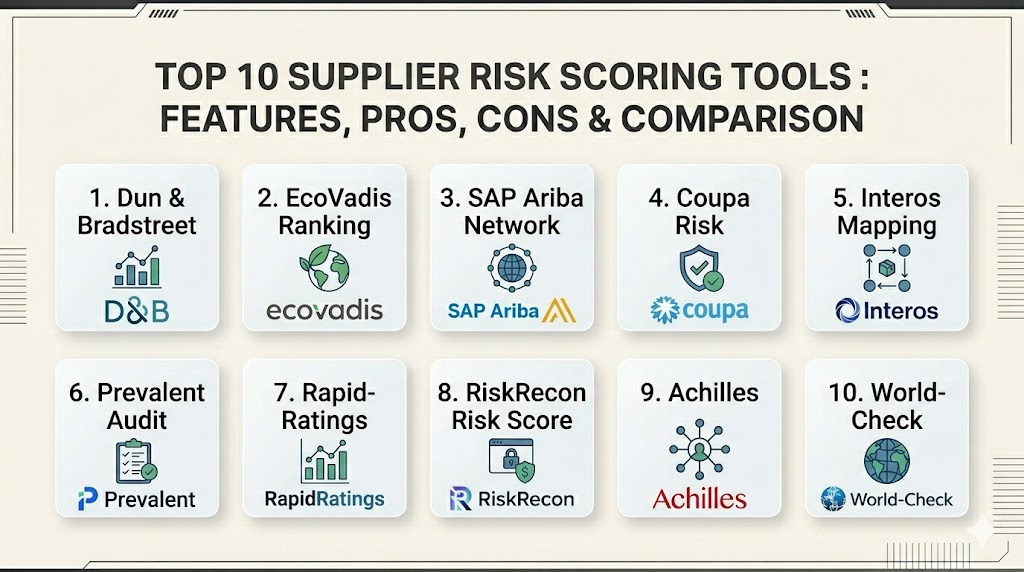
Introduction
Supplier risk scoring has transitioned from a manual, periodic compliance check into a real-time, data-driven necessity for modern global enterprises. In an era defined by volatile supply chains, shifting geopolitical landscapes, and increasing regulatory pressure, understanding the health and reliability of third-party vendors is critical. These tools provide a systematic way to quantify risks—ranging from financial instability and cyber vulnerabilities to ESG compliance and operational reliability—allowing organizations to make informed procurement decisions and mitigate disruptions before they occur.
As we move deeper into an integrated global economy, the ability to automate risk monitoring is what separates resilient companies from those vulnerable to sudden shocks. Buyers must look for platforms that offer more than just a snapshot; they need dynamic scoring models that update based on live data feeds, news sentiment, and financial filings. By centralizing this data, procurement and risk teams can move away from reactive firefighting and toward a proactive strategy that protects both the bottom line and the company’s reputation.
Best for: Procurement officers, Chief Risk Officers (CROs), supply chain managers, and sustainability teams at mid-sized to large enterprises who manage a complex web of global vendors and require automated, high-fidelity risk intelligence.
Not ideal for: Small local businesses with a handful of well-known domestic suppliers, or organizations looking for a simple contact management system without the need for deep financial or cybersecurity forensics.
Key Trends in Supplier Risk Scoring
- AI-Driven Sentiment Analysis: Modern tools use natural language processing to scan thousands of global news sources and social media in real-time to detect early warning signs of supplier trouble.
- Predictive Financial Modeling: Moving beyond historical credit scores, new systems use machine learning to predict the likelihood of a supplier’s bankruptcy up to two years in advance.
- ESG and Sustainability Integration: Risk scores now heavily weigh environmental impact, labor practices, and carbon footprints to align with new global transparency laws.
- Cybersecurity Posture Monitoring: Assessing a supplier’s digital defense mechanisms has become a core component of the total risk score to prevent supply chain data breaches.
- Geopolitical Risk Mapping: Tools now include “n-tier” visibility, mapping not just direct suppliers but also the sub-suppliers located in high-risk geographic regions.
- N-Tier Transparency: The shift from monitoring Tier 1 suppliers to gaining visibility into Tier 2 and Tier 3 entities to uncover hidden vulnerabilities deep in the chain.
- Automated Remediation Workflows: When a risk score drops below a certain threshold, systems now automatically trigger mitigation plans or request updated documentation from the vendor.
- Interoperability with ERP Systems: Seamless data flow between risk scoring platforms and core enterprise resource planning tools ensures that risk is considered during every purchase order.
How We Selected These Tools
- Data Depth and Quality: We prioritized platforms that aggregate data from a wide variety of verified sources, including financial bureaus, legal records, and cyber-security feeds.
- Real-Time Monitoring Capabilities: Preference was given to tools that offer continuous updates rather than static, one-time reports.
- Analytic Sophistication: We evaluated the complexity of the underlying scoring algorithms and their ability to provide actionable insights rather than just raw numbers.
- Market Reputation and Adoption: The selection includes industry leaders recognized by major analyst firms and used by Global 2000 companies.
- Ease of Integration: We looked for tools that can be easily plugged into existing procurement and supply chain management ecosystems.
- Comprehensive Risk Coverage: Only tools that cover multiple risk domains—financial, operational, ethical, and digital—were considered for this list.
Top 10 Supplier Risk Scoring Tools
1. Dun & Bradstreet Risk Analytics
A cornerstone of the financial intelligence world, this tool leverages one of the largest commercial databases to provide deep insights into the financial health and operational stability of millions of businesses globally.
Key Features
- Failure Score and Delinquency Score to predict financial instability.
- Global Data Cloud access with information on over hundreds of millions of entities.
- Integrated restricted party screening for sanctions and compliance.
- ESG Intelligence scores to measure environmental and social impact.
- Real-time alerts for significant changes in a supplier’s risk profile.
Pros
- Unmatched database size and historical financial data.
- Highly recognized scores that are used as a standard by banks and government agencies.
Cons
- The interface can be complex due to the sheer volume of data.
- Premium data access comes with a significant price tag.
Platforms / Deployment
Web / Windows / macOS
Cloud
Security & Compliance
Enterprise-level encryption and secure multi-factor authentication.
SOC 2 compliant.
Integrations & Ecosystem
Integrates deeply with major ERP and CRM platforms, allowing risk scores to be pulled directly into procurement workflows via robust API connections.
Support & Community
Extensive corporate support with dedicated account managers and a wide range of technical documentation for developers.
2. EcoVadis
The global standard for business sustainability ratings, EcoVadis focuses heavily on the ethical, environmental, and social risks within a supply chain.
Key Features
- Evidence-based ratings across environment, labor, and human rights.
- Actionable corrective action plans for suppliers to improve their scores.
- Industry-specific benchmarks to compare supplier performance.
- Carbon Action Module for tracking and reducing supply chain emissions.
- Global network of rated companies for easier benchmarking.
Pros
- The most respected name in ESG risk scoring.
- Easy-to-understand scorecard format for both buyers and suppliers.
Cons
- Heavily reliant on supplier-provided documentation for initial assessments.
- The assessment process can take several weeks to complete.
Platforms / Deployment
Web
Cloud
Security & Compliance
Standard web security protocols and data privacy protections.
ISO 27001 compliant.
Integrations & Ecosystem
Connects with leading procurement software suites to ensure sustainability is a key factor in the vendor selection process.
Support & Community
Provides extensive training for suppliers on how to improve their sustainability practices and overall risk scores.
3. SAP Ariba Supplier Risk
As part of the broader SAP ecosystem, this tool provides a comprehensive risk management framework that is natively integrated into the world’s largest procurement network.
Key Features
- Risk exposure dashboards tailored to specific categories or regions.
- Real-time monitoring of over 200 risk types including news and social media.
- Automated risk assessment triggers during the onboarding process.
- Seamless integration with supplier performance management data.
- Global map views to visualize geographic risk concentrations.
Pros
- Perfect for organizations already using the SAP suite for procurement.
- Broad coverage of risk types from financial to reputational.
Cons
- Can feel restrictive if you are not using other SAP modules.
- Requires a significant initial configuration to align with specific business rules.
Platforms / Deployment
Web / iOS / Android
Cloud
Security & Compliance
High-level enterprise security within the SAP Cloud environment.
SOC 2 and GDPR compliant.
Integrations & Ecosystem
Best-in-class integration with SAP ERP and S/4HANA, as well as external data providers for credit and cyber risk.
Support & Community
Large global support network with a massive community of users and certified implementation partners.
4. Coupa Risk & Performance
Coupa focuses on “Business Spend Management” and integrates risk scoring directly into the point of purchase, ensuring that employees are always buying from low-risk vendors.
Key Features
- Community Intelligence that uses anonymized data to benchmark supplier performance.
- Automated risk scoring based on financial, legal, and social data.
- Integrated diversity and sustainability tracking.
- Continuous monitoring of third-party risk throughout the contract lifecycle.
- Streamlined onboarding with built-in risk vetting.
Pros
- Excellent user experience that encourages high adoption rates.
- Unique community data provides insights that other tools lack.
Cons
- More focused on spend management than deep-dive forensic risk.
- Premium features can add up quickly in terms of cost.
Platforms / Deployment
Web / iOS / Android
Cloud
Security & Compliance
Robust identity management and data encryption.
SOC 1, SOC 2, and ISO 27001 compliant.
Integrations & Ecosystem
Strong API-led connectivity with a wide variety of third-party data providers and financial systems.
Support & Community
A very active user community and a well-structured customer success program.
5. Interos
Interos uses advanced AI to map global supply chains in their entirety, offering a “living map” of n-tier relationships and identifying vulnerabilities deep within the network.
Key Features
- AI-driven mapping of multi-tier supplier relationships.
- Instant visibility into geographic, financial, and cyber risks.
- Real-time monitoring of global events impacting supply lines.
- Automated discovery of “hidden” suppliers in the chain.
- Comprehensive risk scoring for every entity in the network.
Pros
- Unbeatable for visualizing complex, multi-tier supply chain risks.
- Rapid discovery of sub-tier vulnerabilities that manual audits miss.
Cons
- The amount of data can be overwhelming for smaller procurement teams.
- Requires a shift in mindset to manage risks beyond direct Tier 1 vendors.
Platforms / Deployment
Web
Cloud
Security & Compliance
Secure cloud architecture with modern data protection standards.
Not publicly stated.
Integrations & Ecosystem
Integrates with major supply chain planning and procurement tools to provide a layer of risk intelligence over existing data.
Support & Community
Professional service teams available to help enterprises map and interpret complex supply chain data.
6. Prevalent
A leader in Third-Party Risk Management (TPRM), Prevalent combines automated scanning with managed services to provide a 360-degree view of vendor risk.
Key Features
- Automated vendor risk assessment questionnaires.
- Continuous cyber, business, and financial monitoring.
- Centralized risk register for all third-party entities.
- Compliance mapping for standards like HIPAA, GDPR, and NIST.
- Evidence-based risk scoring and validation.
Pros
- Excellent for meeting strict regulatory and compliance requirements.
- Combines internal assessments with external monitoring for a complete picture.
Cons
- Setup can be time-consuming due to the level of detail required.
- Smaller vendors may find the assessment questionnaires burdensome.
Platforms / Deployment
Web
Cloud
Security & Compliance
Dedicated focus on compliance with international security standards.
SOC 2 compliant.
Integrations & Ecosystem
Connects with GRC (Governance, Risk, and Compliance) platforms and internal security tools.
Support & Community
Strong customer support and a wealth of educational webinars on risk management trends.
7. RapidRatings
Specializing in financial health, RapidRatings uses a unique, math-based methodology to analyze the financial statements of both public and private companies.
Key Features
- Financial Health Rating (FHR) based on a consistent, objective model.
- Predictive analysis of a supplier’s ability to sustain operations.
- Benchmarking tools to compare suppliers within the same industry.
- Dedicated portals for private companies to securely share financial data.
- Detailed reports that translate complex financials into risk scores.
Pros
- Highly accurate and objective financial risk assessment.
- Effective for getting visibility into the health of private suppliers.
Cons
- Strictly focused on financials; requires other tools for cyber or ESG risk.
- Dependent on suppliers’ willingness to share financial statements.
Platforms / Deployment
Web
Cloud
Security & Compliance
Secure data rooms for sensitive financial information.
Not publicly stated.
Integrations & Ecosystem
Integrates with major procurement and risk platforms to add financial depth to existing scores.
Support & Community
Provides expert analyst support to help users interpret complex financial data.
8. RiskRecon (by Mastercard)
RiskRecon specializes in cybersecurity risk, providing automated assessments of a supplier’s digital footprint and security hygiene.
Key Features
- Automated discovery of a supplier’s internet-facing assets.
- Continuous monitoring for vulnerabilities and misconfigurations.
- Risk scores based on the severity and presence of security issues.
- Benchmarking of a vendor’s security against industry standards.
- Actionable insights for vendors to remediate their security gaps.
Pros
- Provides an objective, “outside-in” view of a supplier’s security.
- Very fast to deploy with no integration required from the supplier.
Cons
- Limited to cybersecurity; does not cover financial or operational risk.
- Some “outside-in” scans may produce false positives that require validation.
Platforms / Deployment
Web
Cloud
Security & Compliance
Part of the Mastercard security ecosystem.
SOC 2 compliant.
Integrations & Ecosystem
Plugs into broader TPRM and procurement suites to provide the cyber-risk component of a total score.
Support & Community
Solid technical support and clear documentation for security teams.
9. Achilles
Achilles focuses on high-risk industries like energy, construction, and mining, providing deep-dive audits and verified supplier data.
Key Features
- Industry-specific pre-qualification questionnaires.
- On-site audits to verify supplier claims and compliance.
- Financial, health and safety, and environmental risk scoring.
- Global network of pre-vetted suppliers for specific sectors.
- Carbon reduction and ethical employment tracking.
Pros
- Provides high-confidence data through physical and digital audits.
- Specifically tailored to the complex needs of heavy industry.
Cons
- The audit-based approach is slower than purely automated scanning.
- Generally more expensive than software-only solutions.
Platforms / Deployment
Web
Cloud / Hybrid
Security & Compliance
High standards for data verification and physical security audits.
ISO 9001 and 14001 compliant.
Integrations & Ecosystem
Used primarily as a standalone verification hub that can export data to enterprise systems.
Support & Community
Strong regional support in Europe and Latin America with industry-specific working groups.
10. Refinitiv (LSEG) World-Check
This tool is the gold standard for compliance and screening, focusing on legal, regulatory, and reputational risk.
Key Features
- Database of Politically Exposed Persons (PEPs) and sanctioned entities.
- Monitoring for adverse media and legal enforcement actions.
- KYC (Know Your Customer) and KYB (Know Your Business) screening.
- Ultimate Beneficial Ownership (UBO) tracking to uncover hidden risks.
- Real-time automated screening against global watchlists.
Pros
- Essential for preventing money laundering and ensuring regulatory compliance.
- Massive, highly accurate database of legal and reputational risk.
Cons
- Focuses on “bad actors” rather than general operational performance.
- Can generate many “potential matches” that require manual review.
Platforms / Deployment
Web / API
Cloud
Security & Compliance
Highest levels of data security required for financial compliance.
ISAE 3000 compliant.
Integrations & Ecosystem
Designed to be integrated via API into onboarding and payment systems for instant screening.
Support & Community
Global support for financial institutions and large corporate compliance departments.
Comparison Table
| Tool Name | Best For | Platform(s) Supported | Deployment | Standout Feature | Public Rating |
| 1. Dun & Bradstreet | Financial Health | Web, Windows, macOS | Cloud | Global Data Cloud | N/A |
| 2. EcoVadis | Sustainability/ESG | Web | Cloud | ESG Scorecards | N/A |
| 3. SAP Ariba | ERP Integration | Web, iOS, Android | Cloud | Ariba Network | N/A |
| 4. Coupa Risk | Spend Management | Web, iOS, Android | Cloud | Community Intelligence | N/A |
| 5. Interos | N-Tier Visibility | Web | Cloud | AI Multi-Tier Mapping | N/A |
| 6. Prevalent | Compliance/TPRM | Web | Cloud | Automated Questionnaires | N/A |
| 7. RapidRatings | Financial Foresight | Web | Cloud | FHR Predictive Math | N/A |
| 8. RiskRecon | Cyber Security | Web | Cloud | Passive Asset Scanning | N/A |
| 9. Achilles | Heavy Industry | Web | Cloud/Hybrid | On-site Verifications | N/A |
| 10. World-Check | Legal Compliance | Web, API | Cloud | Sanctions Screening | N/A |
Evaluation & Scoring
| Tool Name | Core (25%) | Ease (15%) | Integrations (15%) | Security (10%) | Perf (10%) | Support (10%) | Value (15%) | Total |
| 1. Dun & Bradstreet | 10 | 6 | 9 | 9 | 9 | 9 | 7 | 8.50 |
| 2. EcoVadis | 9 | 8 | 8 | 8 | 8 | 8 | 8 | 8.25 |
| 3. SAP Ariba | 9 | 5 | 10 | 9 | 9 | 8 | 6 | 8.10 |
| 4. Coupa Risk | 8 | 9 | 9 | 9 | 8 | 9 | 7 | 8.25 |
| 5. Interos | 9 | 6 | 7 | 8 | 10 | 8 | 7 | 8.05 |
| 6. Prevalent | 8 | 7 | 8 | 9 | 8 | 8 | 8 | 7.90 |
| 7. RapidRatings | 10 | 7 | 8 | 8 | 9 | 8 | 7 | 8.30 |
| 8. RiskRecon | 8 | 9 | 9 | 9 | 10 | 8 | 8 | 8.70 |
| 9. Achilles | 9 | 5 | 6 | 8 | 7 | 8 | 6 | 7.15 |
| 10. World-Check | 10 | 6 | 9 | 10 | 9 | 8 | 7 | 8.45 |
The scoring above demonstrates that the “best” tool is highly dependent on which risk domain is most critical to your organization. For instance, RiskRecon scores highly on total value and performance because it provides instant, objective data on a critical modern threat: cyber attacks. Dun & Bradstreet remains the heavyweight for financial data due to its sheer scale. Meanwhile, Achilles scores lower on ease and performance only because its rigorous, human-led audit process is inherently slower and more complex than pure software solutions, even though it provides higher data certainty.
Which Supplier Risk Scoring Tool Is Right for You?
Solo / Freelancer
For individual consultants or very small firms, the complexity of these tools is likely overkill. However, using the free portions of EcoVadis or basic business lookups through Dun & Bradstreet can help ensure you aren’t partnering with high-risk entities.
SMB
Small to medium businesses should look for tools with high “Ease of Use” and lower integration hurdles. Coupa or EcoVadis offer intuitive interfaces that allow a small procurement team to gain significant risk visibility without needing a dedicated risk department.
Mid-Market
Mid-market companies often face growing regulatory pressure and need to prove their supply chain is clean. Prevalent or RapidRatings provide excellent middle-ground solutions that offer professional-grade risk reporting and compliance mapping at a manageable scale.
Enterprise
Large enterprises with thousands of global suppliers require the heavy lifting of SAP Ariba, Dun & Bradstreet, or Interos. These platforms can handle the massive data volumes and complex multi-tier relationships that define global 2000 supply chains.
Budget vs Premium
If budget is the primary concern, focusing on “Outside-In” scanners like RiskRecon can provide immediate value without high implementation costs. For premium needs where data accuracy is the top priority, the audit-verified data from Achilles is worth the investment.
Feature Depth vs Ease of Use
Coupa is the leader for ease of use, making it easy for non-experts to see risk scores. On the other hand, Houdini-level complexity in the risk world is found in Interos, which offers deep, multi-tier mapping that requires more time to master but provides much more depth.
Integrations & Scalability
For organizations running their entire business on a specific ERP, the native risk modules in SAP Ariba are the most scalable. For those with a “Best of Breed” approach, Dun & Bradstreet and World-Check offer the most robust APIs.
Security & Compliance Needs
When legal compliance is the absolute priority, World-Check is the non-negotiable standard. For high-tech companies where data protection is the primary risk, RiskRecon and Prevalent provide the necessary security-focused scoring.
Frequently Asked Questions (FAQs)
1. What is the difference between a risk score and a credit score?
A credit score focuses strictly on financial reliability and payment history, while a supplier risk score incorporates broader factors like cybersecurity, operational stability, and ethical compliance.
2. How often are these supplier risk scores updated?
Many modern tools offer real-time or daily updates based on news feeds and financial filings, whereas traditional audit-based scores might only be updated once or twice a year.
3. Do these tools require the supplier’s permission to scan them?
Financial and cyber-security tools like RiskRecon or Dun & Bradstreet use publicly available data. However, tools like EcoVadis or Achilles require the supplier to actively participate and provide documentation.
4. Can one tool cover all types of supplier risk?
While some platforms like SAP Ariba attempt to be all-encompassing, most enterprises use a combination of tools—one for financials, one for cyber, and one for ESG—to get a complete picture.
5. What is n-tier risk mapping?
It is the process of identifying not just your direct suppliers (Tier 1), but also the suppliers who sell to them (Tier 2 and beyond) to find hidden risks deep in the supply chain.
6. Are these tools suitable for small businesses?
Most of these tools are designed for mid-market to enterprise companies. Small businesses may find the cost and complexity prohibitive unless they operate in a highly regulated industry.
7. How do these tools handle private company data?
Tools like RapidRatings have established secure portals where private companies can share their financial data confidentially to receive a standardized risk score without going public.
8. What is adverse media monitoring?
It is an AI-driven process that scans global news and social media for negative reports about a company, such as arrests, lawsuits, or environmental scandals.
9. Why is ESG scoring becoming so important in procurement?
New laws in various regions now require companies to report on the environmental and social impact of their entire supply chain, making ESG scores a legal necessity.
10. How long does it take to implement a supplier risk tool?
Simple “outside-in” scanners can be active in days, but a full enterprise integration with a platform like SAP Ariba or Coupa can take several months.
Conclusion
Navigating the complexities of modern procurement requires a shift from static vendor lists to dynamic risk ecosystems. The Top 10 tools highlighted here represent the vanguard of this movement, offering diverse methodologies to protect your operations from financial, ethical, and digital threats. Whether you prioritize the deep financial history of established bureaus or the cutting-edge AI mapping of n-tier relationships, the goal remains the same: transforming risk from a hidden liability into a manageable data point. By implementing a robust scoring framework today, organizations can ensure their supply chains are not only efficient but fundamentally resilient against the uncertainties of tomorrow.

Best Cardiac Hospitals Near You
Discover top heart hospitals, cardiology centers & cardiac care services by city.
Advanced Heart Care • Trusted Hospitals • Expert Teams
View Best Hospitals