Introduction
Supply Chain Management (SCM) suites are integrated software ecosystems designed to oversee the flow of goods, data, and finances as they move from supplier to manufacturer to wholesaler and finally to the end consumer. These platforms synchronize complex global networks by unifying procurement, inventory management, logistics, and demand forecasting into a single pane of glass. In the current landscape, SCM suites have transitioned from reactive tracking tools into proactive, AI-driven engines capable of simulating thousands of disruption scenarios to ensure business continuity.
The modernization of the supply chain is no longer a luxury but a requirement for survival in a volatile global market. Modern suites leverage cloud-native architectures to provide real-time visibility across multi-tier supplier networks, breaking down the silos that traditionally lead to overstocking or critical shortages. For decision-makers, evaluating an SCM suite requires a deep look at the platform’s ability to handle “What-If” analysis, its native integration with existing ERP systems, and its capacity to manage sustainability and ESG reporting requirements.
Best for: Global manufacturers, large-scale retailers, third-party logistics (3PL) providers, and multi-national distributors requiring end-to-end synchronization of materials and finished goods.
Not ideal for: Small local service businesses with no physical inventory or companies with extremely simple, single-source procurement needs.
Key Trends in Supply Chain Management Software
- Autonomous Planning: AI and machine learning are now automating demand forecasting and replenishment triggers, reducing the reliance on manual spreadsheets.
- Control Tower Visibility: Organizations are implementing digital control towers that provide a 360-degree view of the entire supply chain, including real-time transit tracking.
- Blockchain for Traceability: Distributed ledger technology is being utilized to provide immutable proof of origin for raw materials, supporting ethical sourcing and compliance.
- Resilience Modeling: Advanced suites now include digital twin technology to stress-test the supply chain against geopolitical shifts or natural disasters.
- Circular Economy Support: New modules are emerging to track the return, repair, and recycling of products, aligning supply chain operations with sustainability goals.
- Edge Computing in Logistics: Real-time data processing at the warehouse and transportation level is reducing latency in tracking and autonomous vehicle routing.
How We Selected These Tools (Methodology)
- End-to-End Breadth: We prioritized suites that cover the entire lifecycle, from strategic sourcing to final mile delivery.
- AI and Analytics Depth: Selection was based on the sophistication of the predictive engines and the quality of the prescriptive insights provided.
- Global Scalability: We evaluated the tools based on their ability to handle multiple currencies, languages, and complex international trade regulations.
- Integration Maturity: Priority was given to platforms that offer robust, pre-built connectors to major ERP and CRM ecosystems.
- Market Resilience: We chose established leaders with a proven track record of maintaining uptime and data integrity during global disruptions.
- User Adoption: We considered the intuitiveness of the interface for both office-based planners and warehouse-based operators.
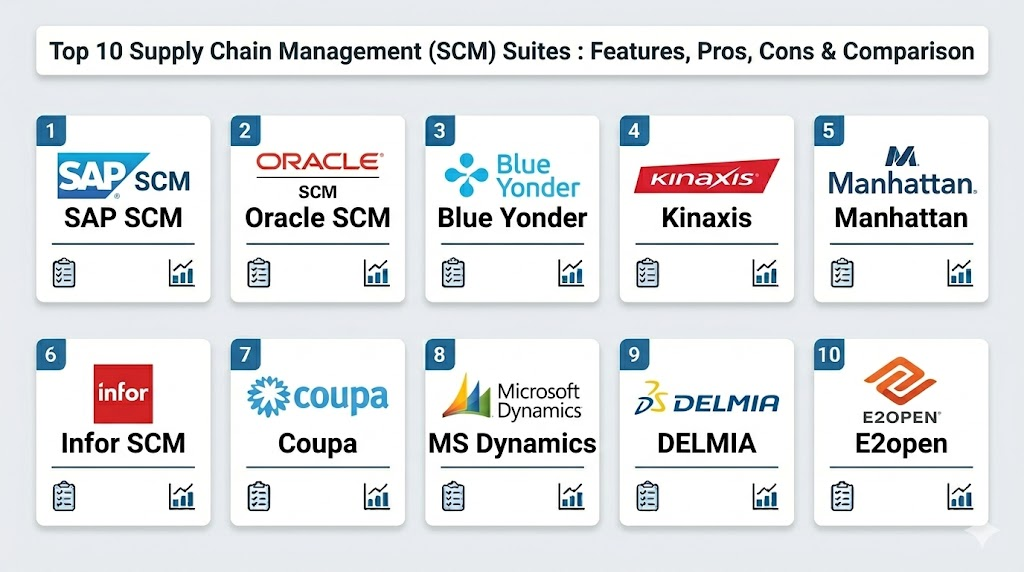
Top 10 Supply Chain Management (SCM) Suites
1. SAP SCM (Digital Supply Chain)
SAP is the definitive leader in the enterprise space, offering a massive, integrated suite that connects supply chain planning with execution and the wider business network. It is built to handle the world’s most complex logistics challenges.
Key Features
- Integrated Business Planning (IBP) for advanced demand and supply synchronization.
- SAP Transportation Management for optimized global shipping routes.
- Extended Warehouse Management (EWM) for high-volume warehouse operations.
- Ariba Network integration for seamless digital procurement.
- Real-time tracking via the SAP Logistics Business Network.
Pros
- Unmatched depth of features for global enterprise operations.
- Native integration with the world’s most used ERP system.
Cons
- Extremely high implementation costs and long deployment timelines.
- Requires highly specialized consultants to manage and configure.
Platforms / Deployment
- Windows / Web / Mobile
- Cloud / On-premise / Hybrid
Security & Compliance
- SOC 1, SOC 2, ISO 27001, and GDPR compliant.
- Advanced RBAC and encryption protocols.
Integrations & Ecosystem
The largest enterprise ecosystem globally, connecting to nearly all business software.
- SAP S/4HANA
- Salesforce
- Microsoft Azure
- Various IoT platforms
Support & Community
Unrivaled global support network and a massive community of certified professionals.
2. Oracle Cloud SCM
Oracle Cloud SCM is a cloud-native suite built from the ground up to provide a unified data model across procurement, manufacturing, and logistics. It is known for its strong built-in analytics.
Key Features
- Oracle Global Order Promising to accurately predict delivery dates.
- Inventory Management with real-time visibility across all locations.
- Procurement Cloud for automated strategic sourcing and contracts.
- Product Lifecycle Management (PLM) for managing innovation.
- Blockchain-ready tracking for supply chain transparency.
Pros
- Unified cloud platform reduces data silos between departments.
- Very strong financial integration for cost-to-serve analysis.
Cons
- The user interface can be dense and requires significant training.
- Customizations can be difficult compared to modular competitors.
Platforms / Deployment
- Web / iOS / Android
- Cloud-native
Security & Compliance
- FedRAMP, SOC 2, and ISO 27001 standards.
- Hardware-level security via Oracle Cloud Infrastructure.
Integrations & Ecosystem
Strongest within the Oracle ecosystem but highly extensible via APIs.
- Oracle ERP Cloud
- NetSuite
- Microsoft Power BI
- Workday
Support & Community
Extensive Oracle University training and professional enterprise support tiers.
3. Blue Yonder (formerly JDA Software)
Blue Yonder is a specialist SCM provider that focuses heavily on AI-driven cognitive retail and supply chain excellence. It is the go-to for high-velocity retail and consumer goods.
Key Features
- Luminate Planning for AI-powered demand and supply balancing.
- Warehouse Management Systems (WMS) for complex fulfillment.
- Transportation Management (TMS) with real-time carrier collaboration.
- Category Management for optimizing retail shelf space.
- Cognitive “What-If” scenario planning.
Pros
- Industry-leading AI for demand forecasting accuracy.
- Deeply specialized for the retail and CPG sectors.
Cons
- Can be more expensive than generalist ERP-based suites.
- Integration with non-Blue Yonder WMS can be complex.
Platforms / Deployment
- Web / Mobile
- Cloud-native (Microsoft Azure based)
Security & Compliance
- SOC 2 and ISO 27001 certifications.
- Azure-backed data security and encryption.
Integrations & Ecosystem
Strong partnership with Microsoft and major retail tech providers.
- Microsoft Dynamics 365
- SAP
- Oracle
- Various warehouse automation robotics.
Support & Community
Strong focus on customer success and specialized retail industry forums.
4. Kinaxis RapidResponse
Kinaxis is famous for its concurrent planning capabilities, allowing companies to plan and execute in real-time across the entire supply chain simultaneously.
Key Features
- Concurrent Planning engine for instant impact analysis.
- Demand, Supply, and Inventory planning in a single environment.
- S&OP (Sales and Operations Planning) visualization tools.
- Capacity planning for manufacturing constraints.
- Automated exception management and alerting.
Pros
- Fastest platform for running complex “What-If” scenarios.
- Highly visual and intuitive dashboards for executive planning.
Cons
- Not a full execution suite (requires separate WMS/TMS).
- Best suited for very large, high-complexity supply chains.
Platforms / Deployment
- Web-based
- Cloud-native
Security & Compliance
- SOC 2 Type II, ISO 27001, and GDPR.
- Dedicated private cloud options for sensitive industries.
Integrations & Ecosystem
Designed to sit on top of existing ERP systems.
- SAP
- Oracle
- Microsoft Dynamics
- Legacy ERP systems
Support & Community
Excellent training via Kinaxis Learning Center and a focused user group community.
5. Manhattan Active Supply Chain
Manhattan Associates is the leader in warehouse and transportation management, offering a unified suite that focuses on “Active” real-time execution.
Key Features
- Manhattan Active WMS with versionless, evergreen updates.
- Unified Distribution for combining warehouse and labor management.
- Advanced Transportation Management for multi-modal shipping.
- Slotting optimization for maximized warehouse efficiency.
- Omnichannel commerce integration for retail fulfillment.
Pros
- The absolute gold standard for warehouse management and fulfillment.
- Continuous updates mean you are never on an “old version.”
Cons
- Heavy focus on execution; less robust in long-term strategic planning.
- Premium pricing reflects its market-leader status in WMS.
Platforms / Deployment
- Web / Mobile
- Cloud-native
Security & Compliance
- SOC 1 and SOC 2 Type II compliance.
- Multi-tenant security architecture.
Integrations & Ecosystem
Essential for any major retail or 3PL operation.
- Shopify / Magento
- Salesforce
- SAP / Oracle
- Locus Robotics
Support & Community
Deep technical expertise and a very strong annual user conference (Manhattan Momentum).
6. Infor CloudSuite SCM
Infor provides industry-specific SCM solutions, particularly for the healthcare, food and beverage, and automotive sectors. It focuses on fine-tuned vertical capabilities.
Key Features
- Nexus Commerce Network for global multi-party visibility.
- Supply Chain Planning with industry-specific heuristics.
- Warehouse Management with advanced 3D visualization.
- Strategic Sourcing and Contract Management.
- Multi-enterprise collaboration via the Infor Nexus platform.
Pros
- Best-in-class features for specific industries like Healthcare.
- Very strong at managing global trade and financial supply chains.
Cons
- The suite can feel fragmented across different acquisitions.
- Implementation requires deep knowledge of Infor’s specific logic.
Platforms / Deployment
- Web / Mobile
- Cloud-native (AWS based)
Security & Compliance
- ISO 27001, SOC 2, and HIPAA (for healthcare).
- AWS-backed security infrastructure.
Integrations & Ecosystem
Strongest within the Infor and AWS ecosystems.
- Infor ERP (M3, LN)
- Amazon S3
- Salesforce
- Various EDI providers
Support & Community
Solid professional services and specialized industry user groups.
7. Coupa (Supply Chain Design & Planning)
Coupa, following its acquisition of LLamasoft, offers a powerful suite focused on supply chain design, optimization, and spend management.
Key Features
- Supply Chain Modeler for digital twin creation.
- Demand Modeling using external causal factors.
- Inventory Optimization across multi-echelon networks.
- Strategic Sourcing and Business Spend Management (BSM).
- Risk Management with real-time supplier health monitoring.
Pros
- The best tool for strategic supply chain design and network optimization.
- Unified view of spend and supply chain risk.
Cons
- Less focus on day-to-day warehouse or transport execution.
- Can be overkill for organizations with static supply chains.
Platforms / Deployment
- Web / Mobile
- Cloud-native
Security & Compliance
- SOC 1, SOC 2, and PCI DSS compliance.
- Enterprise-grade encryption and RBAC.
Integrations & Ecosystem
Designed to integrate spend and supply chain data.
- NetSuite
- SAP
- Oracle
- Workday
Support & Community
Excellent support for strategic planners and a large community focused on BSM.
8. Microsoft Dynamics 365 Supply Chain Management
Microsoft offers a highly integrated SCM suite that leverages the familiar Power Platform and Azure AI to provide a flexible and scalable solution for mid-market and enterprise firms.
Key Features
- Asset Management for predictive maintenance of machinery.
- Advanced Warehouse and Transportation modules.
- Real-time inventory visibility and replenishment.
- IoT Intelligence for shop-floor monitoring.
- Native integration with Microsoft Teams for collaboration.
Pros
- Easiest to adopt for organizations already on the Microsoft stack.
- Highly flexible and customizable via the Power Platform.
Cons
- Some advanced WMS/TMS features require third-party add-ons.
- Frequent updates can require consistent IT oversight.
Platforms / Deployment
- Windows / Web / Mobile
- Cloud / Hybrid
Security & Compliance
- Industry-leading security via Microsoft Azure.
- FedRAMP, HIPAA, and GDPR compliant.
Integrations & Ecosystem
Perfect integration with the world’s most common productivity tools.
- Power BI
- Azure IoT Hub
- Microsoft Office 365
- LinkedIn (for talent/sourcing)
Support & Community
Massive global network of partners and a huge community of developers.
9. Dassault Systèmes (DELMIA)
DELMIA focuses on the intersection of manufacturing and supply chain, providing “Virtual Twin” technology for complex engineering and production industries.
Key Features
- Virtual Twin technology for manufacturing simulation.
- Supply Chain Planning and Optimization (Quintiq).
- Collaborative operations via the 3DEXPERIENCE platform.
- Lean manufacturing and shop floor execution.
- Advanced scheduling for complex production lines.
Pros
- Unmatched for industries like Aerospace or Automotive.
- Excellent at bridging the gap between product design and supply chain.
Cons
- Extremely technical and complex to implement.
- UI is geared toward engineers rather than business planners.
Platforms / Deployment
- Windows / Web
- Cloud / On-premise
Security & Compliance
- ISO 27001 and strict aerospace-grade security protocols.
- Encrypted data lifecycle management.
Integrations & Ecosystem
Central to the 3DEXPERIENCE ecosystem.
- CATIA / SOLIDWORKS
- SAP
- ENOVIA
- Various PLC/SCADA systems
Support & Community
Highly specialized technical support and engineering user groups.
10. E2open
E2open is a multi-enterprise cloud platform that focuses on connecting the entire supply chain ecosystem, including suppliers, distributors, and logistics providers.
Key Features
- Multi-tier demand and supply sensing.
- Channel Shaping for coordinating with distributors.
- Global Trade Management (GTM) for customs and compliance.
- Logistics Ecosystem connecting thousands of carriers.
- Business Network for real-time partner collaboration.
Pros
- Best-in-class for managing complex multi-tier partner networks.
- Strongest features for international trade and customs compliance.
Cons
- UI can feel fragmented due to numerous acquisitions.
- Configuration for small partners can be time-consuming.
Platforms / Deployment
- Web-based
- Cloud-native
Security & Compliance
- SOC 2 Type II and GDPR compliance.
- Secure multi-party data isolation.
Integrations & Ecosystem
Built to be a “network of networks.”
- SAP
- Oracle
- Major global carriers
- Customs authorities
Support & Community
Strong professional services for global trade and network onboarding.
Comparison Table
| Tool Name | Best For | Platform(s) Supported | Deployment | Standout Feature | Public Rating |
| 1. SAP SCM | Global Enterprise | Win, Web, Mobile | Hybrid | IBP Integration | N/A |
| 2. Oracle SCM | Cloud-first Enterprise | Web, iOS, Android | Cloud | Unified Data Model | N/A |
| 3. Blue Yonder | Retail & CPG | Web, Mobile | Cloud | AI Demand Sensing | N/A |
| 4. Kinaxis | Concurrent Planning | Web | Cloud | What-If Simulation | N/A |
| 5. Manhattan | Warehouse & 3PL | Web, Mobile | Cloud | Manhattan Active WMS | N/A |
| 6. Infor SCM | Industry Verticals | Web, Mobile | Cloud | Nexus Network | N/A |
| 7. Coupa | Network Design | Web, Mobile | Cloud | Digital Twin Modeling | N/A |
| 8. MS Dynamics | Mid-Market / Power | Win, Web, Mobile | Hybrid | Power Platform Sync | N/A |
| 9. DELMIA | Complex Mfg | Win, Web | Hybrid | Virtual Twin Tech | N/A |
| 10. E2open | Multi-tier Partners | Web | Cloud | Global Trade Mgmt | N/A |
Evaluation & Scoring of Supply Chain Management Suites
| Tool Name | Core (25%) | Ease (15%) | Integrations (15%) | Security (10%) | Performance (10%) | Support (10%) | Value (15%) | Weighted Total |
| 1. SAP SCM | 10 | 3 | 10 | 10 | 9 | 10 | 5 | 8.10 |
| 2. Oracle SCM | 9 | 5 | 9 | 10 | 9 | 9 | 7 | 8.05 |
| 3. Blue Yonder | 9 | 6 | 8 | 9 | 9 | 8 | 7 | 7.90 |
| 4. Kinaxis | 8 | 8 | 9 | 9 | 10 | 9 | 8 | 8.70 |
| 5. Manhattan | 10 | 7 | 8 | 9 | 10 | 9 | 7 | 8.45 |
| 6. Infor SCM | 8 | 6 | 8 | 9 | 8 | 8 | 8 | 7.70 |
| 7. Coupa | 7 | 8 | 9 | 9 | 9 | 8 | 8 | 7.95 |
| 8. MS Dynamics | 8 | 9 | 10 | 10 | 8 | 9 | 9 | 8.90 |
| 9. DELMIA | 9 | 4 | 8 | 10 | 9 | 8 | 6 | 7.50 |
| 10. E2open | 8 | 5 | 9 | 9 | 8 | 8 | 8 | 7.65 |
The scoring indicates that while SAP and Oracle remain the functional heavyweights, Microsoft Dynamics and Kinaxis offer higher weighted scores due to their superior ease of use and modern integration flexibility.
Which SCM Suite Tool Is Right for You?
Solo / Freelancer
SCM suites are generally built for large-scale operations. For individual supply chain consultants, the planning modules of Microsoft Dynamics or Coupa offer the most accessible frameworks to learn and implement for clients.
SMB
Small to medium businesses should look at Microsoft Dynamics 365 or Blue Yonder. These platforms offer modular entry points that allow a company to start with simple inventory and warehouse needs before scaling to complex global logistics.
Mid-Market
For mid-sized manufacturers, Infor CloudSuite or Kinaxis provide high-end capabilities without the massive overhead of a full SAP implementation. Kinaxis is especially effective for companies dealing with rapid demand changes.
Enterprise
Global multi-nationals require the power of SAP SCM or Oracle Cloud SCM. These tools are the only ones capable of managing tens of thousands of SKUs across hundreds of global locations with full financial compliance.
Budget vs Premium
Microsoft Dynamics offers a more affordable entry point through its integration with existing Office 365 licenses. Manhattan Associates and SAP represent the premium standard where performance in high-stress environments is the top priority.
Feature Depth vs Ease of Use
If you need deep, specialized engineering and production scheduling, DELMIA is the leader. If you need a tool that your management team can pick up and use for planning within a week, Kinaxis is the better choice.
Integrations & Scalability
Microsoft and SAP lead this category. Microsoft offers unrivaled connection to daily productivity tools, while SAP offers unrivaled connection to the world’s core business data and procurement networks.
Security & Compliance Needs
All listed enterprise tools meet high security standards, but Oracle and Dassault (DELMIA) are often preferred in government, defense, and aerospace due to their long history of managing highly sensitive industrial data.
Frequently Asked Questions
What is a Supply Chain Management (SCM) suite?
It is an integrated platform that coordinates the planning, sourcing, manufacturing, and delivery of goods across an entire business network.
How does AI improve supply chain management?
AI analyzes historical data and external signals to predict demand more accurately and identify potential disruptions before they occur.
What is the difference between ERP and SCM?
ERP manages internal business processes like finance and HR, while SCM focuses on the external flow of goods and raw materials between partners.
What is “Control Tower” visibility?
A supply chain control tower is a dashboard that provides real-time data from across the entire supply chain, allowing for rapid decision-making.
How long does it take to implement an SCM suite?
Small deployments can take 4 to 6 months, while full global enterprise implementations often take 18 months or more.
Can SCM software help with sustainability?
Yes, modern suites include modules to track carbon footprints, ensure ethical sourcing, and manage product life-cycles for the circular economy.
What is concurrent planning?
It is the process of planning all parts of the supply chain (demand, supply, inventory) at the same time, so a change in one area instantly updates the others.
Is SCM software cloud-based?
Most modern leaders have moved to cloud-native architectures to allow for better real-time collaboration with external suppliers and carriers.
What is the “last mile” in supply chain?
The last mile refers to the final step of the delivery process from a distribution center or facility to the end customer.
Do I need a consultant to install these tools?
For enterprise suites like SAP, Oracle, and Manhattan, specialized implementation partners are almost always required to ensure success.
Conclusion
A modern SCM suite is the nervous system of a successful global business, providing the agility and foresight needed to navigate an increasingly complex world. Moving away from siloed spreadsheets and toward integrated, AI-driven platforms allows organizations to transform their supply chain from a cost center into a strategic competitive advantage. Whether you are looking to optimize warehouse efficiency with Manhattan or achieve real-time concurrent planning with Kinaxis, the goal is total visibility and rapid response capability. To move forward, focus on a “pilot and scale” approach—identifying your most critical bottleneck, selecting a modular solution to address it, and gradually expanding into a full end-to-end digital supply chain.

Best Cardiac Hospitals Near You
Discover top heart hospitals, cardiology centers & cardiac care services by city.
Advanced Heart Care • Trusted Hospitals • Expert Teams
View Best Hospitals