Introduction
Treasury Asset Liability Management (ALM) software is a specialized category of financial technology designed to help institutions manage the complex relationship between their assets and liabilities. Unlike basic accounting or treasury systems that focus on day-to-day cash movements, ALM software looks at the structural health of the balance sheet. It allows financial officers to model how changes in interest rates, liquidity levels, and market volatility will impact the organization’s long-term stability and profitability. In the current global economy, where interest rate paths are increasingly unpredictable, these tools are essential for protecting net interest margins and ensuring regulatory compliance.
Modern ALM platforms serve as a strategic command center for the Chief Financial Officer (CFO) and the Asset Liability Committee (ALCO). They transform raw transaction data into forward-looking simulations, enabling teams to stress-test their portfolios against various economic “what-if” scenarios. From managing the “gap” between maturing assets and sensitive liabilities to ensuring that the institution maintains enough high-quality liquid assets to survive a sudden market shock, these systems provide the mathematical rigor required for institutional survival.
Best for: Commercial and retail banks, credit unions, insurance firms, non-banking financial companies (NBFCs), and large multinational corporations with complex, multi-currency balance sheets.
Not ideal for: Small startups, localized businesses with simple cash flow needs, or organizations that do not hold significant interest-bearing assets or long-term debt obligations.
Key Trends in Treasury ALM Software
- Intraday Liquidity Monitoring: The move from periodic (monthly or quarterly) ALM reporting to real-time, intraday visibility to navigate sudden market shifts.
- AI-Driven Behavioral Modeling: Using machine learning to predict customer behavior, such as the likelihood of early loan prepayments or “sticky” deposit decay rates.
- Unified Risk and Finance Data: Breaking down silos between treasury, risk, and finance departments to create a “single source of truth” for all balance sheet data.
- Climate Risk Integration: Incorporating environmental, social, and governance (ESG) factors into long-term financial stability modeling.
- Cloud-Native Composable Architectures: A shift toward modular “microservices” that allow banks to update their ALM logic without replacing their entire core banking system.
- Regulatory Automation: Direct integration with global regulatory reporting frameworks to ensure that LCR (Liquidity Coverage Ratio) and NSFR (Net Stable Funding Ratio) filings are automated.
- Advanced Scenario Simulation: Moving beyond static gap analysis to dynamic, stochastic modeling that accounts for thousands of possible interest rate paths.
- Digital Twin Balance Sheets: Creating a virtual replica of the bank’s financial state to test new products and pricing strategies before they are launched.
How We Selected These Tools
- Institutional Reputation: We prioritized vendors with a proven track record of supporting Tier-1 and Tier-2 financial institutions.
- Modeling Depth: Selection was based on the software’s ability to handle complex IRRBB (Interest Rate Risk in the Banking Book) and liquidity metrics.
- Regulatory Alignment: Preference was given to tools that natively support global standards like Basel III and Basel IV.
- Integration Flexibility: We looked for platforms that can ingest data from disparate core banking and ERP systems through modern APIs.
- Scenario Flexibility: The ability to run both standard “shocks” and highly customized, idiosyncratic stress tests.
- Operational Reliability: We evaluated the performance of these tools in high-volume environments where data accuracy is non-negotiable.
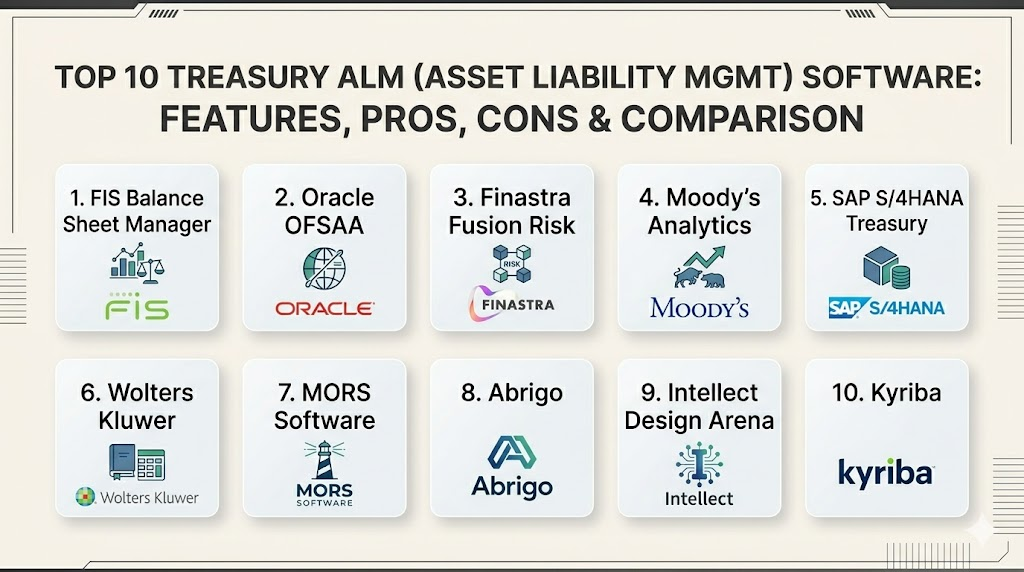
Top 10 Treasury ALM Software Tools
1. FIS Balance Sheet Manager
Part of the Ambit Focus suite, this platform is widely regarded as one of the most comprehensive ALM solutions globally. It provides a highly granular view of the balance sheet, focusing on risk-based performance and strategic planning.
Key Features
- Integrated interest rate risk and liquidity risk on a single analytical engine.
- Advanced Funds Transfer Pricing (FTP) with behavioral integration.
- Multi-GAAP and multi-currency support for global reporting standards.
- Stochastic modeling for complex embedded options in retail products.
- Automated regulatory reporting for global supervisors.
Pros
- Unrivaled depth for institutions facing heavy regulatory scrutiny.
- Excellent at transforming compliance data into strategic business insights.
Cons
- The interface is dense and can be technically demanding for new users.
- Implementation cycles are typically longer due to the software’s complexity.
Platforms / Deployment
Windows / Linux
Hybrid
Security & Compliance
Enterprise-grade security with full audit trails.
Not publicly stated.
Integrations & Ecosystem
It is designed to sit at the center of the financial architecture, connecting natively with FIS core banking systems and major market data feeds.
Support & Community
Extensive global support network with dedicated risk management consultants and annual user conferences.
2. Oracle Financial Services Analytical Applications (OFSAA)
Oracle offers a powerful suite specifically for the financial services industry. Its ALM module is built for massive data scalability and deep integration with the broader Oracle ecosystem.
Key Features
- High-performance engine capable of processing millions of accounts.
- Unified data model for risk, performance, and compliance.
- Detailed gap analysis and sensitivity reporting (PVBP, Duration, Convexity).
- Integrated liquidity risk management with stress testing.
- Powerful economic value and earnings-at-risk (EaR) calculations.
Pros
- Seamless data flow for existing users of Oracle’s enterprise tools.
- Unmatched scalability for the world’s largest multinational banks.
Cons
- The user interface can feel less modern than newer agile competitors.
- Requires specialized Oracle consultants for complex customizations.
Platforms / Deployment
Windows / Linux
Cloud / On-Premise
Security & Compliance
SSO/SAML, MFA, and extensive audit logging via Oracle Cloud.
SOC 1/2 and ISO 27001 compliant.
Integrations & Ecosystem
Strongest integration with Oracle ERP and HCM Cloud, along with open banking APIs for external data ingestion.
Support & Community
A massive global support infrastructure and a well-established community of enterprise developers and risk managers.
3. Finastra Fusion Risk
Fusion Risk provides a modern, modular approach to ALM, allowing institutions to manage their liquidity and interest rate risk with an emphasis on speed and usability.
Key Features
- Real-time balance sheet visibility and interactive sensitivity analysis.
- Modular components for ALM, liquidity, and market risk.
- Strong focus on IRRBB (Interest Rate Risk in the Banking Book) compliance.
- Behavioral modeling engine for non-maturing deposits.
- Open API architecture via FusionFabric.cloud.
Pros
- Considered one of the most user-friendly interfaces in the enterprise tier.
- Excellent at scaling from mid-market banks to large institutions.
Cons
- Integration with non-Finastra core systems can be technically intensive.
- Certain legacy modules may feel distinct from the newer cloud-native parts.
Platforms / Deployment
Web / Windows
Cloud / Hybrid
Security & Compliance
Robust identity management and secure data encryption.
Not publicly stated.
Integrations & Ecosystem
Strongly integrated with Finastra’s banking software but supports a wide range of third-party fintech apps.
Support & Community
Access to the FusionFabric developer community and professional global support tiers.
4. Moody’s Analytics RiskConfidence
Moody’s brings its legendary mathematical expertise to the ALM space. This platform is specialized for institutions that need high-precision impairment and capital calculations.
Key Features
- Contract-level cash flow engine for precise margin analysis.
- Market-leading economic scenario generators (ESG).
- Integrated ALM, liquidity risk, and FTP on a single platform.
- Support for IFRS 9 and expected credit loss (ECL) modeling.
- Granular drill-down capabilities from balance sheet to individual contracts.
Pros
- Unbeatable mathematical precision for complex financial instruments.
- Access to Moody’s world-leading credit research directly within the tool.
Cons
- Can be expensive for institutions that only need basic ALM features.
- Implementation requires a deep understanding of advanced accounting standards.
Platforms / Deployment
Web / Windows / Linux
Cloud / Hybrid
Security & Compliance
High-security standards used for global financial data processing.
Not publicly stated.
Integrations & Ecosystem
Connects with major core banking systems and is a core part of the Moody’s risk ecosystem.
Support & Community
Professional support led by financial engineers and quantitative analysts.
5. SAP S/4HANA Treasury and Risk Management
For organizations running the SAP ecosystem, this module provides an integrated approach where treasury transactions are reflected in the general ledger in real-time.
Key Features
- Deep integration with S/4HANA financial accounting and controlling.
- Real-time “Treasury Executive Dashboard” for C-level visibility.
- Automated market data feeds for interest rates and FX.
- Comprehensive debt and investment management tools.
- Integrated hedge management and accounting.
Pros
- Eliminates data silos by keeping ALM within the core enterprise system.
- Extremely robust audit trails and administrative security permissions.
Cons
- Very high total cost of ownership for non-SAP organizations.
- Can feel restrictive for analysts who prefer specialized, niche tools.
Platforms / Deployment
Web
Cloud / Hybrid
Security & Compliance
SOC 1, SOC 2, and ISO 27001 compliant.
Full integration with SAP enterprise security.
Integrations & Ecosystem
Seamless with the entire SAP suite, including SuccessFactors and Ariba, plus external SWIFT connectivity.
Support & Community
Access to the massive SAP global support network and specialized user groups.
6. Wolters Kluwer OneSumX
OneSumX is a heavy-duty platform known for its ability to handle the “alphabet soup” of global banking regulations. It combines risk, finance, and regulatory reporting.
Key Features
- Integrated Regulatory Reporting (RegRep) for global compliance.
- Contract-level data granularity for highly precise modeling.
- Multi-GAAP, multi-currency, and multi-entity support.
- Advanced stress testing and scenario management.
- Automated updates for changing global regulatory rules.
Pros
- The best choice for institutions operating across multiple global jurisdictions.
- Excellent at transforming regulatory data into a strategic risk view.
Cons
- The platform can be complex to navigate due to its massive feature set.
- Updates can sometimes require significant testing time.
Platforms / Deployment
Web / Windows
Cloud / Hybrid
Security & Compliance
ISO 27001 and SOC 2 Type II compliant.
Extensive global certification for banking data.
Integrations & Ecosystem
Designed to integrate with enterprise risk frameworks and various core banking data sources.
Support & Community
Professional support with a strong focus on regulatory and legal expertise.
7. MORS Software
MORS provides a unified treasury and ALM platform that emphasizes daily liquidity management and real-time balance sheet steering.
Key Features
- Daily liquidity and IRRBB reporting for high-frequency monitoring.
- Dynamic balance sheet optimization tools for strategic steering.
- Stress testing for idiosyncratic and market-wide shocks.
- Modular deployment—start with core ALM and add FTP later.
- User-friendly dashboards with real-time risk alerts.
Pros
- Fast implementation compared to the massive legacy giants.
- Highly effective for banks moving away from Excel-based ALM.
Cons
- Lacks the massive global footprint of Oracle or SAP.
- Smaller library of third-party plugins.
Platforms / Deployment
Web / Windows
Cloud / On-Premise
Security & Compliance
Standard identity and data protection protocols.
Not publicly stated.
Integrations & Ecosystem
Strong support for core banking data ingestion and open API connectivity.
Support & Community
Agile support team with deep expertise in Northern European banking standards.
8. Abrigo (Valuant/TPG)
Abrigo focuses on community and mid-sized banks, offering specialized ALM and stress testing tools that are tailored for North American regulatory environments.
Key Features
- Scenario-based balance sheet forecasting and interest rate risk.
- Integrated stress testing and sensitivity analysis.
- Strong focus on CECL (Current Expected Credit Loss) modeling.
- Core banking data integration for automated data loads.
- Simplified regulatory reporting for mid-market institutions.
Pros
- Very strong in the “middle-market” banking sector.
- Implementation is significantly faster than enterprise-level suites.
Cons
- Primarily focused on the North American market.
- Not suitable for massive, multi-continental banking giants.
Platforms / Deployment
Web
Cloud
Security & Compliance
SOC 2 compliant.
Designed specifically for FDIC and credit union standards.
Integrations & Ecosystem
Integrates well with regional core providers like Jack Henry and Fiserv.
Support & Community
Excellent customer success model with strong digital onboarding resources.
9. Intellect Design Arena (eMACH.ai)
Intellect Design provides a modern, composable treasury and ALM solution built on microservices, specifically designed for the volatile 2026 economic environment.
Key Features
- Microservices-based architecture for high modularity.
- Real-time intraday liquidity and HQLA monitoring.
- Integrated working capital synergies between treasury and corporate clients.
- AI-powered cash forecasting and anomaly detection.
- Seamless bridge between front, middle, and back-office data.
Pros
- The most technologically modern architecture on this list.
- Allows institutions to upgrade specific risk modules without a total overhaul.
Cons
- Relatively newer platform compared to the decades-old Ambit suite.
- Requires a modern IT mindset to fully leverage the API-first design.
Platforms / Deployment
Web
Cloud-Native
Security & Compliance
Built on a high-security “zero-trust” microservices framework.
Not publicly stated.
Integrations & Ecosystem
Designed to be the “connector” in a modern fintech ecosystem via extensive APIs.
Support & Community
Global support with a strong focus on digital transformation and innovation.
10. Kyriba (Liquidity Performance)
While primarily a Treasury Management System (TMS), Kyriba has expanded its ALM and liquidity risk capabilities to become a top choice for corporate treasurers.
Key Features
- Global real-time cash visibility across thousands of bank accounts.
- Integrated interest rate and FX risk management.
- Automated cash flow forecasting with AI-driven predictive analytics.
- Direct connectivity to over 1,000 global banks via ISO 20022.
- Compliance tracking for internal and external mandates.
Pros
- The undisputed leader in global bank connectivity and cash visibility.
- Highly agile and can be implemented faster than legacy banking ALM.
Cons
- Lacks the deep “Basel IV” banking-specific compliance of FIS or Moody’s.
- Focused more on corporate treasury than complex bank balance sheet modeling.
Platforms / Deployment
Web
Cloud-Native
Security & Compliance
SOC 1, SOC 2, and ISO 27001 compliant.
Extensive enterprise security and fraud detection.
Integrations & Ecosystem
Massive ecosystem of pre-built ERP connectors and bank APIs.
Support & Community
Very large global user community and professional 24/7 support.
Comparison Table
| Tool Name | Best For | Platform(s) Supported | Deployment | Standout Feature | Public Rating |
| 1. FIS Balance Sheet Manager | Complex Regulatory | Win, Linux | Hybrid | Behavioral Engine | N/A |
| 2. Oracle OFSAA | Massive Scale | Win, Linux | Hybrid | Multi-Entity Scale | N/A |
| 3. Finastra Fusion Risk | User Experience | Web, Win | Hybrid | Open API Design | N/A |
| 4. Moody’s Analytics | Math Precision | Win, Linux | Hybrid | Credit Research Link | N/A |
| 5. SAP S/4HANA Treasury | SAP Ecosystem | Web | Hybrid | Real-Time Accounting | N/A |
| 6. Wolters Kluwer | Global Compliance | Web, Win | Hybrid | RegRep Automation | N/A |
| 7. MORS Software | Daily Steering | Web, Win | Hybrid | Real-Time Gap view | N/A |
| 8. Abrigo | Mid-Market Banks | Web | Cloud | CECL Integration | N/A |
| 9. Intellect Design Arena | Modern Architecture | Web | Cloud-Native | Microservices | N/A |
| 10. Kyriba | Corporate Liquidity | Web | Cloud-Native | Bank Connectivity | N/A |
Evaluation & Scoring
| Tool Name | Core (25%) | Ease (15%) | Integrations (15%) | Security (10%) | Perf (10%) | Support (10%) | Value (15%) | Total |
| 1. FIS Ambit | 10 | 4 | 9 | 9 | 9 | 9 | 6 | 8.10 |
| 2. Oracle OFSAA | 10 | 4 | 10 | 10 | 10 | 8 | 5 | 8.05 |
| 3. Finastra | 9 | 8 | 9 | 8 | 8 | 8 | 7 | 8.30 |
| 4. Moody’s | 10 | 5 | 8 | 9 | 9 | 8 | 6 | 7.90 |
| 5. SAP S/4HANA | 8 | 6 | 10 | 10 | 9 | 9 | 6 | 8.05 |
| 6. Wolters Kluwer | 9 | 5 | 9 | 9 | 8 | 8 | 6 | 7.65 |
| 7. MORS | 7 | 8 | 8 | 7 | 8 | 7 | 9 | 7.60 |
| 8. Abrigo | 7 | 9 | 8 | 8 | 7 | 9 | 9 | 8.00 |
| 9. Intellect Design | 8 | 6 | 10 | 9 | 10 | 8 | 8 | 8.30 |
| 10. Kyriba | 7 | 10 | 10 | 9 | 9 | 9 | 8 | 8.60 |
The evaluation scores highlight the trade-offs between legacy power and modern agility. Tools like FIS and Oracle score perfectly in core modeling and performance because they have been refined over decades to handle the world’s most complex balance sheets. However, they lose points on “Ease of Use” compared to modern SaaS platforms like Kyriba or Intellect Design Arena. When choosing, an institution must decide if it needs the brute mathematical force of a legacy system or the rapid deployment and real-time connectivity of a modern cloud-native tool.
Which Treasury ALM Software Tool Is Right for You?
Solo / Freelancer
While individual freelancers rarely need full-scale ALM, those consulting for small credit unions should focus on MORS or Abrigo. These platforms are accessible enough to be managed without a massive IT team.
SMB
Small and mid-sized financial institutions should look for “all-in-one” platforms like Abrigo. These tools provide the necessary regulatory coverage for North American standards without the extreme overhead of a global tier-1 system.
Mid-Market
For banks with a regional presence, Finastra or MORS offer a perfect balance. They provide sophisticated risk modeling and FTP (Funds Transfer Pricing) but maintain a level of usability that allows the treasury team to be self-sufficient.
Enterprise
Tier-1 global banks require the heavy machinery of FIS, Oracle, or Moody’s. These platforms are designed for high-volume, multi-jurisdictional environments where precision and auditability are more important than a simple user interface.
Budget vs Premium
Kyriba and MORS often provide the best “value for money” for organizations that prioritize liquidity visibility over complex Basel IV modeling. The “premium” choices remain the major enterprise suites which carry higher implementation costs.
Feature Depth vs Ease of Use
If your team consists of high-level quantitative analysts, the depth of Houdini or Moody’s is an asset. If you need a tool that a general finance team can pick up quickly, Finastra is a superior choice.
Integrations & Scalability
SAP S/4HANA is the leader in integration for existing SAP users. For those looking for a modern, API-first approach that can grow into a custom fintech stack, Intellect Design Arena is the most scalable future-ready option.
Security & Compliance Needs
Organizations operating under strict European or North American central bank supervision should prioritize Wolters Kluwer or FIS. These vendors provide the most frequent and reliable updates to their regulatory reporting engines.
Frequently Asked Questions (FAQs)
1. What is the primary difference between ALM and Treasury Management?
Treasury management focuses on short-term liquidity, cash visibility, and payment execution. ALM focuses on long-term balance sheet stability, interest rate risk, and the “matching” of asset and liability maturities.
2. Why is IRRBB (Interest Rate Risk in the Banking Book) so important in 2026?
As central banks shift their interest rate policies to combat inflation or stimulate growth, the value of a bank’s fixed-rate assets and floating-rate liabilities can diverge sharply, potentially wiping out capital if not managed by ALM software.
3. Can ALM software help with climate risk?
Yes, modern platforms allow for “ESG Stress Testing,” where users can model how a transition to a low-carbon economy might impact the credit quality and value of their long-term loan portfolios.
4. What is Funds Transfer Pricing (FTP)?
FTP is a method used by banks to measure how each department contributes to the institution’s overall profitability. ALM software uses FTP to assign the cost of funding to assets and the value of liquidity to deposits.
5. How long does a typical ALM software implementation take?
For a mid-sized bank, it usually takes 4 to 9 months. For a global enterprise, it can take 12 to 24 months, depending on the complexity of the data integration and the number of entities involved.
6. Do I need to replace my core banking system to use ALM software?
No. Most modern ALM tools are designed to sit on top of your existing systems, ingesting data through flat files or real-time APIs without requiring a core banking overhaul.
7. Is cloud-based ALM secure enough for banks?
Yes, leading providers now offer SOC 2 and ISO 27001 certified cloud environments with encryption and dedicated private clouds that meet the strict security requirements of global regulators.
8. What is a “Gap Analysis” in ALM?
It is a simple but critical report that shows the volume of assets and liabilities maturing or repricing in specific time buckets (e.g., 0-3 months, 1-2 years) to identify where the bank is exposed to rate changes.
9. Can ALM software predict bank runs?
While it cannot predict them perfectly, “Liquidity Stress Testing” allows a bank to model what would happen to its HQLA (High-Quality Liquid Assets) if a certain percentage of deposits were withdrawn over 30 days.
10. Why is behavioral modeling included in these tools?
Because customers don’t always act according to a contract; they might pay off a mortgage early or keep money in a zero-interest savings account for years. Behavioral modeling uses math to estimate these real-world actions.
Conclusion
It requires a deep, simulated understanding of how the balance sheet will react to tomorrow’s volatility. Treasury ALM software has evolved from a back-office compliance requirement into a front-office strategic asset. They transform raw transaction data into forward-looking simulations, enabling teams to stress-test their portfolios against various economic “what-if” scenarios. Whether you prioritize the absolute mathematical precision of a legacy giant or the real-time agility of a cloud-native platform, the right choice depends on your institutional scale and regulatory environment. By selecting a tool that offers both modeling depth and seamless data integration, treasury leaders can ensure long-term stability in an increasingly unpredictable world.

Best Cardiac Hospitals Near You
Discover top heart hospitals, cardiology centers & cardiac care services by city.
Advanced Heart Care • Trusted Hospitals • Expert Teams
View Best Hospitals