Introduction
A Vendor Management System (VMS) is software used to manage vendors and the external workforce or services they provide, helping organizations standardize processes such as requesting, sourcing, onboarding, tracking, and paying for contingent labor and statement-of-work work. In many organizations, a VMS becomes the shared operating layer across procurement, HR, finance, security, and hiring managers so vendor engagements follow consistent controls and reporting.techtarget+1
Common use cases include creating contingent requisitions, distributing demand to staffing suppliers, onboarding and offboarding workers with consistent checks, capturing time and expenses, managing SOW projects, consolidating invoicing, and tracking supplier performance and program metrics.
What buyers should evaluate:
- Requisition intake and approval workflows
- Supplier distribution and vendor portal experience
- Worker onboarding/offboarding controls and auditability
- SOW management and services procurement coverage
- Time/expense capture and validation rules
- Invoicing consolidation, rate cards, and budget guardrails
- Compliance workflow support (policy enforcement, exception handling)
- Analytics (spend, time-to-fill, supplier performance, headcount visibility)
- Integrations (HRIS, ERP/AP, identity/SSO, security/badging, reporting)
- Admin experience and scalability across regions and business units
Best for: procurement and HR teams managing multi-supplier contingent workforce and services programs that require spend control, compliance, and enterprise visibility.
Not ideal for: organizations with low external workforce volume or a single vendor relationship where a full program layer adds more overhead than value.
Key trends in VMS platforms
- Wider scope: contingent labor plus SOW services managed under one governance model.
- More automation: policy-driven approvals, routing, and invoice consolidation to reduce manual effort.
- Better supplier experience: faster feedback loops and clearer requirements to improve fulfillment quality.
- Stronger controls: rate governance, budget caps, and exception workflows to reduce leakage.
- Increased compliance expectations: standardized onboarding/offboarding and auditable processes.
- Analytics maturity: programs expect spend, headcount, time-to-fill, and supplier performance insights as defaults.
- Integration-first adoption: HRIS + ERP/AP + identity alignment is treated as mandatory, not “nice to have.”
- Faster time-to-value: buyers want minimal-click manager workflows and quick rollout playbooks.
How we selected these tools
- Included widely recognized VMS platforms and vendor management suites used for contingent workforce and services procurement programs.
- Balanced enterprise-focused VMS tools with options that can fit growing mid-market programs.
- Prioritized coverage from intake through invoicing: request, supplier distribution, onboarding, time/expense, billing, and reporting.
- Considered tools that support both staffing-style engagements and SOW-based work, since many programs run both.
- Included supplier lifecycle and supplier governance suites for organizations where “vendor management” extends beyond labor.
- Avoided guessing public ratings and treated security/compliance as “verify during procurement.”
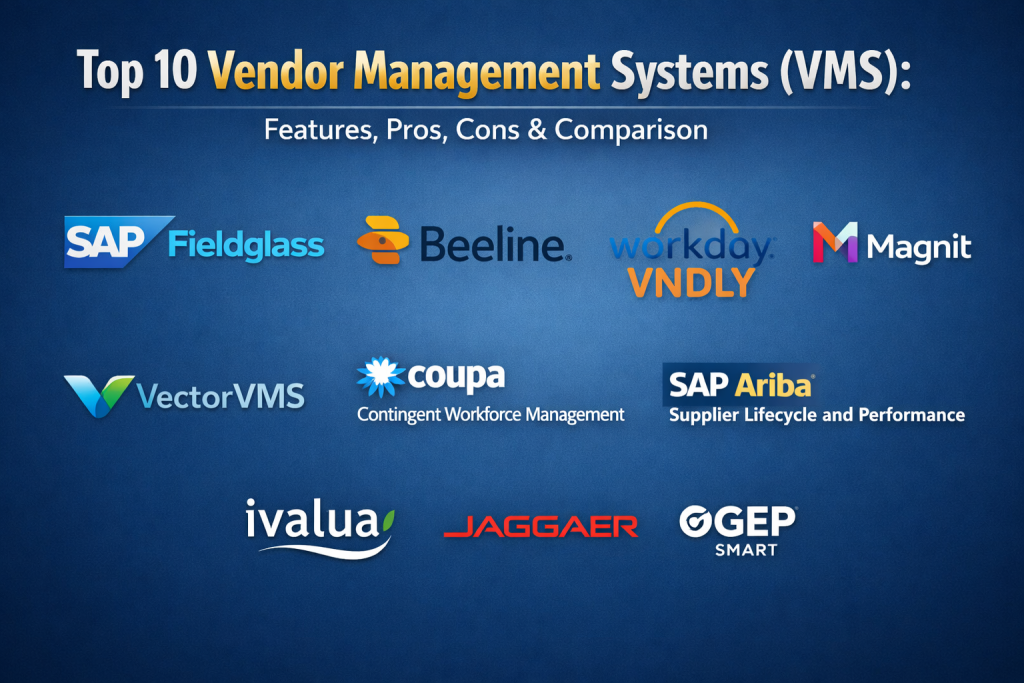
Top 10 Vendor Management Systems (VMS)
1.SAP Fieldglass
SAP Fieldglass is commonly used to manage external workforce and services procurement programs with standardized workflows and governance, especially for larger organizations.
Key features
- Requisition intake, approval routing, and demand distribution (varies)
- Supplier engagement workflows (varies)
- Worker lifecycle tracking (varies)
- Time and expense capture (varies)
- Invoicing and billing workflows (varies)
- Program reporting and spend visibility (varies)
- Controls for multi-region program standardization (varies)
Pros
- Strong governance for complex, multi-supplier programs
- Works well when you need standardized processes across business units
Cons
- Can be complex to implement without a clear operating model
- Adoption depends on manager usability and supplier participation
Platforms / Deployment
- Web
- Cloud
Security & Compliance
Not publicly stated.
Integrations & Ecosystem
Typically evaluated for HRIS, ERP/AP, identity, and reporting connectivity.
- HRIS and payroll-related handoffs (varies)
- ERP/AP invoicing handoffs (varies)
- Identity/SSO (varies)
- Reporting exports (varies)
- Automation interfaces (varies)
Support & Community
Varies / Not publicly stated.
2.Beeline
Beeline is widely known in enterprise contingent workforce programs and is often chosen when organizations need strong supplier oversight, process controls, and program visibility at scale.
Key features
- End-to-end contingent workflow coverage (varies)
- SOW handling support (varies)
- Supplier portal workflows and fulfillment tracking (varies)
- Rate governance and spend controls (varies)
- Invoice consolidation and approvals (varies)
- Program analytics and supplier performance reporting (varies)
- Multi-region workflow standardization (varies)
Pros
- Strong for enterprise programs with many suppliers and stakeholders
- Clear fit when spend visibility and controls are top priorities
Cons
- Implementation can be heavy if workflows are over-customized early
- Requires disciplined governance to keep data and suppliers consistent
Platforms / Deployment
- Web
- Cloud
Security & Compliance
Not publicly stated.
Integrations & Ecosystem
Often assessed on HR/ERP integration and supplier ecosystem alignment.
- HR and finance integrations (varies)
- SSO and identity (varies)
- Data exports for analytics (varies)
- Supplier portal and vendor workflows (varies)
- APIs/automation (varies)
Support & Community
Varies / Not publicly stated.
3.Workday VNDLY
Workday VNDLY is commonly evaluated by organizations that want contingent workforce management aligned with broader HR and finance processes, including vendor participation and invoicing workflows.
Key features
- Contingent workforce requisition and approvals (varies)
- SOW and services procurement support (varies)
- Vendor portal access and supplier collaboration workflows (varies)
- Consolidated invoicing and process visibility (varies)
- Headcount and spend visibility dashboards (varies)
- Policy controls and exception handling (varies)
- Program reporting across suppliers and worker types (varies)
Pros
- Strong when you want contingent and SOW governance together
- Good fit for organizations emphasizing unified workforce visibility
Cons
- Outcomes depend heavily on configuration and governance choices
- Reporting accuracy depends on consistent manager and supplier usage
Platforms / Deployment
- Web
- Cloud
Security & Compliance
Not publicly stated.
Integrations & Ecosystem
Typically evaluated for HR/finance alignment and identity controls.
- HR/finance system alignment (varies)
- SSO and provisioning (varies)
- Invoicing handoffs (varies)
- Data exports (varies)
- Supplier workflows (varies)
Support & Community
Varies / Not publicly stated.
4.Magnit
Magnit is often associated with contingent workforce program operations and can be relevant for organizations looking to centralize external labor workflows and reporting.
Key features
- Centralized program operations for external labor (varies)
- Supplier engagement workflows (varies)
- Process standardization across worker types (varies)
- Spend visibility and reporting (varies)
- Compliance process support (varies)
- Workflow automation for approvals and routing (varies)
- Program dashboards for leadership visibility (varies)
Pros
- Useful for centralized operations and program consistency
- Can support multi-supplier workflows (varies)
Cons
- Feature depth varies by offering and implementation
- Requires clear ownership for supplier governance and data quality
Platforms / Deployment
- Web
- Cloud (varies)
Security & Compliance
Not publicly stated.
Integrations & Ecosystem
Commonly evaluated on HR, procurement, and finance connectivity.
- HR/ERP integrations (varies)
- Identity/SSO (varies)
- Supplier workflow interfaces (varies)
- APIs (varies)
- Reporting exports (varies)
Support & Community
Varies / Not publicly stated.
5.VectorVMS
VectorVMS is often evaluated for programs that want coverage across staff augmentation, services procurement, and extended workforce management with operational controls around time, approvals, and invoicing.
Key features
- Staff augmentation workflows (varies)
- Services procurement workflows (varies)
- Extended workforce tracking concepts (varies)
- Timesheet capture and approvals (varies)
- Invoicing consolidation and controls (varies)
- Budget visibility and alerts (varies)
- Supplier and performance tracking signals (varies)
Pros
- Broad coverage across multiple external workforce use cases
- Practical controls for spend visibility and process consistency
Cons
- Requires governance discipline to keep suppliers and workflows standardized
- Fit depends on your program model (staffing-led vs services-led)
Platforms / Deployment
- Web / iOS / Android (varies)
- Cloud
Security & Compliance
Not publicly stated.
Integrations & Ecosystem
Often assessed on HR/procurement integration and analytics exports.
- HR/procurement integrations (varies)
- Identity/SSO (varies)
- APIs (varies)
- Reporting exports (varies)
- Supplier workflow interfaces (varies)
Support & Community
Varies / Not publicly stated.
6.Coupa Contingent Workforce Management
Coupa Contingent Workforce Management is often considered when procurement-led teams want tighter spend governance for contingent labor and services engagements as part of broader spend management.
Key features
- Intake and approvals for contingent and services needs (varies)
- Supplier participation workflows (varies)
- Onboarding/offboarding control patterns (varies)
- Time/deliverables tracking (varies)
- Invoicing controls and spend guardrails (varies)
- Reporting for spend visibility (varies)
- Governance workflows for exceptions and approvals (varies)
Pros
- Strong fit when spend control is the primary driver
- Useful for procurement-led operating models (varies)
Cons
- Capability depth depends on modules and rollout design
- Requires alignment across procurement, HR, and finance to avoid friction
Platforms / Deployment
- Web
- Cloud
Security & Compliance
Not publicly stated.
Integrations & Ecosystem
Typically evaluated for ERP/AP handoffs and supplier workflows.
- ERP/AP integrations (varies)
- Identity/SSO (varies)
- Supplier data flows (varies)
- APIs (varies)
- Reporting exports (varies)
Support & Community
Varies / Not publicly stated.
7.SAP Ariba Supplier Lifecycle and Performance
SAP Ariba Supplier Lifecycle and Performance is commonly used for supplier onboarding, supplier information governance, and ongoing supplier performance processes, and can complement a VMS when vendor management extends beyond labor suppliers.
Key features
- Supplier onboarding workflows (varies)
- Supplier information management and approvals (varies)
- Supplier performance tracking (varies)
- Risk and compliance information capture (varies)
- Workflow automation for reviews (varies)
- Reporting for supplier programs (varies)
- Procurement ecosystem alignment (varies)
Pros
- Strong for supplier lifecycle governance and standardization
- Useful for building a consistent supplier data foundation
Cons
- Not a replacement for contingent workforce execution workflows
- Requires integration design to prevent fragmented vendor records
Platforms / Deployment
- Web
- Cloud (varies)
Security & Compliance
Not publicly stated.
Integrations & Ecosystem
Typically assessed on procurement/ERP alignment and supplier master data flow.
- Procurement/ERP integrations (varies)
- Identity/SSO (varies)
- Supplier data connections (varies)
- APIs (varies)
- Reporting exports (varies)
Support & Community
Varies / Not publicly stated.
8.Ivalua
Ivalua is commonly used for procurement-driven supplier management, including onboarding, governance, and supplier performance workflows.
Key features
- Supplier onboarding and qualification workflows (varies)
- Supplier information governance (varies)
- Supplier performance tracking (varies)
- Workflow automation for approvals and reviews (varies)
- Procurement process alignment (varies)
- Reporting on supplier programs (varies)
- Configurability for enterprise processes (varies)
Pros
- Strong for procurement-led vendor governance and standardization
- Useful for repeatable supplier processes across categories
Cons
- May not cover full contingent workforce timesheet/invoicing execution by itself
- Requires strong data governance for trusted reporting
Platforms / Deployment
- Web
- Cloud (varies)
Security & Compliance
Not publicly stated.
Integrations & Ecosystem
Often evaluated for ERP integration and supplier data governance.
- ERP/procurement integrations (varies)
- Identity/SSO (varies)
- Supplier data connections (varies)
- APIs (varies)
- Analytics exports (varies)
Support & Community
Varies / Not publicly stated.
9.JAGGAER
JAGGAER is often used for procurement-aligned supplier management, including onboarding, supplier information governance, and performance processes.
Key features
- Supplier onboarding workflows (varies)
- Supplier data governance and approvals (varies)
- Supplier performance processes (varies)
- Procurement-aligned workflows and controls (varies)
- Reporting for supplier programs (varies)
- Roles and permissions (varies)
- Integration patterns for procurement ecosystems (varies)
Pros
- Strong for procurement-driven supplier lifecycle control
- Useful for standardized supplier processes
Cons
- Not a direct replacement for contingent workforce execution workflows
- Requires disciplined data ownership for reliable supplier records
Platforms / Deployment
- Web
- Cloud (varies)
Security & Compliance
Not publicly stated.
Integrations & Ecosystem
Typically assessed on ERP/procurement integration and supplier data flow.
- ERP/procurement integrations (varies)
- Identity/SSO (varies)
- Supplier data connections (varies)
- APIs (varies)
- Reporting exports (varies)
Support & Community
Varies / Not publicly stated.
10.GEP SMART
GEP SMART is commonly used in procurement programs emphasizing supplier management, spend visibility, and governance workflows, and can support vendor governance aligned to procurement operations.
Key features
- Supplier management workflows (varies)
- Supplier onboarding and information governance (varies)
- Spend visibility and reporting (varies)
- Workflow automation for approvals and controls (varies)
- Supplier performance tracking patterns (varies)
- Procurement process alignment (varies)
- Enterprise analytics and reporting (varies)
Pros
- Strong fit when vendor governance is coupled with procurement operations
- Useful for standardizing supplier governance and reporting
Cons
- May not replace a dedicated contingent workforce VMS for execution steps
- Requires clean supplier data governance for reliable visibility
Platforms / Deployment
- Web
- Cloud (varies)
Security & Compliance
Not publicly stated.
Integrations & Ecosystem
Often evaluated for ERP connectivity and supplier ecosystem alignment.
- ERP/procurement integrations (varies)
- Identity/SSO (varies)
- Supplier data connections (varies)
- APIs (varies)
- Analytics exports (varies)
Support & Community
Varies / Not publicly stated.
Comparison table (same 10 tools)
| Tool Name | Best For | Platform(s) Supported | Deployment (Cloud/Self-hosted/Hybrid) | Standout Feature | Public Rating |
|---|---|---|---|---|---|
| SAP Fieldglass | Enterprise external workforce and services programs | Web | Cloud | Enterprise governance for external workforce | N/A |
| Beeline | Multi-supplier contingent workforce programs | Web | Cloud | Strong supplier workflows and program controls | N/A |
| Workday VNDLY | Contingent + SOW programs with unified visibility | Web | Cloud | Approvals, invoicing, and vendor portal workflows | N/A |
| Magnit | Centralized contingent program operations | Web | Cloud (varies) | Program operations and visibility (varies) | N/A |
| VectorVMS | Staff aug + services procurement + extended workforce | Web / iOS / Android (varies) | Cloud | Broad coverage with operational controls | N/A |
| Coupa Contingent Workforce Management | Spend-governed contingent and services needs | Web | Cloud | Spend controls and governance workflows | N/A |
| SAP Ariba Supplier Lifecycle and Performance | Supplier onboarding and supplier governance | Web | Cloud (varies) | Supplier lifecycle controls | N/A |
| Ivalua | Procurement-driven supplier governance | Web | Cloud (varies) | Configurable supplier lifecycle workflows | N/A |
| JAGGAER | Supplier management within procurement programs | Web | Cloud (varies) | Supplier onboarding and governance processes | N/A |
| GEP SMART | Supplier governance + spend visibility | Web | Cloud (varies) | Procurement-aligned analytics and controls | N/A |
Evaluation and scoring (same 10 tools)
Weights used:
- Core features – 25%
- Ease of use – 15%
- Integrations & ecosystem – 15%
- Security & compliance – 10%
- Performance & reliability – 10%
- Support & community – 10%
- Price / value – 15%
| Tool Name | Core (25%) | Ease (15%) | Integrations (15%) | Security (10%) | Performance (10%) | Support (10%) | Value (15%) | Weighted Total (0–10) |
|---|---|---|---|---|---|---|---|---|
| SAP Fieldglass | 9 | 6 | 9 | 8 | 8 | 7 | 5 | 7.30 |
| Beeline | 9 | 7 | 8 | 8 | 8 | 7 | 5 | 7.40 |
| Workday VNDLY | 9 | 7 | 8 | 8 | 8 | 7 | 5 | 7.40 |
| Magnit | 8 | 7 | 7 | 7 | 7 | 7 | 6 | 7.05 |
| VectorVMS | 8 | 8 | 7 | 7 | 7 | 7 | 7 | 7.45 |
| Coupa Contingent Workforce Management | 8 | 7 | 8 | 7 | 7 | 7 | 6 | 7.15 |
| SAP Ariba Supplier Lifecycle and Performance | 7 | 6 | 9 | 8 | 8 | 7 | 5 | 6.95 |
| Ivalua | 7 | 6 | 8 | 8 | 8 | 7 | 5 | 6.80 |
| JAGGAER | 7 | 6 | 8 | 8 | 8 | 7 | 6 | 6.95 |
| GEP SMART | 7 | 6 | 8 | 8 | 8 | 7 | 6 | 6.95 |
How to interpret the scores:
These scores are comparative and meant for shortlisting. A lower total can still be the best fit if your primary need is supplier lifecycle governance instead of contingent workforce execution. Treat security and compliance as a formal verification step during procurement. Use a pilot to validate real workflows: intake speed, supplier response, onboarding controls, invoice accuracy, and reporting trust.
Which VMS is right for you?
Solo / Freelancer
A full VMS is usually unnecessary if you manage a small number of vendors. Focus on a simple intake checklist, clear approvals, and consistent recordkeeping.
SMB
If you are adding multiple staffing suppliers or recurring SOW projects, a VMS can reduce unmanaged spend and inconsistent onboarding. Prioritize ease of use and the minimum workflow that enforces approvals and invoicing controls.
Mid-market
Mid-market programs need stronger supplier governance, clearer reporting, and role-based controls. If services procurement is meaningful, prioritize SOW workflows and invoice consolidation to reduce operational overhead.
Enterprise
Enterprise programs should prioritize scale, auditability, and integration into HRIS, ERP/AP, and identity ecosystems. Choose the platform that supports your global operating model without creating manager friction.
Budget vs Premium
Pick the tool that fixes your biggest leak first: lack of visibility, slow approvals, weak onboarding/offboarding, or invoicing errors. Premium platforms pay off when supplier count is high and compliance risk is meaningful.
Feature depth vs Ease of use
If adoption is the main risk, optimize for hiring-manager usability and keep workflows simple initially. If governance is the main risk, prioritize stronger controls and invest in program ownership.
Integrations & Scalability
List required integrations: HRIS, ERP/AP, identity, security/badging, and analytics. Validate that worker data moves end-to-end without manual re-entry, especially for onboarding/offboarding and invoicing.
Security & Compliance Needs
Many programs fail due to inconsistent non-employee tracking and weak offboarding enforcement. Validate role-based access, audit logs, and consistent lifecycle workflows as non-negotiables.
Frequently Asked Questions
1) What is a VMS?
A VMS is software used to manage vendors and the external workforce or services they provide, typically supporting sourcing, onboarding, tracking, and oversight workflows.
2) What is the difference between a VMS and supplier management software?
A VMS is usually focused on contingent labor and services procurement execution. Supplier management software is often focused on supplier onboarding, supplier data governance, and performance across broader categories.
3) Do I need SOW support?
If services projects are a meaningful part of your program, SOW support reduces tool sprawl and improves governance. If you rarely use SOW, keep the initial rollout staffing-focused.
4) Who should own a VMS program?
Ownership typically sits with procurement, HR, or a joint model. What matters most is clear authority over suppliers, approvals, onboarding rules, and reporting definitions.
5) What metrics should I track?
Track spend under management, time-to-fill, supplier fulfillment rates, invoicing accuracy, tenure exceptions, and headcount visibility. Pick a small set leadership will actually review.
6) How do I reduce rogue spend in contingent labor?
Standardize intake, enforce approvals, and consolidate invoicing so every engagement is visible and controllable. Make exceptions explicit and report on them.
7) What are common VMS implementation mistakes?
Over-complicating workflows early, migrating messy vendor data without cleanup, and ignoring hiring-manager adoption. Another issue is unclear ownership of onboarding/offboarding controls.
8) Can a VMS improve compliance?
Yes, mainly by standardizing onboarding/offboarding steps, enforcing policy, and improving auditability. Results depend on consistent usage and governance.
9) How should I run a VMS pilot?
Pilot one region or business unit and run a full cycle: requisition, supplier response, onboarding, time capture, invoicing, and reporting. Include one SOW project if it’s part of your program.
10) How do I choose between enterprise VMS vendors?
Start with must-have workflows (staffing, SOW, onboarding/offboarding, invoicing) and must-have integrations (HR, ERP/AP, identity). Then validate usability and reporting trust in a real pilot with real suppliers.
Conclusion
A VMS becomes valuable when you need repeatable control over suppliers, contingent workers, and services engagements across multiple teams. Choose based on your dominant program shape: staffing-heavy, SOW-heavy, or procurement-governed supplier lifecycle management. Shortlist two or three tools, pilot from intake through invoicing, and verify integrations with HR, finance, and identity systems. Then lock governance: supplier ownership, approval rules, exception handling, onboarding/offboarding enforcement, and the metrics leadership will use to manage the program.

Best Cardiac Hospitals Near You
Discover top heart hospitals, cardiology centers & cardiac care services by city.
Advanced Heart Care • Trusted Hospitals • Expert Teams
View Best Hospitals