Introduction
Voice AI Agent platforms are specialized software environments that enable the creation of autonomous, conversational agents capable of handling complex phone interactions without human intervention. Unlike traditional Interactive Voice Response (IVR) systems that rely on rigid “press 1 for sales” menus, these platforms use Large Language Models (LLMs), natural language understanding, and advanced speech-to-text (STT) technology to engage in fluid, multi-turn dialogue. They are designed to understand context, handle interruptions, and execute multi-step tasks across business systems.
As we progress through the mid-2020s, the “agentic” shift has transformed these tools from simple answering machines into proactive operational assets. These platforms now offer sub-second latency, making conversations feel natural and human-like. For businesses, this means the ability to resolve customer issues, schedule appointments, and qualify leads at massive scale with minimal overhead. The integration of emotional intelligence also allows these agents to detect user frustration or urgency, ensuring a high-quality experience that mimics a seasoned human professional.
Real-World Use Cases
- Customer Support Automation: Resolving high-volume inquiries such as order tracking, password resets, and policy questions without live agent involvement.
- Healthcare Appointment Scheduling: Managing complex patient intake, verifying insurance details, and booking clinical appointments 24/7.
- Outbound Sales & Lead Qualification: Conducting high-volume outreach to verify lead interest and automatically transferring qualified prospects to a live closer.
- Debt Collections & Payment Reminders: Handling sensitive financial conversations with consistent compliance and empathy to facilitate immediate payments.
- Logistics & Dispatch Coordination: Managing real-time driver updates, delivery rescheduling, and freight status inquiries for supply chain operations.
Evaluation Criteria for Buyers
- End-to-End Latency: The total time from when a user stops speaking to when the AI begins its response (ideally sub-500ms).
- Interruption Handling (Barge-in): How gracefully the AI stops speaking when a user cuts in with a new question or correction.
- Multi-System Orchestration: The ability for the agent to take real actions, such as updating a CRM or triggering a refund, during the call.
- Security & Compliance: Essential certifications such as SOC 2 Type II, HIPAA, and PCI DSS for handling sensitive data.
- Voice Naturalness: The quality and emotional range of the Text-to-Speech (TTS) engine to ensure the brand voice remains empathetic.
- Multilingual Support: The capability to handle regional accents and switch languages mid-conversation.
- Analytics & Sentiment Tracking: Built-in tools to monitor call resolution rates and identify customer mood trends.
Best for: Enterprises managing high call volumes, customer service teams requiring 24/7 coverage, and industries with strict compliance needs like healthcare and finance.
Not ideal for: Simple businesses with very low call volumes where a standard voicemail is sufficient, or highly creative roles requiring deep personal intuition.
Key Trends in Voice AI Agent Platforms
- Transition from Chatbots to Agentic AI: Moving away from scripted trees toward autonomous agents that can plan and execute multi-step workflows.
- Emotional Intelligence Integration: Standardized use of sentiment analysis to detect frustration and adjust the agent’s tone in real-time.
- Human-in-the-Loop Architecture: Sophisticated handoff protocols that transfer complex calls to humans with a full summarized transcript of the AI’s interaction.
- Voice Biometric Security: Using unique voiceprints for identity verification to reduce fraud in banking and healthcare deployments.
- Zero-Latency Streaming: Technical shifts toward streaming architectures that eliminate awkward pauses between conversational turns.
- Localized Dialect Mastery: Advanced models that can distinguish between regional accents and slang to improve accessibility for global users.
- Outcome-Based Pricing: A shift toward billing for successful resolutions rather than just total minutes spent on a call.
- Multimodal Synchronization: The ability for a voice agent to push a visual link or text message to the user’s phone during the call.
How We Selected These Tools
The selection of these top ten voice AI platforms is based on a methodology that prioritizes enterprise-grade reliability and measurable ROI. We analyzed hundreds of deployment results, focusing on platforms that deliver sub-800ms response times and high first-contact resolution rates. Key considerations included the maturity of their integration ecosystems (CRM, Telephony, ERP) and their ability to operate in regulated environments. We also looked for a balance between “developer-first” API platforms and “no-code” builders to ensure options for teams of all technical levels. Finally, we evaluated the quality of their proprietary voice stacks, ensuring each tool could handle real-world speech challenges like background noise and accents.
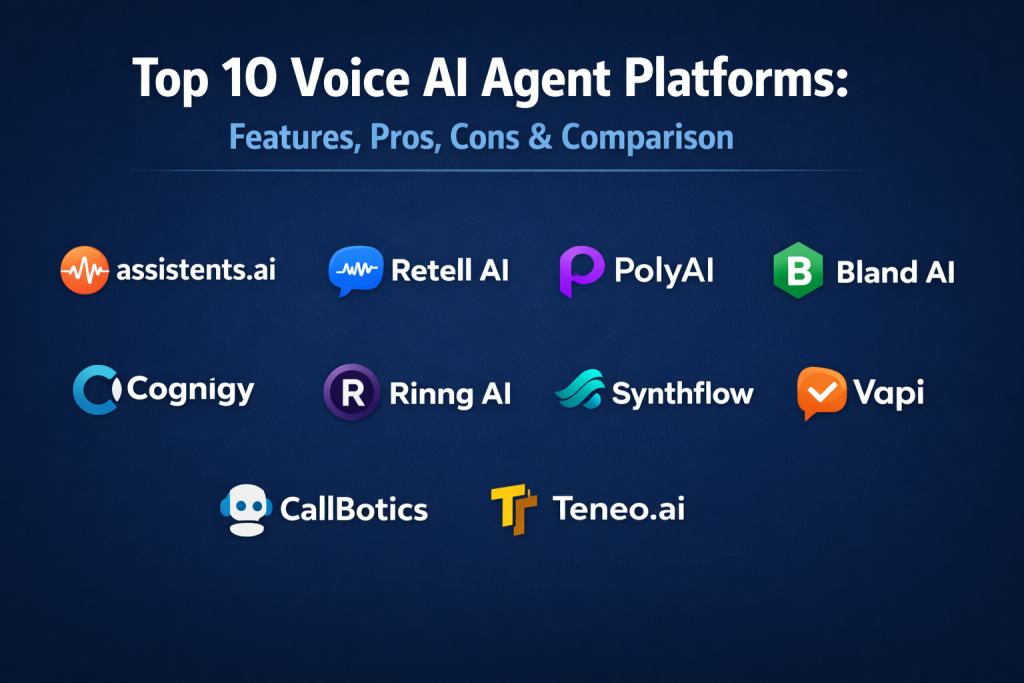
Top 10 Voice AI Agent Platforms
1. assistents.ai
This platform is a leader in enterprise-grade voice automation, particularly for organizations requiring deep integration into live operational data. It is known for its “three-layer” architecture that handles context, relationship mapping, and workflow execution within a single call.
Key Features
- Sub-200ms Latency: One of the fastest response times in the industry for fluid conversations.
- Action Engine: Capable of triggering workflows in SAP, Salesforce, and ServiceNow live.
- Human-in-the-Loop: Seamless handoffs to live agents with full conversation context pre-loaded.
- Multilingual Native Support: Deep optimization for both English and Hindi, including regional accents.
- Context Engine: Ingests live data from over 300 enterprise systems to ensure accurate answers.
Pros
- Exceptional speed and enterprise-grade governance controls.
- High first-contact resolution rates for complex service tasks.
Cons
- Higher implementation effort compared to simple outbound tools.
- Primarily designed for large-scale enterprise deployments.
Platforms / Deployment
Cloud / Hybrid — Managed
Security & Compliance
SOC 2 Type II, HIPAA, GDPR, and ISO 27001 certified.
Integrations & Ecosystem
Integrates with nearly every major enterprise system, including Salesforce, Workday, and SAP, through a robust API framework.
Support & Community
Provides dedicated enterprise support teams and extensive technical documentation for custom builds.
2. Retell AI
Retell AI is a developer-centric platform favored for its production-ready infrastructure and extreme reliability. It is designed for businesses that need to build custom voice logic while maintaining carrier-grade uptime.
Key Features
- Layered Fallback Mechanisms: Ensures calls never drop by using multiple LLM and TTS providers.
- Sub-500ms Latency: High-speed processing that enables realistic turn-taking.
- Real-time CRM Sync: Automatically updates records in HubSpot and Zendesk during the conversation.
- Context Retention: Capable of remembering details across 30+ turns in a single conversation.
- Multilingual Detection: Automatically identifies and switches between 31+ languages.
Pros
- Incredible reliability with a 99.99% uptime track record.
- Highly secure infrastructure built specifically for compliance-heavy sectors.
Cons
- Requires technical expertise to piece together different STT and LLM components.
- Pricing can be unpredictable due to a modular, usage-based structure.
Platforms / Deployment
Cloud — Managed
Security & Compliance
HIPAA and PCI DSS compliant by default.
Integrations & Ecosystem
Strongest ties to the developer ecosystem with clean SDKs and extensive webhook support.
Support & Community
Known for excellent developer documentation and a robust community of engineers.
3. PolyAI
PolyAI has earned a reputation for creating the most natural-sounding voice experiences in the market. Their platform is highly specialized for consumer-facing industries like hospitality and retail, where brand voice is paramount.
Key Features
- Branded Voice Personas: Custom-designed voices that match a company’s specific brand identity.
- Natural Multi-turn Dialogue: Handles complex requests that involve changing topics mid-call.
- Interruption Mastery: Smoothly stops and adjusts when a user cuts in naturally.
- Accent Adaptation: Specifically trained to understand diverse accents and speech variations.
- Enterprise Dashboard: Provides real-time insights into call quality and resolution rates.
Pros
- Industry-leading conversation quality and naturalness.
- Proven ROI in high-volume hospitality and retail sectors.
Cons
- Less flexible for highly technical enterprise system integrations.
- Implementation timelines can be longer due to custom voice design.
Platforms / Deployment
Cloud — Managed
Security & Compliance
SOC 2, HIPAA, and GDPR compliant.
Integrations & Ecosystem
Focuses on major contact center platforms like Genesys and Avaya.
Support & Community
High-touch professional services for custom conversation design and optimization.
4. Bland AI
Bland AI is a popular choice for high-volume outbound calling and sales automation. It offers an API-first approach that allows developers to launch voice agents for scale very quickly.
Key Features
- Outbound Optimization: Built specifically for sales, collections, and appointment reminders.
- Voice Cloning: Allows businesses to replicate specific human voices for their agents.
- Real-time Call Logging: Provides immediate data on call outcomes and transcripts.
- High Throughput: Engineered to power thousands of concurrent calls without performance loss.
- Simple API Builder: Quick setup for standard outbound use cases.
Pros
- Very competitive pricing for high call volumes.
- Easiest platform for launching outbound sales campaigns.
Cons
- Less sophisticated for complex, multi-system inbound support.
- Conversation handling is more “scripted” compared to higher-end enterprise tools.
Platforms / Deployment
Cloud — Managed
Security & Compliance
SOC 2 and HIPAA certified.
Integrations & Ecosystem
Supports “Bring Your Own Carrier” (BYOC) and various telephony platform integrations.
Support & Community
Active developer community and straightforward technical support.
5. Vapi
Vapi is an engineering-led platform that offers deep API control for teams building custom voice applications. It is often the choice for technical teams that want maximum configurability over every part of the voice stack.
Key Features
- Model Flexibility: Allows developers to choose their own STT, LLM, and TTS providers.
- Real-time Audio Streaming: Low-latency architecture for responsive interactions.
- Omnichannel Capabilities: Supports voice across phone, web, and other digital interfaces.
- Webhook Routing: Triggers custom backend actions based on conversational triggers.
- Multilingual Support: Handles over 100 languages for global reach.
Pros
- Maximum flexibility for technical teams needing custom builds.
- Very low latency numbers for high-quality user experiences.
Cons
- Requires ongoing development resources to maintain and optimize.
- Less “pre-built” capability compared to full-service enterprise platforms.
Platforms / Deployment
Cloud — Managed
Security & Compliance
Standard SOC 2 security protocols.
Integrations & Ecosystem
Highly programmable with excellent documentation for building custom integrations.
Support & Community
Focused on engineering-level support and a collaborative developer environment.
6. Cognigy
Cognigy is a mature platform that specializes in replacing legacy IVR systems in large contact centers. It provides a robust workflow orchestration engine for complex enterprise environments.
Key Features
- Omnichannel Orchestration: Manages conversations across voice, chat, and messaging.
- Low-code Visual Builder: Allows business users to design conversation flows without deep coding.
- NLU Accuracy Booster: Proprietary technology to ensure high intent recognition.
- Agent Assist: Provides live human agents with suggestions and data during calls.
- Global Scalability: Built to handle massive volumes for Fortune 500 companies.
Pros
- Excellent for omnichannel strategies beyond just voice.
- Strong presence and data residency options for the European market.
Cons
- Can be complex to set up and requires significant implementation effort.
- Performance for voice naturalness is dependent on deep configuration.
Platforms / Deployment
Cloud / On-premises / Hybrid — Managed
Security & Compliance
GDPR, HIPAA, and SOC 2 compliant with strong data residency controls.
Integrations & Ecosystem
Deeply integrated with major contact center suites like Five9 and Genesys.
Support & Community
Extensive training programs and a large partner network for implementation support.
7. Ringg AI
Ringg AI is a newer enterprise-grade platform designed for operational teams in healthcare and logistics. It provides a “no-code” environment to launch sophisticated agents in minutes.
Key Features
- No-code Logic Builder: Drag-and-drop interface for non-technical managers.
- Sub-400ms Latency: High-speed responsiveness for natural dialogue.
- Pre-trained Agents: Ready-made agents for sales, collections, and healthcare intake.
- Sentiment Tracking: Built-in analytics to monitor caller emotion during the call.
- Hindi & Arabic Support: Specialized optimization for diverse global languages.
Pros
- Fastest deployment timeline for “production-ready” agents.
- All-in-one stack reduces the need for external service subscriptions.
Cons
- Less configurability for developers who want deep API control.
- Smaller community compared to established industry giants.
Platforms / Deployment
Cloud — Managed
Security & Compliance
Meets healthcare and finance industry security standards.
Integrations & Ecosystem
Clean integrations with major telephony services and CRM platforms.
Support & Community
Offers personalized onboarding and operations-friendly support.
8. Synthflow
Synthflow is the premier choice for “no-code” enthusiasts and small businesses. It focuses on making voice AI accessible through a visual interface that requires no engineering knowledge.
Key Features
- Drag-and-Drop Flow Builder: Simple visual tool for designing conversations.
- Google Calendar Integration: Direct scheduling capabilities for appointments.
- Tone Modulation: Allows users to adjust the “human-ness” and tone of the voice.
- Fast Pilot Deployment: Can go from setup to a working agent in under 48 hours.
- Predictable Monthly Pricing: Subscription-based models that are easy to budget.
Pros
- The easiest platform for non-technical users to build and deploy.
- Great for quick pilots and structured scheduling workflows.
Cons
- Not designed for complex enterprise multi-system orchestration.
- Higher latency compared to engineer-led platforms like Vapi.
Platforms / Deployment
Cloud — Managed
Security & Compliance
SOC 2 and HIPAA compliant.
Integrations & Ecosystem
Strongest in the small business space with integrations like Google Calendar and HubSpot.
Support & Community
Active community of small business owners and no-code developers.
9. CallBotics
CallBotics is a self-learning platform focused on end-to-end call resolution for mid- to large-scale enterprises. It uses adaptive technology that improves the agent’s performance with every interaction.
Key Features
- Self-Learning Agents: AI that refines its own scripts and logic based on call outcomes.
- Emotion-Aware Tech: Detects and responds to the caller’s emotional state.
- 48-Hour Go-Live: Optimized for rapid enterprise deployment.
- Workflow Resolution: Focused on actually solving problems, not just routing calls.
- Enterprise Security: Built-in compliance for protected customer data.
Pros
- High ROI through automated self-improvement over time.
- Excellent resolution rates for repetitive customer service tasks.
Cons
- Limited customization for highly unique or non-standard workflows.
- Primarily focused on English-speaking markets.
Platforms / Deployment
Cloud — Managed
Security & Compliance
SOC 2 and HIPAA ready.
Integrations & Ecosystem
Seamlessly connects with enterprise CRM and contact center stacks.
Support & Community
Focused on enterprise success with dedicated account management.
10. Teneo.ai
Teneo is the leader for enterprises that demand the highest levels of accuracy and zero-hallucination. It uses a “Hybrid AI” architecture that combines LLMs with deterministic NLU for mission-critical tasks.
Key Features
- Hybrid AI Engine: Combines LLM flexibility with strict linguistic guardrails.
- 99% Accuracy Rate: Independently validated for high-stakes enterprise use.
- Linguistic Modeling Language: Allows for precise control over how the AI speaks.
- Multi-LLM Support: Avoids vendor lock-in by supporting various AI models.
- ROI Calculator: Integrated tools to track financial impact in real-time.
Pros
- Best choice for regulated industries where accuracy is non-negotiable.
- Proven ROI with global Fortune 500 companies.
Cons
- The most technical platform on the list, requiring expert configuration.
- Higher price point reflecting its enterprise-grade accuracy.
Platforms / Deployment
Cloud / Hybrid — Managed
Security & Compliance
Full compliance with GDPR, HIPAA, and SOC 2.
Integrations & Ecosystem
Deep integration capabilities for massive global deployments across multiple languages.
Support & Community
Top-rated for vendor satisfaction and expert professional services.
Comparison Table (Top 10)
| Tool Name | Best For | Platform(s) Supported | Deployment | Standout Feature | Public Rating |
| 1. assistents.ai | Enterprise Data | Cloud / Hybrid | Managed | 3-Layer Architecture | 4.7/5 |
| 2. Retell AI | Developer Reliability | Cloud | Managed | 99.99% Uptime | 4.8/5 |
| 3. PolyAI | Branded Experience | Cloud | Managed | Natural Conversation | 4.6/5 |
| 4. Bland AI | Outbound Sales | Cloud | Managed | High Call Volume | 4.4/5 |
| 5. Vapi | Technical Customization | Cloud | Managed | Low-latency SDK | 4.5/5 |
| 6. Cognigy | Omnichannel CCaaS | Cloud / On-prem | Managed | Workflow Engine | 4.5/5 |
| 7. Ringg AI | Ops-Friendly Healthcare | Cloud | Managed | No-code Builder | 4.3/5 |
| 8. Synthflow | No-code Scheduling | Cloud | Managed | 48hr Go-Live | 4.6/5 |
| 9. CallBotics | End-to-end Resolution | Cloud | Managed | Self-Learning AI | 4.5/5 |
| 10. Teneo.ai | Mission-Critical Accuracy | Cloud / Hybrid | Managed | 99% Accuracy | 4.7/5 |
Evaluation & Scoring of Voice AI Platforms
| Tool Name | Core (25%) | Ease (15%) | Integrations (15%) | Security (10%) | Perf (10%) | Support (10%) | Value (15%) | Total |
| 1. assistents.ai | 10 | 6 | 10 | 10 | 10 | 9 | 7 | 8.8 |
| 2. Retell AI | 9 | 6 | 9 | 10 | 10 | 8 | 8 | 8.5 |
| 3. PolyAI | 9 | 6 | 8 | 9 | 9 | 10 | 6 | 8.1 |
| 4. Bland AI | 7 | 8 | 7 | 8 | 8 | 7 | 10 | 7.7 |
| 5. Vapi | 8 | 7 | 8 | 8 | 10 | 8 | 9 | 8.2 |
| 6. Cognigy | 9 | 5 | 10 | 10 | 8 | 9 | 6 | 8.1 |
| 7. Ringg AI | 8 | 9 | 8 | 9 | 9 | 8 | 8 | 8.4 |
| 8. Synthflow | 6 | 10 | 7 | 8 | 7 | 8 | 9 | 7.7 |
| 9. CallBotics | 8 | 8 | 8 | 9 | 8 | 8 | 8 | 8.0 |
| 10. Teneo.ai | 10 | 4 | 9 | 10 | 9 | 9 | 6 | 8.1 |
Scoring is based on enterprise benchmarks. A high “Core” score indicates the platform’s ability to handle autonomous tasks without hallucinations. “Perf” (Performance) scores prioritize latency and interruption handling, while “Ease” scores identify how quickly a business user can launch an agent.
Which Voice AI Agent Tool Is Right for You?
Solo / Freelancer
If you are looking to automate your personal appointment booking or qualify basic leads, Synthflow is the best choice. Its visual, no-code builder allows you to set up a professional voice assistant in a single afternoon without hiring a developer.
SMB
For small businesses that need consistent after-hours coverage or outbound dialing at a low cost, Bland AI or Ringg AI are the most effective. They provide a high level of automation with a very clear, predictable pricing model.
Mid-Market
Organizations with a growing customer service team should look at CallBotics or PolyAI. These platforms provide a more “human” experience that protects your brand reputation while significantly reducing the load on your live staff.
Enterprise
Large-scale enterprises with complex data requirements must choose assistents.ai or Teneo.ai. These platforms offer the security, integration depth, and deterministic accuracy required for mission-critical operations in banking, healthcare, and telecom.
Budget vs Premium
Bland AI and Synthflow are the winners for those on a tight budget. For teams that view voice as a strategic differentiator and are willing to pay for premium accuracy and naturalness, Teneo.ai and PolyAI are the standard.
Feature Depth vs Ease of Use
Vapi and Retell AI offer the most feature depth for technical teams but require a coding background. Ringg AI and Synthflow prioritize the user experience, allowing non-technical managers to control the AI logic.
Integrations & Scalability
If your operation relies on a complex stack like SAP or ServiceNow, assistents.ai offers the best native integration. For massive outbound scaling across global markets, Bland AI and Alibaba Cloud (for Asia-Pacific) are the leaders.
Security & Compliance Needs
For highly regulated industries, Teneo.ai and IBM Watson provide the most robust security frameworks, ensuring that every AI interaction is governed by strict compliance guardrails.
Frequently Asked Questions (FAQs)
1. What is the difference between a voice bot and a voice AI agent?
A voice bot follows a scripted tree, while an AI agent uses LLMs to understand context, handle interruptions, and execute multi-step tasks dynamically.
2. Is the AI fast enough for a natural conversation?
Yes. Leading platforms now achieve sub-500ms latency, which is faster than the typical human reaction time in a phone conversation.
3. Can these agents handle different accents?
Modern voice AI is trained on diverse global datasets, allowing it to recognize and adapt to regional accents and varied speaking styles effectively.
4. How do I prevent the AI from making things up (hallucinating)?
Platforms like Teneo.ai use a “Hybrid AI” approach that applies strict linguistic guardrails to the LLM to ensure all answers are grounded in your business data.
5. Do I need to buy new phone numbers?
No. Most platforms support “Number Porting” or can sit in front of your existing telephony system using SIP or BYOC (Bring Your Own Carrier).
6. Can the AI transfer a call to a real person?
Yes. This is called a “Warm Transfer.” The AI can identify when a human is needed and transfer the call while providing the agent with a summary of the conversation so far.
7. Is Voice AI compliant with healthcare laws?
Yes. Leading platforms are HIPAA and SOC 2 compliant, ensuring that all voice data is encrypted and handled according to strict privacy regulations.
8. Can I clone my own voice for the agent?
Many platforms like Bland AI offer voice cloning, allowing you to create a digital version of a specific person’s voice to maintain a consistent brand personality.
9. How much does it cost to run a voice AI agent?
Pricing is typically usage-based, ranging from $0.07 to $0.60 per minute, depending on the complexity of the agent and the enterprise features required.
10. What happens if the customer gets angry?
The AI can detect frustration through sentiment analysis and is programmed to either de-escalate the situation or immediately transfer the call to a human supervisor.
Conclusion
The evolution of Voice AI Agent platforms has transformed the phone from a reactive channel into a proactive tool for business growth. By moving away from frustrating menus and toward natural, empathetic conversations, these platforms allow organizations to provide world-class service at a fraction of the traditional cost. Whether you are an enterprise seeking 99% accuracy with Teneo or a startup looking for the rapid scaling of Bland AI, the key is to choose a platform that integrates seamlessly with your operational data. As agentic AI becomes a standard part of the business stack, the focus remains on delivering high-resolution outcomes while maintaining the human touch that builds long-term customer trust. I recommend conducting a small “Opt-out” trial with 20–50 calls using a platform like Ringg AI or Synthflow. This will allow you to see firsthand how the AI handles your specific customer queries before you commit to a full-scale enterprise integration.

Best Cardiac Hospitals Near You
Discover top heart hospitals, cardiology centers & cardiac care services by city.
Advanced Heart Care • Trusted Hospitals • Expert Teams
View Best Hospitals