Introduction
Warehouse Labor Management (WLM) tools are specialized software solutions engineered to optimize the productivity, engagement, and performance of the logistics workforce. These platforms move beyond simple time-tracking by utilizing industrial engineering standards to calculate the “preferred time” for specific tasks like picking, packing, and replenishment. In the high-velocity supply chain environment, these tools have become the primary engine for balancing labor costs against rising consumer demands. By providing real-time visibility into individual and team throughput, WLM systems allow facility managers to transform raw labor data into actionable coaching opportunities.
The transition toward automated labor management is driven by the global volatility in workforce availability and the need for extreme operational efficiency. Modern WLM suites integrate directly with Warehouse Management Systems (WMS) to pull transactional data, applying machine learning to predict future labor requirements based on historical order volumes. For organizations looking to remain competitive, the evaluation of these tools must center on their ability to handle complex incentive pay structures, their mobile-first employee engagement features, and the accuracy of their predictive scheduling algorithms. When implemented correctly, these systems shift the culture from reactive supervision to proactive, data-driven performance management.
Best for: Distribution center managers, third-party logistics (3PL) providers, and retail fulfillment operations with large hourly workforces requiring high-frequency task optimization.
Not ideal for: Small storefronts with limited staff or highly automated dark warehouses where human labor accounts for less than 10% of operational activity.
Key Trends in Warehouse Labor Management
- Gamification and Peer Recognition: Modern tools use digital leaderboards and badge systems to increase engagement and provide instant feedback to workers on the floor.
- Algorithmic Labor Forecasting: Advanced platforms now use AI to analyze seasonal trends and promotional spikes, suggesting precise staffing levels weeks in advance.
- Dynamic Incentive Pay: Systems are increasingly automating the calculation of performance-based bonuses, allowing for daily or even shift-based incentive payouts.
- Wearable Integration: Real-time performance data is being pushed directly to wrist-worn devices or voice-picking headsets to guide workers toward optimal pace.
- Labor-as-a-Service (LaaS) Connectors: Integration with on-demand staffing platforms allows managers to fill labor gaps instantly based on real-time shortfall alerts.
- Safety-First Monitoring: Emerging features use motion data to identify ergonomic risks or fatigue, alerting supervisors before an injury occurs on the warehouse floor.
How We Selected These Tools (Methodology)
- Integration Capability: We prioritized tools that offer native, low-latency “hooks” into major Warehouse Management Systems and ERPs.
- Industrial Engineering Rigor: Every selected tool supports the creation and maintenance of Discrete Labor Standards (DLS) for high-accuracy benchmarking.
- Real-Time Visibility: We evaluated the speed at which supervisor dashboards update after a task is completed on the floor.
- Mobile Accessibility: Selection was based on the availability of mobile-first portals for both supervisors to manage and workers to view their own stats.
- Compliance and Reporting: We looked for platforms that automate the complex reporting required for labor laws and incentive auditing.
- Scalability: The tools were chosen for their ability to handle single-site operations as well as global multi-node distribution networks.
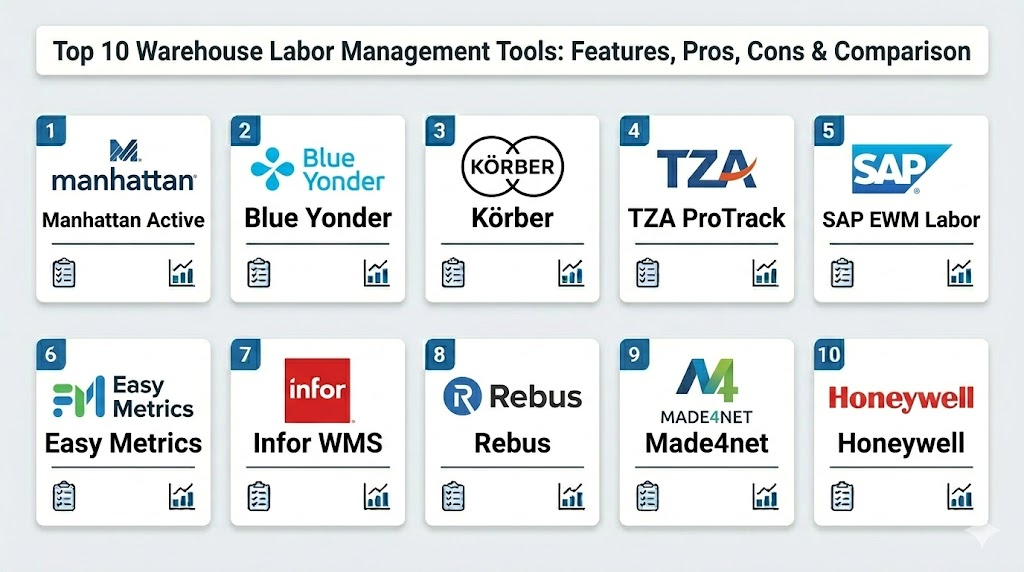
Top 10 Warehouse Labor Management Tools
1. Manhattan Active Labor Management
Manhattan Associates offers a cloud-native solution that is widely considered the industry benchmark. It focuses on creating a “unified” view of labor by combining performance data with employee engagement and wellness tracking.
Key Features
- Discrete Labor Standards (DLS) calculation for precise task benchmarking.
- Gamification modules to drive healthy competition and engagement.
- Advanced supervisor mobile dashboards for floor-level coaching.
- Integrated labor forecasting and automated scheduling.
- Real-time performance-to-plan tracking across all warehouse zones.
Pros
- Unmatched depth in industrial engineering and labor standards.
- Part of a truly unified supply chain execution platform.
Cons
- Higher total cost of ownership compared to standalone apps.
- Best suited for very large, high-complexity operations.
Platforms / Deployment
- Web / iOS / Android
- Cloud-native
Security & Compliance
- SOC 2 Type II, ISO 27001, and robust RBAC.
- Comprehensive audit logs for incentive pay.
Integrations & Ecosystem
Designed to be the center of the Manhattan Active ecosystem.
- Manhattan WMS
- SAP ERP
- Oracle NetSuite
- Various HRIS platforms
Support & Community
Industry-leading professional services and a massive global user conference network.
2. Blue Yonder Labor Management
Blue Yonder (formerly JDA) provides a data-heavy labor suite that excels in complex, multi-site environments where predictive analytics and labor planning are paramount.
Key Features
- Predictive labor planning using machine learning.
- Self-service employee scheduling and shift swapping.
- Support for multi-level incentive and bonus structures.
- Extensive labor modeling and “what-if” scenario planning.
- Real-time supervisor alerts for performance “out-of-bounds” events.
Pros
- Exceptional at long-term labor forecasting and planning.
- Highly configurable for diverse union and non-union environments.
Cons
- The user interface can feel more technical and less “consumer-grade.”
- Configuration requires significant time and expertise.
Platforms / Deployment
- Web / Windows / Mobile
- Cloud / Hybrid
Security & Compliance
- Enterprise-grade encryption and global regulatory compliance.
Integrations & Ecosystem
Deeply integrated with the Blue Yonder supply chain suite.
- Blue Yonder WMS
- Microsoft Azure
- MuleSoft
- Salesforce
Support & Community
Comprehensive global support network and deep technical documentation.
3. Körber (HighJump) Labor Management
Körber’s solution is known for its flexibility and ability to adapt to unique warehouse workflows. It focuses on reducing non-productive time through better task interleaving and visibility.
Key Features
- Flexible labor standards that can be adjusted without coding.
- Direct integration with voice and automated material handling systems.
- Detailed indirect time tracking (cleaning, meetings, training).
- Intuitive supervisor “cockpit” for real-time labor re-allocation.
- Automated coaching trigger notifications.
Pros
- Highly adaptable for unique or non-standard warehouse tasks.
- Strongest performance in “middle-market” enterprise environments.
Cons
- Reporting customization can be complex for new users.
- Some features still require the legacy HighJump architecture.
Platforms / Deployment
- Web / iOS / Android
- Cloud / On-premise
Security & Compliance
- Standard enterprise security protocols and role-based access.
Integrations & Ecosystem
Strongest within the Körber Supply Chain software family.
- Körber WMS
- SAP
- Microsoft Dynamics 365
- Zebra Technologies
Support & Community
Strong regional support and an active user group community.
4. TZA ProTrack
ProTrack by TZA is a standalone, “best-of-breed” labor management system. It is specifically designed for companies that want deep labor engineering without necessarily switching their entire WMS.
Key Features
- Multi-variable labor standards based on travel distance and weight.
- Integrated coaching module to record and track 1-on-1 interactions.
- Advanced incentive payroll export functionality.
- Executive-level dashboards for multi-site labor benchmarking.
- Mobile supervisor tool for on-the-floor observation.
Pros
- Can be implemented alongside almost any Warehouse Management System.
- Deep focus on the “human” element of coaching and culture.
Cons
- Lacks the broader “unified commerce” features of Manhattan.
- Integration requires more custom mapping during setup.
Platforms / Deployment
- Web-based
- Cloud-native (SaaS)
Security & Compliance
- SOC 2 compliant and secure data encryption.
Integrations & Ecosystem
Agnostic platform with wide connectivity.
- Oracle WMS
- Infor WMS
- Kronos
- ADP
Support & Community
Deep expertise in labor engineering and onsite consulting services.
5. SAP Extended Warehouse Management (EWM) Labor
For organizations already running on the SAP ecosystem, the labor management module within EWM provides a powerful, integrated way to manage workforce productivity.
Key Features
- Seamless mapping of EWM tasks to labor activities.
- Calculation of planned versus actual execution times.
- Integration with SAP SuccessFactors for HR data.
- Support for travel distance calculation within the warehouse map.
- Built-in workload balancing and task interleaving.
Pros
- No “integration risk” for existing SAP EWM users.
- High degree of data accuracy from the single source of truth.
Cons
- Extremely complex to configure from scratch.
- Limited gamification and “frontline” engagement features.
Platforms / Deployment
- Web / Mobile (SAP Fiori)
- On-premise / Cloud (S/4HANA)
Security & Compliance
- Highest enterprise security standards (SAP Global Security).
Integrations & Ecosystem
Native to the SAP S/4HANA environment.
- SAP ERP
- SAP SuccessFactors
- SAP Analytics Cloud
Support & Community
Unrivaled global enterprise support and vast partner ecosystem.
6. Easy Metrics
Easy Metrics is a cloud-based performance management platform that focuses on “cost-to-serve” analytics. It is particularly effective for 3PLs that need to link labor productivity to client billing.
Key Features
- Activity-based costing for labor and equipment.
- Cross-facility performance benchmarking.
- Dynamic incentive pay modeling and auditing.
- Cost-to-serve analytics at the customer or SKU level.
- Simple, visually driven executive dashboards.
Pros
- Best-in-class for understanding the financial cost of labor.
- Very fast deployment compared to traditional WLM suites.
Cons
- Less focus on “real-time” floor coaching alerts.
- Not a full labor scheduling or forecasting tool.
Platforms / Deployment
- Web-based
- Cloud-native
Security & Compliance
- Standard cloud security and data privacy controls.
Integrations & Ecosystem
Agnostic and easy to connect via flat files or APIs.
- Most WMS platforms
- Major ERP systems
- Business Intelligence tools
Support & Community
Personalized support and a strong focus on ROI consulting.
7. Infor WMS Labor Management
Infor provides a robust labor module within its WMS that is designed for high-volume distribution and complex fulfillment. It excels at visual labor planning and execution.
Key Features
- Visual warehouse representation for labor tracking.
- Performance-based incentive calculation engine.
- Support for multi-lingual workforces in the mobile app.
- Integrated time and attendance tracking.
- Automated labor standards maintenance.
Pros
- Very strong visualization of where labor is being spent.
- Excellent for multi-national organizations.
Cons
- Requires the Infor WMS for full functionality.
- The mobile interface can be slightly dated.
Platforms / Deployment
- Web / iOS / Android
- Cloud / On-premise
Security & Compliance
- Tier-1 cloud security and SOC 2 compliance.
Integrations & Ecosystem
Part of the Infor CloudSuite family.
- Infor CloudSuite Distribution
- Infor HR
- Birst Analytics
Support & Community
Vast enterprise support and a dedicated Infor user network.
8. Rebus (by Longbow Advantage)
Rebus is a real-time data platform that acts as a “layer” over existing WMS systems to provide immediate labor visibility and performance management without a full WLM install.
Key Features
- Real-time labor dashboards that update in seconds.
- Historical performance trend analysis.
- Automated “coaching alerts” sent to supervisor mobile devices.
- Cross-WMS data aggregation for multi-site firms.
- Workforce utilization and efficiency heatmaps.
Pros
- Fastest “time-to-visibility” in the industry.
- Works across different WMS brands simultaneously.
Cons
- Does not replace a full engineered labor standards engine.
- Focused more on visibility than on forecasting/scheduling.
Platforms / Deployment
- Web-based / Mobile
- Cloud-native
Security & Compliance
- Secure data extraction and encryption.
Integrations & Ecosystem
Specifically designed to bridge different supply chain tools.
- Manhattan WMS
- Blue Yonder WMS
- SAP EWM
- Oracle WMS
Support & Community
Focused customer success and deep technical WMS expertise.
9. Made4net Labor Management
Made4net offers an agile, mid-market friendly labor solution that is integrated into their WarehouseExpert suite. It is built for speed and ease of configuration.
Key Features
- Real-time productivity monitoring and reporting.
- Simplified labor standards for faster setup.
- Integrated incentive and piece-rate calculation.
- Task-level performance tracking.
- Supervisor dashboards for workload balancing.
Pros
- Very fast implementation for mid-sized warehouses.
- Lower technical barrier to entry.
Cons
- Lacks the high-end industrial engineering depth of Manhattan.
- Smaller third-party plugin ecosystem.
Platforms / Deployment
- Web / Mobile
- Cloud / On-premise
Security & Compliance
- Standard enterprise security and user role management.
Integrations & Ecosystem
Part of the SCExpert platform.
- WarehouseExpert WMS
- RoutingExpert
- Most major mid-market ERPs
Support & Community
Responsive support and direct access to product experts.
10. Honeywell Vocollect Labor
While primarily a voice-picking solution, Honeywell’s labor module leverages the data from voice interactions to provide unique insights into picker performance and labor standards.
Key Features
- Precision data capture via voice-to-text interactions.
- Real-time throughput monitoring for voice-enabled workers.
- Voice-guided coaching and feedback.
- Integrated travel time and “dead-heading” analysis.
- Automatic updates to labor standards based on voice task data.
Pros
- Uniquely accurate data for “hands-free” environments.
- Eliminates the need for separate manual data entry.
Cons
- Primarily limited to voice-enabled tasks.
- Not a full-featured scheduling or forecasting suite.
Platforms / Deployment
- Voice Device / Web
- On-premise / Hybrid
Security & Compliance
- Industrial-grade security for voice data.
Integrations & Ecosystem
Works as an add-on to major WMS platforms.
- Manhattan
- Blue Yonder
- SAP
- Oracle
Support & Community
Global Honeywell support and deep hardware integration expertise.
Comparison Table
| Tool Name | Best For | Platform(s) Supported | Deployment | Standout Feature | Public Rating |
| 1. Manhattan Active | Enterprise Unified | Web, iOS, Android | Cloud-native | Unified Performance/Wellness | N/A |
| 2. Blue Yonder | Predictive Planning | Web, Windows, Mobile | Hybrid | ML Labor Forecasting | N/A |
| 3. Körber | Agile Mid-Market | Web, iOS, Android | Hybrid | Task Interleaving Logic | N/A |
| 4. TZA ProTrack | Best-of-Breed WLM | Web, Mobile | Cloud-native | Coaching Module | N/A |
| 5. SAP EWM Labor | SAP Ecosystem | Web, Fiori Mobile | S/4HANA | Native ERP Integration | N/A |
| 6. Easy Metrics | 3PL Financials | Web | Cloud-native | Cost-to-Serve Analytics | N/A |
| 7. Infor WMS | Visual Planning | Web, iOS, Android | Cloud | Visual Warehouse Map | N/A |
| 8. Rebus | Multi-WMS Visibility | Web, Mobile | Cloud-native | Instant Real-time Layer | N/A |
| 9. Made4net | Rapid Setup | Web, Mobile | Hybrid | Agile Configuration | N/A |
| 10. Honeywell | Voice Operations | Voice, Web | Hybrid | Voice-to-Labor Data | N/A |
Evaluation & Scoring of Warehouse Labor Management Tools
| Tool Name | Core (25%) | Ease (15%) | Integrations (15%) | Security (10%) | Performance (10%) | Support (10%) | Value (15%) | Weighted Total |
| 1. Manhattan | 10 | 6 | 10 | 10 | 9 | 9 | 7 | 8.70 |
| 2. Blue Yonder | 9 | 5 | 9 | 10 | 9 | 9 | 7 | 8.20 |
| 3. Körber | 8 | 8 | 9 | 9 | 8 | 8 | 8 | 8.25 |
| 4. TZA ProTrack | 10 | 7 | 8 | 9 | 9 | 9 | 8 | 8.55 |
| 5. SAP EWM | 9 | 3 | 10 | 10 | 10 | 8 | 7 | 7.85 |
| 6. Easy Metrics | 7 | 9 | 8 | 8 | 8 | 8 | 9 | 7.90 |
| 7. Infor WMS | 8 | 7 | 8 | 9 | 8 | 8 | 8 | 7.90 |
| 8. Rebus | 6 | 10 | 10 | 9 | 10 | 9 | 8 | 8.50 |
| 9. Made4net | 7 | 9 | 8 | 8 | 8 | 8 | 9 | 7.90 |
| 10. Honeywell | 6 | 8 | 8 | 9 | 9 | 9 | 7 | 7.60 |
This evaluation highlights that while Manhattan and Blue Yonder offer the most comprehensive core features for massive enterprises, Rebus and Made4net provide significantly higher scores in “Ease of Use” and “Time to Value” for mid-sized operations.
Which Warehouse Labor Management Tool Is Right for You?
Solo / Freelancer
In the warehouse world, this level of software is rarely used by solo operators. However, labor engineering consultants often use Easy Metrics or TZA ProTrack to provide site assessments and productivity audits for their clients.
SMB
Small to medium warehouses should look for agile tools like Made4net or Easy Metrics. These platforms allow you to gain visibility into labor costs without the massive engineering overhead of enterprise-grade suites.
Mid-Market
For companies with 200–500 workers across a few sites, Körber and Rebus offer the best combination of real-time visibility and flexibility to grow alongside your Warehouse Management System.
Enterprise
Large, global distribution networks should prioritize Manhattan Active or Blue Yonder. These are the only platforms capable of managing global labor standards and providing the predictive depth required for thousands of employees.
Budget vs Premium
Easy Metrics and Made4net represent the best value for organizations starting their labor optimization journey. Manhattan and SAP are the premium standard where absolute reliability and deep integration are non-negotiable.
Feature Depth vs Ease of Use
If you need deep industrial engineering (Discrete Labor Standards), TZA ProTrack is the leader. If you need your supervisors to be productive with the tool on Day 1, Rebus is the superior choice.
Integrations & Scalability
Manhattan Active and SAP EWM lead the industry in their ability to scale across hundreds of nodes while maintaining a single, unified data model for the entire workforce.
Security & Compliance Needs
Organizations with strict union reporting or complex multi-national labor laws should lean toward Blue Yonder or Infor, as they have the most extensive configuration options for local compliance.
Frequently Asked Questions
What is the difference between WMS and LMS?
A WMS (Warehouse Management System) manages the inventory, while an LMS (Labor Management System) manages the people doing the work, calculating their efficiency against standards.
What are Discrete Labor Standards (DLS)?
These are highly precise benchmarks for a specific task (e.g., picking a small item vs. picking a heavy case) based on travel distance, equipment used, and physical complexity.
Can labor management tools reduce turnover?
Yes, when used for positive coaching and incentive pay rather than just “monitoring,” they increase engagement and fairly reward high performers.
Is incentive pay automated?
Top-tier tools like Manhattan and TZA automate the calculation of performance-based pay, ensuring it is accurate and ready for payroll export.
How long does it take to see ROI?
Most organizations see a 10% to 15% reduction in labor costs within the first 6 to 12 months of a full WLM implementation.
Do these tools track “indirect” time?
Yes, they allow workers to log time for non-picking activities like cleaning, safety meetings, and training to ensure total hours are accounted for.
Can I use labor management with a legacy WMS?
Yes, “best-of-breed” tools like Rebus and Easy Metrics are designed to sit on top of legacy systems and pull data via APIs or flat files.
Is labor management only for big warehouses?
While most beneficial for sites with 50+ workers, the predictive scheduling features are increasingly valuable for smaller, high-growth fulfillment centers.
Does it require special hardware?
No, most modern tools are mobile-first and run on standard ruggedized warehouse tablets or even employee smartphones in some environments.
How do I deal with union concerns?
The most successful implementations use the data for objective fairness—ensuring that production standards are realistic and that all workers are coached consistently.
Conclusion
Adopting a Warehouse Labor Management tool is a strategic shift from managing the warehouse as a collection of boxes to managing it as a high-performance team of people. In an era where labor is both the highest operational cost and the most scarce resource, having a data-driven approach to productivity is no longer optional. By focusing on industrial engineering rigor, real-time coaching, and employee engagement, organizations can unlock hidden capacity and build a culture of continuous improvement. The next logical step is to audit your current “indirect time” and run a pilot program with a visibility-first tool like Rebus to identify your biggest labor leakage points before committing to a full standards-based rollout.

Best Cardiac Hospitals Near You
Discover top heart hospitals, cardiology centers & cardiac care services by city.
Advanced Heart Care • Trusted Hospitals • Expert Teams
View Best Hospitals