Introduction
Web3 node infrastructure is the underlying hardware and software layer that allows developers to interact with blockchain networks. Without a node, a decentralized application (dApp) has no way to read data from the blockchain or broadcast new transactions to the network. Traditionally, running a blockchain node required significant technical expertise, high-end hardware, and constant maintenance to keep the data synchronized. Node infrastructure providers have simplified this by offering “Nodes-as-a-Service,” allowing developers to connect to the decentralized web via simple API calls.
As the industry moves toward a more mature, multi-chain future, the reliability and speed of these providers have become critical. High-performance node infrastructure ensures that users experience low latency when using DeFi platforms, NFT marketplaces, or gaming environments. These providers handle the heavy lifting of data indexing, load balancing, and global distribution, allowing engineering teams to focus entirely on building the user-facing application rather than managing server clusters.
Best for: Web3 developers, DevOps engineers, blockchain startups, and enterprise financial institutions that need reliable, scalable access to blockchain data without the overhead of self-hosting.
Not ideal for: Purely centralized applications with no blockchain components, or extreme decentralization purists who insist on running their own local hardware for maximum sovereignty.
Key Trends in Web3 Node Infrastructure
- Multi-Chain Ubiquity: Providers are moving beyond Ethereum to support dozens of Layer 1 and Layer 2 networks through a single unified interface.
- Enhanced Data Indexing: Integration of specialized APIs that allow developers to query complex data, like NFT metadata or token balances, in a single request.
- Geographic Distribution: Use of global edge networks to ensure that a user in Tokyo experiences the same low latency as a user in New York.
- Auto-Scaling Architecture: Systems that automatically handle spikes in traffic during major events like popular NFT mints or high-volatility trading days.
- Pay-As-You-Go Models: A shift from expensive flat monthly fees to granular pricing based on actual compute units or requests used.
- Institutional Security: Implementation of enterprise-grade security features including SOC 2 compliance, dedicated endpoints, and role-based access control.
- Developer Tooling Integration: Direct bridges between node providers and popular development frameworks to speed up the local-to-production pipeline.
- The Rise of Decentralized RPCs: Emerging protocols that aim to decentralize the provider layer itself, reducing the risk of a single point of failure.
How We Selected These Tools
- Network Uptime and Reliability: We prioritized providers with a proven track record of maintaining high availability during periods of extreme network congestion.
- Breadth of Supported Networks: Evaluation included the number of different blockchains and testnets available through the provider.
- API Feature Set: We looked for “extra” capabilities beyond basic JSON-RPC, such as WebSockets, enhanced APIs, and debug modes.
- Security and Compliance: Preference was given to providers that offer robust security protocols and clear data privacy standards.
- Ease of Onboarding: The selection includes tools that allow a developer to get an API key and start querying a node in under five minutes.
- Performance Metrics: We evaluated the speed of request processing and global latency across multiple regions.
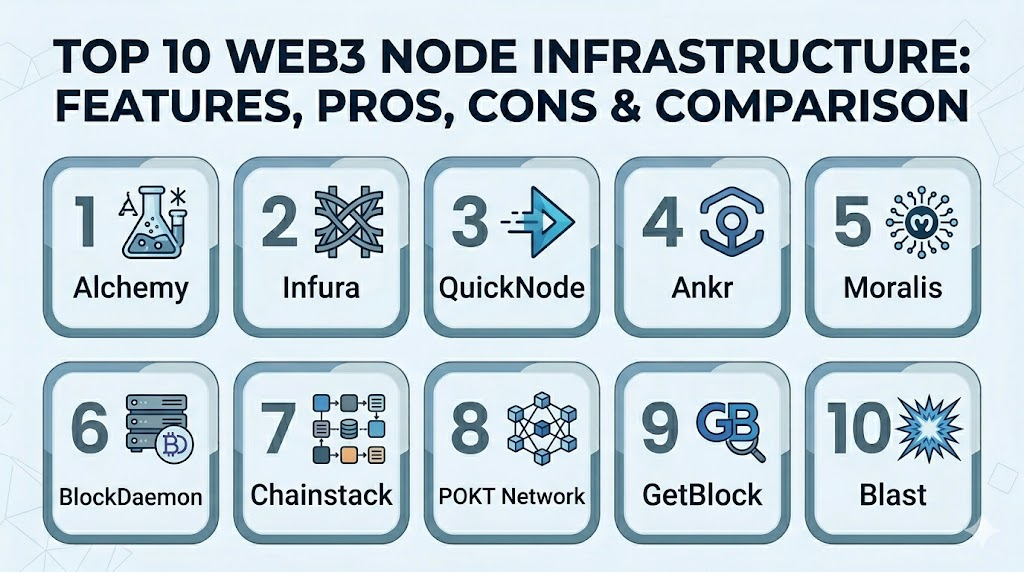
Top 10 Web3 Node Infrastructure Tools
1. Alchemy
Widely considered the industry leader, Alchemy provides a massive suite of developer tools alongside its core node infrastructure. It powers some of the largest names in the Web3 space through its high-performance “Supernode” architecture.
Key Features
- Supernode architecture that ensures data consistency and high reliability across chains.
- Enhanced APIs for simplified NFT, token, and transaction history queries.
- Robust developer dashboard with real-time request monitoring and debugging tools.
- Integrated notification system for monitoring on-chain events via webhooks.
- Support for a wide range of networks including Ethereum, Polygon, Solana, and Arbitrum.
Pros
- Exceptional reliability and data accuracy for production-grade applications.
- Most comprehensive suite of “extra” developer tools in the market.
Cons
- The pricing can scale quickly as an application grows in popularity.
- Some advanced features are locked behind higher-tier enterprise plans.
Platforms / Deployment
Cloud
Web-based Console
Security & Compliance
SSO, MFA, and SOC 2 Type 2 compliance.
GDPR compliant.
Integrations & Ecosystem
Integrates perfectly with popular libraries like Ethers.js and Web3.js, as well as development environments like Hardhat.
Support & Community
Industry-leading documentation and a very active developer community on Discord and Twitter.
2. Infura
Owned by ConsenSys, Infura is one of the oldest and most trusted names in the space. It is the default provider for millions of MetaMask users and is deeply embedded in the Ethereum ecosystem.
Key Features
- Simple API access to Ethereum, IPFS, and various Layer 2 scaling solutions.
- High-availability infrastructure with a global distribution of nodes.
- Support for both JSON-RPC and WebSockets for real-time data streaming.
- Dedicated IPFS gateway for decentralized file storage management.
- Robust security features tailored for enterprise-scale deployments.
Pros
- Proven track record of stability over many years in the industry.
- Seamless integration for teams already using the ConsenSys product suite.
Cons
- Has faced criticism in the past regarding centralization and service outages.
- Documentation can sometimes feel less modern compared to newer competitors.
Platforms / Deployment
Cloud
Web-based Console
Security & Compliance
Role-based access control and secure API key management.
Not publicly stated.
Integrations & Ecosystem
Native integration with MetaMask, Truffle, and Diligence, creating a complete development lifecycle.
Support & Community
Extensive enterprise support options and a large legacy community of blockchain developers.
3. QuickNode
QuickNode focuses on raw speed and performance. It provides developers with dedicated nodes that offer lower latency and higher throughput compared to many shared infrastructure models.
Key Features
- Global edge network designed to route requests to the nearest available node.
- Support for over 25 different blockchains and counting.
- Marketplace for third-party add-ons like security scanners and data indexers.
- Advanced analytics dashboard for tracking performance and usage patterns.
- Multi-chain endpoints that simplify managing different networks in one project.
Pros
- Generally faster request speeds than many shared-node providers.
- Very flexible pricing plans that cater well to both startups and enterprises.
Cons
- The UI for managing multiple endpoints can become cluttered for complex projects.
- Dedicated node pricing is higher than basic shared access.
Platforms / Deployment
Cloud / Dedicated
Web-based Console
Security & Compliance
API key protection and secure endpoint tunneling.
Not publicly stated.
Integrations & Ecosystem
Strong support for NFT-focused projects and integrates well with major cloud providers.
Support & Community
Known for fast technical support and clear, concise developer documentation.
4. Ankr
Ankr provides a decentralized alternative to the major cloud-based node providers. It leverages a distributed network of nodes to provide RPC access while contributing to the decentralization of the networks it supports.
Key Features
- Decentralized RPC infrastructure that reduces reliance on single cloud providers.
- Advanced APIs for cross-chain data retrieval and liquid staking.
- Support for a vast number of Proof-of-Stake networks.
- Enterprise-grade “Node-as-a-Service” for dedicated staking and validator nodes.
- SDKs for building multi-chain applications with minimal configuration.
Pros
- Aligns better with the decentralized ethos of the Web3 movement.
- Very competitive pricing for high-volume request counts.
Cons
- Latency can occasionally vary depending on the specific decentralized node provider.
- Developer dashboard is less feature-rich than Alchemy or QuickNode.
Platforms / Deployment
Cloud / Hybrid / Decentralized
Web-based Console
Security & Compliance
Standard authentication and secure distributed architecture.
Not publicly stated.
Integrations & Ecosystem
Integrates with a wide range of DeFi protocols and governance platforms.
Support & Community
Strong community presence and a focus on empowering individual node operators.
5. Moralist (Web3 Nodes)
Moralis offers a managed backend service that includes high-performance node access. It is designed to be the “Firebase of Web3,” focusing on developer productivity and rapid deployment.
Key Features
- Unified Web3 API that abstracts away the complexities of different chains.
- Real-time sync for database-like access to on-chain events.
- Integrated authentication for users via popular wallets.
- Support for EVM-compatible chains as well as Solana and Aptos.
- Built-in tools for handling NFT metadata and token pricing.
Pros
- Best choice for developers who want a “all-in-one” backend solution.
- Drastically reduces the amount of boilerplate code needed for a dApp.
Cons
- Being a full-service platform, it can feel like “vendor lock-in” for some teams.
- Less focused on raw node performance compared to specialized providers like QuickNode.
Platforms / Deployment
Cloud
Web-based Console
Security & Compliance
Secure API management and end-to-end data encryption.
Not publicly stated.
Integrations & Ecosystem
Integrates with Firebase, AWS Lambda, and other traditional cloud-native tools.
Support & Community
Excellent educational content through the Moralis Academy and a very active YouTube presence.
6. BlockDaemon
BlockDaemon is an institutional-grade infrastructure provider that focuses on security, compliance, and dedicated node hosting for the world’s largest financial entities.
Key Features
- Fully managed dedicated nodes with 99.9% uptime guarantees.
- Support for staking and validator infrastructure alongside RPC access.
- Institutional-grade security with multi-layer protection and monitoring.
- High-performance API access for data-heavy institutional trading.
- “Ubiquity” API that provides a single interface for multiple blockchains.
Pros
- The premier choice for banks and large-scale financial institutions.
- Exceptional focus on regulatory compliance and uptime.
Cons
- Not designed for small-scale developers or hobbyists.
- Pricing is significantly higher than shared-node services.
Platforms / Deployment
Cloud / Dedicated / On-premises
Web-based Console
Security & Compliance
SOC 2 compliance and rigorous security auditing.
ISO 27001 compliant.
Integrations & Ecosystem
Integrates with enterprise custody solutions and institutional trading desks.
Support & Community
White-glove 24/7 support with dedicated account managers for enterprise clients.
7. Chainstack
Chainstack offers a highly flexible platform that allows developers to deploy their own nodes on various cloud providers like AWS, Google Cloud, or Azure through a simplified interface.
Key Features
- Multi-cloud and multi-region deployment options for maximum resilience.
- Support for both elastic (shared) and dedicated nodes.
- Global nodes for reduced latency and improved performance.
- Deep support for enterprise-focused protocols like Hyperledger and Corda.
- Intuitive control panel for managing complex node clusters.
Pros
- Gives developers more control over where their nodes are physically hosted.
- Excellent support for both public and private blockchain networks.
Cons
- Setting up dedicated clusters requires more technical knowledge than a simple API.
- The pricing model can be complex due to the multi-cloud variables.
Platforms / Deployment
Multi-Cloud / Hybrid
Web-based Console
Security & Compliance
Enterprise-grade identity management and secure firewalling.
Not publicly stated.
Integrations & Ecosystem
Works well with traditional IT management tools and enterprise cloud stacks.
Support & Community
Professional support with a strong focus on enterprise-level technical guidance.
8. POKT Network (Pocket Network)
Pocket Network is a decentralized protocol that incentivizes a global network of node operators to provide RPC services. It is designed to eliminate the risks associated with centralized infrastructure.
Key Features
- Decentralized marketplace for node services that removes single points of failure.
- Stake-to-access model that can reduce long-term costs for developers.
- Support for dozens of blockchains through a globally distributed network.
- Protocol-level load balancing that routes requests to the healthiest nodes.
- Open-source infrastructure that anyone can contribute to.
Pros
- Provides the highest level of censorship resistance in the infrastructure layer.
- Can be more cost-effective for high-volume users through its unique token model.
Cons
- Configuration can be more complex than a standard SaaS sign-up.
- Latency and reliability depend on the performance of individual network participants.
Platforms / Deployment
Decentralized Network
Protocol-based
Security & Compliance
Security through decentralization and cryptographic verification.
Not publicly stated.
Integrations & Ecosystem
Strongly favored by the DeFi community and projects that prioritize decentralization.
Support & Community
Community-governed through a DAO with a heavy focus on open-source contributions.
9. GetBlock
GetBlock provides a straightforward “Node-as-a-Service” model with support for over 40 blockchains, making it one of the most diverse providers in terms of network coverage.
Key Features
- Instant access to shared and dedicated nodes for a vast array of chains.
- Simple pricing based on the number of requests, with no hidden costs.
- Support for both JSON-RPC and WebSockets for real-time interaction.
- Explorer-like interface for testing API calls directly in the browser.
- Dedicated nodes available for high-load projects.
Pros
- Very easy to use for developers who need access to niche blockchains.
- Transparent and affordable pricing for early-stage startups.
Cons
- The developer dashboard is simpler and lacks some of the advanced features of Alchemy.
- Not as many high-level “enhanced APIs” for complex data querying.
Platforms / Deployment
Cloud
Web-based Console
Security & Compliance
Standard API key protection and secure server environments.
Not publicly stated.
Integrations & Ecosystem
Good support for developers building multi-chain wallets and explorers.
Support & Community
Active technical support and a growing community of independent developers.
10. Blast (by Bware Labs)
Blast is a multi-chain API platform that focuses on providing high-performance access with a decentralized backend, aiming for a “best of both worlds” approach.
Key Features
- Decentralized architecture with a focus on institutional-grade reliability.
- Global distribution of nodes for low-latency request processing.
- Built-in load balancing and failover mechanisms for high availability.
- Support for all major EVM chains and several non-EVM networks.
- User-friendly dashboard for managing API keys and usage statistics.
Pros
- Combines the ease of a SaaS platform with the resilience of a decentralized network.
- Very strong performance benchmarks for common RPC calls.
Cons
- Newer to the market compared to giants like Infura and Alchemy.
- Network support, while growing, is currently smaller than some competitors.
Platforms / Deployment
Cloud / Decentralized
Web-based Console
Security & Compliance
Secure authentication and distributed node verification.
Not publicly stated.
Integrations & Ecosystem
Gaining traction within the DeFi and NFT ecosystem due to its performance.
Support & Community
Professional support with a focus on building a sustainable decentralized ecosystem.
Comparison Table
| Tool Name | Best For | Platform(s) Supported | Deployment | Standout Feature | Public Rating |
| 1. Alchemy | Production Apps | Web-based | Cloud | Supernode Reliability | N/A |
| 2. Infura | Ethereum Standard | Web-based | Cloud | MetaMask Native | N/A |
| 3. QuickNode | Raw Performance | Web-based | Dedicated/Cloud | Global Edge Network | N/A |
| 4. Ankr | Decentralized Access | Web-based | Hybrid/Decent. | Multi-chain SDKs | N/A |
| 5. Moralis | Full-stack Devs | Web-based | Cloud | Web3 Firebase | N/A |
| 6. BlockDaemon | Institutions | Web-based | Dedicated/On-prem | 99.9% Uptime SLA | N/A |
| 7. Chainstack | Multi-Cloud Control | Web-based | Multi-Cloud | Platform Flexibility | N/A |
| 8. POKT Network | Censorship Resist. | Protocol-based | Decentralized | Stake-to-Access | N/A |
| 9. GetBlock | Diverse Networks | Web-based | Cloud | 40+ Blockchains | N/A |
| 10. Blast | High Availability | Web-based | Decentralized | Performance Logic | N/A |
Evaluation & Scoring
| Tool Name | Core (25%) | Ease (15%) | Integrations (15%) | Security (10%) | Perf (10%) | Support (10%) | Value (15%) | Total |
| 1. Alchemy | 10 | 9 | 10 | 9 | 9 | 9 | 7 | 8.95 |
| 2. Infura | 9 | 9 | 10 | 8 | 8 | 8 | 8 | 8.55 |
| 3. QuickNode | 9 | 9 | 8 | 8 | 10 | 9 | 8 | 8.65 |
| 4. Ankr | 8 | 8 | 8 | 7 | 8 | 7 | 9 | 7.95 |
| 5. Moralis | 7 | 10 | 9 | 8 | 7 | 9 | 8 | 8.15 |
| 6. BlockDaemon | 10 | 6 | 8 | 10 | 10 | 10 | 5 | 8.15 |
| 7. Chainstack | 9 | 7 | 8 | 9 | 9 | 8 | 7 | 8.05 |
| 8. POKT Network | 8 | 5 | 7 | 8 | 7 | 7 | 9 | 7.25 |
| 9. GetBlock | 7 | 9 | 7 | 7 | 8 | 7 | 9 | 7.75 |
| 10. Blast | 8 | 8 | 7 | 8 | 9 | 7 | 8 | 7.90 |
The scoring above focuses on the critical requirements for a production-level Web3 application. Alchemy and QuickNode lead the total scores because they offer the best balance between raw performance and developer-friendly features. Infura remains a high-scoring titan due to its absolute ubiquity and integration with the most popular wallets. For organizations that prioritize security over everything else, BlockDaemon is the clear winner, while POKT Network is the choice for those who view decentralization as a core technical requirement rather than just a buzzword.
Which Web3 Node Infrastructure Tool Is Right for You?
Solo / Freelancer
If you are just starting your Web3 journey, Alchemy or Moralis are the best options. They offer generous free tiers and extensive educational resources that help you move from a “hello world” contract to a deployed dApp without spending a cent on infrastructure.
SMB
Small to medium-sized teams should look at QuickNode or Infura. These providers offer the reliability needed for a growing user base while remaining simple enough to manage without a dedicated DevOps team.
Mid-Market
For companies with a scaling product, Chainstack or Ankr provide the flexibility to manage costs while expanding across multiple chains. Chainstack’s multi-cloud options are particularly useful for teams that want to avoid reliance on a single hosting provider.
Enterprise
Large-scale financial institutions or corporations must choose BlockDaemon. The focus on compliance, dedicated hardware, and legal SLAs is essential for any project that needs to meet strict corporate risk standards.
Budget vs Premium
GetBlock and Ankr offer excellent value for teams on a tight budget. Alchemy and QuickNode are considered premium services where you pay for the advanced indexing and performance optimizations that save your engineers time.
Feature Depth vs Ease of Use
Moralis is the king of ease of use, providing a high-level API that hides the complexity of the node. Alchemy provides the most depth for developers who need to dig into the technical nuances of blockchain data.
Integrations & Scalability
Infura is the most integrated tool in the world thanks to MetaMask. For raw scalability during massive traffic spikes, Alchemy’s Supernode architecture is designed specifically to handle enterprise-level loads.
Security & Compliance Needs
If your project requires SOC 2 or other high-level certifications, BlockDaemon and Alchemy are the only providers that consistently meet these rigorous standards.
Frequently Asked Questions (FAQs)
1. What exactly is a Web3 node provider?
It is a service that hosts the blockchain’s ledger on powerful servers and provides you with an API key so you can read and write data to the network without running your own hardware.
2. Is it better to run my own node or use a provider?
For most developers, a provider is better. Running your own node requires high-end hardware, 24/7 monitoring, and significant bandwidth, whereas a provider handles all of this for a small fee.
3. Will using a provider make my app centralized?
Technically, you are relying on a central company for data. However, many developers use multiple providers or decentralized options like POKT Network to mitigate this risk.
4. What is a “Compute Unit”?
It is a way for providers like Alchemy to price different API calls. Simple tasks like checking a balance cost fewer compute units than complex tasks like searching for all NFTs in a specific wallet.
5. Do I need different providers for different chains?
No, most top-tier providers like QuickNode or GetBlock support dozens of chains through a single dashboard, allowing you to manage your multi-chain projects in one place.
6. What happens if my node provider goes down?
Your app will likely stop working unless you have a “failover” strategy where your code automatically switches to a backup API key from a different provider.
7. Are free tiers enough for a production app?
Rarely. Free tiers are great for development and testing, but a production app with even a few hundred users will quickly exceed the daily request limits.
8. What is the difference between Shared and Dedicated nodes?
Shared nodes are used by many developers at once, which is cheaper. Dedicated nodes are reserved only for your app, providing faster speeds and more consistent performance.
9. Can I switch providers easily?
Yes, because most providers use the standard JSON-RPC interface, switching usually just involves changing one line of code in your application (the API URL).
10. Do node providers store my users’ private keys?
No. Node providers only see the signed transactions you send them. Your users’ private keys remain safely in their own wallets, like MetaMask.
Conclusion
The success of any decentralized application depends on the strength of its connection to the blockchain. Node infrastructure providers have moved from being a luxury to a fundamental necessity for modern Web3 development. Whether you prioritize the rapid-fire speed of a dedicated node, the massive feature set of a managed platform, or the censorship resistance of a decentralized network, there is a tool on this list that fits your specific needs. Node infrastructure providers have simplified this by offering “Nodes-as-a-Service,” allowing developers to connect to the decentralized web via simple API calls. As the industry continues to scale toward billions of users, these providers will remain the critical bridge between traditional web architecture and the decentralized future.

Best Cardiac Hospitals Near You
Discover top heart hospitals, cardiology centers & cardiac care services by city.
Advanced Heart Care • Trusted Hospitals • Expert Teams
View Best Hospitals