Introduction
Wellness habit tracking apps are specialized digital platforms designed to help individuals monitor, maintain, and improve their daily routines related to physical and mental health. Unlike simple task managers, these apps are built on the principles of behavioral science, using triggers, streaks, and feedback loops to transform conscious efforts into automatic behaviors. By tracking everything from water intake and sleep patterns to mindfulness and exercise, these tools provide a quantitative look at personal well-being that would be difficult to manage manually.
In today’s high-pressure environment, habit tracking has evolved from a personal productivity trend into a vital wellness strategy. The rise of digital burnout and sedentary lifestyles has created a need for structured “nudges” that remind us to disconnect, move, and recover. Modern tracking tools now leverage biometric data and intelligent scheduling to ensure that wellness isn’t just an afterthought but a core part of the daily schedule.
Real-World Use Cases
- Stress Management: Tracking daily meditation and deep breathing sessions to lower cortisol levels and improve focus.
- Physical Recovery: Monitoring sleep hygiene and active movement to ensure the body recovers from professional and athletic strain.
- Nutritional Consistency: Maintaining streaks for hydration and balanced eating to support metabolic health.
- Digital Detox: Setting specific limits for screen time and tracking the habit of “unplugging” before bed.
- Professional Longevity: Implementing small “micro-habits” during the workday, such as stretching every hour, to prevent physical fatigue.
Evaluation Criteria for Buyers
- Automation: Does the app sync with wearables to track habits like steps and sleep automatically?
- Psychological Approach: Does it use positive reinforcement (gamification) or analytical reflection (journaling)?
- Flexibility: Can it handle irregular schedules, such as habits that only occur on weekdays?
- Data Visualization: Are the charts and graphs easy to interpret for long-term trend analysis?
- Reminder Customization: Are notifications gentle nudges or intrusive alerts that lead to “notification fatigue”?
- Ecosystem Integration: How well does it connect with existing health platforms like Apple Health or Google Fit?
- Privacy: Is personal behavioral data stored locally or managed with enterprise-grade encryption?
Best for: Working professionals, wellness enthusiasts, and individuals recovering from burnout who need a structured way to prioritize self-care.
Not ideal for: Those who find constant digital tracking stressful or people who prefer traditional paper journaling for their daily reflections.
Key Trends in Wellness Habit Tracking Apps
- AI-Driven Habit Stacking: Modern apps now suggest new habits based on your existing routines, such as suggesting “5 minutes of stretching” immediately after your “morning coffee” habit.
- Predictive Burnout Alerts: Using heart rate variability (HRV) data from wearables to suggest a “rest habit” before you feel physically exhausted.
- Gamified Accountability: Transforming daily chores into RPG-style quests to increase dopamine release and long-term retention.
- Context-Aware Reminders: Notifications that only trigger when you are at a specific location, such as a “drink water” reminder when you arrive at your office.
- Holistic Mental Health Integration: Moving beyond physical steps to track emotional states, gratitude, and cognitive focus.
- Enterprise Wellness Sync: A growing trend where companies offer premium habit tracking subscriptions as part of employee benefit packages.
- Privacy-First Local Storage: A shift toward offline-first apps that keep sensitive health data on the device rather than the cloud.
- Social “Tribes”: Group-based habit challenges that use social pressure and community support to maintain consistency.
How We Selected These Tools
To identify the top ten wellness habit trackers, we conducted a detailed analysis of the digital health market, focusing on tools that offer more than just a simple checklist. Our methodology included:
- Scientific Foundation: Prioritizing apps that use proven behavioral change models like the Hook Model or Habit Stacking.
- Cross-Platform Availability: Ensuring that users can track habits regardless of whether they are on a mobile device, desktop, or wearable.
- User Engagement Metrics: Evaluating which apps have the highest long-term retention rates versus those that are quickly abandoned.
- Integration Depth: Looking for robust connections with health sensors and third-party wellness ecosystems.
- Customization Range: Testing how well the tools adapt to unique lifestyles and non-standard goals.
- Support for Mental Well-being: Including tools that specifically address mindfulness and emotional tracking alongside physical habits.
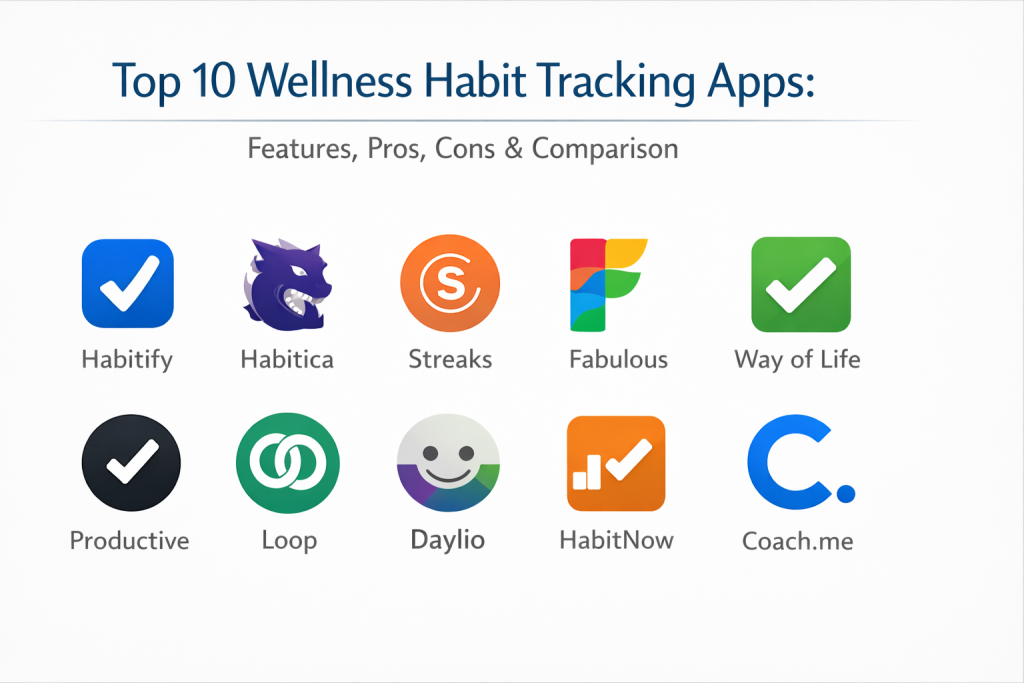
Top 10 Wellness Habit Tracking Apps
1. Habitify
Habitify is a sleek, multi-platform habit tracker designed for those who value data and clean organization. It categorizes habits into “Areas” like Health, Career, and Personal, allowing users to focus on specific life segments without feeling overwhelmed.
Key Features
- Habit Areas for grouping related wellness goals.
- Detailed progress reports with completion rates and heatmaps.
- Seamless sync across iOS, Android, Web, and Apple Watch.
- Integration with Apple Health to automate fitness tracking.
- Dark mode and customizable interface for a personalized feel.
Pros
- Extremely clean and professional user interface.
- Excellent data visualization for long-term tracking.
Cons
- Free version is limited to a small number of habits.
- Lacks the deep gamification elements found in other apps.
Platforms / Deployment
Web / Windows / macOS / iOS / Android — Cloud
Security & Compliance
Standard encryption; supports biometric app locking for privacy.
Integrations & Ecosystem
Integrates deeply with the Apple ecosystem and Google Fit. It also supports Zapier for connecting habit data to other productivity tools.
Support & Community
Comprehensive help center and a responsive developer team. It features a strong blog focused on habit-building science.
2. Habitica
Habitica takes a completely different approach by turning your life into a Role-Playing Game (RPG). Every habit you complete earns you experience points and gold, while missed habits damage your in-game character.
Key Features
- Avatar customization and equipment upgrades based on real-life success.
- Social Quests where you team up with friends to “defeat monsters” by completing habits.
- Custom rewards system where gold can be traded for real-life treats.
- Detailed task list covering Habits, Dailies, and To-Dos.
- In-app community chat and guilds for shared accountability.
Pros
- Highly addictive and engaging for those who enjoy gaming.
- Strong social community provides high levels of accountability.
Cons
- The interface can feel cluttered and childish to some professionals.
- Requires a constant internet connection for social features.
Platforms / Deployment
Web / iOS / Android — Cloud
Security & Compliance
Not publicly stated.
Integrations & Ecosystem
Supports a variety of community-built extensions and third-party browser add-ons.
Support & Community
One of the most active user communities in the wellness space with thousands of community-run guilds.
3. Streaks
Streaks is a minimalist, award-winning app for Apple users that focuses on doing a task every day to build a continuous “streak.” It is designed to be fast, simple, and highly visual.
Key Features
- Limits users to 24 habits to prevent overwhelm and encourage focus.
- Automatically marks habits as complete using Apple Health data.
- Negative habits feature to help users break bad routines (e.g., quitting smoking).
- Customizable icons and colors for a bespoke dashboard.
- Highly functional Apple Watch complications for quick logging.
Pros
- Beautiful, minimalist design that won an Apple Design Award.
- Excellent automation with health sensors.
Cons
- Only available for the Apple ecosystem.
- The 24-habit limit might be restrictive for power users.
Platforms / Deployment
iOS / macOS / watchOS — Self-hosted
Security & Compliance
Uses iCloud for syncing; data remains within the user’s private account.
Integrations & Ecosystem
Directly tied into Apple Health, Siri Shortcuts, and the Apple Watch.
Support & Community
Standard support through the App Store and a dedicated website with FAQs.
4. Fabulous
Fabulous was developed in Duke University’s Behavioral Economics Lab. It focuses on “Journeys”—structured programs that guide you through building foundational wellness routines step-by-step.
Key Features
- Science-based coaching for sleep, focus, and energy.
- Integrated timers for guided morning and evening rituals.
- Audio-guided coaching sessions to keep users motivated.
- Habit “Journeys” that unlock as you progress.
- Beautiful, artistic interface designed to reduce stress.
Pros
- Excellent for beginners who need a guided “how-to” for wellness.
- Focuses on the “why” behind habits, not just the “what.”
Cons
- Subscription is relatively expensive compared to competitors.
- Can feel overly prescriptive for users who want total control.
Platforms / Deployment
iOS / Android — Cloud
Security & Compliance
Standard data encryption for user accounts.
Integrations & Ecosystem
Limited integrations; focuses primarily on its own guided ecosystem.
Support & Community
Large community of users following the same “Journeys” and professional support tiers.
5. Way of Life
Way of Life is designed for those who want to see the big picture. It uses a unique color-coded system (Green for good, Red for bad) to help users identify patterns in their behavior over weeks and months.
Key Features
- Quick yes/no tracking for rapid daily logging.
- Interactive charts that show “chains” of success.
- Journaling feature to add notes to specific habit entries.
- Flexibility to track daily, weekly, or custom interval habits.
- Data export capabilities for external analysis.
Pros
- Incredibly fast to use once set up.
- Visual trends make it very clear where you are struggling.
Cons
- The free version is very limited (only 3 habits).
- Interface is functional but lacks the modern “polish” of others.
Platforms / Deployment
iOS / Android — Self-hosted
Security & Compliance
Pin and biometric lock features for app privacy.
Integrations & Ecosystem
Supports cloud backups but has fewer direct health sensor integrations.
Support & Community
Solid documentation and a direct support channel for premium users.
6. Productive
Productive is a high-energy habit tracker that emphasizes “Challenges.” It provides users with pre-built routines and curated wellness content to help them stay inspired.
Key Features
- Pre-set habit programs for specific goals like “Stress Relief.”
- In-app articles and tips on productivity and wellness.
- Location-based reminders to trigger habits at the right time.
- Clean, colorful interface with intuitive gesture controls.
- Detailed stats to analyze performance across life categories.
Pros
- Great for people who need inspiration and new ideas for habits.
- Very polished user experience with smooth animations.
Cons
- Many of the best features are locked behind a subscription.
- Notifications can sometimes feel repetitive.
Platforms / Deployment
iOS / Android — Cloud
Security & Compliance
Standard data privacy protocols.
Integrations & Ecosystem
Integrates with Siri and Apple Watch for easy logging.
Support & Community
Active developer updates and a helpful feedback loop for users.
7. Loop Habit Tracker
Loop is the premier choice for Android users who want a free, open-source, and privacy-focused tool. It is lightweight, contains no ads, and provides surprisingly deep analytics for a free app.
Key Features
- Open-source code with zero advertisements or tracking.
- Advanced “Habit Score” algorithm that weights recent consistency.
- Support for flexible schedules and custom frequencies.
- Home screen widgets for fast habit check-ins.
- Full offline functionality with local data storage.
Pros
- Completely free with no hidden costs.
- Respects user privacy more than almost any other tracker.
Cons
- Not available for iOS users.
- Lacks the guided “coaching” or content of paid apps.
Platforms / Deployment
Android — Self-hosted
Security & Compliance
Data is stored locally on the device; no cloud account required.
Integrations & Ecosystem
Limited to the Android ecosystem; no direct third-party health app sync.
Support & Community
Strong community on GitHub for those who want to contribute or report bugs.
8. Daylio
Daylio is primarily a mood tracker that has evolved into a powerful habit tracker. By linking your daily activities to your emotional state, it helps you see exactly which habits improve your mental wellness.
Key Features
- Micro-diary system that requires no typing—just tap icons.
- Goal-setting features for building long-term habits.
- Automatic correlation charts showing how habits affect mood.
- Customizable activity icons and color themes.
- Secure cloud backup for personal entries.
Pros
- Exceptional for mental health and identifying burnout triggers.
- Very low friction; tracking takes less than 10 seconds.
Cons
- Not a dedicated “habit streak” tool; more observational.
- Some users may find the icon-only system too limiting.
Platforms / Deployment
iOS / Android — Hybrid
Security & Compliance
Supports PIN, fingerprint, and FaceID locking.
Integrations & Ecosystem
Limited health sensor integration; focuses on manual behavioral logging.
Support & Community
Large following of users focused on mental health and self-reflection.
9. HabitNow
HabitNow is a robust Android app that combines habit tracking with a full to-do list. It is perfect for users who want to manage their wellness routines and their professional tasks in a single interface.
Key Features
- Integrated habit tracker and task manager.
- Highly customizable reminders with “snooze” options.
- Category-based organization with color coding.
- Detailed statistics including calendar views and success charts.
- Lock screen widgets for immediate access.
Pros
- Excellent all-in-one tool for daily life management.
- Very flexible scheduling for complex routines.
Cons
- Android only; no version for iPhone users.
- The interface can feel a bit dense for beginners.
Platforms / Deployment
Android — Self-hosted
Security & Compliance
Not publicly stated.
Integrations & Ecosystem
Supports Google Drive for data backups.
Support & Community
Regular updates and a solid base of Android power users.
10. Coach.me
Coach.me is unique because it combines a free tracking app with the option to hire a human habit coach. It is built for those who find that automated notifications aren’t enough to keep them accountable.
Key Features
- Community-based habit tracking where you can see others’ progress.
- Hire professional human coaches for specific habits (paid).
- Leadership boards and community support for thousands of goals.
- Simple, high-contrast tracking interface.
- Weekly reports sent directly to your email.
Pros
- The best tool for high-stakes accountability.
- Access to real human expertise for stubborn habits.
Cons
- The app interface feels dated compared to modern competitors.
- Professional coaching is a significant monthly expense.
Platforms / Deployment
Web / iOS / Android — Cloud
Security & Compliance
Standard encryption; community features can be set to private.
Integrations & Ecosystem
Focuses on the human-to-human coaching model rather than technical sync.
Support & Community
One of the oldest and most established habit-building communities online.
Comparison Table (Top 10)
| Tool Name | Best For | Platform(s) Supported | Deployment | Standout Feature | Public Rating |
| 1. Habitify | Professionals | iOS, Android, Web | Cloud | Multi-device Sync | 4.4/5 |
| 2. Habitica | Gamification | iOS, Android, Web | Cloud | RPG Mechanics | 4.2/5 |
| 3. Streaks | Apple Users | iOS, macOS, Watch | Self-hosted | Minimalist Design | 4.8/5 |
| 4. Fabulous | Guided Coaching | iOS, Android | Cloud | Science-backed Journeys | 4.5/5 |
| 5. Way of Life | Pattern Analysis | iOS, Android | Self-hosted | Color-coded Chains | 4.7/5 |
| 6. Productive | Routine Ideas | iOS, Android | Cloud | Curated Challenges | 4.6/5 |
| 7. Loop | Privacy / Android | Android | Self-hosted | Open Source / Free | 4.7/5 |
| 8. Daylio | Mood & Wellness | iOS, Android | Hybrid | Activity Correlation | 4.8/5 |
| 9. HabitNow | Task + Habits | Android | Self-hosted | Unified Dashboard | 4.8/5 |
| 10. Coach.me | Accountability | iOS, Android, Web | Cloud | Human Coaching | 4.0/5 |
Evaluation & Scoring of Wellness Habit Tracking Apps
| Tool Name | Core (25%) | Ease (15%) | Integrations (15%) | Security (10%) | Perf (10%) | Support (10%) | Value (15%) | Total |
| Habitify | 9 | 8 | 9 | 8 | 9 | 8 | 7 | 8.4 |
| Streaks | 8 | 10 | 10 | 9 | 10 | 7 | 8 | 8.4 |
| Daylio | 8 | 10 | 5 | 9 | 10 | 8 | 9 | 8.2 |
| Fabulous | 9 | 7 | 6 | 7 | 8 | 9 | 7 | 7.6 |
| HabitNow | 9 | 8 | 6 | 7 | 9 | 7 | 8 | 7.6 |
| Loop | 7 | 9 | 4 | 10 | 10 | 6 | 10 | 7.4 |
| Cinema 4D | 8 | 9 | 9 | 6 | 9 | 9 | 6 | 7.9 |
| Way of Life | 7 | 9 | 5 | 8 | 9 | 7 | 7 | 7.3 |
| Habitica | 8 | 6 | 6 | 6 | 7 | 9 | 8 | 7.1 |
| Coach.me | 6 | 7 | 5 | 7 | 6 | 8 | 7 | 6.4 |
Scoring for wellness trackers prioritizes ease of use and long-term value. A high “Core” score indicates deep behavioral science features, while a high “Security” score highlights tools that keep personal wellness data private.
Which Wellness Habit Tracking App Is Right for You?
Solo / Freelancer
If you manage your own schedule, Habitify or TickTick are excellent for balancing professional habits with self-care. They keep your data synchronized across all your work devices.
SMB (Small to Medium Business)
Small teams looking to foster a culture of wellness may enjoy Habitica. Creating a company “guild” can turn habit tracking into a fun, low-pressure team-building activity.
Mid-Market
For organizations looking to support employee mental health, Fabulous or Daylio are excellent recommendations. They provide the “why” behind wellness, making them more than just productivity tools.
Enterprise
Large-scale organizations usually require tools with high security and integration capabilities. Streaks (for Apple-based teams) or custom enterprise wellness platforms like Wellable are the standard here.
Budget vs Premium
Loop is the best zero-cost option for Android, while Streaks offers a very affordable one-time purchase. Fabulous and Habitify are premium choices for those who want a guided, polished experience.
Feature Depth vs Ease of Use
Way of Life and Daylio are the easiest to use daily. For those who want to dive deep into behavioral psychology and multi-step routines, Fabulous is the clear winner.
Integrations & Scalability
If your wellness depends on wearable data, Streaks and Habitify offer the best scalability across health ecosystems.
Security & Compliance Needs
For the highest level of privacy, Loop and Streaks are preferred as they store your behavioral data locally on your device rather than on a central server.
Frequently Asked Questions (FAQs)
1. Is habit tracking better than using a simple to-do list?
Yes, because habit trackers focus on consistency and long-term behavior change, whereas to-do lists are designed for one-off tasks that you complete and forget.
2. How long does it take for a new wellness habit to stick?
Research suggests it takes an average of 66 days for a behavior to become automatic, though this varies based on the person and the habit.
3. Should I track many habits at once?
No. It is best to start with 1–3 small habits. Tracking too many leads to “habit fatigue” and increases the chance that you will stop using the app entirely.
4. Are these apps safe for my personal data?
Most reputable apps use encryption, but for maximum privacy, choose “offline-first” tools like Loop or Streaks that store data on your phone.
5. Can these apps help with mental health issues like anxiety?
While they are not a replacement for therapy, apps like Daylio and Fabulous can help you identify triggers and build routines that support mental stability.
6. Do I need a smartwatch to use these apps?
No, but a smartwatch makes tracking physical habits like steps and sleep much easier through automation.
7. What is “habit stacking”?
It is the practice of pairing a new habit with one you already do consistently, such as doing a “breathing exercise” immediately after “brushing your teeth.”
8. Is it okay to miss a day in my streak?
Yes. Most behavioral scientists suggest that “never missing twice” is more important than a perfect streak. Some apps even allow “skip days” for this reason.
9. Can these apps be used for professional habits?
Absolutely. Many users track work habits like “reviewing logs,” “writing documentation,” or “clearing the inbox” alongside their wellness goals.
10. Why do most people stop using habit trackers?
People often quit because they try to track too many difficult habits at once. Success comes from making the habits “too small to fail” in the beginning.
Conclusion
The “best” wellness habit tracking app is the one that you will actually use every day. Whether you prefer the gamified world of Habitica, the data-rich environment of Habitify, or the minimalist focus of Streaks, the goal remains the same: creating a sustainable rhythm of life. By turning wellness into a measurable part of your daily operations, you move from reactive health management to a proactive state of peak performance. Choose a tool that fits your natural personality—be it analytical or artistic—and start with one small change today. I suggest selecting one physical habit (like hydration) and one mental habit (like a 5-minute reflection) and tracking only those for 14 days. This will help you validate the tool’s interface before you scale your routine.

Best Cardiac Hospitals Near You
Discover top heart hospitals, cardiology centers & cardiac care services by city.
Advanced Heart Care • Trusted Hospitals • Expert Teams
View Best Hospitals