Introduction
Workspace Analytics Tools are advanced data platforms designed to measure, visualize, and optimize how physical and digital office environments are utilized. These solutions aggregate data from various sources—including Wi-Fi logs, badge swipes, occupancy sensors, and calendar bookings—to provide facility managers and HR leaders with actionable insights. By moving beyond anecdotal evidence, these tools allow organizations to understand the “heartbeat” of their office, identifying underutilized zones and high-traffic areas to improve the overall employee experience.
In the modern landscape of flexible and hybrid work, workspace analytics have transitioned from a luxury to a operational necessity. Organizations can no longer afford to maintain vast amounts of expensive real estate based on guesswork. These platforms provide the empirical evidence needed to right-size office footprints, redesign layouts for better collaboration, and reduce energy consumption by identifying empty zones that do not require climate control or lighting.
Real-world use cases include:
- Real Estate Right-Sizing: Identifying that an office is only at 40% peak capacity, allowing the company to consolidate floors and save millions in rent.
- Collaboration Mapping: Analyzing which departments sit near each other and how that proximity affects cross-functional project success.
- Peak Demand Planning: Using historical data to predict which days of the week will require the most desk availability or catering services.
- Environmental Impact Reduction: Linking occupancy data with building management systems to automate energy savings in vacant office areas.
Buyers should evaluate these platforms based on:
- Diversity of data sources supported (Sensors, Wi-Fi, Calendars, Badge data).
- Granularity of reporting (Global view vs. individual desk level).
- Real-time monitoring capabilities vs. historical trend analysis.
- Ease of integration with existing IWMS or HRIS systems.
- Employee privacy protections and data anonymization features.
- Quality of data visualization and ease of use for non-analysts.
- Predictive modeling capabilities for future space requirements.
- Scalability across a global portfolio of diverse office types.
Mandatory paragraph
- Best for: Real estate executives, facility managers, and workplace experience leads in medium-to-enterprise organizations looking to make data-driven decisions about their physical assets.
- Not ideal for: Small startups with a single open-plan room where physical presence is obvious and the cost of analytical software outweighs the potential savings.
Key Trends in Workspace Analytics Tools
The field of spatial intelligence is rapidly evolving with the integration of AI and IoT technologies:
- AI-Powered Spatial Intelligence: Using computer vision and machine learning to distinguish between a person, a laptop, or a bag left on a desk.
- Passive Occupancy Sensing: Moving away from manual check-ins toward seamless “invisible” data collection via existing network infrastructure.
- Employee Sentiment Overlay: Combining physical usage data with employee surveys to understand not just where people sit, but why they chose that spot.
- Predictive Maintenance Integration: Using high-traffic data to trigger automated cleaning requests or equipment inspections.
- Digital Twin Visualization: Creating 3D virtual replicas of the office that update in real-time to show live occupancy levels.
- Health and Wellness Monitoring: Correlating occupancy levels with CO2, humidity, and temperature data to ensure optimal working conditions.
- Neighborhood Optimization: Identifying the “natural” boundaries where teams congregate to better define hybrid work zones.
- Dynamic Space Allocation: Systems that automatically suggest reconfiguring modular furniture based on changing team sizes and needs.
How We Selected These Tools (Methodology)
To identify the top 10 solutions, we utilized a framework focused on data integrity, integration breadth, and actionable outcomes:
- Data Agnosticism: We prioritized platforms that can ingest data from multiple hardware vendors and software systems.
- Privacy by Design: Evaluating the methods used to anonymize employee data and comply with global privacy regulations.
- Actionable Insights: Checking if the tool merely provides “graphs” or if it offers specific recommendations for space optimization.
- Implementation Complexity: Assessing the technical effort required to go from installation to a fully functional dashboard.
- Reliability: Reviewing the accuracy of occupancy detection and the stability of the cloud infrastructure.
- Cross-Functional Utility: Ensuring the data is valuable to IT, HR, and Real Estate departments alike.
- Customer Success Record: Analyzing the platform’s history of helping large organizations successfully reduce real estate costs.
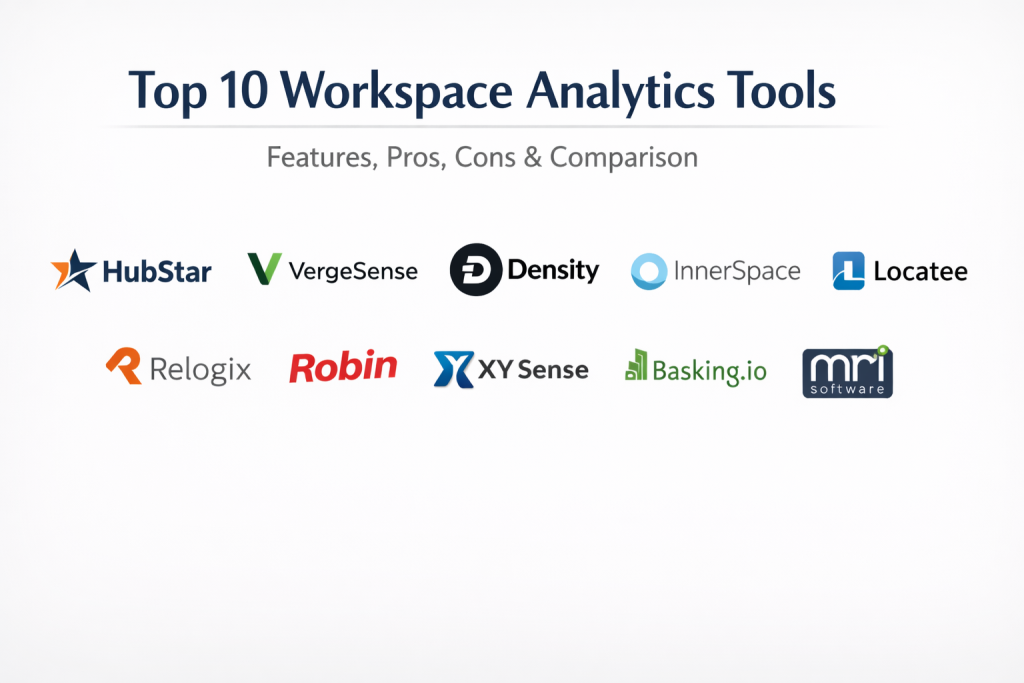
Top 10 Workspace Analytics Tools
1.HubStar
HubStar is a leading spatial intelligence platform that specializes in helping enterprise organizations optimize their hybrid workplace through advanced data science.
Key Features
- Unified Data Hub: Combines data from sensors, Wi-Fi, and badge systems into one dashboard.
- Predictive Analytics: Uses AI to forecast future space requirements based on current trends.
- Proximity Reporting: Analyzes how different teams interact based on their physical location.
- Space Suggestion Engine: Recommends specific layout changes to improve utilization.
- Mobile Experience Integration: Provides data to employees to help them find quiet or collaborative zones.
Pros
- Exceptionally powerful predictive modeling for long-term real estate planning.
- High degree of data accuracy by cross-referencing multiple sources.
Cons
- The depth of features can be overwhelming for smaller organizations.
- Enterprise-level pricing reflects its comprehensive capabilities.
Platforms / Deployment
- Web / Cloud
Security & Compliance
- SOC 2 Type II
- GDPR compliant
Integrations & Ecosystem
- Integrates with major IWMS providers and IoT sensor hardware.
- Native sync with Microsoft 365 and Google Workspace.
Support & Community
Dedicated customer success managers and specialized workplace strategy consulting.
2.VergeSense
VergeSense is a pioneer in the “Spatial Intelligence” category, utilizing high-fidelity optical sensors and AI to provide deep insights into how space is used.
Key Features
- Optical Sensors: Highly accurate sensors that can detect true human presence without violating privacy.
- Passive Tracking: No action required from employees; data is collected automatically.
- Real-time Occupancy: Live maps showing exactly which desks and rooms are currently in use.
- Collaborative Analysis: Measures how often meeting rooms are used for collaborative vs. solo work.
- API First: Built to feed highly accurate occupancy data into other workplace apps.
Pros
- Some of the most accurate hardware-based occupancy detection on the market.
- Beautiful and intuitive data visualization dashboards.
Cons
- Requires the installation of physical hardware throughout the office.
- Higher upfront costs due to sensor deployment.
Platforms / Deployment
- Web / Cloud / Hardware Sensors
Security & Compliance
- SOC 2 Type II
- Privacy-first (no PII captured by sensors)
Integrations & Ecosystem
- Partners with almost all major desk and room booking software providers.
- Open API for custom building automation.
Support & Community
Detailed implementation guides and proactive hardware monitoring.
3.Density
Density uses radar-based “Open Area” sensors to track how people move through and utilize spaces without ever using cameras or capturing images.
Key Features
- Radar Technology: Uses mid-range radar to detect human movement and presence.
- Tailgating Detection: High-accuracy entry/exit counting for security and capacity.
- Space Performance Scores: Benchmarks your office against industry standards.
- Live Webhooks: Trigger alerts or actions in real-time based on room capacity.
- Historical Benchmarking: Compare usage across different months, years, or locations.
Pros
- Total privacy; no images or video are ever recorded or processed.
- Excellent for large open areas and entry/exit point tracking.
Cons
- Radar technology can occasionally be affected by certain physical obstructions.
- Installation requires specialized placement for maximum accuracy.
Platforms / Deployment
- Web / Cloud / Hardware Sensors
Security & Compliance
- SOC 2 Type II
- HIPAA compliant options
Integrations & Ecosystem
- Works with Cisco DNA Spaces and various smart building platforms.
- Integration with Slack for capacity alerts.
Support & Community
Highly responsive technical support and detailed spatial data reports.
4.InnerSpace
InnerSpace focuses on using existing Wi-Fi infrastructure to map employee movement and behavior patterns without requiring new hardware.
Key Features
- Wi-Fi Fingerprinting: Uses existing network access points to track location.
- Path Analysis: Visualizes how people move through the building during the day.
- Team Synergy Reports: Tracks how often different departments cross paths.
- No-Hardware Deployment: Can be activated remotely using existing Cisco or Aruba gear.
- Wayfinding Data: Feeds location data into mobile apps for office navigation.
Pros
- Extremely fast deployment since no physical sensors are needed.
- Provides a “macro” view of building-wide movement patterns.
Cons
- Generally less accurate at the individual “desk” level than optical sensors.
- Accuracy depends heavily on the density of the existing Wi-Fi network.
Platforms / Deployment
- Web / Cloud
Security & Compliance
- GDPR compliant
- Data anonymization at the source
Integrations & Ecosystem
- Native partnerships with Cisco, Aruba, and Mist.
- API for workplace experience apps.
Support & Community
Strong focus on network architecture support and data interpretation.
5.Locatee
Locatee is a Swiss-based solution that leverages corporate network data to provide a holistic view of office occupancy across a global portfolio.
Key Features
- Network-Based Analytics: Utilizes LAN and Wi-Fi data to determine presence.
- Portfolio Overview: Compare utilization across different cities and countries.
- Trend Identification: Spot long-term shifts in office attendance.
- Privacy Protection: Strong focus on European-standard data privacy.
- Space Optimization Insights: Identifies opportunities to lease out unused floors.
Pros
- Excellent for global organizations looking for a “one-view” dashboard.
- Requires zero hardware installation, reducing maintenance overhead.
Cons
- Less effective for tracking short-term meetings in small breakout rooms.
- Relies on employees being connected to the corporate network.
Platforms / Deployment
- Web / Cloud
Security & Compliance
- ISO 27001
- GDPR compliant
Integrations & Ecosystem
- Integrates with major IT infrastructure providers.
- Data export functionality for business intelligence tools.
Support & Community
Dedicated customer success and deep expertise in European labor laws.
6.Relogix
Relogix provides a comprehensive platform that combines high-quality sensors with a powerful analytics engine to drive real estate decisions.
Key Features
- Sensor Flexibility: Supports both PIR (infrared) and optical sensors.
- Predictive Modeling: Advanced AI to help plan for hybrid work scenarios.
- Workplace Vitality Score: A proprietary metric for office “health.”
- Comparative Benchmarking: Compare your data against similar companies in your industry.
- Real-time Maps: Live visual representation of floor-by-floor occupancy.
Pros
- Highly customizable dashboards that can be tailored to specific KPIs.
- Very strong analytical support and “data storytelling” for executives.
Cons
- Hardware-heavy approach requires significant physical planning.
- Interface can be complex for occasional users.
Platforms / Deployment
- Web / Cloud / Hardware
Security & Compliance
- SOC 2 Type II
- GDPR compliant
Integrations & Ecosystem
- Wide range of partnerships with booking and IWMS software.
- Open API for enterprise data lakes.
Support & Community
Comprehensive onboarding and ongoing workplace strategy workshops.
7.Robin
While famous for booking, Robin’s analytics suite is powerful for understanding the “intent vs. reality” of office usage.
Key Features
- Intent Data: Tracks what people planned to do via calendar bookings.
- Actual Usage: Cross-references bookings with check-in data.
- Heatmaps: Visualizes the most popular areas of the office over time.
- Ghost Meeting Reports: Identifies rooms that are booked but never used.
- Desk Utilization: Detailed tracking of flexible seating adoption.
Pros
- Best for understanding employee behavior and booking habits.
- Extremely easy to use for both administrators and end-users.
Cons
- Lacks the deep “movement” and “path” data of sensor-based tools.
- Primarily reliant on manual check-ins unless integrated with third-party sensors.
Platforms / Deployment
- Web / iOS / Android
- Cloud
Security & Compliance
- SOC 2 Type II
- GDPR compliant
Integrations & Ecosystem
- Deepest integration with Microsoft 365 and Google Workspace.
- Integrates with sensor partners like VergeSense.
Support & Community
Highly active community and extensive public help documentation.
8.XY Sense
XY Sense is an Australian spatial intelligence company offering high-resolution AI sensors for real-time desk and room management.
Key Features
- AI Computer Vision: High-frequency scanning for 100% accurate desk occupancy.
- Privacy-First Processing: No images leave the sensor; only coordinates are sent to the cloud.
- Live View: Real-time office maps that update every few seconds.
- Utilization Deep-Dives: Tracks not just “if” a desk is used, but for how long.
- Sustainability Insights: Data to help reduce the building’s carbon footprint.
Pros
- Industry-leading resolution for individual desk and workstation tracking.
- Very sleek and compact hardware that is easy to install.
Cons
- The high-resolution data may be “more than needed” for macro-level planning.
- Requires a stable and robust PoE (Power over Ethernet) infrastructure.
Platforms / Deployment
- Web / Cloud / AI Sensors
Security & Compliance
- SOC 2 Type II
- GDPR compliant
Integrations & Ecosystem
- Native integrations with major desk booking and workplace apps.
- Rich API for custom building dashboards.
Support & Community
Strong technical support and proactive hardware maintenance alerts.
9.Basking.io
Basking.io is a “Wi-Fi only” analytics platform that focuses on workplace ROI and attendance tracking for hybrid offices.
Key Features
- Zero Hardware: Uses existing Wi-Fi controller data to track presence.
- Team-Level Insights: See how often specific teams are coming in and for how long.
- Real Estate ROI: Calculates the cost per square foot based on actual usage.
- Attendance Trends: Automated reports on office “rhythm” and peak days.
- Fast Setup: Can be integrated with existing Cisco, Aruba, or Meraki in hours.
Pros
- Lowest total cost of ownership as no physical sensors are purchased or maintained.
- Very focused on the “business” metrics of real estate management.
Cons
- Cannot tell if a specific chair is occupied, only if a person is in the zone.
- Dependent on employees having their devices connected to Wi-Fi.
Platforms / Deployment
- Web / Cloud
Security & Compliance
- GDPR compliant
- Privacy-focused data hashing
Integrations & Ecosystem
- Strongest with Cisco Meraki, Aruba, and HPE.
- Exportable data for PowerBI and Tableau.
Support & Community
Excellent for companies looking for a quick, data-driven entry into analytics.
10.MRI Software
MRI Software provides a broad range of real estate tools, with specialized analytics focused on visitor and employee presence.
Key Features
- Presence Tracking: Aggregates badge swipes and visitor check-ins.
- Evacuation Reporting: Live list of who is in the building for safety.
- Contractor Management: Analytics on external staff presence.
- Multi-Site Dashboard: View presence across a global facility portfolio.
- Integration with MRI: Part of a larger ecosystem of property management tools.
Pros
- Excellent for companies that prioritize safety and security alongside occupancy.
- Strongest for tracking “people” (visitors/contractors) rather than just “seats.”
Cons
- Less focused on the “spatial” and “design” optimization of the office.
- Interface is more administrative and less visual than modern startups.
Platforms / Deployment
- Web / Cloud
Security & Compliance
- SOC 2 Type II
- ISO 27001
Integrations & Ecosystem
- Part of the massive MRI Software ecosystem.
- Integrates with various physical access control systems (PACS).
Support & Community
Enterprise-grade global support and specialized training for large teams.
Comparison Table (Top 10)
| Tool Name | Best For | Platform(s) Supported | Deployment | Standout Feature | Public Rating |
|---|---|---|---|---|---|
| HubStar | Hybrid ROI | Web | Cloud | Predictive Modeling | N/A |
| VergeSense | High-Accuracy Data | Web | Cloud/Sensors | Optical AI Sensors | N/A |
| Density | Privacy & Open Areas | Web | Cloud/Radar | Radar-Based Tracking | N/A |
| InnerSpace | Fast Wi-Fi Mapping | Web | Cloud | Path Analysis | N/A |
| Locatee | Global Portfolio | Web | Cloud | Portfolio Benchmarking | N/A |
| Relogix | Data Storytelling | Web | Cloud/Sensors | Vitality Score | N/A |
| Robin | Intent vs Reality | Web, iOS, Android | Cloud | Ghost Meeting Reports | N/A |
| XY Sense | High-Res Desk Tracking | Web | Cloud/Sensors | High-Frequency AI | N/A |
| Basking.io | Budget-Friendly ROI | Web | Cloud | Zero Hardware Setup | N/A |
| MRI Software | Safety & Compliance | Web | Cloud | Evacuation Analytics | N/A |
Evaluation & Scoring of Workspace Analytics Tools
| Tool Name | Core (25%) | Ease (15%) | Integrations (15%) | Security (10%) | Performance (10%) | Support (10%) | Value (15%) | Weighted Total |
|---|---|---|---|---|---|---|---|---|
| HubStar | 10 | 7 | 9 | 9 | 9 | 9 | 8 | 8.85 |
| VergeSense | 10 | 6 | 9 | 10 | 10 | 8 | 7 | 8.55 |
| Density | 9 | 7 | 8 | 10 | 9 | 9 | 7 | 8.40 |
| InnerSpace | 8 | 9 | 9 | 9 | 8 | 8 | 9 | 8.45 |
| Locatee | 9 | 8 | 8 | 10 | 8 | 9 | 8 | 8.45 |
| Relogix | 9 | 7 | 8 | 9 | 9 | 10 | 7 | 8.35 |
| Robin | 8 | 10 | 9 | 9 | 8 | 8 | 8 | 8.45 |
| XY Sense | 10 | 6 | 8 | 9 | 10 | 8 | 7 | 8.35 |
| Basking.io | 7 | 9 | 9 | 9 | 8 | 8 | 10 | 8.30 |
| MRI Software | 8 | 7 | 8 | 10 | 8 | 9 | 8 | 8.15 |
How to interpret these scores: Scores are based on the tool’s ability to drive actual real estate savings. HubStar leads in weighted total due to its exceptional predictive capabilities. VergeSense and XY Sense dominate in performance/accuracy but require more effort to deploy. Basking.io and InnerSpace represent the highest value for organizations wanting data without hardware investment.
Which Workspace Analytics Tools Tool Is Right for You?
Solo / Freelancer
Workspace analytics is generally an enterprise-scale need; however, if you manage a small coworking space or a shared studio, Basking.io is the best entry point as it leverages your existing Wi-Fi to show you when your space is busiest.
SMB
Small-to-medium businesses should look toward Robin or InnerSpace. Robin is excellent if you are already using it for booking, while InnerSpace allows you to get movement data across your single office location without installing a single sensor.
Mid-Market
Growing companies that need to decide whether to sign a lease for a second floor should choose HubStar or Relogix. These tools provide the “Vitality” and “Predictive” metrics needed to determine if your current space can be optimized before spending on expansion.
Enterprise
For global organizations managing millions of square feet, Locatee or VergeSense are the standard choices. VergeSense provides the “ground truth” for flagship offices, while Locatee can provide a broad overview of occupancy across dozens of international sites.
Budget vs Premium
- Budget: Basking.io and InnerSpace offer data-driven insights with almost zero upfront capital expenditure as they use existing IT assets.
- Premium: VergeSense and XY Sense are premium, hardware-led solutions for those who require the absolute highest level of occupancy precision.
Feature Depth vs Ease of Use
- Feature Depth: HubStar and Relogix offer the deepest analytical capabilities and custom reporting for professional data analysts.
- Ease of Use: Robin and Basking.io offer the most “out of the box” functionality with intuitive dashboards that any office manager can understand.
Integrations & Scalability Needs
If your primary goal is to feed data into other apps (like a mobile “find a desk” app), VergeSense’s API is the industry leader. For scaling across thousands of access points globally, Locatee and InnerSpace are the most efficient.
Security & Compliance Needs
Organizations with extreme privacy concerns (like those in the EU or healthcare) should prioritize Density or Locatee, as they are built specifically to provide data without ever identifying a specific human being or capturing personal images.
Frequently Asked Questions (FAQs)
Is workspace analytics “spying” on employees?
No, professional tools are designed to be anonymized. They track “human presence” or “device location” without linking it to a specific person’s identity or private communication.
What is the difference between PIR and Optical sensors?
PIR (Passive Infrared) detects heat and motion, essentially knowing “something warm is here.” Optical sensors use AI to know “this is a person sitting in a chair.”
Do I really need hardware sensors?
Not necessarily. You can get high-level data from Wi-Fi logs or badge swipes, but sensors are required if you want to know if a specific desk is being used at any given moment.
How accurate is Wi-Fi based tracking?
Wi-Fi tracking is generally accurate within 3–5 meters. It is excellent for knowing which room someone is in, but not which chair they are sitting in.
Can these tools help reduce my energy bill?
Yes, by integrating occupancy data with Building Management Systems (BMS), you can automatically turn off lights and AC in zones that have been empty for a set period.
What is “Ghosting” in an office context?
Ghosting is when a room is booked on the calendar but no one actually uses it. Analytics tools identify these patterns so you can implement “auto-release” policies.
How do I use this data to redesign my office?
The data shows which space types (e.g., phone booths vs. large boardrooms) are over-subscribed, allowing you to convert underused areas into the types of spaces people actually want.
Are these tools GDPR compliant?
The top tools listed here are built with GDPR in mind, using data hashing and anonymization techniques to ensure that no personally identifiable information (PII) is stored.
What is a “Digital Twin”?
A digital twin is a 3D map of your office that updates live with data from your analytics tool, showing you a “live view” of the office from any device.
Can I track the usage of collaborative spaces like cafeterias?
Yes, radar-based tools like Density are specifically designed to track the “count” of people in large, open communal areas where individual desks don’t exist.
Conclusion
The transition to a data-driven workplace is the single most important step in managing the complexities of a modern hybrid office environment. By moving away from anecdotal observations and toward empirical occupancy data, organizations can make confident decisions that save millions in real estate costs. The diversity of tools available ensures that whether you prefer a “hardware-free” Wi-Fi approach or high-precision AI sensors, there is a solution for your needs. As workplace technology continues to evolve, the integration of predictive AI will allow managers to solve space problems before they even occur for the employees. Ultimately, the best workspace analytics tool is one that not only provides beautiful data but also drives a better, more responsive office experience for the people using it. Investing in workspace intelligence today ensures that your physical office remains a high-performance asset that supports the evolving needs of your workforce.

Best Cardiac Hospitals Near You
Discover top heart hospitals, cardiology centers & cardiac care services by city.
Advanced Heart Care • Trusted Hospitals • Expert Teams
View Best Hospitals