Introduction
A Yard Management System (YMS) is a specialized software category designed to oversee the movement of trucks, trailers, and inventory within the “grey space” of a logistics facility—the area between the warehouse doors and the facility gate. While many organizations rely on spreadsheets or manual clipboards, a modern YMS provides a digital nervous system that tracks asset locations in real-time, optimizes the flow of traffic, and ensures that dock doors are utilized to their maximum capacity. In the current global supply chain, where every minute of delay translates into significant financial penalties, these systems have moved from being a luxury to a operational necessity.
The landscape demands that a YMS does more than just record a trailer’s position. It must now act as a predictive orchestration engine, coordinating with Warehouse Management Systems (WMS) and Transportation Management Systems (TMS) to ensure a seamless flow of goods. As e-commerce volumes continue to break records and labor shortages persist, the yard has become the ultimate bottleneck. A well-implemented YMS eliminates this friction by automating gate check-ins, prioritizing high-value loads, and providing the data needed to hold carriers accountable for dwell times.
Best for: Large-scale distribution centers, third-party logistics (3PL) providers, manufacturing plants with high trailer volume, and retail fulfillment hubs that need to eliminate gate congestion and reduce detention fees.
Not ideal for: Small facilities with fewer than five dock doors, sites with very low daily trailer rotations, or businesses that do not have a dedicated yard shunter or spotter team.
Key Trends in Yard Management Systems
- Computer Vision and AI Monitoring: Cameras equipped with artificial intelligence now automatically recognize license plates and trailer numbers at the gate, removing the need for manual data entry and speeding up check-in by over 80%.
- Predictive Dwell Time Analytics: Systems now use historical data and real-time traffic patterns to predict when a yard will become congested, allowing managers to adjust staffing before a bottleneck occurs.
- Autonomous Yard Tractors: Integration with self-driving spotter trucks is becoming a standard feature for high-end systems, allowing for 24/7 trailer movements with minimal human intervention.
- Environmental Impact Tracking: New modules track the idling time of trucks and reefers, providing detailed reports on carbon emissions and fuel waste to help companies meet sustainability goals.
- Digital Twin Visualization: Managers can now view a 3D, live-updating map of their yard on any device, seeing exactly which trailers are loaded, empty, or needing maintenance at a glance.
- Carrier Self-Service Portals: Drivers can book appointments and pre-check through mobile apps, drastically reducing the time spent idling at the facility entrance.
- IoT and Sensor Fusion: High-precision tracking now combines GPS, RFID, and Bluetooth sensors to provide centimeter-level accuracy for every asset in the yard.
- Inter-Facility Orchestration: Enterprise-level systems now allow a central control tower to manage multiple yards across a global network from a single interface.
How We Selected These Tools
- Market Presence and Reliability: We focused on tools that are currently deployed across major global logistics networks and have a proven track record of stability.
- Integration Depth: Preference was given to systems that offer native, “plug-and-play” connectivity with industry-standard ERP, WMS, and TMS platforms.
- Automation Capabilities: We evaluated how well each tool handles automated gate processes and AI-driven task assignment for yard jockeys.
- User Experience for Drivers: A key criterion was the ease of use for the people on the ground—gate guards, yard spotters, and external truck drivers.
- Scalability and Flexibility: The list includes a mix of enterprise-grade suites and modular SaaS solutions that can grow alongside a business.
- Security and Compliance Standards: We prioritized vendors that maintain high standards for data protection and offer robust audit trails for facility security.
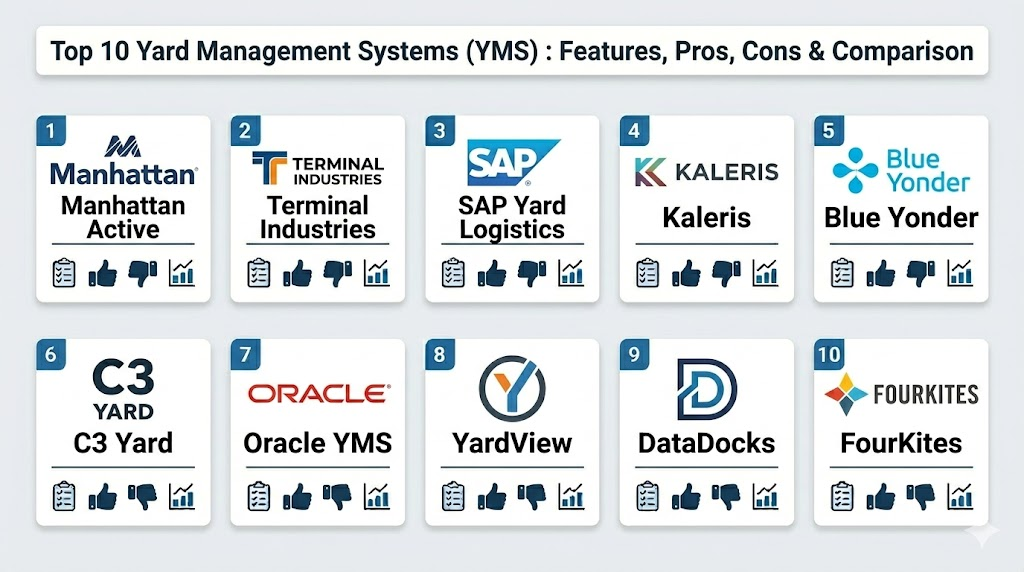
Top 10 Yard Management Systems (YMS)
1. Manhattan Active Yard Management
This system is part of a unified supply chain platform, offering a “wall-to-wall” view of inventory. It is designed for enterprises that need to synchronize yard activities perfectly with warehouse labor and outbound shipping schedules.
Key Features
- Full synchronization with Manhattan’s warehouse and transportation modules for a single source of truth.
- Automated task interleaving that assigns yard moves based on real-time dock priority.
- Advanced visibility into trailer contents, allowing for “dark” transfers without full unloading.
- Mobile applications specifically designed for yard jockeys to receive and confirm moves.
- Sophisticated gate management that supports both manual and automated kiosks.
Pros
- Unrivaled integration for existing users of the Manhattan ecosystem.
- Highly effective at reducing trailer search time through precise location tracking.
Cons
- The implementation process can be complex and time-intensive.
- Total cost of ownership is on the higher end of the market spectrum.
Platforms / Deployment
Windows / macOS / Android / iOS
Cloud (SaaS)
Security & Compliance
SSO/MFA, AES-256 encryption, and detailed access logs.
SOC 2 and ISO 27001 compliant.
Integrations & Ecosystem
It acts as a core component of the Manhattan Active platform, connecting seamlessly with high-end ERPs and global carrier networks. It supports extensive API-based connections for custom hardware like gate cameras.
Support & Community
Professional global support with dedicated account managers for enterprise clients. A robust user group community provides regular feedback and best-practice sharing.
2. Terminal Industries (Yard Operating System)
Positioned as an AI-native “Yard Operating System,” this tool moves away from manual data entry and focuses on autonomous orchestration using vision-based technology.
Key Features
- “Terminal-in-a-Camera” technology that uses computer vision to track assets without RFID tags.
- Agentic AI that proactively assigns dock doors to prevent congestion before it starts.
- Real-time digital twin that maintains 99% accuracy of yard inventory automatically.
- Rapid deployment model that requires minimal on-site infrastructure.
- Automated exception handling for misplaced trailers or delayed arrivals.
Pros
- Eliminates the need for expensive hardware like RFID readers on every trailer.
- Extremely high data accuracy compared to manual entry systems.
Cons
- Newer technology that may require a mindset shift for traditional logistics teams.
- Highly dependent on camera placement and site visibility.
Platforms / Deployment
Web / Windows / Linux
Cloud
Security & Compliance
End-to-end encryption and secure edge-computing protocols.
Not publicly stated.
Integrations & Ecosystem
Built on an open architecture that integrates with modern cloud-based WMS and visibility platforms like FourKites and project44.
Support & Community
Direct technical support from AI engineers and a growing community of early adopters in the high-volume retail sector.
3. SAP Yard Logistics
Tailored for the world’s largest organizations, this system provides deep control over complex yard processes, including rail and maritime movements alongside traditional trucking.
Key Features
- Unified management for truck, rail, and sea-vessel movements within a single yard.
- Direct integration with SAP S/4HANA and Extended Warehouse Management (EWM).
- Sophisticated dock appointment scheduling with automated resource allocation.
- Support for complex industrial processes like weighing and hazardous material checks.
- Visual yard map with drag-and-drop functionality for planning movements.
Pros
- The best choice for global companies already running on the SAP backbone.
- Capable of handling the most complex, multi-modal industrial yards.
Cons
- Requires a significant investment in both time and specialized consulting for setup.
- Interface can be overwhelming for users who only need basic tracking features.
Platforms / Deployment
Windows / Web
Cloud / Hybrid
Security & Compliance
Enterprise SAP security framework with full SSO and MFA support.
SOC 2, ISO 27001, and GDPR compliant.
Integrations & Ecosystem
Fully embedded in the SAP Supply Chain execution suite, allowing for seamless data flow between procurement, warehousing, and transportation.
Support & Community
Global support network with a vast ecosystem of certified implementation partners and consultants.
4. Kaleris (formerly PINC)
A pioneer in the space, Kaleris is known for its high-performance tracking and its ability to handle massive, multi-site campuses with thousands of trailers.
Key Features
- Real-time location systems (RTLS) that provide pinpoint accuracy for every asset.
- Automated gate check-in kiosks that guide drivers through the process in multiple languages.
- Sophisticated yard jockey optimization that reduces fuel waste and travel distance.
- Deep analytics suite that identifies carrier performance and yard efficiency trends.
- Scalable multi-site visibility that allows for “campus-wide” management.
Pros
- Extremely reliable and battle-tested in high-pressure distribution environments.
- Offers one of the most comprehensive sets of reporting tools in the industry.
Cons
- Can be hardware-heavy, often requiring RFID tags or specialized sensors.
- Higher entry price point compared to newer, software-only solutions.
Platforms / Deployment
Web / Windows / Android
Cloud
Security & Compliance
Robust data encryption and role-based access controls.
Not publicly stated.
Integrations & Ecosystem
Strong pre-built connectors for all major WMS providers and a history of successful integrations with complex industrial hardware.
Support & Community
Excellent onboarding programs and a long-standing reputation for responsive customer service.
5. Blue Yonder Yard Management
This solution excels at “task interleaving,” which means it intelligently combines yard moves with warehouse tasks to maximize the productivity of every worker.
Key Features
- AI-driven task prioritization based on the urgency of outbound shipments.
- Seamless connectivity with Blue Yonder’s Luminate platform for end-to-end visibility.
- Automated gate processing with integrated driver communication tools.
- Real-time alerts for trailers that have exceeded their allowed dwell time.
- Intuitive visual dashboard for yard supervisors to manage “hot” loads.
Pros
- Highly effective at reducing detention and demurrage costs.
- Excellent at aligning yard operations with broader labor management goals.
Cons
- Best performance is achieved when used within the full Blue Yonder suite.
- May be more feature-heavy than necessary for mid-market facilities.
Platforms / Deployment
Web / Windows / Android
Cloud
Security & Compliance
Standard enterprise security protocols including SSO and data-at-rest encryption.
SOC 2 and GDPR compliant.
Integrations & Ecosystem
Part of a massive supply chain ecosystem that connects to global trade and transportation networks.
Support & Community
Extensive online training resources and a large global support team capable of handling 24/7 operations.
6. C3 Yard (by C3 Solutions)
A web-based system that is frequently praised for its ease of deployment and its specific focus on optimizing dock and gate throughput.
Key Features
- Sophisticated dock scheduling that prevents facility overcrowding before it starts.
- User-friendly interface designed for rapid adoption by gate staff and drivers.
- Real-time trailer status updates visible to both the warehouse and carriers.
- Multi-site management capabilities for regional logistics managers.
- Configurable business rules that automate trailer movement priorities.
Pros
- Known for having one of the fastest “time-to-value” ratios in the market.
- Very flexible configuration that adapts to unique site-specific workflows.
Cons
- Lacks some of the ultra-deep industrial features found in SAP or Oracle.
- Mobile app for yard jockeys is functional but less advanced than premium competitors.
Platforms / Deployment
Web / Windows / macOS
Cloud
Security & Compliance
Standard cloud security with secure data silos for different clients.
Not publicly stated.
Integrations & Ecosystem
Offers a robust API that allows it to act as a standalone visibility layer or a connected module within a larger TMS.
Support & Community
Responsive support team with a strong focus on North American and European logistics hubs.
7. Oracle Yard Management
Integrated directly into the Oracle SCM Cloud, this tool provides a unified view of the supply chain, ensuring that yard moves are perfectly timed with production and sales orders.
Key Features
- Seamless data flow between the yard, inventory, and transportation modules.
- Real-time gate activity monitoring with automated notifications for delays.
- Advanced appointment management that synchronizes carrier arrivals with dock availability.
- Comprehensive yard inventory reporting for audit and compliance purposes.
- Performance dashboards that track the efficiency of yard jockeys and gate staff.
Pros
- Perfect for enterprises already invested in the Oracle Cloud infrastructure.
- Provides a very stable and highly secure environment for sensitive data.
Cons
- Not available as a standalone product; requires the broader Oracle SCM license.
- Can be slower to update and innovate compared to agile, specialized YMS startups.
Platforms / Deployment
Web / Windows
Cloud
Security & Compliance
Oracle’s world-class enterprise security, including MFA and full data encryption.
SOC 2, ISO 27001, HIPAA, and GDPR compliant.
Integrations & Ecosystem
Directly connected to the Oracle Cloud ecosystem, providing a holistic view of the global supply chain from factory to final mile.
Support & Community
Premium global support with extensive documentation and a massive community of enterprise IT professionals.
8. YardView
A highly rated, cloud-based YMS that specializes in providing a clear, simple visual interface for mid-market companies that need to professionalize their yard operations quickly.
Key Features
- Drag-and-drop yard map that reflects the real-time layout of the facility.
- Automated email and SMS alerts for carrier arrivals and departures.
- Simplified gate check-in process that can be mastered by staff in hours.
- Robust reporting on trailer turn times and yard inventory accuracy.
- Cost-effective deployment model for facilities with 10–50 dock doors.
Pros
- One of the most intuitive and user-friendly systems on this list.
- Offers excellent value for companies that don’t need “enterprise-sized” complexity.
Cons
- May lack the advanced AI-driven automation found in high-end competitors.
- Integration depth for very niche ERPs can be more limited.
Platforms / Deployment
Web / Windows / Android
Cloud
Security & Compliance
Secure cloud hosting with standard encryption and access controls.
Not publicly stated.
Integrations & Ecosystem
Focuses on essential connections to major WMS and TMS providers, with a focus on simplicity over high-end complexity.
Support & Community
Very high customer satisfaction ratings for their hands-on support and implementation team.
9. DataDocks
A modern, lightweight solution that is quickly gaining traction for its focus on driver self-service and reducing administrative work at the gate.
Key Features
- QR-code based driver check-in that allows drivers to enter data from their cabs.
- Real-time carrier portal where partners can book and reschedule their own appointments.
- Visual yard map with status timers that flag trailers nearing their detention limits.
- Multi-user editing that allows the warehouse and the gate to work simultaneously.
- Simplified, rule-based automation for assigning trailers to specific docks.
Pros
- Drastically reduces the volume of phone calls and emails between the gate and carriers.
- Very modern, clean interface that requires almost zero training.
Cons
- Primarily focused on scheduling and visibility; less deep in “task orchestration.”
- Not intended for massive, multi-modal industrial complexes like ports.
Platforms / Deployment
Web / Windows / macOS / Android / iOS
Cloud
Security & Compliance
Standard cloud security protocols with a focus on data privacy.
Not publicly stated.
Integrations & Ecosystem
Strong connectors for mid-market WMS tools and a very easy-to-use API for custom data exports.
Support & Community
Excellent support for small-to-midsize growing companies, with a focus on partnership and rapid feedback.
10. FourKites Dynamic Yard
Unlike traditional YMS, FourKites connects the dots between freight in transit and the activity in the yard, providing a “predictive” look at what is coming.
Key Features
- Predictive arrival times based on real-time GPS data from the highway.
- Automated yard checks using a combination of software and site-level hardware.
- Dynamic dock scheduling that automatically adjusts based on delayed shipments.
- Unified view of in-transit inventory and on-site inventory.
- Carrier collaboration tools that provide full visibility to all stakeholders.
Pros
- Exceptional for organizations that manage high volumes of inbound freight from many carriers.
- Provides a level of “forward-looking” visibility that most traditional YMS cannot match.
Cons
- Can be more expensive than a basic standalone YMS.
- Requires good data quality from carriers to provide the best results.
Platforms / Deployment
Web / Windows / Android / iOS
Cloud
Security & Compliance
High-level data security with enterprise-grade encryption and access controls.
SOC 2 compliant.
Comparison Table
| Tool Name | Best For | Platform(s) Supported | Deployment | Standout Feature | Public Rating |
| 1. Manhattan Active | Enterprise WMS Users | Win, macOS, Android, iOS | Cloud | Integrated Labor Sync | N/A |
| 2. Terminal Industries | High-Accuracy Automation | Win, Linux, Web | Cloud | AI Vision Tracking | N/A |
| 3. SAP Yard Logistics | Complex Global Orgs | Win, Web | Hybrid | Multi-modal Control | N/A |
| 4. Kaleris | High-Volume Sites | Win, Web, Android | Cloud | Multi-site Visibility | N/A |
| 5. Blue Yonder | Productivity Focus | Win, Web, Android | Cloud | Task Interleaving | N/A |
| 6. C3 Yard | Rapid Deployment | Win, macOS, Web | Cloud | Dock Scheduling | N/A |
| 7. Oracle YMS | Oracle SCM Users | Win, Web | Cloud | Secure SCM Integration | N/A |
| 8. YardView | Mid-Market Logistics | Win, Web, Android | Cloud | Simple Visual Map | N/A |
| 9. DataDocks | Driver Self-Service | Win, macOS, Mobile | Cloud | QR Code Check-in | N/A |
| 10. FourKites | Predictive Visibility | Win, macOS, Mobile | Cloud | In-transit Tracking | N/A |
Evaluation & Scoring of Yard Management Systems (YMS)
| Tool Name | Core (25%) | Ease (15%) | Integrations (15%) | Security (10%) | Perf (10%) | Support (10%) | Value (15%) | Total |
| 1. Manhattan | 10 | 5 | 10 | 9 | 9 | 9 | 6 | 8.40 |
| 2. Terminal | 8 | 8 | 8 | 7 | 9 | 7 | 8 | 7.95 |
| 3. SAP | 10 | 4 | 10 | 10 | 9 | 9 | 5 | 8.15 |
| 4. Kaleris | 9 | 7 | 9 | 8 | 9 | 8 | 7 | 8.20 |
| 5. Blue Yonder | 9 | 6 | 10 | 9 | 9 | 8 | 7 | 8.20 |
| 6. C3 Yard | 8 | 9 | 8 | 8 | 8 | 8 | 8 | 8.10 |
| 7. Oracle | 9 | 6 | 9 | 10 | 9 | 8 | 6 | 7.95 |
| 8. YardView | 7 | 10 | 7 | 7 | 8 | 9 | 9 | 7.90 |
| 9. DataDocks | 6 | 10 | 7 | 7 | 8 | 9 | 10 | 7.90 |
| 10. FourKites | 8 | 8 | 10 | 8 | 9 | 8 | 7 | 8.15 |
These scores provide a relative look at how these tools perform in the current professional environment. A high total score usually represents a platform that has achieved a strong balance between advanced technical capabilities and user accessibility. For example, Manhattan and Blue Yonder score highly because they offer deep enterprise features while maintaining excellent support structures. Meanwhile, newer tools like DataDocks and YardView score exceptionally high in “Value” and “Ease of Use,” making them perfect for operations that need to move away from manual processes quickly without a massive IT overhead.
Which Yard Management System Tool Is Right for You?
Solo / Freelancer
In the YMS world, “solo” usually refers to a single-site warehouse manager or a third-party consultant. For these users, DataDocks or YardView are the best options because they provide immediate visibility without requiring a dedicated IT team to maintain the software.
SMB
Small to medium-sized logistics providers should prioritize C3 Yard or YardView. These platforms offer the best “middle ground,” providing robust dock scheduling and trailer tracking at a price point that makes sense for a growing business.
Mid-Market
For companies managing multiple sites with moderate volumes, Kaleris or FourKites are excellent choices. They provide the necessary “campus” visibility and predictive analytics to manage more complex labor and carrier challenges across a region.
Enterprise
Global organizations with high-throughput needs should stick to the “Big Three”: Manhattan, SAP, or Oracle. These systems are designed to handle the scale and security requirements of a Fortune 500 company and will grow with your global expansion.
Budget vs Premium
- Budget: DataDocks offers the lowest entry point with a modern, driver-first focus.
- Premium: SAP and Manhattan offer the deepest features but require a significant upfront investment in licensing and implementation.
Feature Depth vs Ease of Use
- Depth: Houdini and SAP provide the most control for complex industrial setups but are harder to learn.
- Ease of Use: YardView and DataDocks can be used by a new gate guard with just 30 minutes of training.
Integrations & Scalability
If your yard is just one part of a massive supply chain project, Oracle and Blue Yonder offer the best scalability. Their ability to connect the yard to the rest of the world ensures that you never outgrow your software.
Security & Compliance Needs
For facilities handling high-value goods (electronics, pharmaceuticals) or those operating in highly regulated regions, Oracle and SAP provide the most comprehensive security frameworks to ensure full compliance with global standards.
Frequently Asked Questions (FAQs)
1. How does a YMS differ from a Warehouse Management System (WMS)?
A WMS tracks inventory once it is inside the four walls of the warehouse, whereas a YMS focuses on everything outside—the trucks, trailers, and drivers waiting in the yard or at the gate.
2. Can a YMS really help reduce detention and demurrage fees?
Yes, by providing real-time alerts when a trailer is approaching its “free time” limit, the system allows managers to prioritize those moves and avoid costly penalties from carriers.
3. Do I need to put a GPS tracker on every trailer for these systems to work?
Not necessarily. Many modern systems use computer vision at the gate or RFID tags, which are much more cost-effective than a full GPS unit for every single asset.
4. How long does a typical YMS implementation take?
A cloud-based modular system can be up and running in as little as 4 weeks, while a full enterprise-grade suite like SAP or Manhattan may take 6 months or more to fully integrate.
5. Is a YMS worth it for a facility with only 10 dock doors?
It depends on your volume. If those 10 doors see constant turnover and your gate is frequently backed up, the efficiency gains in labor and reduced fees will usually pay for the system in under a year.
6. Can these systems help with yard safety?
Absolutely. By automating the communication with yard jockeys and keeping drivers in their cabs (via mobile apps/kiosks), you reduce the risk of accidents in the high-traffic yard environment.
7. Do YMS platforms work for rail and maritime yards?
Specialized enterprise tools like SAP Yard Logistics are built specifically for multi-modal environments, though most standard YMS are focused primarily on truck and trailer movements.
8. Will a YMS work if our yard has poor internet connectivity?
Most modern cloud-based YMS offer offline modes for their mobile apps, allowing jockeys to record moves which then sync to the server once they are back in range of a signal.
9. How do these systems track “empty” vs “loaded” trailers?
This is usually managed at the gate during check-in or through a carrier portal, though some high-end systems can integrate with trailer sensors to confirm status automatically.
10. What is the most common reason for a YMS implementation to fail?
The biggest hurdle is usually “data hygiene.” If the gate staff or drivers don’t use the system consistently, the digital map becomes inaccurate, leading to a loss of trust in the software.
Conclusion
Selecting the right Yard Management System is a critical step in transforming a chaotic, manual environment into a high-efficiency logistics hub. As we navigate the complexities, the yard is no longer a place where “hours go to die,” but a strategic asset that can be optimized through AI, real-time visibility, and seamless integration. It must now act as a predictive orchestration engine, coordinating with Warehouse Management Systems (WMS) and Transportation Management Systems (TMS) to ensure a seamless flow of goods. By choosing a system that aligns with your facility’s volume and technical maturity, you can drastically reduce operational costs, improve safety, and ensure that your supply chain remains resilient in the face of constant change. The “grey space” of the yard is finally coming out of the shadows.

Best Cardiac Hospitals Near You
Discover top heart hospitals, cardiology centers & cardiac care services by city.
Advanced Heart Care • Trusted Hospitals • Expert Teams
View Best Hospitals