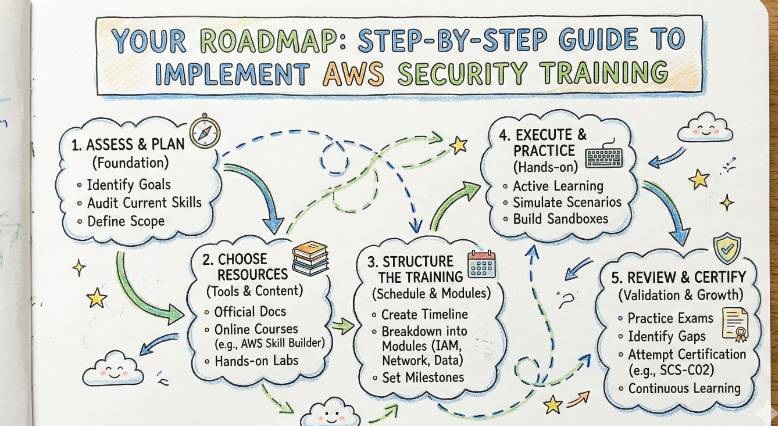
Protecting a company’s digital assets has evolved from a back-office task into a strategic priority that affects every level of an organization. Whether you are an engineer on the front lines or a manager overseeing a global team, understanding the nuances of cloud security is vital. The AWS Certified Security Specialty (SCS-C02) serves as a definitive benchmark for professionals who need to demonstrate they can build and maintain a fortified cloud environment.
From a strategic viewpoint, this certification is about more than just understanding tools; it is about mastering the logic of risk mitigation. This guide is designed to help you navigate the training required to earn this credential and, more importantly, to apply those skills in real-world scenarios.
Navigating the AWS Certification Ecosystem
Understanding the relationship between different AWS certifications is essential for planning a long-term career. The following table provides a clear overview of the paths available and where the Security Specialty fits.
| Track | Level | Primary Audience | Entry Requirements | Core Knowledge Areas | Suggested Sequence |
| Security | Specialty | Security Teams & Cloud Engineers | 2+ years AWS experience | IAM, Logging, Data Security, Incident Response | After Associate |
| Solutions Architect | Associate | Systems Designers | Foundational knowledge | Scalable and resilient architecture design | 1st or 2nd |
| SysOps Administrator | Associate | Systems Admins & SREs | Foundational knowledge | System operations and automation | 2nd |
| Developer | Associate | Software Engineers | Basic hands-on AWS use | Coding and deployment for cloud apps | 1st or 2nd |
| DevOps Engineer | Professional | SREs & DevOps Leads | Associate-level certification | Continuous delivery and governance | After Associate |
AWS Certified Security Specialty (SCS-C02) Training
What it is
The SCS-C02 is an advanced certification that focuses on the deep technical aspects of securing AWS workloads. It isn’t just a broad overview; it requires a granular understanding of identity management, data protection, and infrastructure defense. The exam tests your ability to think critically and choose the most secure solution from several technically viable options.
Who should take it
This training is specifically built for those who carry the weight of an organization’s security on their shoulders.
- Cloud Security Engineers: Who need to validate their expertise in technical controls.
- DevOps Professionals: Who are tasked with automating security within the delivery pipeline.
- Engineering Managers: Who must understand technical risks to make informed business decisions.
- Software Engineers: Who want to build applications that are inherently safe from external threats.
Skills you’ll gain
Completing this training program provides a deep understanding of how to manage a secure perimeter in a cloud-native way.
- Advanced Access Management: You will learn the intricate logic of IAM policies, including how to handle complex cross-account access and identity federation.
- Infrastructure Protection: You will gain the skills to build secure networks using VPCs, Web Application Firewalls (WAF), and advanced DDoS protection strategies.
- Data Privacy and Encryption: You will master the use of the Key Management Service (KMS) to encrypt data both while it is stored and while it is moving across the network.
- Continuous Monitoring: You will learn to use tools like GuardDuty and Security Hub to spot anomalies and respond to security events automatically.
Real-world projects you should be able to do
The goal of this training is to enable you to perform high-level security tasks in a production environment.
- Building a Compliance Engine: You will be able to use AWS Config to create rules that automatically fix resources that do not meet your company’s security standards.
- Implementing Zero Trust Architecture: You can design a system where every request is verified, regardless of where it comes from, using a combination of IAM, VPC endpoints, and encryption.
- Automating Incident Response: You will have the skills to set up a system that detects an unauthorized login and automatically revokes that user’s access within seconds.
Preparation Plan
Successful preparation depends on your current experience level. Here are three recommended timelines:
- The 14-Day Executive Plan: For those who already handle AWS security daily. Focus heavily on the official exam blueprint and take multiple practice exams to identify specific gaps in your service knowledge.
- The 30-Day Professional Plan: The ideal path for most working engineers. Dedicate time each day to hands-on labs. Spend the first half of the month on the “Security Domains” and the second half on policy evaluation logic and encryption scenarios.
- The 60-Day Foundation Plan: Best for those transitioning from traditional IT security to the cloud. Spend the first month getting comfortable with core AWS services. Use the second month to deep-dive into the security-specific tools like Macie, GuardDuty, and KMS.
Common Mistakes
Many candidates struggle with the exam because they overlook these critical details:
- Misunderstanding Policy Precedence: Many fail to grasp that a single “Deny” in any relevant policy will override all “Allow” statements, regardless of where they are placed.
- Overlooking KMS Details: Knowing how to use KMS is not enough; you must understand the difference between key types and how key policies affect access across accounts.
- Ignoring the Monitoring Loop: Candidates often focus too much on prevention and not enough on detection. Understanding CloudTrail and CloudWatch is essential for passing the exam.
Best Next Certification After This
Once you have secured the environment, the logical progression is to master the automation of that security. The AWS Certified DevOps Engineer – Professional is the ideal follow-up. It shifts the focus from “what is secure” to “how to keep it secure at scale through automation.”
Choose Your Path: 6 Learning Paths
Depending on your career goals, here is how you should layer your certifications:
- DevOps Path: Associate Developer → Security Specialty → DevOps Engineer Professional.
- DevSecOps Path: Associate SysOps → Security Specialty → Advanced Networking Specialty.
- SRE Path: Associate SysOps → Security Specialty → DevOps Engineer Professional.
- AIOps/MLOps Path: Cloud Practitioner → Machine Learning Specialty → Security Specialty.
- DataOps Path: Data Engineer Associate → Security Specialty → Data Analytics Specialty.
- FinOps Path: Cloud Practitioner → Security Specialty → Certified FinOps Practitioner.
Role → Recommended Certifications Mapping
| Professional Role | Core Certification | Supporting Certification |
| DevOps Engineer | DevOps Engineer Professional | Security Specialty |
| SRE | SysOps Admin Associate | Security Specialty |
| Platform Engineer | Solutions Architect Associate | Security Specialty |
| Cloud Engineer | Solutions Architect Professional | Security Specialty |
| Security Engineer | Security Specialty | Solutions Architect Associate |
| Data Engineer | Data Engineer Associate | Security Specialty |
| FinOps Practitioner | Cloud Practitioner | Security Specialty |
| Engineering Manager | Solutions Architect Associate | Security Specialty |
Next Certifications to Take
Based on industry data from Gurukulgalaxy, there are three primary directions you can take after completing the SCS-C02:
- Vertical Growth (Same Track): AWS Certified Advanced Networking – Specialty. This is for those who want to master the network layer, which is where many security battles are won or lost.
- Horizontal Growth (Cross-Track): AWS Certified Data Engineer – Associate. As data becomes the primary target for attackers, knowing how to build secure data pipelines is a massive advantage.
- Leadership Growth (Architecting): AWS Certified Solutions Architect – Professional. This moves you toward a strategic role where you oversee the entire cloud lifecycle for an enterprise.
Top Training Institutions for SCS-C02
Choosing the right training provider is essential for bridging the gap between theory and practice.
- DevOpsSchool: A leading provider for professionals who need instructor-led, hands-on training. Their curriculum is built by practitioners and focuses on real-world engineering challenges and deep-dive labs.
- Cotocus: They offer high-intensity bootcamps designed for those who want to upskill quickly. Their focus is on technical mastery and helping engineers bridge the gap to senior roles.
- Scmgalaxy: A vast resource hub that provides community-led tutorials and blogs. It is perfect for self-starters who want a wide variety of perspectives on cloud security and operations.
- BestDevOps: This institution focuses on practical, job-ready skills. Their training programs are designed to ensure that you can perform your duties on the job as effectively as you can pass the exam.
- Devsecopsschool: Specializes in the critical intersection of development and security. Their courses are ideal for teams looking to integrate security directly into their automated workflows.
- Sreschool: Focuses on the reliability aspect of systems. They provide training that ensures your security measures do not come at the cost of system uptime or performance.
- Aiopsschool: A forward-looking school that explores how artificial intelligence can be used to manage and secure complex cloud environments through automation.
- Dataopsschool: Best for those who handle massive data sets. Their training ensures that your data pipelines remain secure, compliant, and efficient throughout their lifecycle.
- Finopsschool: Teaches the financial side of the cloud. They show how proper security—like cleaning up unused resources—directly contributes to a healthier cloud budget.
General Career & Certification FAQs
- Is the SCS-C02 exam difficult for managers? It can be, as it requires deep technical knowledge. However, it is invaluable for managers who need to assess risk accurately.
- How much time should I invest weekly? Aim for 7 to 10 hours. Consistency is more important than total hours spent in a single session.
- Is hands-on experience mandatory? While not a formal rule, passing without at least a year of hands-on experience is extremely challenging due to the practical nature of the questions.
- Should I take the Cloud Practitioner first? If you are completely new to AWS, yes. If you are already an engineer, start with an Associate-level certification.
- How is this certification viewed in India? It is highly respected, especially in the growing fintech and SaaS sectors where security is a top-tier priority.
- Will this help with career advancement? Absolutely. Specialized security skills are in high demand and often lead to senior-level roles and higher compensation.
- What happens after the three-year validity? You will need to retake the current version of the exam to maintain your “active” status.
- Can the exam be taken remotely? Yes, through online proctoring services. You must ensure your environment meets the strict requirements.
- What is the minimum passing score? You need a 750 to pass. The score is calculated based on the difficulty of the questions you receive.
- Is there coding on the exam? There is no heavy programming, but you must be able to troubleshoot JSON policies and understand the flow of Lambda functions.
- How long should I plan to sit for the exam? The time limit is 170 minutes. Use it wisely to review the complex scenario-based questions.
- Are there any official prerequisites? No, AWS removed all mandatory prerequisites, though they suggest specific levels of experience for each tier.
AWS Certified Security Specialty (SCS-C02) Specific FAQs
- What is the focus on Identity Management? It is a core pillar. You must understand how IAM policies, resource-based policies, and service control policies (SCPs) interact.
- How deeply is KMS tested? Very deeply. You need to know how to manage keys, handle rotation, and troubleshoot access issues related to encryption.
- Are hybrid cloud scenarios included? Yes. You should know how to secure connections between on-premise data centers and AWS using VPN and Direct Connect.
- How much should I know about GuardDuty? You should understand how it works, what kind of threats it detects, and how to automate responses based on its findings.
- Is S3 security a separate domain? While it falls under Data Protection, it is a major part of the exam. Understanding bucket policies and public access blocks is critical.
- Does the exam cover third-party tools? No. It focuses exclusively on AWS services and how they solve security problems natively.
- How important is logging for this exam? Logging is the foundation of the “Monitoring” section. You must know CloudTrail and VPC Flow Logs inside and out.
- What is the best way to use practice exams? Use them to simulate the timing and the “vibe” of the actual test. Focus on the questions you get wrong to identify weak areas in your logic.
Conclusion
Earning the AWS Certified Security Specialty (SCS-C02) is a transformative step for any technical professional. It signals to the industry that you are not just a user of the cloud, but a protector of it. In a world where the landscape of threats is constantly changing, the ability to architect secure, resilient, and compliant systems is a skill that will always be in demand. This training forces you to look beneath the surface of AWS services and understand the fundamental logic of cloud security. Whether you are aiming for a promotion, a new role, or simply want to lead your team with greater technical authority, the path to this certification will provide the clarity and confidence you need. By following a disciplined study plan and focusing on the core principles of identity, encryption, and automation, you are building a career that is as secure as the systems you will design.

Best Cardiac Hospitals Near You
Discover top heart hospitals, cardiology centers & cardiac care services by city.
Advanced Heart Care • Trusted Hospitals • Expert Teams
View Best Hospitals