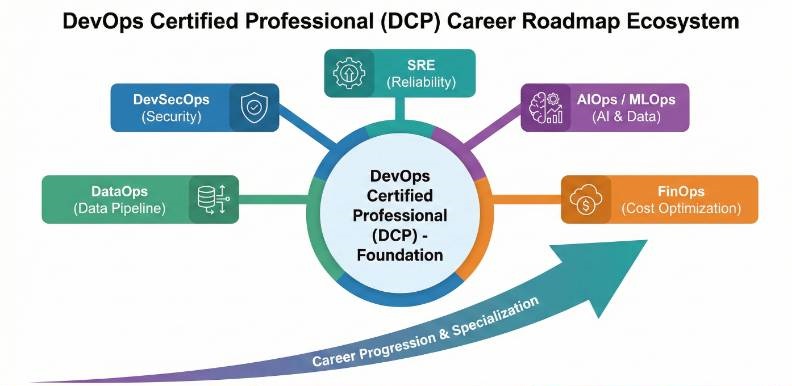
The software engineering landscape is undergoing a massive transformation. The days of siloed development and operations are long gone, replaced by a culture of continuous integration, rapid deployment, and automated infrastructure. For engineers and managers in India and across the globe, staying relevant means moving beyond basic coding or system administration. It requires a mastery of the entire ecosystem.
The DevOps Certified Professional (DCP) program has emerged as the industry benchmark for those who want to validate their expertise in this fast-moving field. This guide provides a comprehensive roadmap for navigating this certification and building a high-impact career in the modern IT era.
The Master Certification Ecosystem
To understand where the DevOps Certified Professional (DCP) fits, we must look at the broader landscape of modern engineering specializations. Below is a comprehensive breakdown of the core tracks available today.
| Track | Level | Who it’s for | Prerequisites | Skills Covered | Recommended Order |
| DevOps (DCP) | Professional | Developers, Admins, QA | Basic Linux & SDLC | CI/CD, Docker, IaC, Cloud, Git | Foundation (Start here) |
| DevSecOps | Specialist | DevOps & Security Engineers | DCP or equivalent | SAST/DAST, Vault, Compliance | Second |
| SRE | Specialist | Ops Engineers, Senior Devs | Strong Networking/Linux | SLOs, Error Budgets, Metrics | Second |
| AIOps/MLOps | Advanced | Data & DevOps Engineers | Python & DCP basics | Model Pipelines, Data Versioning | Third |
| DataOps | Specialist | Data Engineers, DBAs | SQL & DCP basics | ETL Automation, Data Quality | Third |
| FinOps | Management | Managers, Architects | Cloud basics | Cost Governance, Optimization | Third |
Deep Dive: DevOps Certified Professional (DCP)
The DevOps Certified Professional (DCP) is the primary credential for anyone aiming to become a versatile engineer. It bridges the gap between theoretical agile concepts and the technical reality of automation.
What it is
The DCP is a comprehensive training and certification program designed to validate a professional’s ability to implement DevOps tools and culture. It covers the end-to-end lifecycle, focusing on open-source toolchains and cloud-agnostic strategies that are applicable in any enterprise environment.
Who should take it
This certification is tailor-made for Software Engineers, System Administrators, Quality Assurance Engineers, and IT Managers who need to understand the mechanics of modern software delivery. It is particularly valuable for those in mid-career transitions looking to move into specialized DevOps or SRE roles.
Skills you’ll gain
- Advanced Version Control strategies using Git.
- Automating builds and deployments with CI/CD tools like Jenkins and GitLab.
- Containerization of applications using Docker.
- Orchestration and management of services using Kubernetes.
- Infrastructure as Code (IaC) with Terraform and Ansible.
- Cloud infrastructure management and monitoring using the ELK stack and Prometheus.
Real-world projects you should be able to do after it
- Zero-Downtime Deployment: Building a Blue-Green or Canary deployment pipeline for a production application.
- Automated Infrastructure: Writing a single script to provision a complete virtual private cloud (VPC) with load balancers and database clusters.
- Container Migration: Successfully migrating a legacy monolithic application into a microservices-based architecture running on Kubernetes.
Preparation Plan
30-Day Fast Track (For experienced engineers)
- Days 1–7: Master Git, Linux internals, and Shell Scripting.
- Days 8–15: Intensive Docker training and CI/CD pipeline construction.
- Days 16–23: Deep dive into Terraform (IaC) and Configuration Management with Ansible.
- Days 24–30: Kubernetes basics, Monitoring tools, and Mock Exams.
60-Day Comprehensive Path (Recommended for working professionals)
- Weeks 1–2: Foundation: Linux, Networking, and SDLC models.
- Weeks 3–4: CI/CD: Setting up automated build and test environments.
- Weeks 5–6: Automation: Learning Terraform for infrastructure and Ansible for config.
- Weeks 7–8: Orchestration & Observability: Mastering Kubernetes and Prometheus/Grafana.
Common mistakes
- Focusing only on tools: Many candidates learn Jenkins but don’t understand the strategy of continuous delivery.
- Neglecting Linux: DevOps is built on Linux; if your command-line skills are weak, you will struggle with automation.
- Skipping the Labs: Theory is easy; debugging a failing YAML file is where the real learning happens.
Best next certification after this
Once you have the DCP, the most natural progression is the Certified Kubernetes Administrator (CKA) for deep technical specialization or a DevSecOps Certified Professional to add security to your repertoire.
Choose Your Path: 6 Learning Tracks
The DCP is the trunk of the tree. From here, you can branch out into these six specialized domains based on your career goals.
1. The DevOps Path
Focus on the speed of delivery. This path is for those who love building pipelines, optimizing developer workflows, and ensuring that code reaches production as quickly and safely as possible.
2. The DevSecOps Path
Focus on “Shift Left” security. You will learn how to integrate vulnerability scanning, secret management, and compliance checks into every stage of the automated pipeline.
3. The SRE Path
Focus on reliability and scale. SREs use software engineering to solve operations problems. You will deal with service level objectives (SLOs), error budgets, and large-scale incident response.
4. The AIOps/MLOps Path
Focus on the future of AI. MLOps engineers build the infrastructure that allows data scientists to deploy and monitor machine learning models at scale, while AIOps uses AI to automate traditional IT operations.
5. The DataOps Path
Focus on the data lifecycle. You apply DevOps principles to data pipelines, ensuring that data flows from sources to analytics engines without errors and with high reliability.
6. The FinOps Path
Focus on cloud economics. As organizations spend millions on the cloud, the FinOps practitioner ensures that every dollar spent provides maximum business value through cost optimization and governance.
Role → Recommended Certifications Mapping
Use this table to align your current job title with the certifications that will provide the most immediate ROI for your career.
| Current Role | Primary Certification | Secondary Certification |
| DevOps Engineer | DCP | CKA (Kubernetes) |
| SRE | DCP | SRE Practitioner |
| Platform Engineer | DCP | Terraform Associate / CKA |
| Cloud Engineer | DCP | AWS/Azure Solutions Architect |
| Security Engineer | DevSecOps | DCP (Foundational) |
| Data Engineer | DataOps | DCP (For CI/CD skills) |
| FinOps Practitioner | FinOps | DCP (For technical context) |
| Engineering Manager | DCP (Awareness) | Agile / Leadership Certs |
Next Certifications to Take (The 3 Best Options)
To continue your growth after the DCP, consider these three distinct directions to maximize your marketability.
- Same Track: Kubernetes Specialization (CKA/CKAD)Deepen your core DevOps skills. In today’s market, being a “DevOps Engineer” without deep Kubernetes knowledge is no longer viable. This moves you from a generalist to a specialized architect.
- Cross-Track: Cloud Security SpecialtyBroaden your scope. By combining your DCP automation skills with a specialized Cloud Security certification (like AWS Security Specialty), you become an elite candidate capable of handling high-stakes enterprise environments.
- Leadership Track: Site Reliability Engineering (SRE) / ManagementShift toward strategy. Moving into SRE or leadership-focused certifications prepares you for roles like “Head of Infrastructure” or “Engineering Director” by focusing on the business value of reliability.
Top Institutions for DevOps Training & Certification
Choosing the right partner for your certification journey is critical. These institutions provide specialized curriculum and hands-on support for the DCP program.
- DevOpsSchool: A leading global provider specializing in high-end DevOps, Cloud, and SRE training. They offer extensive hands-on labs and real-world project scenarios that go beyond standard exam preparation.
- Cotocus: Known for its corporate-level training programs, Cotocus helps large teams transition to DevOps methodologies through structured certification paths and consulting-led training.
- Scmgalaxy: A long-standing community and training platform focused on Configuration Management and Build Engineering. They provide deep technical insights into the “Ops” side of the DevOps equation.
- BestDevOps: This institution offers focused bootcamps designed for quick career transitions, emphasizing the most in-demand tools in the current job market.
- devsecopsschool: The premier destination for security-focused engineering. Their training covers the essential transition from traditional security to automated, pipeline-integrated DevSecOps.
- sreschool: Dedicated to the Site Reliability Engineering discipline, providing the mathematical and engineering frameworks required to manage massive, high-availability systems.
- aiopsschool: Specializes in the intersection of Artificial Intelligence and IT Operations, offering training on how to use machine learning to predict and prevent system outages.
- dataopsschool: Focuses on the unique challenges of data engineering pipelines, teaching how to apply DevOps speed and quality to big data environments.
- finopsschool: Provides the essential financial and technical training needed to manage cloud costs effectively in large-scale enterprise environments.
FAQs: DevOps Certified Professional (DCP)
General Career FAQs
Q1: How difficult is the DCP exam?
A: It is moderately difficult. It requires both a strong grasp of theory and the ability to solve practical problems in a lab environment.
Q2: Is there a specific sequence for these certifications?
A: Yes, we always recommend starting with the DCP. It provides the foundational knowledge of Git, CI/CD, and Containers that all other specializations (SRE, DevSecOps, etc.) build upon.
Q3: Does the DCP help with salary growth in India?
A: Absolutely. Certified DevOps Professionals in India often command salaries 30% to 50% higher than traditional software or system engineers.
Q4: How much time should a working manager spend on this?
A: Managers should focus on the “Awareness” level, spending about 4–6 hours a week for a month to understand the ecosystem and decision-making frameworks.
Q5: Are the labs included in the training?
A: Yes, reputable providers like DevOpsSchool include cloud-based labs where you can practice without having to set up complex hardware at home.
Q6: Can I take the DCP if I am a manual QA tester?
A: Yes, but you should spend extra time on the Linux and Python scripting modules, as these are essential for the automation parts of the course.
Q7: Is the certification recognized globally?
A: Yes, the DCP curriculum is built on industry-standard tools (Docker, Jenkins, Kubernetes) that are used by tech giants worldwide.
Q8: What is the most important skill for a DevOps Professional?
A: The ability to learn and adapt. While tools change, the principles of automation and collaboration remain the same.
Q9: Do I need to be a developer to pass the DCP?
A: No, but you must be comfortable with “infrastructure as code,” which involves writing configuration files and simple scripts.
Q10: What if I fail the exam on the first try?
A: Most training programs offer a “retake” option. Use the feedback from your first attempt to focus on your weak areas, usually the hands-on lab sections.
Q11: How do I maintain my certification?
A: Most certifications suggest a refresh or an advanced specialization every 2-3 years to keep up with the fast-moving tech landscape.
Q12: Is Python mandatory for DCP?
A: While not strictly mandatory for every module, having basic Python knowledge will make you much more effective at automation and scripting tasks.
Specific Certification FAQs
Q1: What is the official URL for the DCP certification?
A: DevOps Certified Professional
Q2: Who is the primary provider of the DCP?
A: The primary provider is DevOpsSchool.com.
Q3: Does the DCP cover cloud providers like AWS or Azure?
A: It covers cloud principles that apply to all providers, though most practical labs are demonstrated on major platforms like AWS.
Q4: Is the exam proctored?
A: Yes, to maintain the integrity of the certification, the exam is proctored to ensure that the candidate has genuinely mastered the skills.
Q5: What is the pass percentage?
A: Generally, a score of 70% or higher is required to earn the DevOps Certified Professional designation.
Q6: Are there any group discounts for teams?
A: Most providers like Cotocus and DevOpsSchool offer corporate training packages and group discounts for teams of 5 or more.
Q7: Can I take the training in Hindi?
A: While the exam is in English, many trainers at the listed institutions provide multilingual support to help Indian engineers grasp complex concepts.
Q8: What is the value of DCP compared to a university degree?
A: A degree provides a broad foundation, but the DCP provides the specific, job-ready skills that companies are hiring for right now.
Conclusion
The journey to becoming a DevOps Certified Professional is more than just passing an exam; it is about shifting your mindset from “managing servers” or “writing code” to “delivering value.” As we have explored, the DCP is the foundation upon which you can build a specialized career in SRE, DevSecOps, or AI-driven operations.
In a global market where efficiency and security are paramount, the demand for certified professionals who can navigate these complex ecosystems continues to grow. By choosing a structured learning path and a reputable training institution, you are not just earning a certificate—you are securing your place in the future of technology.

Best Cardiac Hospitals Near You
Discover top heart hospitals, cardiology centers & cardiac care services by city.
Advanced Heart Care • Trusted Hospitals • Expert Teams
View Best Hospitals