Introduction
Account-Based Marketing (ABM) platforms are specialized software solutions designed to help B2B organizations shift their focus from high-volume lead generation to high-value account targeting. Instead of casting a wide net, ABM treats individual target accounts as markets of one. These platforms provide the infrastructure to identify “in-market” accounts, map complex buying committees, and deliver highly personalized marketing and sales experiences tailored to a company’s specific needs and pain points.
In the business environment, ABM is no longer a luxury but a necessity for any organization with a complex sales cycle. With the typical B2B buying committee now involving 6–12 stakeholders, generic outreach is largely ignored. Modern ABM platforms solve this by integrating artificial intelligence and real-time intent data to predict which accounts are ready to buy before they ever fill out a form. This precision allows revenue teams to align their efforts, shorten sales cycles, and significantly increase average deal sizes.
Real-World Use Cases
- Predictive Prospecting: Identifying anonymous website visitors from high-value accounts and alerting sales reps to engage them while interest is peaking.
- Buying Committee Mapping: Discovering and enriching contact data for all key decision-makers within a target organization, from IT and Finance to C-suite executives.
- Personalized Advertising: Serving dynamic display and social media ads that reference a target account’s specific industry challenges or recent company news.
- Content Experience Orchestration: Creating custom microsites or landing pages for “Tier 1” accounts that feature relevant case studies and whitepapers.
- Sales and Marketing Alignment: Providing shared dashboards so both teams can see account engagement across every touchpoint, ensuring a cohesive follow-up strategy.
Evaluation Criteria for Buyers
- Intent Data Quality: The accuracy and depth of signals that indicate an account is actively researching a solution.
- Buying Committee Visibility: The ability to identify individual stakeholders and influencers, not just the company as a whole.
- Orchestration Capabilities: How effectively the platform can trigger multi-channel actions (ads, emails, direct mail) based on account behavior.
- CRM & MAP Integration: The seamlessness of data flow between the ABM platform and existing tools like Salesforce, HubSpot, or Marketo.
- AI & Predictive Scoring: The sophistication of the machine learning models used to prioritize accounts based on fit and engagement.
- Attribution & Analytics: The ability to measure the platform’s direct impact on pipeline velocity and closed-won revenue.
- Ease of Implementation: The time and resources required to set up models, integrate data, and train the revenue team.
Best for: B2B enterprises with long sales cycles, high-growth SaaS companies, and revenue teams seeking to replace “spray and pray” tactics with high-precision targeting.
Not ideal for: B2C companies, businesses with very low average contract values (ACVs), or organizations that lack the resources to create personalized content.
Key Trends in ABM Platforms
- From Targeting to Orchestration: A major shift where platforms no longer just identify accounts but automatically execute complex “playbooks” across sales and marketing channels.
- AI-First Architectures: The integration of generative AI to create account-specific ad copy, landing pages, and email sequences in seconds.
- Dark Funnel Visibility: Advanced de-anonymization technology that reveals research activity happening on third-party sites and across the web.
- Person-Level Precision: Moving beyond account-level signals to identify exactly which stakeholder is engaging, allowing for 1:1 personalization.
- Real-Time Signal To Action: AI agents that monitor buyer behavior and instantly notify sales reps with suggested talking points via Slack or Microsoft Teams.
- Unified Revenue AI: The merging of ABM, sales intelligence, and forecasting into a single “Growth Operating System.”
- Privacy-Compliant Personalization: New methods of targeting that respect global data regulations (GDPR/CCPA) while still delivering high relevance.
- Sustainability & ESG Signals: Incorporating corporate social responsibility data into account profiles to help companies align with the values of their prospects.
How We Selected These Tools
Our selection process for the top ten ABM platforms involved a rigorous evaluation of the 2026 market landscape. We focused on platforms that demonstrate a clear shift from simple data collection to intelligent action orchestration. Our methodology included analyzing market share leaders alongside innovative AI-native challengers that are disrupting the space. We prioritized tools based on their ability to solve the “buying committee” problem—meaning they must provide visibility into multiple stakeholders within an account. Furthermore, we assessed each platform’s integration depth with major CRMs and their proven track record in driving measurable pipeline growth for B2B teams.
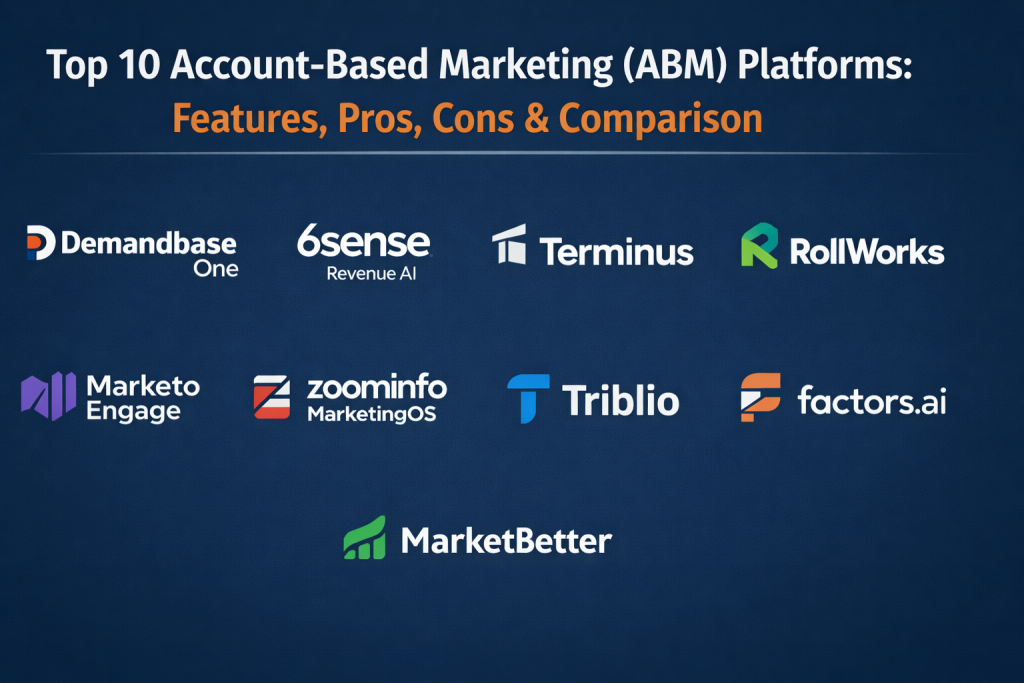
Top 10 Account-Based Marketing (ABM) Platforms
1. Demandbase One
As a pioneer in the ABM space, Demandbase One offers a comprehensive “Account-Based Experience” (ABX) platform. It is designed for large enterprises that need to unify marketing, sales, and customer success around a single view of the account.
Key Features
- Proprietary B2B DSP: An integrated advertising platform specifically built for account-level targeting.
- Predictive Lead & Account Scoring: Uses AI to identify which accounts are in-market and which leads are most likely to convert.
- Real-Time Intent Data: Aggregates trillions of intent signals to provide deep visibility into the buyer journey.
- Orchestration Workflows: Automated plays that trigger actions across email, ads, and CRM based on account engagement.
- Advanced Attribution: Detailed reporting that connects marketing activities directly to revenue and pipeline.
Pros
- The most mature and feature-complete platform for large-scale enterprise ABM.
- Strongest proprietary data set for account identification and intent.
Cons
- High total cost of ownership that may be prohibitive for smaller teams.
- Requires a significant investment in time and training to fully utilize.
Platforms / Deployment
Web / Cloud — Managed
Security & Compliance
SOC 2 Type II, ISO 27001, GDPR, and CCPA compliant.
Integrations & Ecosystem
Offers deep, native integrations with Salesforce, Microsoft Dynamics, HubSpot, and all major marketing automation platforms.
Support & Community
Extensive enterprise support, a dedicated success manager for large accounts, and a large “ABM Certification” community.
2. 6sense Revenue AI
6sense is widely considered the leader in predictive intelligence. Its platform focuses on the “Dark Funnel,” helping teams identify and engage accounts that are researching solutions anonymously.
Key Features
- Predictive Buying Stages: Uses AI to categorize accounts into stages like “Awareness,” “Consideration,” or “Purchase.”
- Dark Funnel Discovery: De-anonymizes website traffic and third-party research to surface hidden opportunities.
- Sales Intelligence: Provides reps with detailed insights into what stakeholders are researching before they reach out.
- Multi-Channel Orchestration: Automated ad campaigns and sales sequences triggered by intent surges.
- Buying Center Logic: Specifically maps out the different personas within a complex buying committee.
Pros
- Best-in-class predictive accuracy for identifying in-market accounts.
- Excellent visibility into the early, “anonymous” stages of the buyer journey.
Cons
- Implementation can take several months to properly calibrate the AI models.
- The platform can be overwhelming for teams without a dedicated ABM manager.
Platforms / Deployment
Web / Cloud — Managed
Security & Compliance
SOC 2, GDPR, and ISO compliant; advanced encryption for data at rest and in transit.
Integrations & Ecosystem
Strongest ties with Salesforce and HubSpot, along with an extensive API for custom data connections.
Support & Community
Highly rated “6sense Academy” and a very active user community of B2B revenue leaders.
3. Terminus
Terminus is a favorite for mid-market and enterprise teams focusing on multi-channel orchestration. Following its merger with DemandScience, it has greatly expanded its data and identification capabilities.
Key Features
- Multi-Channel Ads: Coordinated display, social, and LinkedIn advertising.
- Terminus Chat: A native chat tool that allows for account-based conversations directly on your website.
- Email Signature Marketing: Turns every employee email into a targeted ad channel for specific accounts.
- Sales Alerts & Playbooks: Direct notifications to sales teams when target accounts show high engagement.
- Account-Based Analytics: Comprehensive dashboards focused on account health and pipeline influence.
Pros
- Excellent balance of features for mid-market teams looking for fast implementation.
- Unique engagement channels like email signature and native chat.
Cons
- Predictive AI features are not as deep as those found in 6sense.
- Some users find the interface less intuitive for complex segment building.
Platforms / Deployment
Web / Cloud — Managed
Security & Compliance
Standard enterprise security protocols, including SOC 2 and GDPR alignment.
Integrations & Ecosystem
Native integrations with Salesforce, HubSpot, and Slack; known for its “plug-and-play” simplicity.
Support & Community
Robust onboarding programs and a strong reputation for customer success.
4. RollWorks (by NextRoll)
RollWorks offers a simplified, data-driven ABM platform that is particularly accessible for mid-market B2B companies. It excels in account identification and retargeting with a focus on ease of use.
Key Features
- Fit & Intent Scoring: Combined models to help you find accounts that match your ICP and are showing interest.
- Account-Based Retargeting: Automated display and social ads for de-anonymized site visitors.
- Journey Stage Tracking: Visualizes where each account sits in the sales funnel.
- LinkedIn Integration: Direct sync with LinkedIn Campaign Manager for account-based social ads.
- Lookalike Modeling: Identifies new target accounts based on the characteristics of your best customers.
Pros
- Lower starting price and faster setup time than enterprise-only platforms.
- Highly intuitive interface for creating and managing account-based ad campaigns.
Cons
- Lacks the deep sales intelligence and “Dark Funnel” depth of enterprise competitors.
- Reporting focuses more on advertising metrics than full-funnel revenue attribution.
Platforms / Deployment
Web / Cloud — Managed
Security & Compliance
GDPR and CCPA compliant; uses standard enterprise data protection measures.
Integrations & Ecosystem
Standard connectors for Salesforce, HubSpot, and Marketo; part of the extensive NextRoll advertising network.
Support & Community
Good customer support and a library of resources for teams just starting their ABM journey.
5. HubSpot ABM
For teams already using the HubSpot CRM, their native ABM tools provide a seamless, all-in-one experience. It is designed to bring sales and marketing together without the need for an external third-party platform.
Key Features
- Target Account Home: A central dashboard in the CRM to monitor your highest-priority accounts.
- Breeze AI (formerly Clearbit): Integrated AI for account enrichment and predictive lead scoring.
- Account-Based Workflows: Automation that triggers tasks or emails when account activity reaches a certain threshold.
- Company Insights: Automatically populates account records with firmographic and technographic data.
- Native Ad Integration: Manage LinkedIn and Google account-based ads directly within the HubSpot interface.
Pros
- No integration “headaches” as it lives natively inside your existing CRM and marketing tool.
- Most user-friendly interface for teams that want to get started with ABM quickly.
Cons
- Lacks the advanced proprietary intent data and high-end DSP capabilities of Demandbase.
- Less sophisticated for massive enterprises with highly complex buying centers.
Platforms / Deployment
Web / Cloud — Managed
Security & Compliance
Enterprise-grade security (SOC 2, ISO, HIPAA options) with global data residency.
Integrations & Ecosystem
The center of the massive HubSpot ecosystem, with thousands of marketplace integrations.
Support & Community
Industry-leading support and the famous HubSpot Academy for marketing education.
6. Adobe Marketo Engage
Marketo is the enterprise standard for marketing automation, and its ABM module is designed for teams that need to orchestrate complex, multi-touch campaigns at a global scale.
Key Features
- Account-Based Personalization: Dynamic website and email content tailored to the specific account.
- Predictive Content: Uses AI to suggest the best asset for a specific account at a specific time.
- Advanced Lead-to-Account Matching: Sophisticated logic to ensure leads are correctly routed to their parent accounts.
- Revenue Attribution: Deep reporting that tracks how ABM efforts contribute to closed deals.
- Cross-Channel Orchestration: Coordinated campaigns across email, social, mobile, and web.
Pros
- Massive scalability for global organizations with millions of records.
- Highly customizable for teams with unique or complex business logic.
Cons
- The platform can feel technical and “legacy” compared to newer AI-native tools.
- Requires a dedicated technical admin to manage and maintain effectively.
Platforms / Deployment
Web / Cloud — Managed
Security & Compliance
Meets all global enterprise security and data privacy standards.
Integrations & Ecosystem
Deeply integrated with the Adobe Experience Cloud and provides robust connectors for Salesforce and Microsoft Dynamics.
Support & Community
Huge professional community (Marketo Champions) and extensive enterprise support.
7. ZoomInfo MarketingOS
ZoomInfo has transformed from a data provider into a full-scale ABM platform. It leverages its world-class contact database to provide unmatched precision in account targeting and sales activation.
Key Features
- Best-in-Class B2B Database: Access to millions of verified professional profiles and company records.
- Streaming Intent: Real-time signals that show when an account is researching specific keywords.
- WebSights: Identifies anonymous companies visiting your website in real time.
- Automated Outreach: Integrated email and dialer tools for immediate sales follow-up.
- FormComplete: Automatically enriches web forms so prospects don’t have to fill in every field.
Pros
- The highest quality contact and company data available in the market.
- Direct “bridge” between marketing signals and sales activation (calling/emailing).
Cons
- Pricing can be high and is often opaque until you are deep in the sales cycle.
- The platform can feel more like a “sales tool” than a traditional marketing orchestration suite.
Platforms / Deployment
Web / Cloud — Managed
Security & Compliance
SOC 2 compliant and focused on strict data privacy and verified professional data.
Integrations & Ecosystem
Seamlessly feeds data into Salesforce, HubSpot, and all major marketing automation systems.
Support & Community
Extensive training through “ZoomInfo University” and strong professional support tiers.
8. Triblio (by Foundry)
Triblio focuses on “full-funnel” ABM, specializing in combining account-based advertising with website personalization. It is designed to help teams drive engagement through the entire buyer journey.
Key Features
- Account-Based Advertising: High-precision display and social ads.
- Website Personalization: Dynamic CTAs and banners for target account visitors.
- Intent Signal Orchestration: Aggregates first-party and third-party data to prioritize accounts.
- Sales Activation: Provides sales reps with a “daily digest” of account activity.
- Pipeline Impact Reporting: Shows how specific ABM tactics influenced deal progression.
Pros
- Strongest capability for managing account-specific website experiences.
- Backed by Foundry’s extensive first-party intent data network.
Cons
- Reporting interface is sometimes cited as less flexible than competitors.
- Smaller community and ecosystem compared to Demandbase or 6sense.
Platforms / Deployment
Web / Cloud — Managed
Security & Compliance
Standard encryption and data handling protocols in line with GDPR and SOC 2.
Integrations & Ecosystem
Solid integrations with Salesforce, HubSpot, and Marketo.
Support & Community
Good customer success reputation with a focus on guided implementation.
9. Factors.ai
Factors.ai is an emerging AI-native platform that focuses on account intelligence and de-anonymization. It is an ideal choice for mid-market B2B teams that want deep insights without the enterprise price tag.
Key Features
- De-anonymization: Identifies companies visiting your site with high accuracy.
- Account-Level Attribution: Maps out the multi-touch journey of an account from first visit to closed deal.
- Intent-Based Alerts: Real-time Slack or email notifications when target accounts engage.
- LinkedIn ABM Insights: Provides data on which accounts are engaging with your LinkedIn ads.
- GTM Orchestration: Helps coordinate sales and marketing plays based on engagement patterns.
Pros
- Much more affordable for mid-market teams than the “Big Three” platforms.
- Very fast setup time with a modern, user-friendly interface.
Cons
- Native advertising orchestration is less robust than in Demandbase or Terminus.
- Ecosystem of third-party integrations is still growing.
Platforms / Deployment
Web / Cloud — Managed
Security & Compliance
SOC 2 and GDPR compliant; focused on modern privacy standards.
Integrations & Ecosystem
Strong connectors for HubSpot, Salesforce, and LinkedIn.
Support & Community
Known for being highly responsive and helpful to their growing user base.
10. MarketBetter
MarketBetter is a newcomer that has gained rapid traction by focusing on “Signal-to-Action” ABM. It is built specifically for teams that want their ABM platform to tell their sales reps exactly what to do next.
Key Features
- SDR Playbook: Converts account signals into a daily prioritized task list for sales reps.
- AI-Powered Email Automation: Generates personalized outreach based on the account’s actual web behavior.
- Integrated Smart Dialer: Built-in calling features with AI-suggested talking points.
- Account Visitor Identification: Real-time tracking of target accounts on your website.
- Champion Tracking: Alerts you when a key contact from a past deal moves to a new target account.
Pros
- The most “action-oriented” platform for teams that struggle with sales-marketing handoffs.
- Transparent, usage-based pricing that is accessible for mid-market companies.
Cons
- As a newer platform, it lacks the decades of enterprise case studies of a Demandbase.
- Less focus on high-end display advertising compared to specialized DSPs.
Platforms / Deployment
Web / Cloud — Managed
Security & Compliance
Standard SOC 2 compliance; focuses on modern, secure data handling.
Integrations & Ecosystem
Native links with Salesforce, HubSpot, and Slack; focused on modern GTM stacks.
Support & Community
Highly rated for their hands-on onboarding and direct customer access to the product team.
Comparison Table (Top 10)
| Tool Name | Best For | Platform(s) Supported | Deployment | Standout Feature | Public Rating |
| 1. Demandbase One | Enterprise ABX | Web, Cloud | Managed | Proprietary B2B DSP | 4.3/5 |
| 2. 6sense Revenue AI | Predictive Intent | Web, Cloud | Managed | Dark Funnel Visibility | 4.4/5 |
| 3. Terminus | Multi-channel Orchestration | Web, Cloud | Managed | Email Signature Ads | 4.4/5 |
| 4. RollWorks | Mid-market Ad Scale | Web, Cloud | Managed | Account Retargeting | 4.3/5 |
| 5. HubSpot ABM | HubSpot Users | Web, Cloud | Managed | Native CRM Workflow | 4.4/5 |
| 6. Marketo Engage | Complex Automation | Web, Cloud | Managed | Predictive Content | 4.1/5 |
| 7. ZoomInfo MarketingOS | Data-First ABM | Web, Cloud | Managed | Verified Contact Data | 4.4/5 |
| 8. Triblio | Web Personalization | Web, Cloud | Managed | Dynamic Site Content | 4.2/5 |
| 9. Factors.ai | Analytics & Attribution | Web, Cloud | Managed | De-anonymization | 4.6/5 |
| 10. MarketBetter | Signal-to-Action | Web, Cloud | Managed | SDR Daily Playbook | 4.9/5 |
Evaluation & Scoring of ABM Platforms
| Tool Name | Core (25%) | Ease (15%) | Integrations (15%) | Security (10%) | Perf (10%) | Support (10%) | Value (15%) | Total |
| 1. Demandbase | 10 | 4 | 10 | 10 | 9 | 10 | 5 | 8.2 |
| 2. 6sense | 10 | 4 | 9 | 9 | 10 | 9 | 5 | 8.1 |
| 3. Terminus | 8 | 7 | 9 | 9 | 8 | 9 | 7 | 8.0 |
| 4. RollWorks | 7 | 8 | 8 | 8 | 8 | 8 | 9 | 7.8 |
| 5. HubSpot | 7 | 10 | 10 | 10 | 9 | 10 | 8 | 8.8 |
| 6. Marketo | 9 | 3 | 9 | 10 | 9 | 9 | 5 | 7.4 |
| 7. ZoomInfo | 8 | 7 | 9 | 9 | 9 | 8 | 6 | 7.7 |
| 8. Triblio | 7 | 7 | 8 | 8 | 8 | 8 | 7 | 7.4 |
| 9. Factors.ai | 6 | 9 | 8 | 8 | 9 | 9 | 9 | 7.9 |
| 10. MarketBetter | 7 | 9 | 8 | 8 | 9 | 9 | 9 | 8.2 |
Scoring reflects the balance between enterprise power and operational simplicity. A high “Core” score indicates a deep feature set for complex targeting. “Ease” scores highlight platforms that allow teams to launch campaigns with minimal technical support. “Value” scores prioritize platforms with transparent pricing and high ROI for mid-market budgets.
Which ABM Platform Is Right for You?
Solo / Freelancer
If you are an independent consultant or a tiny team, Apollo.io (or a basic HubSpot plan) is the best starting point. Most full-scale ABM platforms are designed for teams with multiple stakeholders and substantial budgets, so a lightweight sales intelligence tool is often more effective for solo work.
SMB
For companies with 50–500 employees, Factors.ai or RollWorks offer the best balance. They provide the necessary de-anonymization and account-based advertising features without the $50k+ annual price tag of the enterprise leaders.
Mid-Market
Mid-market organizations that need deep sales and marketing alignment should look at MarketBetter or Terminus. These platforms excel at turning data into actionable tasks for sales reps, ensuring that no high-intent account is ever ignored.
Enterprise
Large corporations with $500k+ ABM budgets should stick to Demandbase One or 6sense. These are the only platforms built to handle the complexity of global buying centers, massive data volumes, and sophisticated multi-channel orchestration.
Budget vs Premium
If the budget is tight, Factors.ai and Apollo are the winners. If you are willing to pay for a “premium” experience with the best possible data and AI, 6sense and Demandbase are the industry benchmarks.
Feature Depth vs Ease of Use
Marketo and 6sense offer the most depth but require a steep learning curve and dedicated admins. HubSpot and MarketBetter are designed for the modern marketer who wants to move fast with an intuitive, clean interface.
Integrations & Scalability
Salesforce and HubSpot users will find the most native scalability within their own platforms’ ABM tools. For those running a best-of-breed stack, Demandbase offers the most robust ecosystem for scaling globally.
Security & Compliance Needs
Financial and healthcare enterprises must prioritize the “Big Three” (Adobe, HubSpot, Salesforce) or Demandbase, as they maintain the most rigorous, verified security and data privacy certifications in the world.
Frequently Asked Questions (FAQs)
1. How is ABM different from traditional lead generation?
Traditional marketing focuses on getting as many individual leads as possible. ABM focuses on engaging entire accounts (companies) that fit your ideal customer profile and have high revenue potential.
2. Is ABM only for large enterprise companies?
No. While it started in enterprise, modern AI-powered platforms have made it accessible and highly effective for mid-market and even small B2B teams.
3. What is “intent data” and why do I need it?
Intent data is a collection of signals (like website visits or keyword research) that suggest a company is in the market for a solution. It helps you prioritize who to contact and when.
4. How long does it take to see results from an ABM platform?
Most teams start seeing engagement signals within weeks, but because ABM is used for complex deals, the impact on “closed-won” revenue usually follows your standard sales cycle length.
5. Do I need a specific CRM to use an ABM platform?
While most platforms work best with Salesforce or HubSpot, many offer open APIs or connectors for other systems. Always check integration compatibility before buying.
6. Can ABM platforms help with existing customers?
Yes. ABM is highly effective for expansion, cross-selling, and renewal campaigns within your existing high-value customer accounts.
7. How much do these platforms usually cost?
Mid-market tools can start around $10k–$20k per year, while enterprise-grade platforms like 6sense or Demandbase often start at $50k–$60k per year plus implementation fees.
8. What is the “Dark Funnel”?
The Dark Funnel refers to the anonymous research buyers do on third-party sites, social media, and your own website before they ever identify themselves to you.
9. Who should own the ABM platform—Marketing or Sales?
ABM is a joint strategy. While Marketing usually manages the platform and the budget, Sales must be active participants in choosing the accounts and executing the follow-up tasks.
10. Do I need to create unique content for every single account?
Not necessarily. Most teams use a “tiered” approach: 1:1 for top accounts, “1:few” (industry-specific) for the mid-tier, and “1:many” (programmatic) for the broader list.
Conclusion
Successful Account-Based Marketing is defined by the ability to turn signals into meaningful human connections at scale. The platforms listed here provide the necessary intelligence to identify high-value opportunities and the orchestration power to engage them across the entire buyer journey. Whether you choose the predictive depth of 6sense, the enterprise reach of Demandbase, or the action-oriented SDR playbooks of MarketBetter, the core goal remains the same: precision over volume. By aligning your revenue teams around a single source of account truth, you can stop chasing leads and start winning the accounts that truly drive your business forward. I recommend conducting an audit of your current “Total Addressable Market” (TAM) and selecting a small group of 20–50 high-priority accounts for a pilot program. Test two platforms—perhaps a CRM-native option like HubSpot and an intelligence leader like 6sense—to see which provides the best engagement signals for your specific industry.

Best Cardiac Hospitals Near You
Discover top heart hospitals, cardiology centers & cardiac care services by city.
Advanced Heart Care • Trusted Hospitals • Expert Teams
View Best Hospitals