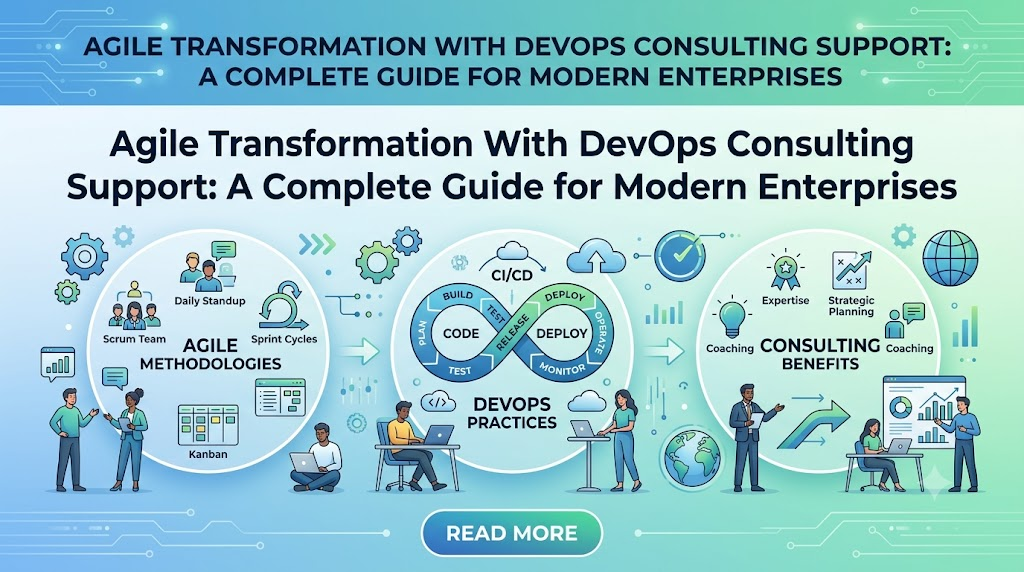
Introduction
Modern enterprises face relentless pressure to deliver software rapidly, scale securely, and adapt instantly to shifting market demands, making traditional waterfall methodologies obsolete due to delayed releases and siloed teams. While adopting Agile provides the necessary framework for iterative planning and customer collaboration, it frequently exposes underlying technical bottlenecks like manual deployments and sluggish testing cycles. To successfully bridge this gap and modernize software delivery, organizations partner with expert DevOps Consulting services to implement automated pipelines, cloud infrastructure, and continuous integration practices that turn theoretical Agile strategies into high-speed execution engines.
What Is Agile Transformation?
Agile transformation is the organizational process of shifting from traditional, rigid development models to an adaptive, collaborative, and iterative way of working. It is not merely adopting a new project management tool or holding daily stand-up meetings; it is a fundamental shift in company culture, mindset, and operational structure.
Evolution From Traditional Software Development
Historically, software was built using sequential phases where requirements, design, coding, testing, and deployment happened in long, isolated blocks. If a requirement changed halfway through, the entire project suffered. Agile evolution introduces iterative cycles—often called sprints—where working software is delivered in small, usable increments every few weeks.
Core Agile Principles
- Individuals and interactions over processes and tools.
- Working software over comprehensive documentation.
- Customer collaboration over contract negotiation.
- Responding to change over following a strict plan.
Continuous Improvement and Customer Focus
Agile transformation prioritizes continuous feedback from end-users. By releasing software in smaller batches, teams can test hypotheses, gather user feedback, and pivot quickly. This customer-centric approach reduces financial risk and ensures that engineering efforts align perfectly with business goals.
What Is DevOps Consulting?
DevOps consulting involves partnering with external technology specialists who assess an organization’s software development lifecycle, infrastructure, and culture to implement modern DevOps practices. DevOps consultants act as strategic advisors, architects, and implementers who bridge the gap between software development and IT operations.
Role of DevOps Consultants
DevOps consultants evaluate current workflows, identify manual bottlenecks, design automated pipelines, implement Infrastructure as Code, and foster a collaborative engineering culture. They bring objective viewpoints and deep multi-industry experience that internal teams may lack.
Technical and Business Responsibilities
- Technical: Designing CI/CD pipelines, automating testing, provisioning cloud infrastructure, and establishing robust monitoring.
- Business: Aligning technology investments with revenue goals, reducing time-to-market, and optimizing operational costs.
Consulting, Implementation, and Training
- Consulting: Assessing maturity, defining strategy, and drafting roadmaps.
- Implementation: Hands-on building of pipelines, scripts, and cloud environments.
- Training: Upskilling internal engineers and coaching teams on best practices.
Why Agile and DevOps Work Better Together
Agile and DevOps are two sides of the same coin. Agile optimizes how work is planned, prioritized, and managed, while DevOps optimizes how software is built, tested, deployed, and monitored. When combined, they eliminate friction across the entire software delivery lifecycle.
| Agile Focus | DevOps Contribution | Business Outcome |
| Sprint planning and backlog management | Automated build and deployment pipelines | Predictable and frequent release cycles |
| Continuous feedback from business stakeholders | Automated regression and performance testing | Higher software quality and fewer bugs |
| Cross-functional team organization | Shared infrastructure management and IaC | Elimination of developer and operator silos |
| Iterative feature delivery | Robust monitoring, logging, and tracing | Rapid identification and resolution of issues |
Why Organizations Need DevOps Consulting for Agile Transformation
Many enterprises attempt Agile transformations internally, only to hit a wall of technical debt and cultural resistance. External expert guidance accelerates success by addressing common organizational hurdles.
- Lack of Internal Expertise: Internal teams may understand Agile theory but lack deep hands-on experience in advanced CI/CD, Kubernetes orchestration, or cloud architecture.
- Legacy Infrastructure: Monolithic legacy systems make rapid deployments risky and complex. Consultants design strangler patterns and gradual migration strategies.
- Tool Integration Challenges: Choosing and integrating the right mix of version control, testing, security, and deployment tools can overwhelm engineering teams.
- Cultural Resistance: Shifting from finger-pointing silos to shared accountability requires neutral, experienced facilitation.
- Cloud Migration Complexity: Moving workloads to public or hybrid clouds requires specialized cloud-native architectural patterns.
- Security Integration: Balancing speed with compliance demands structured DevSecOps integration from day one.
Core Areas Where DevOps Consulting Supports Agile Transformation
DevOps consultants intervene across multiple technical and cultural domains to ensure Agile workflows deliver maximum business value.
| Area | Consultant’s Role | Business Benefit |
| Strategy & Assessment | Evaluate current maturity and define transformation roadmap | Clear vision and measurable milestones |
| CI/CD Automation | Design automated build, test, and release pipelines | Reduced manual effort and faster releases |
| Cloud Adoption | Architect scalable and cost-effective cloud environments | High availability and elastic scalability |
| Infrastructure as Code | Automate server provisioning using code templates | Environment consistency and disaster recovery |
| Monitoring & Observability | Implement centralized logging, metrics, and alerting | Proactive issue resolution and uptime |
| Security (DevSecOps) | Embed security scans early in the pipeline | Minimized vulnerabilities and regulatory compliance |
| Team Enablement | Conduct workshops, training, and operational coaching | Long-term self-sufficiency and high morale |
Strategy and Assessment
Consultants begin by conducting a comprehensive audit of existing tools, processes, and team structures. This baseline assessment highlights critical friction points and establishes clear Key Performance Indicators.
CI/CD Pipeline Automation
Manual compilation and deployment steps are replaced with fully automated pipelines that trigger tests and deployments upon code commit, ensuring code is always in a releasable state.
Cloud Adoption and Infrastructure as Code
Moving away from physical servers, consultants help organizations leverage cloud platforms, using tools like Terraform to provision infrastructure reproducibly.
Monitoring and Security
Real-time dashboards provide visibility into application health, while automated security checks catch vulnerabilities before production release.
Step-by-Step Agile Transformation With DevOps Consulting Support
A structured roadmap ensures that transformation efforts remain manageable, measurable, and aligned with business objectives.
Step 1: Business and Technical Assessment
Consultants evaluate existing workflows, codebase quality, deployment frequency, lead times, and team dynamics to identify the root causes of delivery delays.
Step 2: Agile and DevOps Strategy
A tailored transformation roadmap is created, defining milestones, toolchain selections, training schedules, and success metrics.
Step 3: CI/CD Pipeline Design
Engineers and consultants collaborate to build automated pipelines for building, testing, packaging, and deploying applications across environments.
Step 4: Infrastructure Automation
Infrastructure is defined as code, allowing development, staging, and production environments to be spun up identically within minutes.
Step 5: Cloud Adoption
Workloads are migrated or refactored for cloud environments, optimizing resource utilization, security groups, and auto-scaling policies.
Step 6: Monitoring and Feedback
Centralized monitoring and logging solutions are established to track application performance, user experience, and system stability.
Step 7: Continuous Optimization
Transformation is not a one-time project. Consultants establish feedback loops for ongoing refinement, skill upgrades, and process tuning.
DevOps Consulting Framework for Agile Organizations
| Phase | Activities | Expected Outcome |
| Assessment | Workflow audits, interviews, toolchain inventory | Comprehensive maturity report and gap analysis |
| Planning | Roadmap creation, KPI definition, tool selection | Agreed transformation strategy and backlog |
| Automation | Pipeline creation, script writing, testing setup | Automated build and test workflows |
| Deployment | Staging validation, blue-green deployment setup | Safe, repeatable production releases |
| Monitoring | Log aggregation, metric tracking, alerting setup | Full system observability and rapid debugging |
| Continuous Improvement | Retrospectives, performance tuning, skill training | Sustainable operational excellence |
Agile Transformation Challenges Without DevOps Consulting
Organizations attempting transformation without external guidance frequently encounter severe roadblocks:
- Manual Deployments: Relying on human intervention for deployments leads to human error, lengthy release windows, and weekend maintenance stress.
- Slow Releases: Even if sprints last two weeks, software may sit in staging for months waiting for manual approvals and integration testing.
- Siloed Teams: Developers write code, QA tests it in isolation, and operations throws it over the wall, leading to lack of shared ownership.
- Limited Automation: Repetitive tasks drain engineering hours, leading to burnout and reduced innovation capacity.
- Poor Visibility: Lack of metrics makes it impossible to pinpoint where bottlenecks occur in the delivery pipeline.
- Security Delays: Security audits happening only at the very end of development halt releases and create friction.
How DevOps Consultants Improve Team Collaboration
Technology alone cannot solve organizational bottlenecks. DevOps consulting emphasizes breaking down cultural barriers between development, operations, testing, and security teams.
Breaking Silos
Consultants foster a culture of shared responsibility. Developers take ownership of how their code behaves in production, while operations engineers participate in design discussions early in the development cycle.
Cross-Functional Collaboration
By aligning incentives and encouraging open communication, consultants help multidisciplinary teams work together smoothly toward shared business objectives.
Knowledge Sharing
Through pair programming, lunch-and-learn sessions, and documentation standards, consultants ensure that critical technical knowledge is distributed across the entire team rather than locked inside a single individual’s head.
Role of CI/CD in Agile Transformation
Continuous Integration and Continuous Delivery (CI/CD) form the beating heart of any modern Agile and DevOps implementation.
Continuous Integration
Developers merge their code changes into a central repository frequently—often multiple times a day. Each merge triggers an automated build and automated unit tests to catch integration bugs instantly.
Continuous Delivery and Deployment
Continuous Delivery ensures that passing builds are automatically deployable to staging environments at any time. Continuous Deployment takes it a step further by automatically pushing validated changes directly to production without manual gatekeeping.
Reducing Risks and Gathering Feedback
Automated testing catches regressions early, while frequent releases ensure users experience continuous value and provide rapid feedback to product teams.
Infrastructure as Code and Cloud Automation
Infrastructure as Code (IaC) treats infrastructure provisioning with the same rigor as application development. Instead of clicking through cloud consoles, engineers write declarative configuration files.
Terraform and Ansible
Tools like Terraform manage cloud infrastructure state, while Ansible handles configuration management and software provisioning.
Environment Consistency
IaC eliminates the dreaded “it works on my machine” problem by ensuring that development, staging, and production environments are 100% identical.
Automated Scaling
Cloud automation allows infrastructure to scale up or down dynamically based on traffic loads, optimizing cloud spend and ensuring high availability.
DevOps Consulting for Cloud-Native Agile Development
Modern enterprises build applications designed specifically to run in cloud environments using containerization and microservices architecture.
Containers and Kubernetes
Consultants help organizations containerize applications using Docker and orchestrate them at scale using Kubernetes. This ensures portability across different cloud providers and on-premise data centers.
Microservices Architecture
Monolithic applications are broken down into small, independently deployable microservices that align perfectly with Agile team structures and rapid iteration cycles.
Security Integration Through DevSecOps
Waiting until the end of a development cycle to test security creates massive delays and costly vulnerabilities. DevSecOps integrates security into every phase of the Agile pipeline.
- Shift-Left Security: Security checks begin during the coding and design phase.
- Automated Scanning: Static Application Security Testing (SAST) and Dynamic Application Security Testing (DAST) run automatically within CI/CD pipelines.
- Compliance as Code: Regulatory compliance requirements are codified and verified automatically with every build.
Real-World Agile Transformation Example
Before DevOps Consulting
- Deployment Method: Manual script execution by a dedicated release engineer.
- Release Cycle: Quarterly monolithic releases fraught with high failure rates.
- Collaboration: Hostile walls between development and operations teams.
- Downtime: Frequent outages requiring emergency weekend rollbacks.
After DevOps Consulting
- Deployment Method: Fully automated CI/CD pipelines triggered automatically upon pull request merge.
- Release Cycle: Multiple daily deployments of small, modular microservices.
- Collaboration: Unified engineering squads sharing operational responsibility.
- Downtime: Zero-downtime rolling updates with instant automated failover.
Business Benefits of Agile Transformation With DevOps Consulting
- Faster Time-to-Market: Deliver features to customers weeks ahead of competitors.
- Improved Software Quality: Automated testing drastically reduces bug leakage into production.
- Better Customer Satisfaction: Rapid feature delivery and high availability delight end-users.
- Lower Operational Costs: Efficient cloud resource utilization and reduced manual toil.
- Increased Productivity: Engineers spend time writing code rather than fixing deployment errors.
- Better Scalability: Cloud-native architectures scale effortlessly with business growth.
Common Mistakes During Agile Transformation
- Ignoring Culture: Focusing solely on tools while maintaining rigid, siloed management structures.
- Choosing Tools Before Strategy: Adopting popular software tools without a clear operational strategy.
- Lack of Executive Support: Failing to secure active leadership sponsorship for organizational change.
- Poor Training: Expecting teams to adopt new paradigms without adequate coaching and upskilling.
- No Success Metrics: Failing to track baseline performance and transformation progress.
Best Practices for Successful Agile and DevOps Transformation
- Commit from the Top: Ensure executive leadership actively champions the transformation.
- Iterate in Small Steps: Implement changes incrementally rather than attempting a risky big-bang overhaul.
- Prioritize Automation: Automate testing, provisioning, and deployment from the earliest stages.
- Measure Relentlessly: Track objective metrics to validate improvement and guide decisions.
- Encourage Psychological Safety: Create an environment where teams can experiment, fail safely, and learn rapidly.
Metrics to Measure Agile Transformation Success
| Metric | Purpose | Desired Improvement |
| Deployment Frequency | Measure how often new code is released | Increase from monthly/quarterly to daily |
| Lead Time for Changes | Track time from code commit to production | Reduce from weeks to minutes/hours |
| Change Failure Rate | Measure percentage of deployments causing failure | Minimize toward zero |
| Mean Time to Recovery | Track time required to restore service after an outage | Reduce drastically through automated rollbacks |
| Customer Satisfaction | Measure end-user happiness and adoption rates | Consistent upward trend |
| Automation Coverage | Track percentage of automated tests and provisioning | Approach 100% |
Industries Benefiting From DevOps Consulting
Banking and Financial Services
Enables rapid delivery of secure fintech features while maintaining strict regulatory compliance and audit trails.
Healthcare
Ensures patient data security through DevSecOps while accelerating the deployment of telemedicine and diagnostic applications.
Retail and E-commerce
Provides elastic scalability to handle massive traffic spikes during seasonal sales events without service interruption.
Manufacturing
Connects IoT devices and supply chain software with rapid software update cycles.
Telecommunications
Accelerates the rollout of 5G services and customer-facing mobile applications.
SaaS Companies
Shortens release cycles to ship new product features faster than competitors and capture market share.
Career Opportunities in DevOps Consulting
Key Roles
- DevOps Consultant: Advises clients on pipeline automation, cloud migration, and toolchain selection.
- Agile Coach: Guides organizational change, scrum adoption, and team collaboration.
- Platform Engineer: Builds internal developer platforms to streamline self-service infrastructure.
- Cloud Architect: Designs scalable, secure, and cost-efficient cloud-native infrastructure.
- DevOps Architect: Oversees end-to-end enterprise toolchain and delivery architecture.
Skills, Demand, and Growth
Enterprise demand for professionals skilled in Agile transformation and DevOps consulting continues to surge. High-value skills include Kubernetes, Terraform, CI/CD toolchains, cloud platforms (AWS, Azure, GCP), and enterprise coaching.
Certifications and Learning Path
Building expertise in Agile and DevOps requires a structured approach combining theoretical frameworks with hands-on practice. The DevOpsSchool learning ecosystem provides comprehensive training programs designed to help professionals master these critical disciplines.
| Certification | Best For | Skill Level | Focus Area |
| Agile & Scrum Certifications | Project managers and team leads | Beginner to Intermediate | Backlog management, sprint planning |
| DevOps Fundamentals | Beginners entering technology | Beginner | CI/CD concepts, version control basics |
| Kubernetes & Containerization | System admins and platform engineers | Advanced | Container orchestration, microservices |
| Infrastructure as Code (IaC) | Cloud and DevOps engineers | Intermediate | Terraform, automation scripting |
| Advanced DevOps Consultant | Experienced engineers and architects | Expert | Enterprise transformation strategy |
Beginner Roadmap to Learn Agile and DevOps Consulting
Stage 1: Agile Fundamentals
Learn Scrum, Kanban, user story writing, and agile ceremonies.
Stage 2: DevOps Concepts
Understand the DevOps lifecycle, version control with Git, and basic Linux administration.
Stage 3: CI/CD and Automation
Master tools like Jenkins, GitLab CI, or GitHub Actions for automated building and testing.
Stage 4: Cloud and Containers
Gain proficiency in Docker, Kubernetes, and major cloud service providers.
Stage 5: Enterprise Transformation Projects
Apply skills in real-world consulting scenarios, focusing on culture, metrics, and large-scale migration strategies.
Future of Agile Transformation With DevOps
The landscape of software delivery continues to evolve rapidly. Future trends shaping enterprise transformation include:
- AI-Assisted DevOps: Utilizing artificial intelligence to automate incident detection, write infrastructure code, and optimize CI/CD pipelines.
- Platform Engineering: Building internal developer platforms (IDPs) that abstract infrastructure complexity and empower developers with self-service capabilities.
- GitOps: Managing infrastructure and application deployments entirely through Git repositories for declarative automation and auditability.
- Intelligent Automation: Smarter testing and continuous compliance validation powered by machine learning models.
FAQs
What is Agile transformation?
Agile transformation is the cultural and structural shift from traditional, sequential software development to iterative, collaborative, and customer-focused Agile methodologies.
Why is DevOps consulting important?
DevOps consulting provides expert guidance, technical implementation support, and cultural coaching to help organizations overcome legacy bottlenecks and successfully scale software delivery.
How does DevOps support Agile teams?
While Agile optimizes work planning and prioritization, DevOps automates building, testing, and deployment, ensuring planned features reach production rapidly and safely.
Can small businesses benefit from DevOps consulting?
Yes. Small businesses benefit by adopting scalable cloud architecture and automated pipelines early, avoiding technical debt as they grow.
What tools are commonly used in DevOps?
Common tools include Git for version control, Jenkins or GitHub Actions for CI/CD, Terraform for Infrastructure as Code, Docker and Kubernetes for containerization, and AWS, Azure, or GCP for cloud infrastructure.
How long does Agile transformation take?
Transformation timelines vary based on enterprise size and existing maturity, typically ranging from six months to several years for full enterprise-wide adoption.
What challenges do organizations face during transformation?
Common challenges include cultural resistance to change, lack of internal technical expertise, reliance on legacy monolithic systems, and poor tool integration.
Is cloud migration necessary for DevOps?
While DevOps principles can be applied on-premise, cloud migration significantly enhances scalability, automation potential, and infrastructure flexibility.
What is the role of an Agile coach?
An Agile coach guides teams and leadership on Agile principles, facilitates scrum ceremonies, and helps resolve internal collaboration friction.
What is DevSecOps?
DevSecOps integrates security practices into every stage of the DevOps pipeline, ensuring applications are secure from inception rather than audited at the end.
How do I measure transformation success?
Success is measured using key metrics such as deployment frequency, lead time for changes, change failure rate, mean time to recovery, and customer satisfaction.
What is Infrastructure as Code (IaC)?
IaC is the practice of managing and provisioning computing infrastructure through machine-readable configuration files rather than manual physical configuration.
How does DevOps improve collaboration?
DevOps breaks down silos between development and operations teams by establishing shared responsibility, cross-functional squads, and transparent communication channels.
Do DevOps consultants provide training?
Yes, reputable consulting partners offer hands-on workshops, training programs, and coaching to ensure internal teams achieve long-term self-sufficiency.
Where can I learn DevOps consulting skills?
Professionals can build expertise through structured learning ecosystems such as DevOpsSchool, combining certifications, hands-on labs, and real-world project experience.
Final Thoughts
Achieving a successful Agile transformation requires much more than adopting new terminology or project management software. True organizational modernization demands a deep commitment to cultural alignment, relentless automation, and robust engineering practices.
By partnering with experienced specialists, organizations can navigate complex technical hurdles, eliminate manual operational toil, and build sustainable, high-velocity software delivery pipelines. Whether you are modernizing legacy systems or scaling cloud-native architectures, expert guidance ensures that your investment in Agile and DevOps translates into measurable business growth and lasting competitive advantage.

Best Cardiac Hospitals Near You
Discover top heart hospitals, cardiology centers & cardiac care services by city.
Advanced Heart Care • Trusted Hospitals • Expert Teams
View Best Hospitals