Introduction
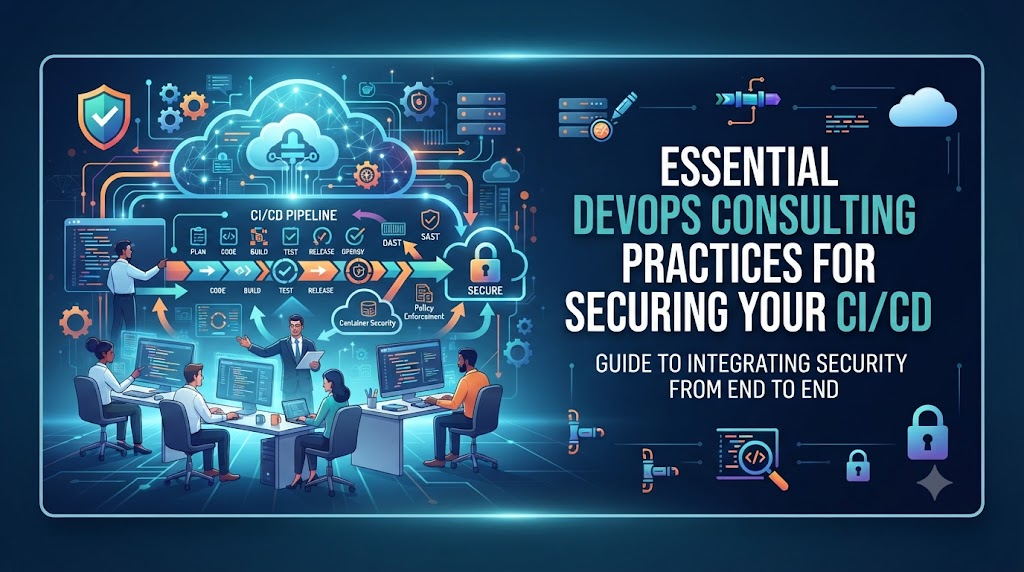
In the modern era of rapid digital transformation, the CI/CD pipeline has become the essential backbone of software delivery, enabling organizations to iterate and deploy at unprecedented speeds; however, this velocity significantly increases the surface area for security risks, making it critical to safeguard every stage of the lifecycle from code to production. Securing your infrastructure is no longer merely about perimeter defenses but about embedding security directly into every commit, build, and deployment, a complex task where DevOps consulting serves as a vital strategic partner. By leveraging the specialized expertise found at devopsschool, enterprises can bridge the gap between high-speed development and rigorous security requirements, transitioning from reactive, manual interventions to a proactive, automated, and resilient DevSecOps posture that protects the entire software supply chain.
What Is a CI/CD Pipeline?
At its core, a CI/CD pipeline is a series of automated processes that allow software to be built, tested, and deployed to production environments efficiently.
- Continuous Integration (CI): Developers frequently merge their code changes into a central repository. Automated tests run to ensure that new code does not break the existing application.
- Continuous Delivery (CD): Once the code passes CI tests, it is automatically prepared for a release to a production-like environment.
- Continuous Deployment (CD): This takes delivery a step further, where every change that passes all stages of the production pipeline is automatically released to the end-users.
These pipelines rely heavily on automation to remove manual intervention, thereby reducing human error and increasing the speed of the software release lifecycle.
Why CI/CD Security Matters
The shift toward automation is powerful, but it introduces unique risks. If a CI/CD pipeline is compromised, the impact is magnified across the entire organization.
- Supply Chain Attacks: Attackers may target the pipeline tools or dependencies to inject malicious code that gets distributed to customers automatically.
- Credential Theft: Pipelines often require high-privileged access to cloud providers and databases; if these secrets are leaked, the entire cloud environment is at risk.
- Compliance Requirements: Regulatory standards like GDPR, PCI-DSS, or HIPAA demand strict control over who can modify production code. Without secure pipelines, passing these audits becomes nearly impossible.
Securing your CI/CD pipeline is not just a technical necessity; it is a business imperative to maintain customer trust and operational continuity.
Common Security Risks in CI/CD Pipelines
| Risk | Potential Impact | Business Consequences |
| Weak Access Controls | Unauthorized pipeline modification | Data breaches, service outages |
| Exposed Secrets | Theft of API keys and credentials | Lateral movement, full cloud takeover |
| Vulnerable Dependencies | Injection of malicious code | Supply chain compromise, loss of reputation |
| Misconfigured Pipelines | Open access to build environments | Intellectual property theft |
| Insecure Build Servers | Exploitation of underlying infrastructure | Long-term persistent access by attackers |
| Third-Party Integrations | Supply chain vulnerabilities | Uncontrolled risk from external vendors |
What Is DevOps Consulting?
DevOps consulting is the process of engaging experienced professionals to optimize the intersection of development and operations. A consultant brings a strategic viewpoint, helping teams implement best practices in automation, culture, and security.
Rather than just installing tools, consultants assess current bottlenecks, design scalable architectures, and foster an environment of continuous improvement. By integrating security into the consulting engagement, organizations can adopt DevSecOps, ensuring that security is a shared responsibility rather than a final gatekeeper.
How DevOps Consulting Secures CI/CD Pipelines
| Consulting Practice | Security Benefit |
| Pipeline Assessment | Identifies current gaps and vulnerabilities in the workflow. |
| Secure Architecture Design | Ensures the pipeline infrastructure follows Zero Trust principles. |
| Security Automation | Integrates security tools directly into the CI/CD flow. |
| Compliance Implementation | Automates evidence collection for audits and regulatory standards. |
| Monitoring & Response | Sets up real-time alerting for suspicious pipeline activities. |
Identity and Access Management (IAM)
Security starts with the principle of least privilege. In a CI/CD context, this means that both humans and machines should only have the permissions necessary to perform their specific tasks.
- Role-Based Access Control (RBAC): Define granular roles within your CI/CD platform (e.g., developers can trigger builds, but only release managers can deploy to production).
- Multi-Factor Authentication (MFA): Mandatory for all users accessing the build server or source control system.
- Service Accounts: Avoid using personal credentials for automation. Use short-lived, managed identity tokens instead.
Secrets Management
Secrets like API keys, database passwords, and SSH certificates should never be stored in plain text within code repositories or environment variables.
- Secure Vaults: Use dedicated solutions like HashiCorp Vault or cloud-native providers (AWS Secrets Manager, Azure Key Vault).
- Secret Rotation: Implement automated rotation so that even if a secret is compromised, its lifespan is extremely limited.
- Injection at Runtime: Secrets should be injected directly into the application process during runtime, never written to disk.
Automated Security Testing
Security testing must happen continuously, not just before a release.
- SAST: Scans source code for known patterns of vulnerabilities.
- DAST: Tests the running application to find security issues from an attacker’s perspective.
- SCA: Analyzes your software dependencies for known vulnerabilities in third-party libraries.
- Container Scanning: Ensures that the images being deployed are free of known vulnerabilities.
Infrastructure as Code (IaC) Security
Infrastructure as Code allows you to provision environments via scripts, which also means you can apply security policies to those scripts before deployment.
- IaC Scanning: Use tools to scan Terraform or CloudFormation templates for misconfigurations, such as open S3 buckets or overly permissive security groups.
- Policy-as-Code: Use tools like Open Policy Agent (OPA) to enforce guardrails that automatically block infrastructure deployments that don’t meet security standards.
Compliance and Governance
Continuous compliance allows organizations to stay audit-ready at all times.
- Immutable Audit Logs: Maintain centralized, tamper-proof logs for every action taken in the pipeline.
- Version Control for Policies: Treat security policies like code, allowing for peer review and a history of changes.
Monitoring and Incident Response
Visibility is essential for security. You cannot protect what you cannot see.
- Centralized Logging: Aggregate logs from build servers, deployment tools, and cloud providers.
- Anomaly Detection: Establish baselines for “normal” pipeline activity and alert on deviations (e.g., a build running at 3 AM from an unknown IP address).
Business Benefits of Secure CI/CD
| Benefit | Business Impact |
| Faster Secure Releases | Reduced friction between security and dev teams. |
| Reduced Vulnerabilities | Lower cost to fix bugs found early in the cycle. |
| Improved Compliance | Reduced legal and financial risk during audits. |
| Better Customer Trust | Reputation for secure and reliable software. |
Common Challenges and Solutions
| Challenge | Impact | Recommended Solution |
| Legacy Systems | Resistance to automation | Phased modernization and containerization. |
| Security Skill Gaps | Fear of breaking production | Investing in training and mentorship. |
| Developer Resistance | Slow adoption | Automate security to make the “secure way” the “easy way.” |
Best Practices for Securing CI/CD
- Protect Source Code: Implement branch protection rules and mandatory code reviews.
- Automate Everything: Security tests should be an integral part of the pipeline, not an afterthought.
- Scan Dependencies: Regularly check for vulnerabilities in third-party libraries.
- Review Permissions: Conduct quarterly audits of access rights.
Measuring CI/CD Security Success
| Metric | Why It Matters | Business Value |
| Vulnerability Detection Rate | Measures the effectiveness of security scanning. | Reduces risk of breach. |
| Mean Time to Remediate (MTTR) | Indicates how fast you can fix a security flaw. | Minimizes exposure window. |
| Deployment Success Rate | Tracks stability alongside security. | Ensures reliability. |
Real-World Example: Securing an Enterprise CI/CD Pipeline
A mid-sized fintech firm struggled with manual security gates that were slowing down their delivery by weeks. They engaged a consulting firm to transform their process.
- The Challenge: High levels of hardcoded secrets and inconsistent environment configurations.
- The Engagement: The consultants implemented a centralized vault for secrets and moved all environment provisioning to Terraform with automated IaC scanning.
- The Outcome: The security team moved from a “bottleneck” to an “enabler,” providing automated policies rather than manual reviews. The company saw a 40% increase in deployment velocity while significantly decreasing their vulnerability backlog.
Common Beginner Mistakes
- Hardcoding Secrets: Never put credentials in your GitHub/GitLab repository.
- Ignoring Dependency Scanning: Relying on outdated libraries is a primary vector for supply chain attacks.
- Weak Access Controls: Granting “admin” access to all engineers on the CI/CD tool.
- Delayed Testing: Testing for security only in the staging environment is too late.
Future of CI/CD Security
The future lies in Zero Trust pipelines and AI-assisted security. We are moving toward a world where the pipeline itself verifies every identity, every machine, and every line of code at every step. Policy-as-Code will become the default, ensuring that security is a non-negotiable part of the software development lifecycle.
Certifications & Learning Paths
Continuous learning is vital in the fast-evolving DevOps space.
| Certification | Best For | Skill Level | Focus Area |
| Certified Kubernetes Security Specialist | Platform Engineers | Advanced | Container/Cloud Security |
| DevSecOps Professional | Security Engineers | Intermediate | Automated Pipeline Security |
| Cloud Security Architect | IT Leaders | Advanced | Infrastructure/Governance |
Explore the DevOpsSchool learning ecosystem to stay ahead of the curve.
Practical CI/CD Security Checklist
- Is your source code repository private with MFA enabled?
- Are all secrets stored in a secure vault?
- Do you have automated SAST/DAST/SCA tools in your pipeline?
- Is your infrastructure defined as code and scanned before deployment?
- Are build logs sent to a centralized, protected location?
- Do you review pipeline permissions every quarter?
FAQs
- Why is CI/CD security important? It protects the integrity of your software delivery from code to production.
- How does DevOps consulting improve pipeline security? It provides expert patterns and proven automation strategies.
- What are the biggest CI/CD security risks? Exposed secrets and weak access controls are at the top.
- How should secrets be managed? Use specialized tools like HashiCorp Vault.
- Which security tests should be automated? SAST, DAST, SCA, and IaC scanning.
- Can small businesses secure CI/CD pipelines? Yes, by using cloud-native security tools and standard best practices.
- How does DevSecOps support CI/CD? It embeds security as a continuous, automated phase.
- How should beginners get started? Focus on securing your secrets and automating your dependency scans first.
- What is the role of IaC in security? It provides a verifiable, repeatable way to deploy infrastructure.
- How often should I scan my pipeline? On every commit and on a scheduled basis.
- Do I need a security expert? Consulting helps fill the knowledge gap for specialized security implementation.
- Is security slow? Not if it is automated into the CI/CD pipeline.
- What is Policy-as-Code? Defining your security rules in code to be enforced automatically.
- How do I handle third-party integrations? Vet them via security audits and limit their access scope.
- What is a “Golden Image”? A pre-hardened container or OS image used for deployments to ensure security baselines.
Final Thoughts
Security is not a final product; it is a continuous process. As threats evolve, so must your pipelines. By integrating security into your CI/CD workflow through professional DevOps consulting practices, you ensure that your organization remains resilient, compliant, and ready to scale. Start small, automate early, and prioritize visibility to build a secure foundation for your future software releases.

Best Cardiac Hospitals Near You
Discover top heart hospitals, cardiology centers & cardiac care services by city.
Advanced Heart Care • Trusted Hospitals • Expert Teams
View Best Hospitals