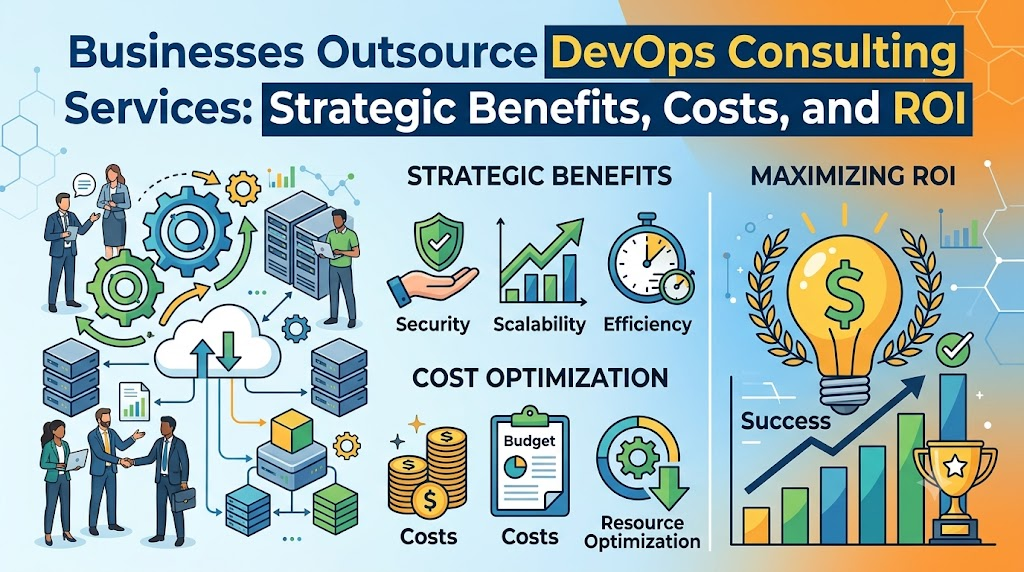
Modern software engineering moves at a relentless pace. As organizations transition to cloud platforms, microservices architectures, and distributed systems, the complexity of deploying, securing, and maintaining infrastructure grows exponentially. While adopting modern delivery practices is a strategic priority for most technology organizations, executing that transition internally presents severe hurdles: engineering talent shortages, runaway cloud expenditures, configuration sprawl, and brittle delivery pipelines.
To navigate these hurdles, organizations frequently turn to external specialists. Outsourced DevOps consulting has transitioned from a temporary stopgap to an established strategic model. By engaging specialized partners, companies accelerate modernisation initiatives, establish production-grade continuous integration and continuous delivery (CI/CD) pipelines, and reinforce infrastructure resilience without the overhead of expanding internal headcount prematurely.
Evaluating whether to build internal capacity or engage external consulting requires understanding what DevOps consulting encompasses, the tangible business drivers behind outsourcing, the associated operational trade-offs, and how to govern an external engagement effectively.
What DevOps Consulting Services Involve
DevOps consulting services encompass technical guidance, architecture design, and hands-on implementation to align software development with infrastructure operations. The primary objective is to make software delivery faster, safer, and more reliable through automation and structured operational workflows.
┌────────────────────────────────────────────────────────┐
│               DevOps Consulting Services               │
└───────────────────────────────────┬────────────────────┘
                                    │
    ┌───────────────────────────────┼───────────────────────────────┐
    ▼                               ▼                               ▼
┌────────────────────────┐  ┌────────────────────────┐  ┌────────────────────────┐
│   Strategic Advisory   │  │ Hands-On Engineering   │  │   Managed Operations   │
├────────────────────────┤  ├────────────────────────┤  ├────────────────────────┤
│ • Pipeline Audits      │  │ • IaC Implementation   │  │ • Observability & 24/7 │
│ • Cloud Architecture   │  │ • CI/CD Automation     │  │ • Incident Management  │
│ • Toolchain Selection  │  │ • Container Platforms  │  │ • Ongoing Optimization │
│ • DevSecOps Governance │  │ • Team Enablement      │  │ • Platform Maintenance │
└────────────────────────┘  └────────────────────────┘  └────────────────────────┘
The scope of an engagement varies widely depending on organizational maturity and business constraints, typically falling into three delivery models:
- Advisory and Strategy: Assessing current delivery pipelines, identifying operational bottlenecks, establishing governance frameworks, and recommending optimal cloud architectures and tooling.
- Targeted Project Implementation: Executing specific, bounded engineering deliverables, such as migrating workloads to containers, building an automated release pipeline, or codifying legacy infrastructure.
- Managed DevOps Services: Providing ongoing operational management, including system observability, cluster administration, routine patching, platform reliability maintenance, and incident remediation.
Across these delivery models, core technical domains addressed by external consulting teams include:
- CI/CD Pipeline Design and Automation: Constructing automated workflows that validate code, run test suites, build artifacts, and deploy applications across environments with minimal manual touchpoints.
- Infrastructure as Code (IaC) and Configuration Management: Managing compute, storage, and networking using declarative code (such as Terraform or OpenTofu) paired with configuration management tools (such as Ansible), ensuring predictable, repeatable environment builds.
- Cloud Architecture and Optimization: Designing scalable, resilient cloud topologies across providers such as AWS, Microsoft Azure, or Google Cloud, while auditing utilization to eliminate idle resources.
- Containerization and Orchestration: Packaging applications into standardized containers and deploying them via container orchestration platforms like Kubernetes to streamline deployment consistency and resource efficiency.
- DevSecOps and Compliance Automation: Embedding vulnerability scanning, static application security testing, policy-as-code controls, and centralized secrets management directly into the delivery pipeline.
- Observability, Telemetry, and Reliability: Configuring centralized log aggregation, distributed tracing, metrics collection, and alerting systems to give teams actionable visibility into production environments.
- Team Enablement and Upskilling: Upskilling internal software engineering teams through technical documentation, operational runbooks, and structured technical training programs—such as those delivered by specialized education platforms like DevOpsSchool—to ensure internal staff can confidently maintain modern platforms.
Key Reasons Businesses Outsource DevOps Consulting
Deciding to engage an external consulting team involves weighing technical capability, commercial urgency, and financial prudence.
1. Access to Specialized Technical Expertise
DevOps engineering spans a sprawling ecosystem: cloud providers, container orchestration platforms, deployment frameworks, telemetry collectors, and infrastructure-as-code languages. Recruiting internal full-time engineers with deep experience across all these disciplines is difficult and cost-prohibitive.
Consulting practices work across diverse technical environments, cloud providers, and architectural patterns. As a result, they bring cross-functional pattern recognition to complex problems, understanding which architectures scale efficiently, which tools integrate smoothly, and which pitfalls cause production degradation.
2. Accelerated Implementation Timelines
Building a deployment pipeline or migrating an infrastructure stack from scratch via an internal team unfamiliar with modern tooling frequently leads to trial-and-error delays. Experienced consultants assess existing workflows, identify operational bottlenecks, and apply battle-tested infrastructure patterns. While external support does not eliminate architectural complexity overnight, it avoids predictable design flaws and accelerates delivery compared to learning through production failure.
3. Relief from Recruitment and Onboarding Pressures
Hiring senior infrastructure and cloud engineers involves long recruitment lead times, high compensation packages, and significant onboarding ramp-up. For organizations needing immediate operational improvements—such as an upcoming software release or an urgent infrastructure migration—waiting months to assemble a permanent team delays strategic business goals. Consulting engagements provide immediate technical capacity while human resources teams focus on long-term, deliberate hiring.
4. Consistent CI/CD Automation
Manual release processes create friction: undocumented server configurations, mismatched libraries between staging and production, and high-stress release cycles. Consulting partners help institutionalize repeatable build and release workflows. By automating validation checks and deployments, organizations reduce human error, configuration drift, and emergency production rollbacks.
5. Cloud Cost Management and Resource Optimization
Cloud waste often stems from over-provisioned instances, unattached persistent storage volumes, unmonitored staging environments, and poor auto-scaling logic. DevOps consultants conduct systematic cloud infrastructure audits, identifying unutilized resources and aligning provisioning models with real-world application loads. This provides organizations with cost visibility without requiring custom tooling builds.
6. DevSecOps Integration and Access Governance
Historically, security audits occurred late in the software lifecycle, creating friction between engineering and security teams. DevOps consultants assist organizations in “shifting security left” by integrating automated vulnerability assessments, secrets management (such as HashiCorp Vault), and role-based access controls directly into delivery pipelines.
Important Governance Note: While external consultants implement technical security controls, ultimate legal responsibility for data protection, regulatory compliance, and system governance always remains with the business itself.
7. Scalability and Operational Flexibility
Technical infrastructure demands fluctuate. Platform migrations, microservices refactoring, and data center transitions require intensive, short-term engineering capacity. Once established, maintaining those platforms demands substantially fewer resources. Outsourcing allows businesses to scale engineering involvement up during complex transformations and scale it back once operations stabilize.
8. Engineering Focus on Core Business Logic
When software developers spend significant hours debugging deployment scripts, resolving server configuration issues, and managing cloud environments manually, core product feature delivery slows down. Offloading platform engineering and tooling maintenance to an experienced consulting partner frees internal developers to concentrate on shipping customer-facing features and business logic.
In-House DevOps vs. Outsourced DevOps Consulting
Choosing between maintaining an entirely in-house team, partnering with a consulting company, or creating a hybrid structure requires a clear evaluation of operational capabilities and trade-offs.
| Evaluation Criteria | Internal In-House Team | Outsourced DevOps Consulting | Hybrid Model |
| Specialized Skill Breadth | Narrower; limited to current staff skillsets and experience. | Broad; spans diverse tools, clouds, and architectures. | High; external specialists augment internal staff capabilities. |
| Recruitment & Setup Speed | Slow; requires sourcing, interviewing, and ramp-up. | Rapid; specialized teams can be deployed based on clear scope. | Balanced; strategic hires paired with immediate external capacity. |
| Domain & Product Context | Deep; complete understanding of business context and history. | Initial learning curve; focused strictly on platform architecture. | Optimal; internal teams provide business context while consultants build. |
| Long-Term Cost Profile | Fixed recurring expenses (salaries, taxes, benefits, equipment). | Variable operational expenditure; scoped per project or retainer. | Predictable baseline cost with scalable project allocations. |
| System Control & Governance | Direct; full internal control over all environments and code. | Requires defined access policies and contract controls. | Strong; internal team owns root access and policy boundaries. |
| Knowledge Retention | Stays within organization, though vulnerable to turnover. | Risk of loss without strict documentation and pairing requirements. | High; pairing models institutionalize knowledge internally. |
| Primary Suitability | Stable, mature enterprises with continuous infrastructure needs. | Startups, fast-growing scale-ups, and modernization projects. | Complex, evolving businesses modernizing critical systems. |
A hybrid model is frequently the most pragmatic path. Internal engineering leads retain technical ownership, system access, and architectural governance, while external consultants provide the specialized capacity required to build modern pipelines, migrate workloads, or overhaul underlying infrastructure.
Costs, Value, and Return on Investment
Evaluating an outsourced DevOps engagement requires a comprehensive assessment of direct costs, indirect overhead, and efficiency gains.
Total Investment = Direct Consulting Fees + Tooling/Cloud Footprint + Internal Coordination
Value Derived    = Engineering Hours Recovered + Outage Reduction + Accelerated Delivery
Direct and Indirect Cost Factors
- Consulting Fees: Project-based milestones, time-and-materials arrangements, or monthly retainers for managed operational support.
- Tooling and Infrastructure Footprint: Third-party licensing costs for SaaS platforms, CI servers, security scanning tools, and cloud provider resources.
- Internal Coordination Overhead: Time spent by internal staff defining requirements, conducting architecture reviews, pairing with consultants, and managing credentials.
- Knowledge Transfer and Enablement: Investment in technical documentation reviews, operational dry-runs, and formal staff training.
- Eventual Transition or Exit Costs: Resources required to transition system administration entirely back to in-house teams.
Evaluating Business Value and ROI
DevOps investments should be evaluated on overall engineering velocity and operational resilience rather than arbitrary upfront cost cuts. Value emerges across several operational dimensions:
- Engineering Capacity Recovered: When automated CI/CD pipelines replace manual build-and-deploy procedures, software developers reclaim hours previously lost to release firefighting.
- Reduction in Change Failure Rates: Structured automated testing and staging environments prevent misconfigured updates from hitting production, reducing revenue impact from customer-facing downtime.
- Cloud Infrastructure Hygiene: Right-sizing over-provisioned instances, identifying idle volumes, and modernizing autoscaling rules can yield noticeable reductions in monthly cloud spend.
Illustrative Return on Investment Scenario
Note: The following scenario is a hypothetical operational model provided solely to illustrate value assessment and does not represent guaranteed metrics.
Consider a software organization with 20 developers spending an average of 4 hours weekly per person managing broken deployment scripts, manual deployments, and environment inconsistencies. That represents 80 engineering hours lost each week.
If an external DevOps consulting partner implements automated testing pipelines, Infrastructure as Code, and standardized container environments that reduce deployment overhead to 1 hour per developer weekly, the business reclaims 60 developer hours each week. Over a full year, that equates to roughly 3,000 engineering hours redirected toward product development, offsetting consulting fees through accelerated product delivery and fewer operational incidents.
Risks, Challenges, and How to Manage Them
Outsourcing technical infrastructure operations introduces specific operational risks that require active governance.
┌───────────────────────────────────────┐      Mitigation Framework
│      Outsourcing Risk Factor          │      ────────────────────
├───────────────────────────────────────┼───►  Strict Runbook Reviews & Pair Programming
│ 1. Institutional Knowledge Loss       │
├───────────────────────────────────────┼───►  Zero-Trust Architecture & Bastion Auditing
│ 2. Security & Access Vulnerabilities  │
├───────────────────────────────────────┼───►  Open-Source Standards (IaC / Kubernetes)
│ 3. Vendor Lock-In & Proprietary Tools │
├───────────────────────────────────────┼───►  Milestone SOWs & Defined Acceptance Criteria
│ 4. Scope Creep & Budget Misalignment  │
└───────────────────────────────────────┘
1. Loss of Internal Knowledge
The Risk: If external consultants build complex, undocumented pipelines and subsequently exit, internal engineers will struggle to maintain the platform, creating dangerous dependencies.
The Mitigation: Mandate that comprehensive architectural documentation, runbooks, and active pair-programming sessions with internal engineers are mandatory deliverables within the contract. Never treat documentation as an afterthought at project close.
2. Security Exposure and Over-Privileged Access
The Risk: Granting external contractors unrestricted administrative privileges across production systems risks accidental data deletion, compliance breaches, or credential leaks.
The Mitigation: Enforce the principle of least privilege (PoLP). Provide scoped, temporary role-based access via identity providers, mandate multi-factor authentication (MFA), isolate production environments, and log all administrative actions via centralized audit trails.
3. Vendor Lock-In and Bespoke Tooling
The Risk: Consultants may use niche, proprietary frameworks or overly customized tooling that few other engineers understand, locking the company into their ongoing services.
The Mitigation: Require the use of industry-standard, cloud-agnostic tools and open-source ecosystems (such as standard Kubernetes manifests, OpenTofu/Terraform, and established CI runners) with standard configuration patterns.
4. Scope Creep and Misaligned Expectations
The Risk: Abstract goals like “make our systems faster” lead to unbounded engagements, budget overruns, and frustration.
The Mitigation: Scope work around clearly defined statements of work (SOWs) with measurable milestones—such as automating a specific deployment pipeline, containerizing a legacy service, or implementing centralized telemetry.
How to Select a DevOps Consulting Partner
Selecting the wrong consulting partner can introduce fragile architectures and technical debt. Use these criteria during technical evaluation:
Key Selection Criteria
- Proven Experience with Your Infrastructure Stack: Ensure the partner has verifiable, hands-on experience with your specific cloud provider, application architecture, and operational scale.
- Pragmatic, Clear Communication: A quality partner translates technical nuances into clear business outcomes without relying on buzzwords or obscure jargon.
- Security-First Mindset: The partner must demonstrate an operational security posture, including how they handle secrets management, environment isolation, and access governance.
- Commitment to Enablement and Documentation: Look for partners that view their job as equipping your team to be self-sufficient rather than making themselves indispensable.
- Transparent Delivery Plans and Clear Metrics: Proposals should outline an initial audit phase, practical milestones, delivery verification, and explicit handover procedures.
Questions to Ask Prospective Partners
- How do you conduct an initial infrastructure audit before recommending architectural changes?
- Can you explain how you document platforms and train internal engineering teams to maintain them after handoff?
- What security policies do your consultants follow when accessing client development and production environments?
- How do you prevent vendor lock-in within the infrastructure-as-code and CI/CD pipelines you design?
- What measurable criteria do you use to evaluate whether an implementation milestone is production-ready?
Practical Business Scenario: Streamlining a Modern Delivery Pipeline
To understand how an engagement operates, consider a hypothetical, realistic scenario of an e-commerce platform struggling with delivery bottlenecks.
The Challenge
A growing mid-market software company runs a monolithic web application alongside several newer microservices. Over two years, feature releases slowed from weekly deployments to stressful, bi-monthly updates. Deployments required engineers to manually SSH into virtual machines, copy artifacts, update configuration files, and restart services after business hours.
Frequent configuration drift between staging and production led to recurring post-release incidents, long rollback times, and burned-out developers. The company lacked the in-house bandwidth to design a modern delivery platform while keeping pace with feature roadmaps.
The Consulting Engagement
The leadership team engaged a specialized DevOps consulting firm for a 12-week infrastructure modernization initiative. The collaboration followed a structured, phased methodology:
Week 1-2: Assessment & Baseline Auditing
  │
  ▼
Week 3-5: Foundation (IaC & Standardized Containers)
  │
  ▼
Week 6-8: Delivery Pipeline & Security Automation
  │
  ▼
Week 9-10: Observability, Logging & Alerting
  │
  ▼
Week 11-12: Runbooks, Knowledge Transfer & Handoff
- Assessment and Baseline (Weeks 1–2): Consultants audited the existing deployment workflow, mapped dependencies, identified failure points, and established baseline metrics for build times and deployment error frequency.
- Environment Codification (Weeks 3–5): The team codified infrastructure using Terraform, standardizing compute instances, database access, and network routing. Applications were packaged into Docker containers, eliminating environment discrepancies between local development and staging environments.
- CI/CD Pipeline Automation (Weeks 6–8): The consultants constructed a modular pipeline that automatically runs unit test suites, executes security vulnerability scans on container images, builds signed production artifacts, and deploys them to a container orchestration cluster via rolling updates.
- Observability and Health Telemetry (Weeks 9–10): Centralized log management and metrics dashboards were established. Automated health checks were configured to trigger safe rollbacks if a newly deployed container failed readiness checks.
- Enablement and Handoff (Weeks 11–12): The consultants conducted hands-on pairing sessions with the company’s internal engineers, delivered clear operational runbooks, and monitored three consecutive production releases led entirely by the internal team.
The Outcome
Through this engagement, the company shifted from manual, stressful weekend releases to fully automated deployments during business hours. Development teams gained the ability to validate and deploy updates predictably, staging environments matched production parity, and engineering leadership retained complete operational control over a modern, fully documented platform.
Measuring the Success of DevOps Consulting
To ensure an engagement delivers tangible business value, track objective metrics before, during, and after implementation. Baseline these indicators prior to making architectural changes:
- Deployment Frequency: How often the organization can deploy stable code to staging and production environments.
- Lead Time for Changes: The elapsed time required for a committed line of code to successfully pass through testing and deploy into production.
- Change Failure Rate: The percentage of production deployments that result in degraded performance, emergency hotfixes, or service rollbacks.
- Mean Time to Recovery (MTTR): The time required to restore service when a production outage or critical failure occurs.
- Infrastructure Provisioning Time: The duration required to stand up a clean, fully configured testing or staging environment using automated code.
- Cloud Spend Efficiency: The ratio of compute, storage, and networking utilization relative to overall cloud infrastructure costs.
- Knowledge Transfer Completion: Verification that internal teams have completed hands-on operational runbook walkthroughs and can independently manage the deployed pipelines.
Operational Insight: Metrics must be analyzed collectively rather than in isolation. Accelerating deployment frequency is detrimental if it spikes the change failure rate or compromises security checks. Sustainable speed is an outcome of system stability and test automation.
Frequently Asked Questions
Why do companies outsource DevOps consulting instead of hiring internally?
Organizations outsource DevOps consulting to access specialized cloud and automation expertise quickly without navigating protracted hiring cycles. It allows businesses to execute complex migrations, set up modern CI/CD pipelines, and resolve operational bottlenecks while keeping internal teams focused on core application development.
What services do DevOps consultants typically provide?
DevOps consultants help organizations automate software delivery pipelines, implement Infrastructure as Code, migrate workloads to containers or Kubernetes, configure cloud environments, integrate DevSecOps vulnerability checks, establish observability and monitoring stacks, and upskill internal development teams.
Is outsourced DevOps consulting cheaper than building an in-house team?
Not necessarily in absolute terms, but it offers a different cost structure. While consulting hourly rates can be higher than full-time base wages, consulting engagements represent flexible operational expenses focused on specific project outcomes. This eliminates ongoing recruitment costs, overhead, benefits, and long-term payroll obligations for skills only needed temporarily.
When should a business hire a DevOps consultant?
A company should consider hiring a DevOps consultant when deployments are manual or error-prone, cloud expenditures are growing without clear visibility, the team is undertaking a cloud or container migration, release cycles are delaying business goals, or internal engineers lack the bandwidth to modernize infrastructure tooling.
What risks should businesses evaluate before outsourcing?
Key risks include losing institutional knowledge if platforms are poorly documented, security vulnerabilities from improperly managed administrative access, scope creep leading to budget overruns, and reliance on complex, proprietary tools. These risks can be managed through clear contracts, least-privilege access, open standards, and mandatory knowledge-transfer milestones.
How can leadership measure the ROI of a DevOps consulting engagement?
Success can be evaluated by tracking core delivery metrics: increased deployment frequency, shortened lead time for code changes, reduced change failure rates, faster recovery times during incidents, more predictable cloud resource costs, and the internal engineering team’s ability to operate the infrastructure independently.
Conclusion
Outsourcing DevOps consulting is not a concession of internal technical control, but an agile operational accelerator that enables organizations to bypass costly recruitment cycles and modernise infrastructure with battle-tested industry practices. By partnering with external specialists for foundational architecture, CI/CD automation, and cloud cost governance while anchoring ownership and ongoing knowledge transfer internally, businesses free their product engineers to focus on core software delivery without sacrificing deployment reliability, security compliance, or long-term system scalability.

Best Cardiac Hospitals Near You
Discover top heart hospitals, cardiology centers & cardiac care services by city.
Advanced Heart Care • Trusted Hospitals • Expert Teams
View Best Hospitals