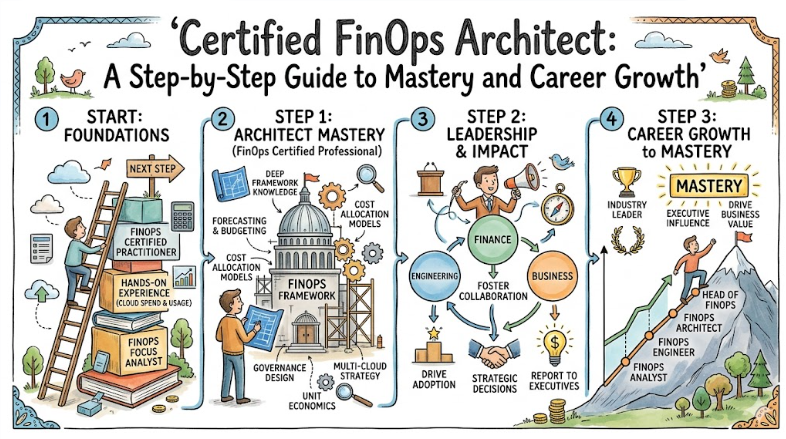
Introduction
The Certified FinOps Architect designation represents the highest tier of technical leadership in the intersection of finance and cloud engineering. As organizations scale their cloud footprint, the need for architects who can design for both performance and profitability has become a critical requirement. This guide is designed for professionals navigating the complex landscape of DevOps, platform engineering, and cloud-native systems who want to master the art of cloud financial management. By following this roadmap, you will understand how to bridge the gap between engineering velocity and fiscal accountability.
In the modern enterprise, cloud spending is often the second or third largest expense, yet it is frequently managed with outdated procurement mindsets. The Certified FinOps Architect curriculum provides the technical depth and strategic framework required to implement real-time cost visibility and automated optimization. This guide, supported by finopsschool, serves as a career blueprint to help you transition from a traditional cloud engineer to a strategic leader capable of driving business value through architectural efficiency.
What is the Certified FinOps Architect?
The Certified FinOps Architect is a professional credential that validates an individual’s ability to design, implement, and lead a FinOps practice within a large-scale organization. It focuses on the architectural decisions that impact cloud costs, moving beyond simple cost-reporting to proactive cost-avoidance and value-based engineering. The program emphasizes that cloud financial management is a distributed responsibility that must be integrated into the continuous integration and delivery pipelines of modern software development.
Unlike theoretical business courses, this certification is rooted in production-focused engineering workflows. It represents a mastery of the FinOps Framework—Inform, Optimize, and Operate—applied specifically to complex multi-cloud and hybrid environments. For an architect, this means understanding how microservices design, storage tiering, and compute scaling policies directly translate into the organization’s profit and loss statement.
Who Should Pursue Certified FinOps Architect?
This certification is primarily targeted at senior technical professionals who hold responsibility for cloud infrastructure and platform strategy. Systems architects, lead DevOps engineers, and Site Reliability Engineers (SREs) will find the curriculum particularly relevant as it provides the metrics needed to justify infrastructure investments. It is also highly beneficial for Engineering Managers and Technical Leads who must balance the competing demands of feature delivery speed and strict budgetary constraints.
In the Indian market, where global delivery centers manage massive cloud estates, the demand for Certified FinOps Architects is exceptionally high. Professionals working in data-heavy industries like Fintech, E-commerce, and SaaS will find this credential essential for career progression into Director or Principal roles. Whether you are a seasoned engineer looking to add financial literacy to your toolkit or a manager seeking to optimize large-scale cloud waste, this certification provides the necessary technical and strategic bridge.
Why Certified FinOps Architect is Valuable in the Modern Era and Beyond
The value of the Certified FinOps Architect lies in its focus on longevity and tool-agnostic strategy. While cloud provider tools like AWS Cost Explorer or Azure Advisor change frequently, the underlying architectural principles of cost-efficient design remain constant. As enterprises move away from “growth at all costs” to “sustainable profitability,” engineers who can demonstrate a direct return on investment (ROI) for their infrastructure decisions will remain the most sought-after talent in the market.
Furthermore, the rise of resource-intensive technologies like AI and large-scale data processing has made cloud billing more unpredictable than ever. An architect who can implement automated guardrails and unit economics will prevent the “sticker shock” that often halts innovation. By achieving this certification, you prove that you can protect the organization’s margins while maintaining the high availability and performance required for enterprise-grade applications.
Certified FinOps Architect Certification Overview
The Certified FinOps Architect program is delivered via the official training portal and hosted on the FinOps School platform. The certification approach is uniquely practical, moving away from simple multiple-choice questions toward scenario-based assessments that mirror real-world cloud sprawl challenges. It is designed to evaluate not just what a candidate knows, but how they apply FinOps principles to solve complex architectural inefficiencies in a production environment.
The program is structured to cover the entire lifecycle of a cloud project, from initial design and tagging strategies to decommission and lifecycle management. It is owned and maintained by industry practitioners who ensure the content evolves alongside the major cloud providers. Candidates are expected to demonstrate proficiency in data analysis, stakeholder management, and the technical implementation of cost-optimization automation tools.
Certified FinOps Architect Certification Tracks & Levels
The certification journey is structured into three distinct tiers to accommodate professionals at different stages of their cloud financial management journey. The Foundation level introduces the core terminology and the three phases of FinOps, making it ideal for those new to the domain. The Professional level dives deeper into tool selection, policy creation, and team collaboration, focusing on the tactical execution of cost-saving measures across multiple engineering squads.
The Advanced or Architect level is the pinnacle of the track, focusing on organizational-wide strategy and complex technical architecture. This level aligns with career progression toward Chief Architect or FinOps Lead roles. By following this tiered approach, professionals can progressively build their skills, ensuring they have a solid grasp of basic unit economics before moving on to advanced automation and cultural transformation initiatives within the enterprise.
Complete Certified FinOps Architect Certification Table
| Track | Level | Who it’s for | Prerequisites | Skills Covered | Recommended Order |
| Core FinOps | Foundation | Junior Engineers, Finance, Procurement | Basic Cloud Knowledge | Terminology, Lifecycle, Basic Reporting | 1 |
| Engineering | Professional | DevOps, SRE, Cloud Engineers | Foundation Cert, 2+ Yrs Experience | Automation, Rightsizing, Tagging Policy | 2 |
| Strategy | Architect | Principal Engineers, Architects | Professional Cert, 5+ Yrs Experience | Unit Economics, Multi-cloud Governance | 3 |
| Leadership | Executive | Directors, CTOs, CFOs | Professional Cert | Cultural Change, Business Value Mapping | 4 |
Detailed Guide for Each Certified FinOps Architect Certification
Certified FinOps Architect – Foundation
What it is
This certification validates a foundational understanding of FinOps principles and the common language used between finance and engineering teams. It ensures that all stakeholders have a shared mental model of how cloud consumption works.
Who should take it
It is suitable for entry-level cloud engineers, procurement specialists, and finance professionals who need to understand cloud billing. It is also an excellent starting point for project managers overseeing cloud-based initiatives.
Skills you’ll gain
- Understanding the difference between Capex and Opex in the cloud.
- Mastering the FinOps lifecycle phases: Inform, Optimize, and Operate.
- Identifying common cloud waste areas like unattached volumes and idle instances.
Real-world projects you should be able to do
- Create a basic cloud cost dashboard for a small engineering team.
- Implement a standardized tagging schema across a single cloud account.
- Conduct a basic monthly billing review and identify top spending services.
Preparation plan
- 7 Days: Focus on the official glossary and the core phases of the FinOps framework.
- 30 Days: Review whitepapers on cloud billing and practice building dashboards in a sandbox environment.
- 60 Days: Deep dive into the specific cost management tools of AWS, Azure, and Google Cloud.
Common mistakes
- Focusing too much on technical optimization and ignoring the cultural/financial terminology.
- Thinking FinOps is only about “spending less” rather than “earning more” through efficiency.
Best next certification after this
- Same-track option: Certified FinOps Professional.
- Cross-track option: AWS Certified Cloud Practitioner.
- Leadership option: ITIL Foundation.
Certified FinOps Architect – Professional
What it is
The Professional level validates the ability to execute FinOps tactics and manage the “Optimize” phase at scale. It focuses on the technical mechanics of rightsizing, reserved capacity, and spot instance integration.
Who should take it
This is designed for DevOps Engineers and SREs who are responsible for the day-to-day operation of cloud environments. It is for those who are tasked with hitting specific cost-saving targets.
Skills you’ll gain
- Advanced rightsizing strategies for compute, memory, and IOPS.
- Managing commitment-based discounts like Reserved Instances and Savings Plans.
- Automating the shutdown of non-production resources during off-hours.
Real-world projects you should be able to do
- Design and implement an automated cleanup script for orphaned cloud resources.
- Negotiate and manage a portfolio of commitment-based discounts for a large department.
- Integrate cost-visibility tools directly into the developer workflow or IDE.
Preparation plan
- 7 Days: Master the logic of Reserved Instances versus Savings Plans across different providers.
- 30 Days: Hands-on practice with automation tools like Terraform or CloudFormation for cost guardrails.
- 60 Days: Study organizational change management to learn how to influence engineering teams to adopt FinOps.
Common mistakes
- Aggressive rightsizing that leads to performance bottlenecks or system outages.
- Failing to account for the “effort vs. reward” ratio when pursuing small cost savings.
Best next certification after this
- Same-track option: Certified FinOps Architect.
- Cross-track option: Certified Kubernetes Administrator (CKA).
- Leadership option: Project Management Professional (PMP).
Certified FinOps Architect – Architect (Advanced)
What it is
The Architect level is the master-tier certification that focuses on the “Operate” phase and long-term strategy. It validates the ability to build a FinOps Center of Excellence (CCoE) and drive unit economics.
Who should take it
Principal Engineers, Enterprise Architects, and aspiring Head of Infrastructure roles. This is for individuals who define the technical standards for the entire organization.
Skills you’ll gain
- Defining Unit Economics (e.g., cost per transaction, cost per user).
- Designing multi-cloud and hybrid-cloud governance frameworks.
- Building automated policy-as-code to prevent cost sprawl before it happens.
Real-world projects you should be able to do
- Lead the creation of a cross-functional FinOps Center of Excellence.
- Architect a serverless transition strategy that demonstrably reduces total cost of ownership.
- Develop a custom “Cloud Efficiency Scorecard” for executive leadership reporting.
Preparation plan
- 14 Days: Deep dive into advanced data analysis and SQL for complex billing export processing.
- 30 Days: Review case studies on large-scale enterprise cloud migrations and their financial outcomes.
- 60 Days: Focus on the strategic integration of FinOps into the broader Enterprise Architecture framework.
Common mistakes
- Staying too “high-level” and losing touch with the technical realities of modern containerized workloads.
- Over-complicating unit economics models to the point where they are not actionable for developers.
Best next certification after this
- Same-track option: Specialized FinOps for SaaS.
- Cross-track option: Google Professional Cloud Architect.
- Leadership option: MBA or Executive Leadership Program.
Choose Your Learning Path
DevOps Path
The DevOps path focuses on integrating cost-visibility into the CI/CD pipeline. Professionals here learn to treat “Cost” as a first-class requirement, similar to “Security” or “Performance.” This involves implementing automated checks that alert developers if a pull request is likely to increase cloud consumption significantly. By mastering these skills, DevOps engineers ensure that infrastructure-as-code deployments are optimized from the moment they are written.
DevSecOps Path
In this path, the focus is on the intersection of cost and security compliance. Many security tools and logging practices can become significant cost drivers if not managed correctly. DevSecOps professionals learn to architect logging and monitoring solutions that satisfy security requirements without inflating the cloud bill. This path is essential for ensuring that “Secure” does not mean “Unnecessarily Expensive” in a highly regulated cloud environment.
SRE Path
The SRE path emphasizes the balance between reliability and efficiency. SREs learn to use FinOps data to inform their error budgets and scaling policies. By understanding the cost of a “nines” of availability, SREs can make data-driven decisions about when to add redundancy. This path helps Site Reliability Engineers justify the costs of high-availability architectures by mapping them to business uptime requirements and revenue protection.
AIOps Path
AIOps professionals use machine learning and artificial intelligence to predict and manage cloud costs. This path involves building models that can identify anomalies in spending patterns faster than human analysts. In an AIOps workflow, the Certified FinOps Architect principles are applied to create self-healing infrastructure that automatically adjusts its footprint based on predicted demand. It represents the cutting edge of automated cloud financial management.
MLOps Path
The MLOps path is specifically designed for the high-cost world of machine learning model training and deployment. ML models require expensive GPU resources and massive storage, which can easily spiral out of control. Professionals on this path learn to optimize data pipelines and model inference architectures for cost. It involves understanding the trade-offs between different hardware accelerators and implementing strict lifecycle management for massive datasets.
DataOps Path
DataOps focuses on the financial management of data warehouses, data lakes, and ETL processes. Large-scale data processing is often one of the largest line items in a cloud bill. This path teaches professionals how to optimize query performance to reduce compute costs and how to implement tiered storage strategies. DataOps specialists ensure that the organization’s data strategy remains sustainable as the volume of information grows exponentially.
FinOps Path
The pure FinOps path is for those dedicated to the FinOps practitioner role. This path focuses on the cultural shift required to align finance, engineering, and business teams. It involves a heavy emphasis on communication, reporting, and building the organizational structures necessary for a successful FinOps practice. This is the ideal path for those who want to lead the FinOps movement within their company and drive a culture of accountability.
Role → Recommended Certified FinOps Architect Certifications
| Role | Recommended Certifications |
| DevOps Engineer | Foundation, Professional |
| SRE | Professional, Architect |
| Platform Engineer | Professional, Architect |
| Cloud Engineer | Foundation, Professional |
| Security Engineer | Foundation, Professional |
| Data Engineer | Professional (Data Focus) |
| FinOps Practitioner | Foundation, Professional, Architect |
| Engineering Manager | Foundation, Architect |
Next Certifications to Take After Certified FinOps Architect
Same Track Progression
Once you have mastered the Architect level, the next step is deep specialization. This might include certifications focused on specific technologies like “FinOps for Kubernetes” or “FinOps for Serverless.” These specialized credentials prove that you can apply broad financial principles to the most complex and rapidly evolving areas of cloud technology. Deep specialization ensures you remain an expert as the market shifts toward specialized compute and storage models.
Cross-Track Expansion
Broadening your skills into other “Ops” domains is a highly effective way to increase your value. Combining a FinOps Architect certification with a professional-level Cloud Architect or Security certification creates a powerful profile. For example, a professional who is both a Certified FinOps Architect and a Certified Kubernetes Administrator is uniquely qualified to manage the complexities of container-based cloud economics, which is a major pain point for many modern enterprises.
Leadership & Management Track
For those looking to move into executive roles, transitioning to leadership-focused certifications is recommended. This could include a PMP for project management or even an executive education program focused on digital transformation. A FinOps Architect has already demonstrated an understanding of the business side of engineering, making them natural candidates for CTO or VP of Infrastructure roles where they must manage multi-million dollar budgets and large engineering organizations.
Training & Certification Support Providers for Certified FinOps Architect
DevOpsSchool
DevOpsSchool provides a comprehensive training ecosystem for professionals looking to master the Certified FinOps Architect curriculum. They offer instructor-led sessions that focus on the practical application of FinOps principles across major cloud providers like AWS, Azure, and Google Cloud. Their training modules are designed to be hands-on, ensuring that students do not just learn the theory but also gain experience with the actual tools used in the industry. With a strong presence in India, they offer flexible scheduling for working professionals and provide extensive study materials, including mock exams and project work that mimics real-world architectural challenges found in large enterprises.
Cotocus
Cotocus is a specialized training provider that focuses on high-end technical certifications for the cloud-native era. Their approach to the Certified FinOps Architect program is centered on the integration of cost-management into modern DevOps workflows. They provide deep-dive workshops on infrastructure-as-code and how to build cost-optimization into automated deployment pipelines. Cotocus is known for its expert trainers who have years of experience managing large-scale cloud estates. Their curriculum is frequently updated to reflect the latest changes in cloud pricing models and best practices, making them a reliable choice for senior engineers looking to advance their technical leadership skills.
Scmgalaxy
Scmgalaxy is a community-driven platform that has evolved into a powerhouse for technical education and certification support. For the Certified FinOps Architect, they provide a wealth of free and premium resources, including detailed guides, video tutorials, and interactive forums. Their strength lies in the collective knowledge of their community members who share real-world scenarios and solutions for cloud cost optimization. Scmgalaxy’s training programs are highly practical, focusing on the specific scripting and automation skills required to manage cloud waste. They are particularly popular among professionals in India who value a community-based approach to learning and long-term career support.
BestDevOps
BestDevOps offers a streamlined and highly effective training path for professionals seeking the Certified FinOps Architect designation. Their courses are structured to maximize learning efficiency, focusing on the most critical skills required to pass the certification and excel in the role. They provide extensive lab environments where students can practice rightsizing and commitment management in a risk-free setting. BestDevOps is committed to helping engineers bridge the gap between technical operations and financial strategy. Their alumni network provides a valuable resource for job placement and peer support, making it an excellent option for those looking to quickly pivot their careers into FinOps.
devsecopsschool.com
devsecopsschool.com provides specialized training that highlights the crucial intersection of security, development, and cloud economics. Their version of the Certified FinOps Architect training ensures that cost-optimization strategies never compromise the security posture of an organization. They teach students how to architect secure, compliant, and cost-effective cloud systems. This is particularly valuable for professionals working in regulated industries like banking or healthcare. Their curriculum includes modules on secure logging, identity management costs, and automated compliance checking. By focusing on the triple constraint of speed, security, and cost, they prepare architects for the most demanding roles in the modern tech landscape.
sreschool.com
sreschool.com focuses on the reliability and performance aspects of the Certified FinOps Architect role. Their training program is built around the idea that a truly reliable system must also be economically sustainable. They teach Site Reliability Engineers how to incorporate cost data into their service level objectives (SLOs) and error budgets. The curriculum includes advanced topics like the cost of redundancy, traffic management economics, and automated scaling for cost-efficiency. sreschool.com provides a unique perspective that is highly valued by organizations running mission-critical applications at scale. Their graduates are known for their ability to design systems that are both highly available and highly profitable.
aiopsschool.com
aiopsschool.com is at the forefront of using artificial intelligence to manage cloud environments. Their training for the Certified FinOps Architect focuses on the application of machine learning to cost prediction and anomaly detection. They teach professionals how to build and deploy AIOps tools that can automatically optimize cloud spend without human intervention. This advanced track is perfect for architects who want to lead the next wave of infrastructure management. The curriculum covers data science basics, model training for cost analysis, and the integration of AI tools into traditional FinOps frameworks. It is a future-focused provider for the most ambitious technical leaders.
dataopsschool.com
dataopsschool.com specializes in the unique financial challenges of big data and analytics. Their training for the Certified FinOps Architect program dives deep into the costs associated with data storage, processing, and egress. They teach Data Engineers and Architects how to build efficient data pipelines and optimize warehouse performance to minimize billing. Given that data-related costs are often the most difficult to predict, this specialized training is highly sought after. Students learn how to use data-specific cost management tools and implement tiered storage architectures that can save organizations millions of dollars. They provide a critical skill set for any data-driven enterprise.
finopsschool.com
finopsschool.com is the primary host and delivery platform for the Certified FinOps Architect program. As the specialized authority on this topic, they provide the most direct and comprehensive path to certification. Their platform offers a complete suite of resources, from foundational courses to advanced architectural masterclasses. They are responsible for maintaining the certification standards and ensuring the curriculum stays aligned with the needs of the global FinOps community. By training directly with the provider, professionals get access to the most up-to-date information and a direct line to the industry leaders who are shaping the future of cloud financial management.
Frequently Asked Questions (General)
- How difficult is the Certified FinOps Architect exam?
The exam is considered challenging because it goes beyond memorization to test scenario-based problem-solving. It requires a solid mix of technical engineering knowledge and financial literacy. - What is the typical time commitment for preparation?
For most professionals, 30 to 60 days of consistent study is required to master the advanced concepts and practical applications. - Are there any mandatory prerequisites for the Architect level?
Yes, it is highly recommended to have several years of cloud engineering experience and to have completed the Foundation level first. - What is the return on investment (ROI) for this certification?
Professionals often see significant salary increases and gain access to more senior roles like Cloud Architect or FinOps Lead. - In what order should I take the certifications?
The recommended order is Foundation, then Professional, and finally the Architect level to build a strong knowledge base. - Does this certification cover multi-cloud environments?
Yes, the Certified FinOps Architect is designed to be cloud-agnostic and covers strategies for AWS, Azure, and Google Cloud. - How does FinOps differ from traditional IT budgeting?
FinOps is about real-time, decentralized decision-making by engineering teams, whereas traditional budgeting is often centralized and static. - Is this certification recognized globally?
Yes, it is a globally recognized standard for cloud financial management and is highly valued by multi-national corporations. - What tools will I learn to use during the program?
You will learn to use native cloud provider cost tools as well as third-party platforms for automation and reporting. - Do I need to be an expert in finance to pass?
No, you do not need a finance degree, but you must be comfortable with basic accounting concepts and unit economics. - How often do I need to renew the certification?
Typically, the certification is valid for two to three years, after which you may need to pass a recertification exam. - Are there community resources available for study?
Yes, platforms like Scmgalaxy and the FinOps School community provide extensive support and peer-to-peer learning opportunities.
FAQs on Certified FinOps Architect
- What specifically does a Certified FinOps Architect do differently than a Cloud Architect?
The FinOps Architect focuses specifically on the economic efficiency of the design, ensuring every technical decision is backed by financial data. - Can a Certified FinOps Architect help with cloud migration planning?
Absolutely, they are essential for creating accurate cost estimates and ensuring the new cloud architecture is optimized from day one. - How does this certification address Kubernetes and container costs?
The curriculum includes specific strategies for allocating shared cluster costs and optimizing container resource requests and limits. - Is the Certified FinOps Architect program available online?
Yes, the training and the exam are delivered digitally via the official hosting platform for global accessibility. - Does the program cover automated cost remediation?
Yes, a major focus of the Architect level is building automated systems that can identify and fix cloud waste without manual intervention. - How does a Certified FinOps Architect interact with a CFO?
They act as a translator, taking complex technical data and presenting it in business terms like ROI, margins, and unit costs. - Is there a focus on specific industry verticals like Fintech?
While the principles are universal, the program uses examples from high-growth verticals where cloud spending is a major business factor. - What is the passing score for the certification exam?
Passing scores can vary slightly by version, but generally, a score of 75% or higher is required to demonstrate mastery of the material.
Final Thoughts: Is Certified FinOps Architect Worth It?
In the current landscape of enterprise technology, the “cloud-first” era has matured into the “cloud-efficient” era. As a mentor who has seen decades of infrastructure shifts, I can tell you that the most successful engineers are those who understand the business impact of their code. The Certified FinOps Architect is not just another badge; it is a fundamental shift in how you perceive and manage digital resources. It empowers you to have a seat at the table where strategic business decisions are made.
If you are an engineer or manager looking to future-proof your career, this path is highly recommended. It moves you away from being a “cost center” to being a “value driver.” The investment in this certification pays off not only in salary potential but in the professional satisfaction of building lean, efficient, and high-performing systems. In an industry where tools come and go, the ability to manage the economics of technology is a skill that will remain in high demand for the foreseeable future.

Best Cardiac Hospitals Near You
Discover top heart hospitals, cardiology centers & cardiac care services by city.
Advanced Heart Care • Trusted Hospitals • Expert Teams
View Best Hospitals