Introduction
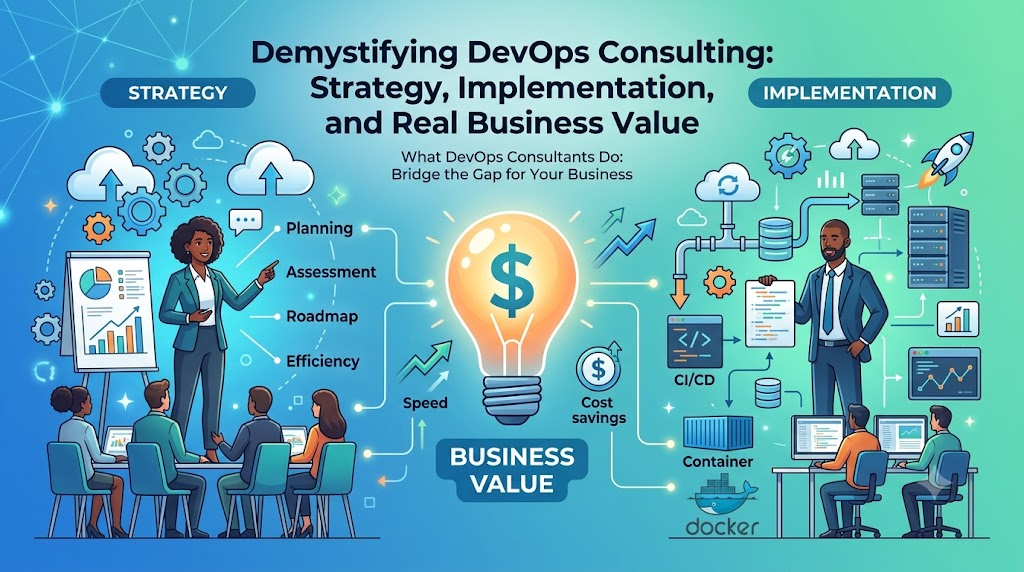
Organizations worldwide invest heavily in DevOps transformations to modernize software delivery, accelerate release velocity, and enhance system reliability, yet many initiatives stall due to a disconnect between high-level planning and technical execution. While strategy defines organizational vision and governance, implementation involves building automated pipelines and provisioning infrastructure, and without a structured bridge between the two, companies frequently struggle with tool sprawl and cultural silos. Experienced professionals from DevOpsSchool help bridge this gap by translating abstract business objectives into practical engineering practices, allowing organizations to establish pragmatic roadmaps, automate workflows, upskill engineering staff, and achieve sustainable software delivery success.
What DevOps Consulting Is
DevOps consulting is a specialized advisory and technical service designed to help organizations optimize their software development lifecycle, infrastructure management, and team collaboration.
Role of DevOps Consultants
DevOps consultants act as objective external catalysts. They analyze existing workflows, identify operational bottlenecks, and introduce industry-proven engineering practices. Their role encompasses both high-level architecture design and hands-on technical troubleshooting.
Business and Technical Responsibilities
On the business side, consultants align IT capabilities with corporate revenue goals, reduce operational expenditure, and manage risk. On the technical side, they design continuous integration and continuous delivery pipelines, implement infrastructure as code, and establish robust monitoring systems.
Enterprise Transformation Support
Large enterprises often struggle with legacy debt, complex compliance mandates, and deeply entrenched organizational silos. Consultants provide the framework, leadership, and technical horsepower needed to guide these complex transformations without disrupting ongoing business operations.
Long-Term Value Creation
Beyond immediate technical fixes, the ultimate goal of DevOps consulting is capability transfer. Consultants empower internal teams to sustain and evolve their own automation practices long after the consulting engagement has concluded.
Understanding DevOps Strategy
DevOps strategy forms the foundational blueprint of any successful transformation. It outlines the vision, path, and governance required to shift an organization from legacy operational models to high-performing delivery pipelines.
- Business Goals: Defining what the organization aims to achieve, such as reducing time-to-market by fifty percent or achieving five nines of system availability.
- Technology Roadmap: Establishing a phased timeline for adopting cloud native platforms, containerization, and automation tools.
- Process Assessment: Evaluating current software development life cycles to pinpoint waste, manual handoffs, and feedback delays.
- Team Structure: Designing optimal organizational topologies, such as platform engineering teams or cross-functional product squads.
- Governance: Setting policies for compliance, security standards, and code quality gates without stifling developer productivity.
- Risk Management: Identifying potential technical, financial, and cultural roadblocks before capital is deployed.
Strategy must always come before implementation. Rushing into tool adoption without a clear strategy leads to expensive software license waste and confused engineering teams.
Understanding DevOps Implementation
DevOps implementation is the active execution phase where strategic plans are transformed into functional, automated technical workflows.
- CI/CD Pipelines: Building automated build, test, and deployment pipelines that move code from developer laptops to production environments seamlessly.
- Infrastructure Automation: Writing code to provision servers, networks, and databases programmatically using Infrastructure as Code tools.
- Cloud Migration: Transitioning on-premises workloads to scalable public or private cloud environments.
- Monitoring and Observability: Implementing comprehensive logging, metrics, and tracing to provide real-time visibility into application health.
- Security Integration: Embedding security checks directly into the delivery pipeline to catch vulnerabilities early in the development cycle.
- Continuous Improvement: Regularly reviewing system performance, feedback loops, and deployment metrics to refine technical workflows.
Implementation breathes life into strategy, turning theoretical roadmaps into measurable business outcomes.
Strategy vs Implementation: Key Differences
| Area | DevOps Strategy | DevOps Implementation |
| Primary Focus | Vision, planning, governance, and cultural alignment | Hands-on engineering, tool configuration, and automation |
| Objectives | Define business goals, risk management, and organizational direction | Build pipelines, automate infrastructure, and deploy applications |
| Timeline | Long-term outlook spanning quarters or years | Short-to-medium-term execution sprints |
| Stakeholders | C-suite, CTOs, VP of Engineering, and business leaders | DevOps engineers, platform architects, and developers |
| Deliverables | Roadmaps, maturity assessments, and governance frameworks | CI/CD pipelines, IaC scripts, and monitoring dashboards |
| Success Metrics | ROI, alignment with business goals, and reduced delivery costs | Deployment frequency, lead time, and change failure rate |
| Risks | Lack of executive buy-in or overly rigid planning | Tool complexity, technical debt, and team burnout |
| Required Skills | Enterprise architecture, financial planning, and organizational psychology | Scripting, cloud administration, container orchestration, and CI/CD tools |
What DevOps Consultants Actually Do
Assess Current Environment
Consultants begin by conducting comprehensive audits of existing codebases, release processes, toolchains, and team interactions to establish a baseline maturity score.
Identify Business Goals
They sit down with executive leadership to understand revenue drivers, customer pain points, and strategic growth objectives.
Design DevOps Roadmap
Consultants build a prioritized, step-by-step transformation plan that delivers quick wins while laying the groundwork for long-term scalability.
Recommend Technology Stack
Rather than following vendor hype, consultants evaluate and recommend the specific cloud services, container tools, and automation platforms that fit the organization’s unique needs.
Build CI/CD Pipelines
They write and optimize robust automation scripts that automate testing, code integration, and deployment routines.
Implement Infrastructure As Code
Consultants replace manual server configuration with reproducible infrastructure templates, ensuring environment consistency across development, staging, and production.
Improve Collaboration
They break down traditional silos between development, QA, and operations by fostering shared responsibility and transparent communication channels.
Train Engineering Teams
Through workshops, pair programming, and documentation, consultants transfer vital technical knowledge to internal staff.
Measure Results
They establish dashboards to track key performance indicators, proving the tangible value of the transformation to stakeholders.
DevOps Consulting Lifecycle
- Discovery: Initial stakeholder interviews, stakeholder alignment, and scope definition.
- Assessment: Deep-dive analysis of current toolchains, bottlenecks, and security posture.
- Strategy Development: Crafting the overarching transformation vision and governance model.
- Roadmap Planning: Prioritizing initiatives into actionable milestones and sprints.
- Tool Selection: Choosing the right combination of open-source and enterprise software.
- Implementation: Writing code, configuring environments, and building automated pipelines.
- Testing: Rigorous validation of security, performance, and failure recovery mechanisms.
- Team Enablement: Conducting hands-on training sessions and establishing internal communities of practice.
- Continuous Optimization: Monitoring performance metrics and refining processes iteratively.
Benefits of Hiring DevOps Consultants
| Benefit | Business Impact |
| Faster Software Delivery | Accelerates time-to-market for new features, helping companies outpace competitors. |
| Reduced Operational Costs | Eliminates manual toil, optimizes cloud resource usage, and reduces costly downtime. |
| Improved Collaboration | Breaks down silos, fostering a culture of shared ownership and higher morale. |
| Better Automation | Replaces error-prone manual tasks with reliable, repeatable automated workflows. |
| Stronger Security | Embeds security governance early in the lifecycle, protecting sensitive customer data. |
| Higher Deployment Reliability | Minimizes human error during releases, resulting in fewer production outages. |
| Faster Cloud Adoption | Smooths migration pains and ensures cloud environments are architected for scale. |
| Continuous Improvement | Establishes data-driven feedback loops that drive ongoing operational excellence. |
Common Challenges During DevOps Implementation
- Resistance to Change: Employees often cling to familiar legacy habits out of fear or comfort. Solution: Involve teams early in the planning process and clearly communicate the personal and professional benefits of automation.
- Legacy Infrastructure: Monolithic systems and aging hardware resist rapid deployment. Solution: Adopt a strangler fig pattern to gradually refactor legacy components into microservices.
- Skill Gaps: Internal teams may lack experience with modern containerization and cloud platforms. Solution: Invest in structured training programs and leverage external consulting mentorship.
- Tool Complexity: Adopting too many tools without integration creates a chaotic developer experience. Solution: Standardize on a cohesive toolchain with minimal cognitive overhead.
- Security Concerns: Speeding up releases can sometimes introduce compliance risks. Solution: Integrate automated compliance checks directly into the CI/CD pipeline.
- Budget Limitations: Transformation initiatives can stall if financial returns are not demonstrated early. Solution: Focus initial efforts on high-impact, low-effort automation tasks to secure quick wins.
DevOps Strategy Framework
- Business Assessment: Map IT capabilities directly to revenue goals and customer satisfaction metrics.
- Process Analysis: Document current value streams to isolate friction points and wait times.
- Technology Evaluation: Audit existing software licenses and hardware to determine modernization priorities.
- Automation Planning: Prioritize manual workflows that consume the highest amount of engineering hours.
- Security Integration: Establish DevSecOps guardrails for vulnerability scanning and secret management.
- Measurement Strategy: Define clear Key Performance Indicators to track velocity and stability improvements.
- Continuous Improvement: Establish regular retrospectives to adapt strategy based on empirical feedback.
Implementation Best Practices
- Start with Small Projects: Pilot your DevOps transformation on a non-critical application to test processes and build confidence.
- Automate Repetitive Tasks: Eliminate manual testing and deployment steps to free up engineering capacity.
- Standardize Workflows: Create golden paths and templates that make doing the right thing the easiest option for developers.
- Monitor Continuously: Implement centralized logging and alerting to detect anomalies before they impact end-users.
- Train Teams: Ensure continuous upskilling so engineers understand not just how to use tools, but why they exist.
- Measure KPIs: Track deployment frequency and recovery times to prove progress over time.
- Encourage Collaboration: Reward cross-functional teamwork and transparent communication across departments.
Real-World Example: DevOps Consulting in Action
A mid-sized retail enterprise was struggling with sluggish software release cycles. Their developers pushed code once every three months, and deployments frequently required tense weekend maintenance windows that often ended in rollbacks.
Frustrated by lost revenue and poor customer experiences, leadership brought in a senior DevOps consultant. The consultant began with a comprehensive environment assessment, discovering that testing was entirely manual and environments were configured by hand.
The consultant designed a transformation roadmap that introduced automated testing suites, containerized application runtimes, and a streamlined CI/CD pipeline. Over six months, the consulting team worked side-by-side with internal engineers, building automated infrastructure scripts and conducting hands-on workshops.
By the end of the engagement, the retailer reduced their release lead time from months to mere hours, eliminated weekend deployment stress, and increased overall deployment frequency by five hundred percent.
Measuring DevOps Consulting Success
| Metric | Why It Matters |
| Deployment Frequency | Measures how often code is successfully released to production. |
| Lead Time for Changes | Tracks the time it takes for a commit to make it into production. |
| Change Failure Rate | Indicates the percentage of deployments that cause a production failure. |
| Mean Time to Recovery | Measures how quickly the organization restores service after an outage. |
| Automation Coverage | Tracks the proportion of testing and infrastructure managed via code. |
| Infrastructure Consistency | Ensures development and production environments match seamlessly. |
| Customer Satisfaction | Reflects how reliably software updates meet end-user expectations. |
| Team Productivity | Gauges engineering morale, retention, and time spent on creative work. |
Skills Every DevOps Consultant Should Have
- DevOps Methodology: Deep understanding of continuous delivery, lean principles, and feedback loops.
- Cloud Platforms: Hands-on expertise with AWS, Microsoft Azure, or Google Cloud Platform.
- CI/CD: Mastery of pipeline orchestration tools like Jenkins, GitLab CI, or GitHub Actions.
- Infrastructure as Code: Proficiency with Terraform, Ansible, or CloudFormation.
- Kubernetes: Strong containerization and orchestration capabilities.
- Security: Practical knowledge of DevSecOps practices and vulnerability management.
- Leadership: Ability to guide teams through organizational change with empathy and clarity.
- Communication: Exceptional verbal and written skills for bridging technical and business discussions.
- Problem-Solving: Aptitude for diagnosing complex distributed system failures under pressure.
- Business Understanding: Capacity to connect technical metrics to broader corporate financial goals.
How DevOpsSchool Supports DevOps Consulting Skills
Organizations and professionals seeking to master enterprise transformation look to comprehensive educational ecosystems like DevOpsSchool. By providing industry-focused training, hands-on consulting scenarios, and real-world enterprise projects, these programs bridge the gap between theoretical knowledge and practical execution. Learners explore cloud-native technologies, advanced CI/CD implementation, and platform engineering principles through career-focused mentoring designed to build both technical competence and strategic leadership acumen.
Future of DevOps Consulting
- AI-Assisted DevOps: Utilizing machine learning models to predict system failures, automate root-cause analysis, and optimize pipeline execution.
- Platform Engineering: Moving away from bespoke pipelines toward self-service internal developer platforms that enhance developer autonomy.
- DevSecOps Integration: Embedding security natively into every phase of software development by default.
- GitOps: Managing infrastructure and application configurations entirely through Git repositories for declarative automation.
- FinOps: Combining financial accountability with cloud engineering to optimize infrastructure spending.
- Cloud-Native Transformation: Accelerating the migration of legacy workloads to resilient serverless and containerized architectures.
- Value Stream Management: Measuring and optimizing the entire flow of value from idea to customer delivery.
FAQs (15 Questions)
What does a DevOps consultant do?
A DevOps consultant analyzes an organization’s software delivery lifecycle, designs strategic roadmaps, builds automated CI/CD pipelines, implements infrastructure as code, and trains internal teams to improve release speed and system reliability.
What is the difference between DevOps strategy and implementation?
DevOps strategy focuses on high-level business goals, roadmaps, governance, and team structure. Implementation involves the hands-on engineering work of building pipelines, configuring tools, and automating infrastructure.
Why do businesses hire DevOps consultants?
Businesses hire consultants to overcome skill gaps, accelerate cloud migrations, reduce deployment failures, modernize legacy systems, and benefit from external industry expertise.
How long does a DevOps transformation take?
A typical DevOps transformation takes anywhere from six months to two years, depending on the organization’s size, legacy complexity, and cultural readiness.
What skills should a DevOps consultant have?
A successful consultant needs a balance of technical skills—such as cloud administration, CI/CD, and IaC—and soft skills like leadership, communication, and strategic problem-solving.
Can small businesses benefit from DevOps consulting?
Yes, small businesses use consulting to establish efficient, scalable delivery practices early, avoiding the technical debt that plagues larger organizations.
How do consultants measure success?
Consultants measure success using key metrics such as deployment frequency, lead time for changes, change failure rate, and mean time to recovery.
Is DevOps consulting only about automation?
No, while automation is critical, DevOps consulting also addresses culture, team topology, security integration, and business alignment.
What is a DevOps roadmap?
A DevOps roadmap is a phased, strategic plan outlining the milestones, tools, and process changes required to reach an organization’s desired delivery maturity level.
How do consultants handle team resistance to change?
Consultants involve team members early, provide thorough training, demonstrate quick wins, and foster an open, collaborative culture.
What is Infrastructure as Code?
Infrastructure as Code is the practice of managing and provisioning computing infrastructure through machine-readable definition files rather than manual physical configuration.
How does security fit into DevOps consulting?
Security is integrated throughout the entire lifecycle via DevSecOps practices, automating vulnerability scanning and compliance checks within CI/CD pipelines.
What role do cloud platforms play in DevOps?
Cloud platforms provide the scalable, flexible infrastructure required to support automated deployments, container orchestration, and rapid scaling.
What is the cost of DevOps consulting?
Consulting costs vary based on the scope of the engagement, enterprise size, and project duration, but they typically yield high ROI through reduced downtime and increased productivity.
How can internal teams prepare for a consulting engagement?
Internal teams can prepare by documenting current workflows, listing major technical bottlenecks, and defining clear business objectives for the transformation.
Final Thoughts
Successful software delivery requires a careful balance between strategic vision and practical execution. Strategy provides the direction, while implementation delivers the results. When organizations attempt to modernize without bridging these two phases, transformations often stall under the weight of tool complexity and cultural resistance.
Experienced DevOps consultants play a critical role in uniting business leaders and engineering teams, translating abstract goals into automated pipelines, resilient infrastructure, and collaborative workflows. True transformation is not just about adopting new software; it is about cultivating a culture of continuous improvement, shared accountability, and operational excellence. By combining thoughtful planning with disciplined execution, organizations can future-proof their software delivery lifecycle for long-term success.

Best Cardiac Hospitals Near You
Discover top heart hospitals, cardiology centers & cardiac care services by city.
Advanced Heart Care • Trusted Hospitals • Expert Teams
View Best Hospitals