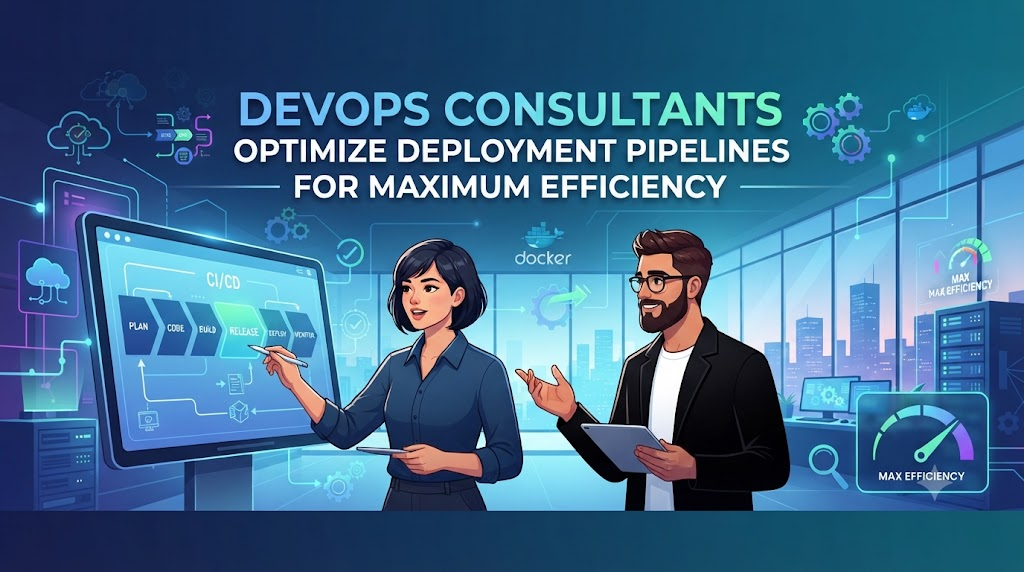
Introduction
In today’s fast-paced digital market, the ability to release software reliably and at speed is a primary competitive advantage, yet many organizations remain trapped by brittle, manual deployment processes that stifle innovation and frustrate engineering teams. A deployment pipeline serves as the critical automated backbone of software delivery, and when plagued by bottlenecks, it frequently leads to high failure rates and operational “deployment hell.” This is where the expertise of DevOpsSchool and experienced DevOps consultants becomes essential; by systematically auditing workflows, eliminating manual toil, and embedding robust automation and security protocols, these experts transform fragmented release cycles into resilient, high-velocity delivery systems that deliver measurable business value and sustained operational excellence.
What Is a Deployment Pipeline?
At its core, a deployment pipeline is a repeatable, automated process that takes code from a developer’s machine and promotes it through various stages—build, test, security analysis, and deployment—to reach the end user.
- Source Control: The foundation where all code changes are managed.
- Build Automation: Compiling code and packaging artifacts consistently.
- Automated Testing: Running unit, integration, and functional tests to ensure quality.
- Security Scanning: Analyzing code for vulnerabilities early in the cycle.
- Artifact Repository: Storing versioned, immutable binaries for deployment.
- Deployment Automation: Using scripts or tools to push artifacts to environments (staging, production).
- Monitoring and Feedback: Tracking health metrics post-deployment to inform future development.
A well-architected pipeline acts as a conveyor belt that ensures every change is verified, secured, and ready for deployment without human intervention.
Why Deployment Pipeline Optimization Matters
Optimization is not about making the pipeline “faster” for the sake of speed; it is about building a sustainable, high-trust system.
- Faster Releases: Reducing cycle time allows features to reach customers quicker, enabling faster feedback loops.
- Improved Quality: Automated testing and gatekeeping catch bugs before they reach the user, drastically reducing defects in production.
- Lower Deployment Risk: Consistent, automated processes remove human error, which is the leading cause of failed deployments.
- Reduced Operational Costs: Automation eliminates the “toil” of manual intervention, allowing engineers to focus on higher-value tasks.
- Better Customer Experience: Reliable delivery means less downtime and faster incident resolution, resulting in a superior product experience.
Role of DevOps Consultants
DevOps consultants provide an objective, high-level perspective that internal teams, often deep in technical debt, might overlook. Their role involves:
- Current State Assessment: Mapping the existing workflow to visualize every manual touchpoint and technical bottleneck.
- Process Analysis: Identifying non-value-added activities—the “muda” in lean methodology.
- Tool Evaluation: Determining if existing toolchains are fit for purpose or if they have become maintenance burdens.
- Automation Planning: Designing a phased roadmap to transition from manual to automated workflows.
- Team Collaboration: Bridging the divide between developers, QA, and operations to foster a shared responsibility model.
- Continuous Improvement: Establishing feedback loops to ensure the pipeline evolves alongside the business.
Typical Deployment Pipeline Architecture
A modern, optimized pipeline is structured as a series of automated gates.
Conceptual Workflow:[Developer Commit] → [CI Build & Unit Test] → [Static Code Analysis] → [Artifact Creation] → [Integration/UAT Testing] → [Security Gate] → [Production Deployment] → [Observability]
- Source Control: The single source of truth (e.g., Git).
- CI Trigger: Every push triggers an automated build.
- Automated Testing: Tests must be deterministic and fast.
- Security Scanning: DevSecOps tools check for vulnerabilities automatically.
- Artifact Storage: Using registries to ensure the same code tested in staging is what is deployed to production.
- Deployment: Infrastructure is provisioned/updated via code, not manual changes.
- Feedback: Real-time data flows back to the engineering team.
Common Pipeline Bottlenecks
| Bottleneck | Business Impact | Recommended Solution |
| Manual deployments | High risk, slow releases | Transition to Infrastructure as Code (IaC) |
| Slow build times | Delayed feedback to devs | Implement build caching and parallelization |
| Weak/Flaky testing | High production failure | Invest in test automation and isolation |
| Inconsistent environments | “It works on my machine” issues | Use containerization and immutable infrastructure |
| Security delays | Blocked releases | Shift-left security scanning |
| Poor monitoring | High MTTR (Mean Time to Recover) | Implement centralized observability |
CI/CD Optimization Strategies
- Build Optimization: Utilize incremental builds to reduce compile times.
- Parallel Testing: Divide large test suites to run simultaneously across worker nodes.
- Incremental Deployments: Avoid “big bang” releases; deploy smaller, frequent batches.
- Automated Approvals: Use policy-as-code to replace manual change advisory board (CAB) reviews where risk is low.
- Pipeline Standardization: Create reusable pipeline templates to ensure consistency across teams.
Infrastructure as Code (IaC)
IaC is the practice of managing and provisioning infrastructure through machine-readable definition files. Consultants advocate for IaC because:
- Environment Consistency: Eliminates configuration drift between dev, test, and production.
- Version Control: Infrastructure changes are tracked, auditable, and reversible.
- Scalability: Rapidly replicate environments or scale infrastructure resources programmatically.
Security Integration (DevSecOps)
Security cannot be an afterthought. Consultants integrate “Shift-Left” security:
- SAST/DAST: Static and Dynamic analysis performed inside the pipeline.
- Dependency Management: Automated scanning for vulnerabilities in third-party libraries.
- Secrets Management: Never hardcode credentials; use tools to inject secrets at runtime.
- Policy-as-Code: Automatically enforce compliance rules (e.g., firewall settings) before deployment.
Deployment Strategies
| Strategy | Best Use Case | Business Benefit |
| Blue-Green | Zero-downtime, high-risk apps | Instant rollback capability |
| Canary | Testing new features on subsets | Limits impact of potential failures |
| Rolling | Gradual updates | Smooth transition for long-running services |
| Recreate | Non-production/simple apps | Complete environment refresh |
Monitoring and Observability
Monitoring answers, “Is the system up?” while Observability answers, “Why is it behaving this way?”
- Metrics: Tracking CPU, memory, and throughput.
- Logging: Centralized logs for deep debugging.
- Alerting: Reducing noise by only alerting on actionable incidents.
- Continuous Optimization: Using post-deployment telemetry to refine future pipeline logic.
Measuring Deployment Pipeline Performance
| Metric | Why It Matters | Business Value |
| Deployment Frequency | Measures release velocity | Faster time-to-market |
| Lead Time for Changes | Time from code commit to production | Improved responsiveness |
| Change Failure Rate | Percentage of failed deployments | Higher software stability |
| MTTR | Time to recover from failures | Minimized downtime costs |
| Build Success Rate | Predictability of the pipeline | Reduced developer frustration |
Common Challenges During Optimization
| Challenge | Impact | Recommended Solution |
| Legacy applications | Hard to modernize | Use strangler fig patterns to migrate |
| Team resistance | Stalls progress | Focus on culture and small wins |
| Tool integration | Siloed data | Adopt platform-neutral tools |
| Skill gaps | Slow adoption | Continuous training and mentorship |
Best Practices Used by DevOps Consultants
- Standardize Everything: Use templates for pipelines to reduce cognitive load.
- Automate Testing: High code coverage is good, but relevant testing is better.
- Integrate Security: Build security guardrails into the pipeline.
- Monitor Continuously: Data-driven decisions prevent guesswork.
- Review KPIs: Treat metrics as a compass for improvement, not as weapons.
- Improve Incrementally: Avoid massive, multi-month overhauls in favor of small iterative changes.
Real-World Example: Enterprise Pipeline Optimization
Initial State: A financial firm was performing monthly manual deployments, leading to frequent production outages. The process involved hand-off meetings, manual database scripts, and siloed verification.
Consultant Assessment: The pipeline had no automated testing and relied on manual configuration.
Redesign:
- Implemented Terraform for IaC to standardize environments.
- Introduced a CI/CD pipeline (Jenkins/GitLab) with automated unit and integration tests.
- Integrated SonarQube for security gatekeeping.
- Adopted blue-green deployments to eliminate downtime.
Outcome: Release frequency increased from monthly to daily. Change failure rate dropped by 70%, and MTTR decreased by 85%. The team moved from a culture of fear to one of continuous delivery.
Common Beginner Mistakes
- Automating Poor Processes: You cannot fix a bad process with automation; it only speeds up failure.
- Ignoring Security: Security must be built-in, not bolted on.
- Weak Monitoring: Deploying blindly leads to massive, costly incidents.
- Hardcoded Configurations: Always separate environment-specific configs from code.
- Lack of Documentation: Even the best-automated pipeline needs a “runbook” for when things break.
Future of Deployment Pipelines
- AI-Assisted DevOps: Using ML to predict deployment failures before they happen.
- GitOps: Managing infrastructure entirely through Git, where the repo is the source of truth.
- Platform Engineering: Treating the internal developer platform as a product to improve developer self-service.
- Policy-as-Code: Automatically ensuring all infrastructure meets compliance requirements.
Certifications & Learning Paths
| Certification | Best For | Skill Level | Focus Area |
| Kubernetes (CKA) | Orchestration | Advanced | Cloud-Native Ops |
| Terraform Associate | IaC | Intermediate | Infrastructure |
| AWS/Azure/GCP DevOps | Cloud-native | Intermediate | Cloud Architecture |
| DevSecOps Expert | Security | Advanced | Pipeline Security |
For those looking to build these high-demand skills, the DevOpsSchool learning ecosystem offers comprehensive pathways to mastering these technologies.
Practical Deployment Pipeline Optimization Checklist
- Review pipeline logs to identify the longest-running stage.
- Eliminate manual hand-offs between development and operations.
- Ensure all infrastructure is provisioned via IaC tools.
- Run automated security scans on every pull request.
- Centralize logs and metrics into a single pane of glass.
- Define and track DORA metrics (Frequency, Lead Time, Change Failure, MTTR).
- Conduct regular “blameless” post-mortems for any pipeline failure.
FAQs
- What is a deployment pipeline? An automated sequence of processes that takes source code from version control and delivers it to a production environment.
- Why should organizations optimize deployment pipelines? To increase release velocity, improve software quality, and reduce the risk associated with changes.
- How do DevOps consultants improve CI/CD? By auditing current workflows, removing manual bottlenecks, and introducing robust automation and security gates.
- Which deployment strategy is best? It depends on your architecture. Canary is excellent for web apps to reduce blast radius; Blue-Green is perfect for zero-downtime requirements.
- How does DevSecOps improve deployments? By catching vulnerabilities earlier, it prevents costly security rework and ensures compliance before the code hits production.
- What metrics should teams monitor? Focus on DORA metrics: Deployment Frequency, Lead Time for Changes, Change Failure Rate, and Mean Time to Recovery.
- Can small businesses optimize deployment pipelines? Yes, small businesses often benefit the most from automation as it allows smaller teams to do more with less.
- How should beginners start? Start by automating your testing, then move to infrastructure automation, and finally integrate security scanning.
- What is the difference between CI and CD? CI (Continuous Integration) focuses on code quality/merging; CD (Continuous Delivery/Deployment) focuses on releasing those changes to users.
- Does optimization ever end? No, continuous improvement is the hallmark of a healthy DevOps culture.
- How do I deal with legacy systems? Wrap them in APIs or use the “Strangler Fig” pattern to gradually replace parts of the system.
- What is the most important part of a pipeline? Feedback. If the pipeline doesn’t tell you why something failed, it isn’t serving its purpose.
- Is manual approval always bad? Not always, but it should be reserved for high-risk changes. Automate everything else.
- How do I select the right tools? Focus on integration capability and community support rather than just the latest feature hype.
- How does culture affect the pipeline? A blame-free culture is essential; if developers fear breaking the pipeline, they will avoid it, leading to infrequent, large, and risky releases.
Final Thoughts
Optimizing a deployment pipeline is not a one-time project; it is a discipline. As your business scales, your requirements will change, and your pipelines must adapt accordingly. Automate with purpose, measure your progress through clear KPIs, and always prioritize security and reliability over raw speed. By focusing on the flow of value and empowering your teams with the right infrastructure, you transform your delivery process from a bottleneck into a competitive engine.

Best Cardiac Hospitals Near You
Discover top heart hospitals, cardiology centers & cardiac care services by city.
Advanced Heart Care • Trusted Hospitals • Expert Teams
View Best Hospitals