A customer adds items to a shopping cart, proceeds to checkout, and clicks submit. The screen freezes, spins for twenty seconds, and returns a blank page or a generic error message. To the engineering team, this might be an unhandled database lock, a misconfigured load balancer, or a failed microservice deployment. To the customer, none of those technical distinctions matter. It is simply a broken service, a waste of time, and a reason to take their business elsewhere.
Digital experiences depend entirely on the operational foundation supporting them. When software is unstable, slow to load, or frequently interrupted by bugs introduced during routine updates, customer trust erodes.
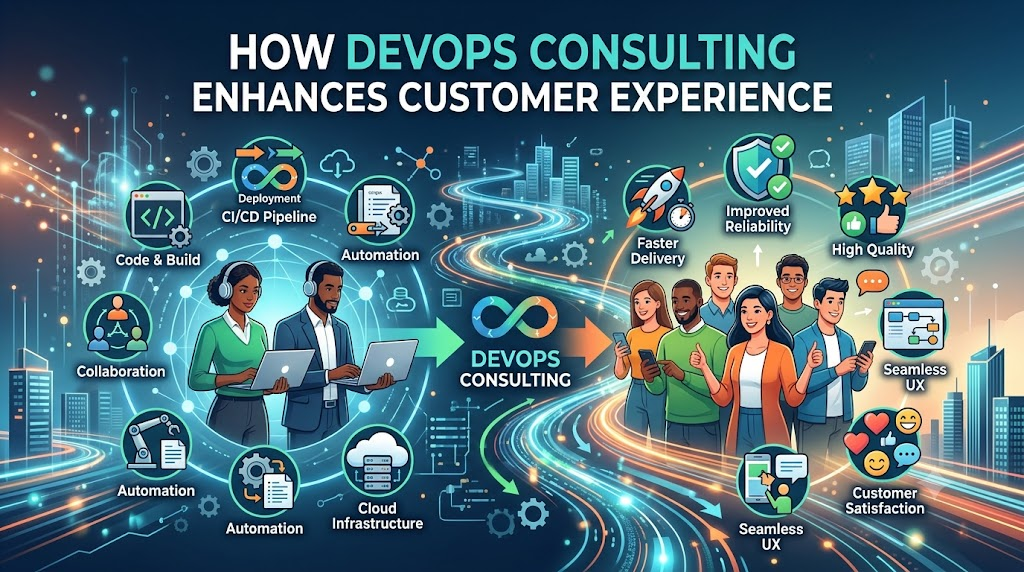
DevOps consulting bridges the gap between engineering workflows and real-world digital interactions. By identifying systemic bottlenecks, modernizing deployment pipelines, improving system observability, and stabilizing infrastructure, external consultants help organizations build resilient technical environments. DevOps consulting does not magically guarantee customer delight. Rather, it establishes a predictable, disciplined operational structure: better engineering practices lead to more reliable systems, which enable safer and faster improvements, resulting in fewer service disruptions and a significantly better customer experience.
What Is DevOps Consulting?
DevOps consulting is a professional service where experienced practitioners evaluate, design, and modernize an organization’s software delivery lifecycle and operational ecosystem. Rather than merely recommending isolated tools, effective DevOps consultants examine how people, processes, and technologies interact across the entire development pipeline.
A comprehensive consulting engagement typically assesses and refines:
- Development Workflows: Code review practices, branch management, and developer environments.
- CI/CD Pipelines: Automated build, test, packaging, and release processes.
- Infrastructure Management: Cloud architecture, Infrastructure as Code (IaC), and configuration management.
- Observability and Monitoring: Telemetry pipelines, metric collection, centralized logging, and tracing.
- Site Reliability and Performance: Capacity planning, load handling, database tuning, and high-availability patterns.
- Security Practices (DevSecOps): Secrets management, vulnerability scanning, and compliance automation.
True consulting does not begin with a predetermined tool stack. It starts by understanding the business model, the architectural debt, and the specific user journeys that define the customer experience.
What Is Customer Experience in Digital Products?
In digital-first environments, customer experience (CX) extends far beyond visual design, intuitive menus, or polished copywriting. A sleek interface cannot rescue a digital product that fails to complete transactions or is chronically unavailable.
Technical factors that directly shape digital customer experience include:
- Availability: Is the platform accessible whenever the user needs it?
- Performance and Latency: Do pages and APIs respond swiftly under normal and peak loads?
- Reliability: Can users complete complex workflows without unexpected application crashes or data losses?
- Security and Privacy: Is customer data handled safely, preventing account takeovers or exposure?
- Consistency: Does the platform behave identically across web browsers, mobile applications, and geographic regions?
- Pace of Feature Delivery: Are user-requested improvements, security patches, and critical bug fixes delivered smoothly without disrupting active sessions?
The Connection Between DevOps and Customer Experience
Engineering operations dictate the runtime reality of software. When internal deployment methods are brittle, manual, and unverified, the digital product reflects that instability.
Engineering Practices ➔ System Behavior ➔ Product Experience ➔ Customer Perception
Consider how direct operational changes influence user outcomes:
- Automated Release Validation reduces human deployment errors, preventing unexpected application outages during operational hours.
- Granular Observability surfaces latency anomalies in checkout or login routes before users submit support tickets.
- Standardized Infrastructure Automation prevents environmental drift, ensuring that code tested in staging runs identically in production.
- Elastic Autoscaling Policies absorb traffic surges during marketing events without degrading user page-load speeds.
- Shortened Delivery Cycles allow engineering teams to respond to customer feature requests and usability feedback in days instead of quarters.
How DevOps Consulting Identifies Customer-Impacting Problems
Internal engineering teams are often consumed by day-to-day feature development and urgent tickets, making it difficult to step back and diagnose systemic delivery flaws. DevOps consultants conduct holistic technical assessments to uncover vulnerabilities that compromise user satisfaction.
Consultants evaluate systems through the lens of user impact:
- Deployment Bottlenecks: Identifying manual sign-offs, fragile deployment scripts, or long validation phases that delay urgent bug fixes.
- Infrastructure Fragility: Locating single points of failure, unmanaged resource contention, and missing redundancy in cloud resources.
- Monitoring Blind Spots: Finding gaps where systems fail silently without triggering alerts because telemetry only measures internal server health rather than transaction success.
- Release Risk Profiles: Identifying monolithic deployments where deploying a minor text change requires restarting the entire application stack.
- Recovery Limitations: Assessing whether backup restorations and failovers have ever been validated under realistic disaster scenarios.
Core Operational Areas Where DevOps Consulting Enhances Customer Experience
1. Faster and Safer Software Releases
When release processes are manual, deploying new software is treated as an infrequent, high-risk event. This leads to massive release bundles that are difficult to test and prone to failure.
DevOps consultants help organizations implement mature Continuous Integration and Continuous Delivery (CI/CD) pipelines. By introducing automated unit, integration, and security tests alongside automated release staging, deployments become routine, low-risk operations. Customers receive bug fixes and feature enhancements regularly, without scheduled maintenance windows taking services offline.
2. Improved Application Reliability
System instability directly alienates users. Consultants analyze application architectures to isolate single points of failure, address cascading dependency faults, and harden underlying infrastructure. Introducing reliability engineering principles—such as circuit breakers, retry policies with exponential backoff, and health-check-driven routing—ensures that transient system failures do not translate into visible downtime for the end user.
3. Better Application Performance
A slow application directly degrades user satisfaction. DevOps consultants collaborate with development and operations teams to identify latency drivers across the stack. This involves rightsizing cloud compute instances, introducing efficient caching layers, optimizing database connection pools, implementing content delivery networks (CDNs), and tuning load balancers to distribute traffic efficiently.
4. Faster Incident Detection
Traditional monitoring often alerts teams only when a server runs out of disk space or CPU utilization spikes to 100%. However, an application can fail functionally while server resources appear completely healthy. Consultants introduce comprehensive observability—combining structured metrics, unified logging, and distributed tracing—enabling teams to spot anomalous drop-offs in user checkouts, abnormal API latency spikes, or failed user authorizations immediately.
5. Faster Incident Resolution (MTTR)
When outages occur, every minute of investigation is a minute of customer frustration. DevOps consultants streamline incident management by establishing clear alert routing, automated on-call escalations, and actionable operational runbooks. By integrating distributed tracing and centralized log analysis, engineers can rapidly pinpoint root causes rather than spending hours sifting through fragmented server logs.
6. Better Scalability Under Load
Marketing promotions, seasonal peaks, and sudden product mentions can overwhelm unprepared infrastructure. Consultants design elastic infrastructure models using dynamic horizontal autoscaling, container orchestration, and asynchronous task queues. Systems scale out proactively to meet user demand and scale in cleanly when traffic normalizes, keeping the platform responsive without incurring wasteful infrastructure costs.
7. Consistent Multi-Environment Experience
Discrepancies between development, staging, and production environments frequently cause bugs that slip past QA only to appear in production. Consultants implement Infrastructure as Code (IaC) using frameworks like Terraform or Ansible, alongside container platforms like Docker and Kubernetes. This guarantees that software runs in fully reproducible, standardized environments at every stage of the lifecycle.
8. Accelerated Feedback and Feature Delivery
When users report functional defects or request product tweaks, an organization’s competitive edge depends on how quickly it can validate and release those adjustments. Streamlined DevOps pipelines compress the cycle time between product decisions, testing, and deployment, allowing businesses to adapt dynamically to evolving customer needs.
9. Rapid Rollbacks and Recovery Mechanisms
Not every deployment goes as planned. The mark of a mature engineering team is how quickly it can recover when an unexpected defect reaches production. Consultants implement automated rollback mechanisms and zero-downtime deployment patterns—such as blue-green environments and canary rollouts. If error rates climb following a release, traffic is instantly reverted to the previous stable build before the majority of users are impacted.
10. Optimized Cloud Architecture
Unstructured cloud environments often suffer from poor network topology, over-provisioned resources, and unmanaged dependencies. DevOps consultants refactor cloud architectures to leverage managed services, optimize multi-zone availability, and implement cost-governance practices that ensure infrastructure remains robust, fast, and financially sustainable.
11. Strengthened Security and Customer Trust
A single data leak or security compromise can permanently destroy brand credibility. DevSecOps consulting integrates automated security scanning directly into CI/CD pipelines. Static and dynamic code analysis, automated dependency vulnerability checks, secrets management tools, and role-based access controls ensure that security verification keeps pace with continuous software delivery.
12. Customer-Centric Observability and Metrics
Effective monitoring goes beyond raw infrastructure utilization. Consultants assist engineering teams in tracking Service Level Indicators (SLIs) and defining Service Level Objectives (SLOs) anchored to user behavior:
Infrastructure Metrics (CPU, Memory, IOPS)
                 +
Customer Indicators (Login Success Rate, Checkout Latency, HTTP 5xx Errors)
                 =
Actionable Service Health
13. Progressive Delivery and Controlled Risk
Deploying code should not be an all-or-nothing proposition. Consultants help teams adopt progressive delivery strategies using feature flags and canary deployments. New functionality can be exposed to a tiny subset of users (e.g., 1%) while monitoring error telemetry. Once validated, exposure is expanded gradually, ensuring that any hidden defect is caught before it impacts the broader user base.
14. Tested Disaster Recovery and Business Continuity
Having a theoretical disaster recovery plan on paper is not enough. DevOps consultants design automated backup schedules, cross-region failover protocols, and data replication strategies. More importantly, they run routine, non-destructive recovery simulations to ensure that if an entire cloud region experiences an outage, operations can be restored within agreed recovery time and point objectives.
15. Cross-Functional Team Collaboration
Organizational silos between developers, operators, security specialists, and product managers lead to prolonged handoffs, finger-pointing during incidents, and fragmented user experiences. Consulting establishes shared operational responsibility, blameless post-mortem cultures, and unified communication channels, ensuring all engineering disciplines work toward shared customer reliability goals.
Connecting Customer Feedback to DevOps Loops
Continuous improvement relies on closing the gap between user behavior and technical execution. An optimized DevOps lifecycle operates as an ongoing closed loop:
Customer Feedback ➔ Product Strategy ➔ Development ➔ Automated Testing ➔ Progressive Deployment ➔ Real-Time Telemetry ➔ Customer Experience Insight
When this cycle operates with minimal friction, user frustrations captured by support channels or telemetry are transformed into prioritized engineering tasks, tested through CI pipelines, and deployed safely back to production.
DevOps Metrics vs. Customer Experience Outcomes
Engineering performance metrics must be interpreted through their direct customer impact rather than tracked as isolated technical goals.
| DevOps Metric | Direct Customer Impact | Potential User Consequence if Ignored |
| Deployment Frequency | Faster access to new capabilities, bug fixes, and UX improvements | Stale products; months of waiting for critical feature requests |
| Change Failure Rate | Fewer buggy releases that break live workflows or disrupt user tasks | Frequent regressions, broken checkout flows, and user distrust |
| Mean Time to Recovery (MTTR) | Shorter outages and swift resolution of unexpected issues | Extended downtime; abandoned workflows; loss of user productivity |
| Lead Time for Changes | Rapid turnaround from identified user problem to live production fix | Prolonged exposure to known defects and UI inconveniences |
| Availability / Uptime | Platform is consistently accessible whenever users need it | Missed business transactions; user migration to competitors |
| Error Rate (HTTP 5xx) | Transactions, API requests, and page submissions complete successfully | Frustrated users facing unexpected failure prompts and lost data |
| Response Latency (p95/p99) | Snappy, fluid, and predictable application responsiveness | High bounce rates; user churn driven by sluggish performance |
Step-by-Step: How DevOps Consultants Assess Customer Impact
A structured consulting process focuses on business-critical workflows before prescribing architectural changes.
- Understand Business Goals: Clarify key customer conversion paths, revenue drivers, and platform expectations.
- Identify Critical Customer Journeys: Map high-value transactions such as user registration, search, authentication, and payments.
- Map Application Dependencies: Trace services, databases, external APIs, and cloud resources supporting those core journeys.
- Audit Deployment Pipelines: Evaluate how code moves from a developer’s machine to production, noting manual handoffs, lack of automated tests, and release risks.
- Assess Infrastructure Reliability: Check for single points of failure, redundancy gaps, and unverified scaling configurations.
- Evaluate Observability Coverage: Identify blind spots in logging, distributed tracing, alerting noise, and customer transaction monitoring.
- Analyze Incident History: Review post-mortems of past outages to uncover recurring architectural or operational failure patterns.
- Identify Delivery Bottlenecks: Pinpoint specific structural constraints slowing down releases or creating production risks.
- Prioritize an Actionable Roadmap: Rank remediation efforts based on customer impact and implementation complexity.
- Measure Engineering and CX Outcomes: Continuously validate changes against both technical indicators (latency, failure rates) and product KPIs (conversion, support volume).
Real-World Scenario: Modernizing a Scaling SaaS Platform
Consider a mid-sized SaaS business providing an invoicing and billing engine for subscription companies. As customer adoption grows, the engineering team encounters severe operational challenges:
- Every bi-weekly deployment causes minor service interruptions, forcing updates to happen late at night.
- Database latency spikes during month-end invoicing runs, resulting in API timeouts for end users.
- Incident investigations take hours because application logs are scattered across individual virtual machines.
The Consulting Intervention
A DevOps consulting team is engaged to restructure the delivery and operational lifecycle:
- CI/CD Modernization: Replaced manual deployment scripts with an automated pipeline running automated unit, integration, and security scans on every pull request.
- Progressive Rollouts: Implemented blue-green deployments on containerized infrastructure, allowing zero-downtime updates with instant rollback capabilities.
- Targeted Scaling and Caching: Introduced read-replicas for the database and decoupled invoice generation using distributed message queues, isolating heavy background processing from interactive user sessions.
- Unified Observability: Configured centralized logging and distributed tracing, defining synthetic monitors that track API latency and checkout failure rates continuously.
The Customer Outcome
- Deployments now occur during normal business hours without disrupting active users.
- End-of-month invoice processing runs smoothly in the background without degrading the interactive dashboard speed.
- When edge-case errors appear, on-call engineers pinpoint the failing component in minutes, resolving anomalies before users need to open support tickets.
Checklist: Choosing a DevOps Consulting Partner
Selecting the right partner requires assessing their strategic and operational depth rather than just a checklist of tool proficiencies.
- Business Alignment: Do they seek to understand your user journeys and commercial goals before discussing tools?
- Holistic Expertise: Are they proficient across cloud architecture, CI/CD, observability, security, and site reliability engineering?
- Pragmatic Tool Selection: Do they recommend solutions tailored to your team’s size and complexity, or do they push a rigid, one-size-fits-all tool stack?
- Security Integration: Do they embed DevSecOps principles naturally into pipelines and infrastructure designs?
- Knowledge Transfer Culture: Is there a deliberate plan to upskill, train, and document systems for your in-house engineers?
- Clear Communication: Can they explain complex architectural trade-offs in plain language that product managers and executives can understand?
- Sustainable Architecture: Do their designs prioritize operational maintainability and cost efficiency over unnecessary complexity?
Key Questions to Ask a DevOps Consultant
Before engaging an external consultant or advisory firm, ask these direct questions:
- How do you assess whether our technical bottlenecks are actively harming our customer experience?
- What is your framework for auditing our existing cloud infrastructure and deployment pipelines?
- How do you prioritize high-impact architectural fixes against daily engineering delivery?
- What strategies do you use to implement zero-downtime releases and safe rollback mechanisms?
- How will you help our team set up meaningful observability around user transactions rather than just server metrics?
- How do you integrate automated security checks without significantly slowing down developer velocity?
- What is your strategy for upskilling our internal team so we are not dependent on external consultants long-term?
- How do you measure the practical success of a DevOps engagement once the implementation is complete?
Common Mistakes in DevOps Engagements
Even well-funded initiatives can fall short if teams lose sight of user outcomes.
- Fixating on Tools Over Culture and Process: Adopting complex orchestration platforms or tool suites without fixing broken, manual workflows simply automates bad habits.
- Ignoring the Critical Path of the User: Optimizing internal microservices that have zero impact on platform availability or user-facing latency while ignoring fragile checkout services.
- Automating Broken Delivery Processes: Writing automated scripts for deployment procedures that are fundamentally unstable instead of simplifying the release strategy first.
- Chasing Vanity Metrics: Celebrating an increase in deployment frequency while ignoring a rising change failure rate or increased user bug reports.
- Neglecting Security and Compliance: Treating security as an afterthought to be checked manually right before a major release.
- Failing to Document and Transfer Knowledge: Leaving internal teams with complex, opaque automation that no one internally understands how to maintain or troubleshoot.
A Practical Roadmap for DevOps Modernization
A structured roadmap balances rapid stabilization with long-term operational resilience.
Phase 1: Assessment & Baseline Audit
  │   └── Audit workflows, evaluate cloud infrastructure, map critical user journeys.
  ▼
Phase 2: Platform Stabilization
  │   └── Remove immediate single points of failure, fix critical alerts, stabilize environments.
  ▼
Phase 3: CI/CD & Pipeline Automation
  │   └── Build automated test suites, standardize builds, implement automated release validation.
  ▼
Phase 4: Customer-Centric Observability
  │   └── Implement distributed tracing, centralize logs, establish user-focused SLIs/SLOs.
  ▼
Phase 5: Progressive Delivery & Recovery
  │   └── Implement canary releases, blue-green deployments, automated rollbacks, and validated backups.
  ▼
Phase 6: DevSecOps Integration
  │   └── Embed static analysis, dependency vulnerability scans, and automated compliance policies.
  ▼
Phase 7: Continuous Optimization & Upskilling
      └── Conduct architectural reviews, optimize cloud costs, and upskill internal engineering teams.
Continuous Learning and Engineering Upskilling
While external consulting helps identify architectural weaknesses and implement foundational automation, sustaining these operational gains over the long term requires continuous internal skill development. Engineering organizations must equip their developers, operations staff, and technical leads with modern skills spanning cloud platforms, container orchestration, CI/CD automation, site reliability principles, and DevSecOps practices.
Structured training programs, industry-recognized curriculum paths, and hands-on professional courses—such as those provided by DevOpsSchool—enable internal engineering teams to master tools like Kubernetes, Terraform, Docker, and modern observability frameworks. Investing in comprehensive team education ensures that when consultants conclude their engagements, the internal organization possesses the technical confidence to operate, scale, and continuously improve the software delivery engine.
The Future of DevOps and Customer-Centric Operations
The discipline of DevOps continues to evolve toward tighter integration with business and customer outcomes:
- Platform Engineering and Internal Developer Platforms (IDPs): Standardizing internal self-service infrastructure so product developers can deploy and test features safely without getting bogged down in infrastructure configuration.
- AIOps and Predictive Telemetry: Using intelligent anomaly detection to surface subtle system degradations and performance bottlenecks before they trigger customer-facing errors.
- Automated Remediation: Establishing self-healing infrastructure patterns where routine operational issues (such as deadlocked worker processes or runaway storage logs) are remediated automatically according to strict safety runbooks.
- Direct Integration of CX Signals into Delivery Pipelines: Automatically halting progressive rollouts if real-time user session errors or conversion drop-offs exceed predefined thresholds during a release.
Frequently Asked Questions
How does DevOps consulting improve customer experience?
DevOps consulting helps organizations build stable, automated, and observable software delivery pipelines. By eliminating deployment risks, improving performance, and ensuring high platform availability, end users experience fewer outages, faster page loads, and continuous feature improvements.
Can DevOps consulting eliminate application downtime entirely?
No engineering methodology can promise zero downtime. However, DevOps consulting significantly minimizes both the frequency and duration of downtime by introducing high-availability infrastructure, automated testing, progressive canary releases, and rapid rollback mechanisms.
How does CI/CD automation directly help the end customer?
Automated CI/CD pipelines run rigorous functional, integration, and security checks on every code change. This prevents buggy code from reaching production, allowing companies to release user-requested features and critical patches quickly and safely.
What is the difference between system monitoring and customer-focused observability?
Basic monitoring typically tracks internal server health, such as CPU utilization and memory consumption. Customer-focused observability tracks actual transaction success, API response times, login error rates, and checkout completions, giving engineering teams visibility into the real user experience.
Can DevOps consulting improve application load speeds?
Yes. Consultants analyze the entire operational pipeline to locate performance bottlenecks. They optimize cloud resource allocations, configure load balancers, implement caching and CDN solutions, and tune database connections to lower latency across user requests.
Which DevOps metrics are most important for customer satisfaction?
While all DORA metrics are valuable, Change Failure Rate (how often releases break production) and Mean Time to Recovery (how fast service is restored) have the most immediate and direct impact on customer perception and trust.
How does DevOps consulting speed up incident resolution?
Consultants replace fragmented logging with centralized telemetry, distributed tracing, automated alert routing, and actionable runbooks. This allows engineers to diagnose root causes in minutes rather than spending hours sifting through disconnected server logs during an active outage.
How should an enterprise choose a DevOps consulting partner?
Look for a partner that evaluates your broader business goals and customer journeys rather than merely selling a specific tool stack. The ideal partner brings deep cross-functional experience in cloud architecture, CI/CD, observability, and security, with a strong commitment to documenting systems and training your in-house team.
Final Thoughts
Customer experience is inextricably linked to engineering reliability. When digital platforms suffer from frequent deployment failures, sluggish interfaces, unhandled errors, or unexpected outages, customer confidence steadily declines.
The true value of DevOps consulting lies far beyond adopting new software tools, scripting automated pipelines, or migrating workloads to the cloud. Its primary purpose is to establish an engineering ecosystem that is resilient, observable, secure, and responsive. When an organization’s software delivery engine is dependable, engineering teams can continuously deliver high-quality digital products that earn customer trust and sustain long-term business growth.

Best Cardiac Hospitals Near You
Discover top heart hospitals, cardiology centers & cardiac care services by city.
Advanced Heart Care • Trusted Hospitals • Expert Teams
View Best Hospitals