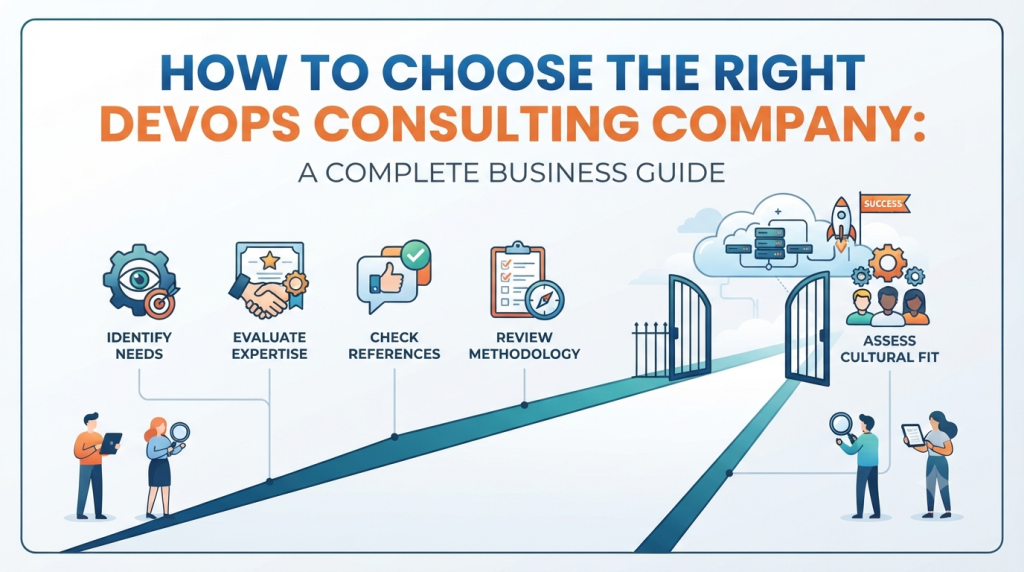
Introduction
Modern businesses depend on software, cloud platforms, and digital services. They need to release updates quickly, maintain reliable systems, and protect important business data. However, managing these responsibilities can become difficult as applications and infrastructure grow.
Many organizations adopt DevOps to improve software delivery and IT operations. DevOps combines development, operations, automation, and continuous improvement. It helps teams work together and deliver software more efficiently.
However, successful DevOps adoption requires the right skills, tools, processes, and technical experience. Some companies have experienced engineers who can manage this transformation internally. Others need external expertise to improve their infrastructure and development workflows.
This is where a DevOps consulting company can help.
A DevOps consulting company works with businesses to assess existing systems, design better processes, automate infrastructure, improve deployment pipelines, and strengthen operational reliability. The right partner can help reduce manual work, improve software quality, and support long-term business growth.
But choosing a consulting company is not always easy. Many providers offer similar services and use similar technology names. Some focus on strategy, while others provide implementation, training, managed support, or complete engineering transformation.
A wrong choice can lead to unnecessary costs, complex infrastructure, poor communication, and long-term technical problems.
This guide explains how to choose the right DevOps consulting company. It covers technical expertise, industry experience, service capabilities, pricing, security, communication, project management, and measurable results. It also provides a practical evaluation checklist that businesses can use before selecting a consulting partner.
1. Understand Why Your Business Needs DevOps Consulting
Before contacting a consulting company, understand why your organization needs external DevOps support.
Every business has different technical challenges. A startup may need help creating its first CI/CD pipeline. A growing software company may want to move applications to the cloud. A large enterprise may need to modernize its infrastructure and improve production reliability.
Clearly identifying your needs makes it easier to select the right consulting partner.
Common Reasons Businesses Hire DevOps Consultants
Slow Software Releases
Some organizations depend on manual deployment processes. These processes take time and increase the risk of mistakes. DevOps consultants can help automate builds, tests, and deployments.
Complex Infrastructure
Managing servers, networks, databases, and cloud resources becomes difficult as applications grow. Consultants can help simplify infrastructure and introduce automation.
Limited Internal Expertise
Some companies do not have enough specialists in Kubernetes, cloud engineering, CI/CD, or Infrastructure as Code. External consultants can provide the skills needed for specific projects.
Frequent Production Issues
Application downtime, failed deployments, and infrastructure problems can affect customers. Consultants can improve monitoring, incident response, and system reliability.
Cloud Migration Challenges
Moving applications from traditional infrastructure to cloud platforms requires planning and technical knowledge. DevOps consultants can help assess workloads and create migration strategies.
Security and Compliance Requirements
Businesses need to protect applications, infrastructure, and customer data. DevOps consultants with security expertise can integrate security checks into software delivery.
Define Your Main Business Objective
Before selecting a provider, write down the problem you want to solve.
For example:
- Reduce deployment time.
- Improve application availability.
- Automate infrastructure provisioning.
- Migrate applications to AWS, Azure, or GCP.
- Improve Kubernetes operations.
- Reduce cloud infrastructure costs.
- Integrate security into CI/CD pipelines.
- Improve monitoring and incident response.
- Train internal engineering teams.
A clear objective helps consultants recommend suitable solutions instead of selling unnecessary services.
2. Identify the Type of DevOps Consulting Service You Need
Not every business needs the same type of consulting engagement. Some organizations need technical advice, while others need engineers who can implement and operate systems.
Understanding the available service models helps you choose a provider that matches your requirements.
DevOps Assessment and Strategy
An assessment examines your existing engineering environment.
A consulting team may review:
- Development and deployment processes.
- Existing CI/CD pipelines.
- Cloud infrastructure.
- Application architecture.
- Monitoring and logging.
- Security practices.
- Team capabilities.
- Infrastructure costs.
The output should include a clear understanding of current problems and a prioritized improvement roadmap.
This service is useful when your organization knows that its DevOps process needs improvement but does not know where to start.
DevOps Implementation
Implementation involves building or improving technical systems.
Typical activities include:
- Setting up CI/CD pipelines.
- Configuring cloud infrastructure.
- Implementing Infrastructure as Code.
- Creating container platforms.
- Automating deployment processes.
- Integrating monitoring tools.
- Improving security controls.
Choose this service when you need working technical solutions rather than recommendations alone.
Managed DevOps Support
Managed support provides ongoing assistance with infrastructure and production operations.
Services may include:
- Infrastructure monitoring.
- Incident response.
- Deployment support.
- Cloud operations.
- Performance optimization.
- System maintenance.
- Operational reporting.
This model can help businesses that need ongoing engineering support but do not want to build a large internal operations team.
DevOps Training and Enablement
Training helps internal employees develop the skills needed to manage modern engineering environments.
Programs may cover:
- DevOps fundamentals.
- CI/CD automation.
- Docker and Kubernetes.
- Cloud platforms.
- Terraform.
- Site Reliability Engineering.
- DevSecOps.
- Monitoring and observability.
Choose a provider that offers practical labs and exercises related to your technology stack.
Cloud and Infrastructure Migration
Migration services help businesses move applications and infrastructure between environments.
This may include:
- Data center to cloud migration.
- Virtual machine migration.
- Monolith modernization.
- Container adoption.
- Kubernetes migration.
- Database migration.
- Hybrid cloud architecture.
Migration planning should address security, testing, rollback, downtime, and data protection.
DevOps Outsourcing and Dedicated Engineering Teams
Some businesses need additional engineers for a longer period.
An outsourcing partner may provide dedicated DevOps, SRE, cloud, or platform engineering professionals who work with your internal teams.
Before selecting this model, clarify team responsibilities, reporting structure, access permissions, service expectations, and knowledge transfer.
3. Check the Company’s Technical Expertise
Technical expertise is one of the most important factors when choosing a DevOps consulting company.
A provider should understand the technologies used by your organization. It should also know how to select and integrate tools based on your actual requirements.
Do not judge a company only by the number of tools displayed on its website. Ask how its engineers have used those technologies in real environments.
Linux and Infrastructure Management
Linux is widely used in cloud infrastructure, application servers, containers, and automation systems.
Your consulting partner should understand:
- Linux administration.
- Server configuration.
- User and permission management.
- System monitoring.
- Network configuration.
- Log analysis.
- Performance troubleshooting.
- Infrastructure security.
CI/CD Pipeline Expertise
CI/CD helps automate software building, testing, and deployment.
Common tools include:
- Jenkins.
- GitHub Actions.
- GitLab CI/CD.
- Azure DevOps.
- CircleCI.
Ask whether the provider can design pipelines that support your development process, testing requirements, deployment environments, and rollback strategy.
Cloud Platform Knowledge
A DevOps consulting company should understand the cloud platforms relevant to your business.
Common platforms include:
- Amazon Web Services.
- Microsoft Azure.
- Google Cloud Platform.
Ask about experience with cloud networking, IAM, storage, compute, managed databases, monitoring, security, and cost optimization.
Containers and Kubernetes
Docker and Kubernetes are important in many cloud-native environments.
Your consulting partner should understand container image creation, orchestration, cluster management, workload security, networking, and resource optimization.
Infrastructure as Code
Infrastructure as Code allows teams to create and manage infrastructure through configuration files.
Popular tools include:
- Terraform.
- OpenTofu.
- Ansible.
- AWS CloudFormation.
- Pulumi.
A qualified provider should know how to create reusable infrastructure modules, manage configuration, review changes, and protect sensitive values.
Monitoring and Observability
A reliable engineering environment needs visibility into applications and infrastructure.
Useful tools include:
- Prometheus.
- Grafana.
- OpenTelemetry.
- ELK Stack.
- Datadog.
- New Relic.
Ask how the consulting team handles metrics, logs, traces, alerting, and incident investigation.
The best provider is not necessarily the one that uses the most tools. It is the one that understands which technologies solve your problems.
4. Evaluate Relevant Industry Experience
Technical skills are important, but industry experience also matters.
Different industries have different application architectures, security needs, compliance requirements, and operational expectations.
For example, a financial organization may need strict access controls and audit records. An e-commerce business may need scalable infrastructure for changing customer traffic. A healthcare company may need careful handling of sensitive data.
A consulting company should understand the operational challenges of your industry.
Questions to Ask About Industry Experience
- Have you worked with companies of similar size?
- Have you supported applications with similar traffic?
- Have you managed similar infrastructure?
- Have you handled strict security requirements?
- Can you share relevant project examples?
- What problems did your team solve?
- What results did the project achieve?
Review Relevant Case Studies
Case studies can help you understand how a consulting provider works.
Look for information about:
- The client’s original problem.
- The technology environment.
- The consulting approach.
- Implementation activities.
- Project duration.
- Challenges encountered.
- Measurable outcomes.
A useful case study explains what changed and why it mattered.
Be careful with vague statements such as “improved efficiency” or “transformed operations.” Ask for meaningful measurements when the provider is allowed to share them.
5. Evaluate the Company’s Assessment Methodology
A reliable DevOps consulting company should understand your current environment before recommending major changes.
Every organization has different infrastructure, team structures, applications, and business requirements.
A provider that immediately recommends the same tools to every client may not be considering your actual needs.
What a Good Assessment Should Cover
Infrastructure Review
The consulting team should examine servers, cloud resources, networking, storage, and infrastructure architecture.
CI/CD Review
The team should evaluate build processes, testing, deployment automation, and release management.
Security Review
The assessment should consider access control, secrets management, vulnerability scanning, and security practices.
Monitoring Review
The provider should examine logs, metrics, alerts, dashboards, and incident response processes.
Team Capability Review
The team should understand existing skills, responsibilities, communication, and operational workflows.
Cost Review
The assessment should identify unnecessary infrastructure spending and possible optimization opportunities.
Expected Assessment Deliverables
Ask the provider to explain what you will receive after the assessment.
Useful deliverables may include:
- Current-state architecture diagram.
- Engineering maturity scorecard.
- Technical gap analysis.
- Security and reliability observations.
- Prioritized improvement plan.
- Estimated project phases.
- Initial implementation recommendations.
The assessment should help your organization make informed decisions.
6. Look for a Security-First Approach
Security should be part of every DevOps project.
A consulting company should not treat security as a final activity after infrastructure and pipelines are already built.
It should integrate suitable security controls into development, testing, deployment, and operations.
Important Security Capabilities
Identity and Access Management
The provider should understand user roles, service identities, permissions, and least-privilege access.
Secrets Management
Passwords, API keys, certificates, and tokens must be protected. They should not be stored in public repositories or exposed through pipeline logs.
Vulnerability Management
The consulting team should know how to identify, assess, prioritize, and remediate vulnerabilities.
Container Security
Container images should be scanned and configured with suitable security settings.
Cloud Security
Cloud resources should use appropriate network rules, encryption, logging, and access policies.
Secure CI/CD Pipelines
Security testing should be integrated into the software delivery process.
Useful Security Tools
- SonarQube.
- Semgrep.
- Trivy.
- Snyk.
- OWASP ZAP.
- Checkov.
- Gitleaks.
- HashiCorp Vault.
Compliance Knowledge
Depending on your industry, you may need to consider frameworks and standards such as:
- ISO 27001.
- SOC 2.
- PCI DSS.
- HIPAA.
- GDPR.
- NIST Cybersecurity Framework.
The consulting provider should understand the technical controls relevant to your requirements. It should not promise compliance without understanding your environment and the scope of the assessment.
7. Check the Quality of the Consulting Team
The experience of the actual delivery team matters more than the promises made during sales discussions.
Some consulting companies use experienced engineers during presentations but assign different resources after the project begins.
Ask who will work on your engagement.
Evaluate the Assigned Consultants
Consider:
- Years of relevant technical experience.
- Cloud and DevOps certifications.
- Production infrastructure experience.
- Previous project responsibilities.
- Problem-solving ability.
- Communication skills.
- Experience with your technology stack.
Practitioner-Led Consulting
A practitioner-led team includes professionals who have built, maintained, and operated real engineering systems.
These engineers can discuss practical issues such as deployment failures, infrastructure drift, production incidents, scaling limitations, and security risks.
Ask whether the people who design the solution will also participate in implementation.
Confirm Team Availability
Clarify:
- Who is the technical lead?
- Who manages the project?
- Who performs implementation?
- How many engineers are assigned?
- What happens if an engineer leaves?
- How can your team contact them?
- Are senior engineers available for technical decisions?
Clear answers reduce the risk of project delays and unexpected staffing changes.
8. Evaluate Communication and Collaboration
DevOps consulting involves continuous interaction between external engineers and internal teams.
Poor communication can delay implementation and create misunderstandings.
Choose a provider that explains technical issues clearly and works collaboratively with your employees.
Important Communication Practices
Regular Meetings
The consulting team should arrange suitable project meetings and technical discussions.
Progress Reports
Reports should explain completed work, upcoming tasks, risks, and blockers.
Clear Documentation
Technical decisions, architecture, configurations, and operational procedures should be documented.
Issue Tracking
The provider should use an agreed process to manage tasks, bugs, incidents, and change requests.
Knowledge Sharing
Internal employees should understand the systems being implemented.
Questions to Ask
- How often will we receive progress updates?
- Which project management tools do you use?
- Who will be our main contact?
- How do you handle technical disagreements?
- How do you communicate urgent issues?
- Will our engineers participate in implementation?
A good consulting partner should make your internal team stronger, not keep all technical knowledge to itself.
9. Check Whether the Company Offers End-to-End Services
Some providers only create strategy documents. Others can assess, design, implement, operate, and improve engineering systems.
The right service scope depends on your business requirements.
End-to-End DevOps Capabilities
| Service | What It Includes |
|---|---|
| Assessment | Reviewing current systems and identifying gaps |
| Strategy | Creating an improvement roadmap |
| Architecture | Designing cloud and infrastructure solutions |
| Implementation | Building pipelines and automation |
| Migration | Moving applications and infrastructure |
| Security | Integrating security controls |
| Monitoring | Improving observability and alerting |
| Support | Managing production operations |
| Training | Developing internal team skills |
| Optimization | Improving performance and cost efficiency |
An end-to-end provider can reduce the need to coordinate several vendors.
However, a specialist firm may be a better choice when your requirement is narrow and highly technical.
Do not pay for services that your organization does not need.
10. Understand the Consulting Company’s Delivery Process
A professional consulting company should follow a clear delivery methodology.
The process should explain how the team moves from initial discussions to implementation and handover.
A typical DevOps consulting engagement can include the following stages.
Stage 1: Discovery
The consulting team understands your business goals, applications, infrastructure, and current problems.
Stage 2: Assessment
The team reviews technical systems, processes, security, and team capabilities.
Stage 3: Planning
The provider prepares a roadmap with priorities, timelines, responsibilities, and expected outcomes.
Stage 4: Design
The team creates the target architecture and selects suitable tools and technologies.
Stage 5: Implementation
Engineers build pipelines, automate infrastructure, configure cloud resources, and introduce monitoring and security controls.
Stage 6: Testing and Validation
The team checks whether the new systems work as expected. It should test deployment processes, security controls, recovery procedures, and performance.
Stage 7: Knowledge Transfer
The provider explains how to operate, maintain, and troubleshoot the implemented systems.
Stage 8: Ongoing Improvement
The team reviews results and identifies further opportunities for improvement.
Before signing an agreement, ask for a delivery plan with milestones and clear acceptance criteria.
11. Compare Pricing and Cost Structures
Pricing is an important part of choosing a DevOps consulting company.
However, the lowest price does not always provide the best value.
A low-cost provider may have limited experience, unclear deliverables, or insufficient support. A more expensive provider may offer better technical expertise and a stronger implementation process.
The goal is to understand what you are paying for.
Common Pricing Models
Fixed-Price Engagement
The provider charges an agreed amount for a defined scope of work.
This model is useful for projects with clear requirements, such as an infrastructure assessment or a specific pipeline implementation.
Hourly or Daily Pricing
The company charges based on the time spent by consultants.
This model can work for advisory services, troubleshooting, and flexible technical support.
Monthly Retainer
The business pays a recurring fee for an agreed level of consulting or support.
This model is useful for ongoing engineering assistance.
Dedicated Team Pricing
The provider assigns engineers or a team for a defined period.
This model can support long-term infrastructure development and managed engineering work.
Managed Services Pricing
The provider charges for ongoing operations based on service scope, infrastructure size, support hours, and agreed service levels.
What Should a Proposal Include?
Ask for a detailed commercial proposal covering:
- Project scope.
- Services included.
- Services excluded.
- Assigned team.
- Estimated timeline.
- Deliverables.
- Payment schedule.
- Support coverage.
- Change request process.
- Additional charges.
- Termination conditions.
Consider the Total Cost of Ownership
The initial consulting fee is only one part of the overall cost.
Your organization may also need to pay for:
- Cloud infrastructure.
- Software licenses.
- Monitoring services.
- Security tools.
- Training.
- Ongoing maintenance.
- Support contracts.
- Future infrastructure changes.
Ask the provider to explain the expected operating costs of its recommended architecture.
A good consulting company considers long-term cost, not just the initial implementation budget.
12. Ask About Measurable Results and KPIs
A DevOps consulting project should produce measurable improvements.
Avoid selecting a provider based only on promises or general statements.
Ask how the company measures success and which indicators it will track.
Important DevOps KPIs
Deployment Frequency
Measures how often an organization successfully releases software.
Lead Time for Changes
Measures the time between a code change and its successful release.
Change Failure Rate
Measures the proportion of deployments that cause failures or require corrective action.
Mean Time to Restore (MTTR)
Measures how quickly a team restores service after an incident.
These four indicators are commonly associated with DORA’s software delivery performance model.
Other useful business and operational measurements include:
- Build duration.
- Deployment success rate.
- Application availability.
- Incident frequency.
- Infrastructure utilization.
- Cloud spending.
- Security findings.
- Vulnerability remediation time.
- Developer productivity.
- Recovery test results.
Set a Baseline Before Implementation
Before the project begins, measure the current state.
For example:
- How long does a deployment take?
- How often do releases fail?
- How long does incident recovery take?
- How much time do engineers spend on manual tasks?
- How much does cloud infrastructure cost?
Then agree on realistic improvement targets.
This makes it easier to understand whether the consulting engagement has delivered value.
13. Review Client References and Case Studies
Client references help you evaluate the provider’s experience and working style.
A company website may contain testimonials, but you should look for detailed evidence whenever possible.
What to Review
Similar Projects
Look for projects involving comparable technologies, infrastructure, and business challenges.
Project Outcomes
Check whether the company describes measurable improvements.
Client Feedback
Look for comments about technical quality, communication, reliability, and knowledge transfer.
Long-Term Relationships
Ongoing partnerships can provide useful evidence of consistent service quality, although they should not be treated as proof on their own.
Questions for Client References
If the provider can introduce a reference, ask:
- Did the consulting team understand your requirements?
- Were project milestones completed as agreed?
- Was the technical implementation maintainable?
- Did the team communicate clearly?
- Was knowledge transfer included?
- Were there unexpected costs?
- Would you work with the provider again?
Respect confidentiality agreements and do not expect every company to disclose client identities or private project details.
14. Check Scalability and Flexibility
Your business needs may change over time.
A small organization may initially need one CI/CD pipeline. Later, it may require multi-environment deployments, Kubernetes, cloud cost management, security automation, and production support.
Your consulting partner should understand how to design solutions that can evolve.
Important Scalability Considerations
Infrastructure Scalability
Can the architecture support additional workloads and increased traffic?
Team Scalability
Can the provider support more applications, teams, or engineering projects?
Technology Flexibility
Can the consulting company work with your existing tools and infrastructure?
Operational Flexibility
Can it support changes in deployment frequency, availability requirements, and business priorities?
Cloud Flexibility
Can it help manage hybrid or multi-cloud environments when those are justified?
Avoid Unnecessary Complexity
Scalability does not mean every business needs Kubernetes, microservices, or multi-cloud architecture.
A simple application may work well with managed cloud services or virtual machines.
The consulting company should recommend architecture based on actual requirements, costs, team skills, and operational complexity.
15. Understand Knowledge Transfer and Documentation
Knowledge transfer is one of the most important parts of a successful consulting engagement.
Your business should not become completely dependent on external consultants to operate its own systems.
A good consulting partner works with internal employees and explains the implemented solutions.
Important Documentation
Ask whether the provider will deliver:
- Architecture diagrams.
- Infrastructure code.
- CI/CD pipeline configurations.
- Deployment procedures.
- Monitoring dashboards.
- Alerting rules.
- Incident response runbooks.
- Security configurations.
- Troubleshooting guides.
- Operational documentation.
Practical Knowledge Transfer
Documentation alone is not enough.
The provider should also arrange:
- Technical walkthroughs.
- Pair programming.
- Hands-on training.
- Deployment demonstrations.
- Troubleshooting exercises.
- Operational handover sessions.
Your internal team should be able to maintain and improve the system after the engagement ends.
16. Check Contracts, Scope, and Service-Level Agreements
A clear contract protects both your business and the consulting provider.
Before signing, understand the responsibilities of each party.
Important Contract Details
Scope of Work
Define the applications, infrastructure, environments, and activities included in the project.
Deliverables
List the technical outputs, documentation, training, and reports.
Timeline
Include project phases, milestones, dependencies, and expected completion dates.
Acceptance Criteria
Explain how each deliverable will be reviewed and approved.
Ownership
Clarify ownership of code, scripts, configurations, documentation, and other project outputs.
Confidentiality
Define how business information and sensitive data will be protected.
Access Management
Specify how consultants receive access, which permissions they need, and when access will be removed.
Change Management
Explain how additional work and changes to the project scope will be handled.
Service-Level Agreements
If the consulting company provides ongoing support, review its SLA carefully.
Check:
- Support hours.
- Incident severity levels.
- Response targets.
- Escalation procedures.
- Communication channels.
- Availability commitments.
- Reporting requirements.
Response time and resolution time are different. Make sure the contract explains both where relevant.
For critical production systems, agree on support arrangements before the service begins.
17. Identify Warning Signs Before Hiring a Consultant
Some warning signs may indicate that a consulting company is not suitable for your project.
Recognizing them early can prevent expensive mistakes.
Common Red Flags
Unrealistic Guarantees
Be careful when a provider promises zero downtime, complete automation, or guaranteed business results without reviewing your systems.
No Discovery Process
A company that recommends a complete architecture before understanding your environment may be offering a generic solution.
Tool-First Recommendations
A consultant should explain why a tool fits your needs. Avoid providers that push a particular product without considering alternatives.
Unclear Project Scope
Vague descriptions such as “complete DevOps transformation” are not enough. Ask for specific deliverables.
Limited Technical Access to Senior Engineers
If you cannot speak with the people responsible for technical decisions, it may be difficult to evaluate the team’s expertise.
No Documentation Plan
A provider that does not include documentation and handover can create long-term dependency.
Unclear Pricing
Hidden fees and vague support costs can increase the total project budget.
Weak Security Practices
Avoid providers that request broad access without justification or do not explain how they protect credentials and client data.
No Measurable Success Criteria
A project should have clear goals. If the provider cannot explain how results will be measured, evaluating success becomes difficult.
18. Use a Practical Scorecard to Compare Consulting Companies
When evaluating several providers, use a structured scorecard.
It helps your team compare companies using the same criteria instead of making decisions based only on presentations or pricing.
The following weights are an example. Adjust them based on your business priorities.
| Evaluation Criteria | Suggested Weight |
|---|---|
| Technical expertise and relevant experience | 20% |
| Assessment and implementation methodology | 15% |
| Security and compliance capabilities | 15% |
| Communication and collaboration | 10% |
| Knowledge transfer and documentation | 10% |
| Case studies and references | 10% |
| Scope, pricing, and transparency | 10% |
| Support and scalability | 10% |
| Total | 100% |
How to Score Each Provider
Give each company a score from 1 to 5.
- 1 = Poor.
- 2 = Below expectations.
- 3 = Meets basic expectations.
- 4 = Strong.
- 5 = Excellent.
Multiply each category score by its assigned weight. Add the weighted scores to compare providers.
For example, a provider with strong technical experience but weak documentation may not be the best choice for a business that wants to operate its infrastructure independently.
Use the scorecard as a decision aid, not as a substitute for technical due diligence.
19. Questions to Ask Before Selecting a DevOps Consulting Company
Before signing an agreement, arrange a technical discussion with each shortlisted provider.
The following questions can help you understand how they work.
Experience and Expertise
- How many years of experience does your team have in DevOps consulting?
- Have you worked with businesses in our industry?
- Which cloud platforms and technologies do you support?
- Can you share examples of similar projects?
- Who will lead our technical engagement?
Assessment and Implementation
- How do you assess an existing DevOps environment?
- What deliverables will we receive?
- How do you choose tools and technologies?
- How do you handle legacy applications?
- How do you test and validate implementations?
Security and Reliability
- How do you protect client credentials and infrastructure access?
- How do you integrate security testing into CI/CD?
- How do you manage production incidents?
- How do you monitor application reliability?
- How do you support compliance requirements?
Project Management
- How often will we receive progress updates?
- How do you manage project changes?
- What happens if a milestone is delayed?
- How do you measure project success?
- What knowledge transfer is included?
Commercial Terms
- What is included in the quoted price?
- Are cloud and software costs separate?
- How are additional requests charged?
- What support is available after implementation?
- What are the termination and handover conditions?
The answers should be specific and supported by examples wherever possible.
20. How to Choose a DevOps Consulting Company Based on Business Size
The right consulting partner can differ depending on the size and maturity of your organization.
Startups
Startups often need a simple and cost-effective engineering environment.
Their priorities may include:
- Setting up initial cloud infrastructure.
- Creating CI/CD pipelines.
- Automating deployments.
- Managing basic monitoring.
- Protecting application secrets.
- Building reliable development workflows.
Startups should look for consultants who can build practical solutions without introducing unnecessary complexity.
Small and Medium Businesses
Growing businesses may need to improve existing infrastructure and support more applications.
Their priorities may include:
- Infrastructure automation.
- Cloud migration.
- Container adoption.
- Monitoring improvements.
- Security integration.
- Internal team training.
Choose a provider that can support growth while keeping infrastructure manageable.
Large Enterprises
Enterprises often operate complex environments with multiple teams, applications, and compliance requirements.
Their priorities may include:
- Enterprise CI/CD architecture.
- Platform engineering.
- Multi-account cloud governance.
- DevSecOps implementation.
- Hybrid infrastructure.
- SRE practices.
- FinOps.
- Large-scale migration.
- 24×7 operational support.
Large organizations should evaluate the provider’s governance, security, delivery capacity, and ability to work with existing enterprise processes.
21. How DevOpsConsulting.in Can Support Your Business
When comparing providers, businesses should review the actual services, technical domains, delivery models, and engagement options available from each company.
DevOpsConsulting.in presents itself as an engineering transformation partner offering consulting, implementation, training, outsourcing, migration, support, and advisory services.
Its website describes capabilities across several engineering domains, including DevOps, SRE, DevSecOps, CloudOps, Platform Engineering, GitOps, FinOps, DataOps, AIOps, MLOps, LLMOps, SecOps, ITOps, and SysOps.
These capabilities can be relevant to businesses looking for support beyond basic CI/CD implementation.
Consulting and Assessment
Organizations can explore consulting support for engineering maturity assessments, architecture reviews, and transformation roadmaps.
This can help businesses understand their current technical environment and identify improvement priorities.
Implementation Services
Implementation support can include:
- CI/CD pipeline construction.
- Infrastructure as Code.
- Toolchain configuration.
- Platform engineering.
- Cloud infrastructure automation.
- Security integration.
- Monitoring setup.
Managed Support
Businesses that need ongoing operational assistance can evaluate managed support options for monitoring, incident response, and continuous improvement.
Cloud and Infrastructure Migration
Organizations planning to modernize infrastructure can explore migration support for legacy-to-cloud-native environments.
Corporate Training
Internal teams can develop practical skills through hands-on training in DevOps and related engineering domains.
Why Consider a Broad Engineering Partner?
Some organizations need expertise across several connected areas. For example, a cloud migration may also require infrastructure automation, security, monitoring, and cost management.
Working with a provider that understands these related domains may simplify coordination.
However, every business should independently verify the assigned team’s experience, proposed scope, references, delivery commitments, and commercial terms.
You can explore the company’s services at https://www.devopsconsulting.in/.
22. Common Mistakes Businesses Make When Choosing a DevOps Consultant
Even experienced organizations can make mistakes during the selection process.
Avoiding these mistakes can improve your chances of choosing a suitable partner.
Choosing Only Based on Price
A low quote may look attractive, but it may not include the technical expertise, documentation, or support you need.
Compare the total value and long-term costs.
Ignoring Internal Team Readiness
A new DevOps system will only succeed if employees can understand and operate it.
Include internal engineers in the planning and implementation process.
Selecting Tools Before Defining Problems
Do not choose Kubernetes, Terraform, or a specific CI/CD tool simply because it is popular.
Define your requirements first, then select suitable technologies.
Ignoring Security
Security should be part of the architecture and delivery process from the beginning.
Review how the provider manages access, secrets, vulnerabilities, and infrastructure security.
Not Defining Success Metrics
Without baseline measurements and clear targets, it becomes difficult to evaluate project results.
Define KPIs before implementation begins.
Forgetting Knowledge Transfer
A consulting project should leave your organization with working systems and the ability to manage them.
Include documentation, training, and handover in the agreement.
Ignoring Long-Term Support
Some businesses need ongoing assistance after implementation.
Discuss support options and operational responsibilities before the project starts.
23. Future Trends to Consider When Choosing a DevOps Consulting Company
DevOps continues to evolve as organizations adopt new infrastructure models and engineering practices.
When selecting a consulting partner, consider whether it understands technologies that may affect your future needs.
Platform Engineering
Platform engineering helps organizations create internal developer platforms and reusable workflows.
It can improve developer experience and reduce repeated infrastructure work.
DevSecOps
DevSecOps integrates security into development and operations.
Businesses can use automated security testing, secrets management, vulnerability scanning, and policy enforcement to reduce risk.
GitOps
GitOps uses Git repositories as a source of truth for infrastructure and application deployment.
Tools such as Argo CD and Flux help automate Kubernetes-based delivery.
FinOps
FinOps helps businesses understand and manage cloud spending.
A consulting company with FinOps expertise can help improve cost visibility, resource allocation, and infrastructure efficiency.
AIOps
AIOps applies AI and machine learning techniques to IT operations.
It can support anomaly detection, alert correlation, and operational analysis.
MLOps and LLMOps
MLOps focuses on managing machine learning workflows. LLMOps supports the deployment, monitoring, and operation of large language model applications.
Businesses building AI-powered services may need these capabilities.
Choose a consulting company that understands current technologies but does not force every new trend into your architecture. Recommendations should match business needs and technical readiness.
Frequently Asked Questions (FAQs)
1. What is a DevOps consulting company?
A DevOps consulting company helps businesses improve software development and IT operations. It may assess existing infrastructure, design CI/CD pipelines, automate deployments, manage cloud environments, introduce monitoring, and improve security practices. Some providers also offer training, migration, outsourcing, and ongoing operational support.
2. Why should a business hire a DevOps consulting company?
A business may hire a DevOps consulting company when it lacks internal expertise, struggles with manual deployments, experiences frequent production issues, or needs cloud migration support. Consultants can help identify technical problems and implement suitable solutions. The right partner can also help internal teams adopt better engineering practices.
3. How do I choose the best DevOps consulting company?
Start by defining your business goals. Then evaluate the provider’s technical expertise, relevant experience, implementation capabilities, security practices, communication, pricing, and client references. Ask for a clear project plan, measurable success criteria, documentation, and knowledge transfer. Compare several providers before making a decision.
4. What services should a DevOps consulting company provide?
Depending on your requirements, services may include DevOps assessment, CI/CD implementation, cloud migration, Infrastructure as Code, Kubernetes, monitoring, security automation, SRE, managed support, and corporate training. You should select services based on your current problems and future business objectives.
5. How much does DevOps consulting cost?
The cost depends on project scope, duration, complexity, consultant experience, infrastructure size, and support requirements. Providers may use fixed-price, hourly, daily, monthly retainer, or dedicated-team pricing. Ask for a detailed proposal that explains deliverables, additional charges, and ongoing operating costs.
6. What technical skills should a DevOps consultant have?
A DevOps consultant should understand Linux, networking, Git, scripting, CI/CD, cloud computing, containers, Kubernetes, Infrastructure as Code, and monitoring. Depending on the project, security, SRE, FinOps, and platform engineering knowledge may also be important.
7. How can I check whether a DevOps consulting company is reliable?
Review relevant case studies, client references, technical experience, and the qualifications of the assigned team. Ask how the company assesses environments, manages projects, protects client access, and handles knowledge transfer. A reliable provider should explain its process clearly and avoid unsupported guarantees.
8. What is the difference between DevOps consulting and DevOps outsourcing?
DevOps consulting usually focuses on advice, assessment, architecture, strategy, and implementation guidance. DevOps outsourcing provides external engineers or teams to perform defined technical responsibilities. Some companies offer both models, allowing businesses to select the level of support they need.
9. How long does a DevOps consulting project take?
The duration depends on the project scope. A focused assessment may take a few weeks, while a pipeline implementation or migration can take longer. Large enterprise transformations may require several months or more. The consulting provider should define phases, dependencies, and realistic milestones before work begins.
10. Why is knowledge transfer important in DevOps consulting?
Knowledge transfer helps internal teams understand and maintain the systems created by consultants. It reduces long-term dependency and improves operational continuity. Documentation, training, pair programming, and technical walkthroughs should be included in the engagement.
11. Should I choose a consulting company that specializes in one cloud platform?
It depends on your infrastructure and business goals. A specialist may provide deeper knowledge of your preferred cloud platform. A multi-cloud provider may be useful when you operate several environments. Choose a company based on relevant experience rather than the number of platforms it advertises.
12. What questions should I ask before signing a DevOps consulting contract?
Ask about project scope, assigned engineers, deliverables, timeline, pricing, security, ownership, support, and acceptance criteria. Confirm how additional work will be charged and what happens when the engagement ends. Ensure the contract includes documentation and a clear handover process.
13. Can a DevOps consulting company help with cloud migration?
Yes. Many consulting providers help businesses assess applications, plan migration, automate infrastructure, move workloads, and validate systems after migration. A good migration plan should cover security, data protection, testing, rollback, cost, and business continuity.
14. What are the red flags when hiring a DevOps consultant?
Warning signs include unrealistic guarantees, unclear pricing, vague deliverables, weak security practices, no discovery process, and limited access to technical experts. Be cautious when a provider recommends tools before understanding your infrastructure or refuses to include documentation and knowledge transfer.
15. How can DevOpsConsulting.in help businesses?
DevOpsConsulting.in describes services across consulting, implementation, training, outsourcing, migration, advisory, and managed support. Its listed engineering domains include DevOps, SRE, DevSecOps, CloudOps, Platform Engineering, GitOps, FinOps, and other modern engineering practices. Businesses can review its service information and discuss their requirements before selecting an engagement model.
Conclusion
Choosing the right DevOps consulting company is an important business decision. The right partner can help improve software delivery, automate infrastructure, strengthen security, and increase operational reliability. However, businesses should not select a provider based only on price, marketing claims, or a long list of tools.
Start by identifying your business objectives. Then evaluate technical expertise, industry experience, assessment methods, security practices, team quality, communication, and delivery capabilities. Review case studies and ask detailed questions. Compare proposals using measurable criteria. Make sure the contract defines scope, milestones, ownership, support, and knowledge transfer.
Most importantly, choose a partner that helps your internal team become more capable. A successful consulting engagement should leave behind maintainable systems, useful documentation, and measurable improvements. DevOpsConsulting.in is one provider businesses can evaluate for consulting, implementation, migration, training, outsourcing, and managed engineering support. Review its service details and compare its capabilities against your organization’s requirements before making a decision.
A thoughtful selection process can help your business build a stronger DevOps foundation and support long-term digital growth.

Best Cardiac Hospitals Near You
Discover top heart hospitals, cardiology centers & cardiac care services by city.
Advanced Heart Care • Trusted Hospitals • Expert Teams
View Best Hospitals