Introduction
In today’s fast-paced digital market, the speed and reliability of your software delivery are primary drivers of business success, yet many organizations remain hindered by manual, brittle, and inconsistent release processes. This is where DevOps consultants provide critical value, moving beyond mere tooling to strategically assess workflows, implement rigorous CI/CD pipeline optimization , and foster a culture of automation that transforms chaotic delivery cycles into secure, scalable, and high-performance engines. By bridging the gap between development and operations through expert architectural guidance, these professionals help engineering leaders eliminate bottlenecks and accelerate time-to-market, ensuring that every deployment is a routine, low-risk event—you can explore the specialized training and consulting resources available to support this transformation at devopsschool .
What Is a Deployment Pipeline?
At its core, a deployment pipeline is an automated implementation of your application’s build, test, and deployment process. It acts as the bridge between raw source code and a running production environment.
The Fundamentals
- Continuous Integration (CI): The practice of frequently merging code changes into a central repository, where automated builds and tests are run to detect integration errors early.
- Continuous Deployment (CD): The automated process of pushing code changes through various environments (testing, staging, and production) without human intervention, provided the code passes all quality gates.
- Automation: The use of tools to handle repetitive tasks like environment provisioning, testing, packaging, and configuration management, reducing the likelihood of human error.
The purpose of a well-designed pipeline is to ensure that every change to the system is tested and verified, providing a rapid feedback loop for developers and ensuring only high-quality code reaches the user.
Why Deployment Pipeline Optimization Matters
Optimization is not just about moving faster; it is about moving safely and sustainably.
- Faster Releases: By removing manual hand-offs and automating testing, teams can deploy multiple times a day instead of once a month.
- Improved Quality: Automated testing at every stage catches bugs early, preventing defects from reaching production.
- Reduced Downtime: Automated rollbacks and consistent deployment strategies (like Blue-Green) significantly minimize the risk of service disruptions.
- Lower Operational Costs: Automation reduces the time engineers spend on “toil”—repetitive manual work—allowing them to focus on building features.
Common Deployment Pipeline Challenges
| Challenge | Business Impact | Consultant Solution |
| Manual Deployments | Human error, inconsistent results | Implement IaC and automated triggers |
| Inconsistent Environments | “It works on my machine” syndrome | Containerization and ephemeral environments |
| Slow Testing | High developer feedback latency | Parallel execution and test optimization |
| Security Vulnerabilities | Risk of breaches, compliance failure | Shift-left security (DevSecOps) |
| Poor Monitoring | Slow incident response | Integrated observability and alerting |
Role of DevOps Consultants in Pipeline Optimization
DevOps consultants act as objective observers who bridge the gap between development, operations, and business goals. Their role involves:
- Process Assessment: Auditing the current end-to-end flow to find waste.
- Tool Evaluation: Determining if the current stack supports scale or if a transition is needed.
- Workflow Redesign: Eliminating silos and automating manual approval steps.
- Team Enablement: Training staff to maintain the new, optimized systems.
How DevOps Consultants Assess Existing Pipelines
A consultant does not start by changing tools. They start by understanding the current state.
1. Analyze Current Workflow
They map out the entire value stream from code commit to production, noting every touchpoint and delay.
2. Identify Bottlenecks
Consultants look for “queues”—where work sits waiting for a human or a resource—and prioritize removing these constraints.
3. Evaluate Toolchain
They determine if the current tools integrate well or if they are creating islands of automation that do not talk to each other.
4. Review Security Controls
They audit whether security is an afterthought (bolted on at the end) or integrated into the pipeline (DevSecOps).
5. Measure Performance Metrics
They establish baselines for key metrics like Deployment Frequency and Mean Time to Recovery (MTTR).
Building an Optimized CI/CD Pipeline
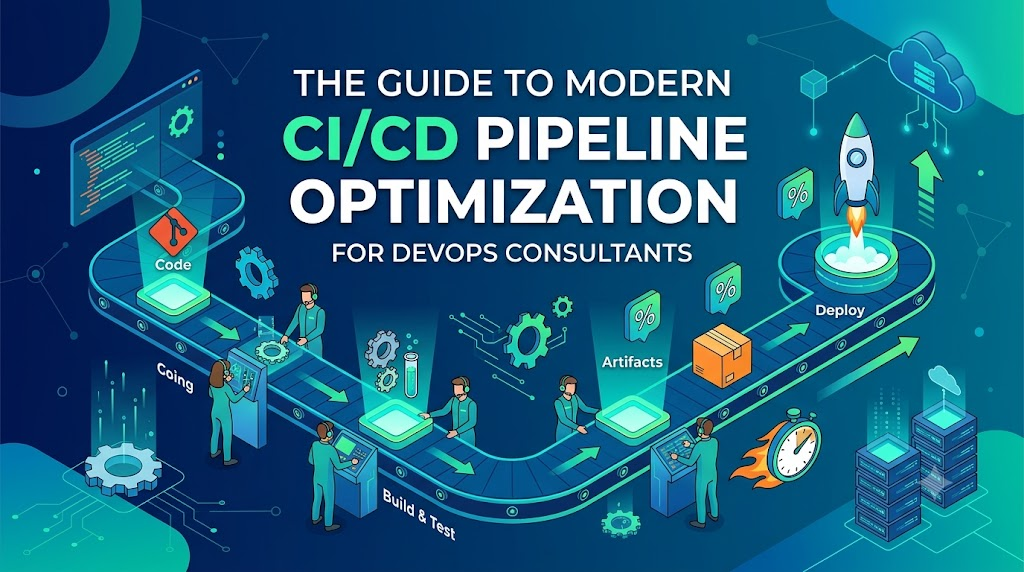
An effective pipeline follows a standard, predictable workflow.
| Stage | Activity | Key Goal |
| Source | Code Commit / Merge | Version control hygiene |
| Build | Compile / Package | Consistency in artifacts |
| Test | Unit, Integration, Security | Quality assurance |
| Deploy | Environment Delivery | Seamless updates |
| Monitor | Feedback Loop | Continuous improvement |
Deployment Automation Best Practices
- Infrastructure as Code (IaC): Treat your infrastructure definition as source code (e.g., Terraform, Ansible) to ensure repeatability.
- Blue-Green Deployments: Maintain two identical production environments; switch traffic between them to eliminate downtime.
- Canary Releases: Roll out changes to a small subset of users before a full release.
- Feature Flags: Decouple deployment from release, allowing you to turn features on/off without re-deploying code.
Improving Pipeline Security
Security must be “shifted left.” This means:
- Secrets Management: Never hardcode credentials; use vaults (e.g., HashiCorp Vault).
- Dependency Scanning: Automatically check open-source libraries for known vulnerabilities before they are integrated.
- Container Security: Scan container images for vulnerabilities during the build process.
Performance Monitoring and Continuous Improvement
An optimized pipeline is never “finished.” It requires:
- Observability: Not just logging, but deep insights into system performance.
- Feedback Loops: Automating alerts to developers immediately when a build fails or a metric degrades.
Measuring Deployment Pipeline Success
| Metric | Why It Matters | Business Value |
| Deployment Frequency | Measures throughput | Faster time to market |
| Lead Time for Changes | Measures agility | Rapid response to demand |
| Change Failure Rate | Measures quality | Stability and trust |
| MTTR | Measures resilience | Minimized business impact |
Common Mistakes Organizations Make
- Over-automation: Automating a broken, inefficient process just makes the bad process run faster.
- Ignoring Testing: Speed without quality leads to disaster.
- Tool Overload: Buying tools before defining the strategy.
Best Practices Used by Experienced DevOps Consultants
- Standardize Workflows: Create reusable templates for teams to follow.
- Automate Everything: If it happens more than once, it should be automated.
- Shift-Left Security: Integrate security checks into the CI/CD flow.
- Monitor Constantly: Use data to drive the next optimization effort.
Real-World Example: Pipeline Transformation
The Challenge: A retail company took 6 hours to deploy, with a 30% failure rate.
The Assessment: The consultant found manual configuration changes and lack of automated testing.
The Strategy: Implemented IaC for environment consistency, introduced automated unit/integration tests, and utilized Canary releases.
The Results: Deployment time dropped to 15 minutes, with a failure rate under 2%. The business gained the ability to release features daily.
Benefits of Hiring DevOps Consultants
| Aspect | Without DevOps Consulting | With DevOps Consulting |
| Deployment Speed | Slow, manual, error-prone | Fast, automated, predictable |
| Reliability | Frequent outages, high risk | Stable, self-healing, low risk |
| Team Productivity | Buried in technical debt | Focused on feature development |
Future of Deployment Pipelines
The future lies in AI-assisted DevOps, where machine learning models predict deployment failures before they happen, and GitOps, where the state of the infrastructure is continuously reconciled with the Git repository.
Certifications & Learning Paths
| Certification | Best For | Skill Level | Focus Area |
| Kubernetes CKA | Platform Engineers | Advanced | Container Orchestration |
| AWS/Azure DevOps | Cloud Engineers | Intermediate | Cloud-native CI/CD |
| CI/CD Specialist | DevOps Teams | Intermediate | Automation Tools |
Common Beginner Mistakes
- Focusing on tools: Remember, DevOps is a culture, not a tool purchase.
- Skipping fundamentals: You cannot optimize a pipeline if you do not understand Linux and networking.
FAQs
- What is a deployment pipeline? An automated process for moving code from development to production.
- Why is pipeline optimization important? It increases speed, quality, and reliability while reducing costs.
- What do DevOps consultants do? They assess, redesign, and automate your delivery processes.
- How does CI/CD improve deployments? It removes manual steps and provides early feedback.
- What are Blue-Green deployments? A strategy to switch traffic between two identical production environments to ensure zero downtime.
- Why is automation important? It eliminates human error and increases speed.
- How do consultants improve release quality? Through automated testing and security gates.
- How can organizations get started? By auditing their current flow and identifying the largest bottleneck.
- What is IaC? Managing infrastructure using code files.
- What is Shift-Left? Doing tasks like security/testing earlier in the development lifecycle.
- What is MTTR? Mean Time to Recovery—how fast you fix a failure.
- Is DevOps a role or a process? It is both a culture and a methodology.
- Do I need cloud for DevOps? It is highly recommended for scalability.
- How often should I deploy? As often as the business value justifies, ideally daily.
- What is the most common mistake? Ignoring testing or manual bottlenecks.
Final Thoughts
Optimizing a deployment pipeline is a journey of continuous improvement. It requires a shift in mindset from “manual verification” to “automated quality.” By partnering with experienced DevOps consultants, organizations can move past the common traps of tool-focused implementation and move toward building a robust, automated delivery culture that drives actual business value.

Best Cardiac Hospitals Near You
Discover top heart hospitals, cardiology centers & cardiac care services by city.
Advanced Heart Care • Trusted Hospitals • Expert Teams
View Best Hospitals