Introduction
Cyber insurance risk platforms are specialized digital solutions designed to help organizations, insurers, and brokers quantify, manage, and mitigate the financial impact of digital threats. Unlike traditional security tools that focus solely on blocking hackers, these platforms translate technical vulnerabilities into financial exposure. They provide the analytical “missing link” between a company’s security posture and its insurance coverage, allowing for more accurate policy pricing and better-informed risk transfer decisions.
The role of these platforms has become indispensable. With the rise of automated extortion and the increasing complexity of cloud-based supply chains, point-in-time assessments are no longer sufficient. Modern platforms offer continuous monitoring and real-time risk scoring, moving the industry away from static annual questionnaires toward a model of active, data-driven resilience. This shift ensures that businesses are not just “buying a policy” but are actively hardening their defenses to remain insurable in a tightening market.
Real-World Use Cases
- Policy Underwriting: Insurers use these platforms to perform non-invasive scans of an applicant’s external attack surface to determine premiums and coverage limits.
- Vendor Risk Management: Enterprises monitor the security ratings of their third-party partners to prevent “ripple effect” breaches through the supply chain.
- Board-Level Reporting: CISOs use financial quantification modules to explain cyber risk in dollars and cents to non-technical stakeholders and boards of directors.
- Incident Readiness: Assessing the likelihood of specific scenarios, such as ransomware or data exfiltration, to prioritize security investments and incident response drills.
- Portfolio Accumulation: Reinsurers analyze aggregated data across thousands of companies to ensure they are not over-exposed to systemic failures in major cloud providers.
Evaluation Criteria for Buyers
- Data Source Variety: Does the platform use outside-in scanning, inside-out telemetry, or a hybrid of both?
- Financial Quantification: Can it translate technical gaps into a specific dollar-based loss distribution?
- Continuous Monitoring: Does it provide real-time alerts when a new vulnerability or misconfiguration is detected?
- Framework Mapping: Are risk findings automatically aligned with standards like NIST, ISO 27001, or SOC 2?
- Underwriting Integration: How easily do the platform’s outputs translate into an actual insurance quote or policy?
- Supply Chain Visibility: Can it effectively track the “fourth-party” risks associated with deep sub-vendors?
- Simulation Depth: Does it allow for “what-if” modeling for emerging threats like AI-enabled social engineering?
- Actionable Remediation: Does the platform provide clear, prioritized steps to fix the issues it discovers?
- User Experience: Is the dashboard intuitive for both technical security teams and risk management professionals?
- Global Scalability: Can the tool handle multi-national footprints with varying regulatory requirements?
Mandatory Paragraph
- Best for: Risk managers, CFOs, insurance brokers, and enterprise security leaders who need to align digital defense spending with financial risk transfer and regulatory compliance.
- Not ideal for: Very small businesses looking for basic antivirus software or companies that do not intend to purchase cyber insurance or manage a formal risk register.
Key Trends in Cyber Insurance Risk Platforms
- Active Insurance Models: A transition toward “active” policies where the insurer provides the risk platform for free to policyholders to maintain a continuous loop of security and coverage.
- AI-Driven Predictive Analytics: The use of machine learning to predict breach likelihood based on historical claims data and real-time threat intelligence feeds.
- Supply Chain Interdependency Mapping: Enhanced visibility into the hidden connections between software-as-a-service providers to prevent massive systemic outages.
- Real-Time Underwriting: Moving toward instant policy adjustments based on live security telemetry rather than waiting for an annual renewal cycle.
- Automation of Compliance Evidence: Platforms are increasingly able to automatically gather and present evidence for insurance applications, reducing the burden on IT teams.
- Cyber Resilience Metrics as KPIs: Organizations are treating “Resilience Scores” as a primary business performance indicator, similar to a credit score.
- Focus on “Silent Cyber” Risks: Improved detection of non-malicious digital risks, such as accidental cloud misconfigurations that lead to massive data exposure.
- Integration with Security Operations: Risk platforms are connecting directly to SIEM and SOAR tools to turn risk insights into immediate defensive actions.
How We Selected These Tools
- Market Visibility and Reputation: We prioritized platforms that are widely recognized by major global insurance carriers and brokerages.
- Analytical Depth: Emphasis was placed on tools that offer sophisticated financial modeling and probabilistic risk assessment.
- Technological Innovation: We selected platforms that are leading the way in real-time scanning and AI-assisted risk prioritization.
- Ease of Integration: The list includes tools that connect seamlessly with the broader security ecosystem and insurance workflows.
- Support for Global Standards: Preference was given to platforms that align with international security and privacy frameworks.
- Customer Success and Adoption: We evaluated the strength of the user community and the consistency of positive professional feedback.
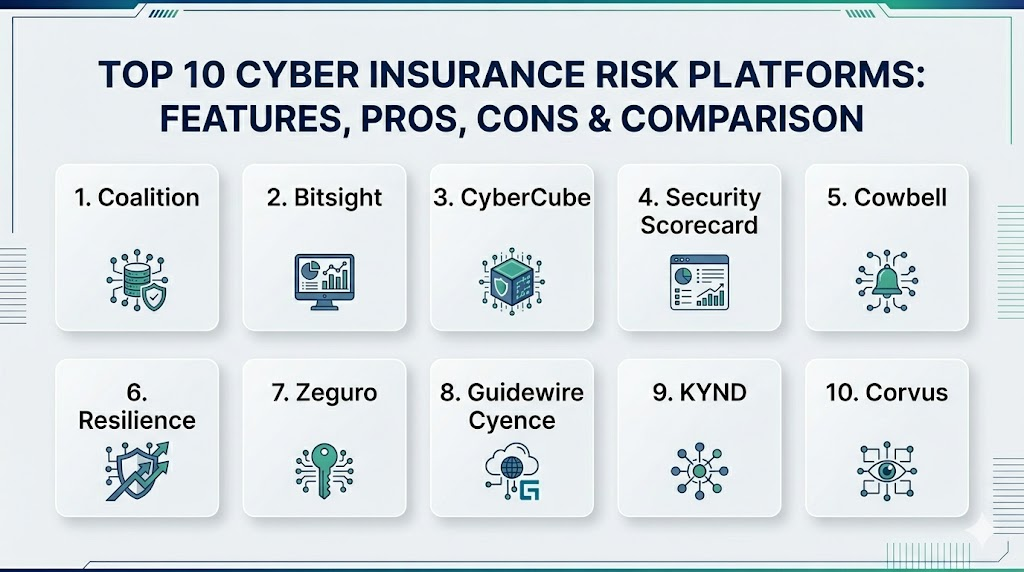
Top 10 Cyber Insurance Risk Platforms
1. Coalition
Coalition is a leader in the “Active Insurance” space, providing a platform that combines comprehensive cyber coverage with proactive risk management tools. It acts as both an insurer and a security partner, continuously monitoring policyholders for emerging threats.
Key Features
- Coalition Control for continuous automated scanning and alerting of the attack surface.
- Automated threat intelligence that identifies vulnerabilities before they lead to claims.
- Integration of security data directly into the underwriting and pricing engine.
- In-house incident response and claims handling teams available 24/7.
- Benchmarking tools to compare security posture against industry peers.
Pros
- Seamlessly links security improvements to potential premium reductions.
- Highly proactive approach that helps prevent breaches before they occur.
Cons
- The deepest features are primarily available to their own policyholders.
- Can be more expensive than standalone software for those not buying their insurance.
Platforms / Deployment
Web / Cloud
Hybrid
Security & Compliance
SOC 2 compliant with rigorous data encryption standards.
Not publicly stated.
Integrations & Ecosystem
Connects with major cloud environments and security suites to pull telemetry. It also integrates with broker portals to simplify the application process for new policies.
Support & Community
Offers 24/7 technical support, a dedicated “Security Labs” research team, and extensive educational webinars for brokers and clients.
2. Bitsight
Bitsight is arguably the most recognized name in the cyber risk rating space. It provides a credit-score-like rating for organizations, which is used by thousands of companies to manage third-party risk and by insurers to underwrite policies.
Key Features
- Daily updated security ratings based on external telemetry and observable data.
- Financial Quantification module that estimates the dollar impact of cyber events.
- Advanced supply chain monitoring to track the risk of thousands of vendors.
- Peer benchmarking to see how an organization ranks within its sector.
- Forecasting tools to see how specific security improvements will affect a rating.
Pros
- The industry standard for third-party risk management and insurance signaling.
- Large data set provides high-confidence ratings across a massive global footprint.
Cons
- Occasional challenges with “false positives” on shared IP addresses.
- The interface can be complex for users who only need basic insights.
Platforms / Deployment
Web / Cloud
Cloud
Security & Compliance
ISO 27001 and SOC 2 Type II certified.
Not publicly stated.
Integrations & Ecosystem
Extensive API library that connects to GRC platforms, vendor management tools, and internal security dashboards for automated reporting.
Support & Community
Very strong professional community and a dedicated customer success model for enterprise clients.
3. CyberCube
CyberCube is the analytics powerhouse designed specifically for the insurance industry. It provides the deep modeling and accumulation insights that reinsurers and large carriers need to manage massive portfolios of cyber risk.
Key Features
- Portfolio Manager for analyzing aggregated risk across thousands of entities.
- Account Manager to assist underwriters in making high-confidence individual decisions.
- Advanced economic modeling for “catastrophic” cyber events like global cloud outages.
- Deep insights into ransomware and systemic risk scenarios.
- Proprietary data lake that combines technical and claims data.
Pros
- Unmatched depth in actuarial-grade risk modeling and accumulation analysis.
- Specifically tailored to the needs of the professional insurance and reinsurance market.
Cons
- Too complex and technical for a typical small business owner.
- High entry cost targeted at large financial institutions.
Platforms / Deployment
Web / Cloud
Cloud
Security & Compliance
Enterprise-grade security protocols for handling sensitive insurance data.
Not publicly stated.
Integrations & Ecosystem
Deeply integrated with insurance-specific workflows and proprietary carrier data sets.
Support & Community
Elite-level support including access to cyber risk experts and catastrophic event modeling specialists.
4. SecurityScorecard
SecurityScorecard provides an easy-to-understand A-through-F grading system for cyber risk. It is widely used for insurance underwriting, self-monitoring, and managing vendor risk at scale.
Key Features
- A-F letter grades across 10 distinct risk factors like DNS health and patching cadence.
- Publicly available ratings for over 12 million organizations worldwide.
- Automatic mapping of security findings to common compliance frameworks.
- Collaboration tools that allow organizations to invite vendors to fix issues.
- Marketplace for third-party security apps and data integrations.
Pros
- Extremely intuitive and easy to communicate to non-technical leaders.
- Very large footprint makes it easy to find a rating for almost any vendor.
Cons
- Letter grades can sometimes lack the nuance required for deep technical audits.
- Remediation advice can occasionally be generic.
Platforms / Deployment
Web / Cloud
Cloud
Security & Compliance
SOC 2 compliant and adheres to global data privacy regulations.
Not publicly stated.
Integrations & Ecosystem
Massive ecosystem of connectors for SIEM, ITSM, and GRC tools. Its API is one of the most widely supported in the industry.
Support & Community
Broad community of users and an extensive knowledge base for self-service learning.
5. Cowbell
Cowbell focuses on the SMB and mid-market sectors, offering “standalone” cyber insurance backed by a platform that emphasizes ease of use and rapid cloud integration.
Key Features
- Cowbell Insights for continuous risk assessment of cloud environments.
- Direct connectors for AWS, Azure, Google Cloud, and Microsoft 365.
- Automated risk pool mapping to determine how a business compares to others.
- “Cowbell Academy” to help policyholders improve their security posture.
- Rapid, AI-assisted underwriting that can provide quotes in minutes.
Pros
- Excellent for businesses that are “born in the cloud” and need fast coverage.
- Very straightforward reporting that doesn’t overwhelm smaller IT teams.
Cons
- Not designed for complex, on-premise legacy enterprise environments.
- Primarily focused on the North American market.
Platforms / Deployment
Web / Cloud
Cloud
Security & Compliance
SOC 2 compliant and adheres to modern cloud security standards.
Not publicly stated.
Integrations & Ecosystem
Strongest in the SaaS and public cloud space, with specialized hooks for the most common productivity suites.
Support & Community
Very responsive chat-based support and a focused community of small business owners and mid-market IT managers.
6. Resilience
Resilience takes a holistic approach, combining insurance, security monitoring, and “Risk Engineering” into a single platform. They focus heavily on high-value enterprises that need a strategic partner rather than just a software vendor.
Key Features
- The Resilience Solution for balancing insurance limits with security investment.
- Deep financial modeling of specific breach scenarios (e.g., business interruption).
- Continuous monitoring of the insured’s external and internal telemetry.
- Custom remediation roadmaps provided by dedicated risk engineers.
- Strategic claims management that integrates with the original risk assessment.
Pros
- Provides a very high level of white-glove service and strategic guidance.
- Exceptional at modeling the “business impact” rather than just the technical risk.
Cons
- Targeted at mid-market and large enterprises; not a fit for micro-businesses.
- Requires a significant commitment to the “partner” model.
Platforms / Deployment
Web / Cloud
Hybrid
Security & Compliance
ISO 27001, SOC 2, and rigorous data privacy protections.
Not publicly stated.
Integrations & Ecosystem
Connects with major enterprise IT systems to provide a “full-stack” view of organizational resilience.
Support & Community
Elite-level support with dedicated “Risk Engineers” for every enterprise client.
7. Zeguro
Zeguro is built specifically for small businesses that lack a dedicated IT department. It provides a simplified platform that handles both the security training of employees and the insurance application process.
Key Features
- Cyber Safety platform that includes employee training and policy templates.
- Automated risk assessments tailored to the needs of small companies.
- Integrated insurance marketplace for easy policy selection and purchase.
- Continuous monitoring for common small-business vulnerabilities.
- Simplified compliance tracking for standards like PCI DSS.
Pros
- All-in-one solution for the “non-expert” business owner.
- Very affordable and helps small teams build a security culture from scratch.
Cons
- Lacks the deep analytical features required by larger enterprise teams.
- Limited customization options for complex industrial risks.
Platforms / Deployment
Web / Cloud
Cloud
Security & Compliance
Adheres to standard SMB security best practices.
Not publicly stated.
Integrations & Ecosystem
Integrates with basic business tools like G Suite and Slack to manage employee training and alerts.
Support & Community
Friendly, accessible support designed for business owners who aren’t technical experts.
8. Guidewire (Cyence)
Guidewire’s Cyence platform is a high-end predictive modeling tool used by insurers and reinsurers to assess the probability and severity of cyber events at both the account and portfolio level.
Key Features
- Predictive modeling for cyber loss frequency and severity.
- Massive data sets that combine technical, behavioral, and economic signals.
- Portfolio stress testing for large-scale “tail risk” events.
- Underwriting decision support that integrates with Guidewire’s core insurance suite.
- Scenario-based risk quantification for board-level reporting.
Pros
- Extremely robust data science foundation for pricing complex risks.
- Part of the Guidewire ecosystem, which is used by most major insurers.
Cons
- Not accessible or useful for an individual business looking to self-monitor.
- Highly technical interface designed for actuaries and senior underwriters.
Platforms / Deployment
Web / Cloud
Hybrid
Security & Compliance
ISO 27001, SOC 2, and FISMA compliant where applicable.
Not publicly stated.
Integrations & Ecosystem
Seamlessly connects with Guidewire’s core insurance platforms, making it a natural choice for existing Guidewire customers.
Support & Community
Global enterprise support with extensive training programs for insurance professionals.
9. KYND
KYND is a UK-based platform known for its extreme simplicity and non-invasive approach. It provides instant “traffic light” reports on the cyber risk of any company, making it a favorite for brokers and M&A teams.
Key Features
- KYND Signals for instant, non-invasive external risk reports.
- Simple “Red, Amber, Green” dashboard for easy risk communication.
- KYND On, a continuous monitoring tool for policyholders.
- Specialized reports for private equity and mergers & acquisitions.
- Industry-specific benchmarking for clear comparative insights.
Pros
- The fastest and simplest tool for a “first look” at an organization’s risk.
- No technical setup required to generate a high-quality report.
Cons
- Does not offer deep inside-out telemetry or technical agent-based monitoring.
- Lacks the complex financial modeling of tools like CyberCube.
Platforms / Deployment
Web / Cloud
Cloud
Security & Compliance
GDPR compliant and adheres to Cyber Essentials standards.
Not publicly stated.
Integrations & Ecosystem
Strongest in the broker and advisory space, with outputs designed to be shared directly with clients and underwriters.
Support & Community
Very high customer satisfaction ratings; known for friendly and accessible support.
10. Corvus (Smart Underwriting)
Corvus uses AI-driven “Smart Underwriting” to provide transparent risk assessments. Their platform helps brokers and policyholders understand exactly which vulnerabilities are affecting their insurance terms.
Key Features
- Corvus Scan for automated vulnerability detection and scoring.
- Smart Cyber Insurance policies that adapt to the user’s risk profile.
- Proactive “Corvus Signal” reports that alert users to new threats.
- Benchmarking data drawn from their proprietary “Crow” data lake.
- Intuitive broker portal for managing multiple clients and policies.
Pros
- Excellent transparency; they show the policyholder exactly what to fix to improve their rate.
- Very efficient underwriting process for mid-market businesses.
Cons
- Primarily accessible through the Corvus insurance ecosystem.
- Feature set is more focused on underwriting than on deep enterprise GRC.
Platforms / Deployment
Web / Cloud
Cloud
Security & Compliance
SOC 2 compliant with a strong focus on policyholder data privacy.
Not publicly stated.
Integrations & Ecosystem
Integrates with the major broker management systems to streamline the insurance sales cycle.
Support & Community
High-touch onboarding for brokers and a proactive “Risk Engineering” team for policyholders.
Comparison Table
| Tool Name | Best For | Platform(s) Supported | Deployment | Standout Feature | Public Rating |
| 1. Coalition | Active Insurance | Web | Hybrid | Integrated Incident Response | N/A |
| 2. Bitsight | Third-Party Risk | Web | Cloud | Global Rating Standard | N/A |
| 3. CyberCube | Reinsurers | Web | Cloud | Catastrophic Risk Modeling | N/A |
| 4. SecurityScorecard | Supply Chain Risk | Web | Cloud | A-F Letter Grading | N/A |
| 5. Cowbell | Cloud-First SMBs | Web | Cloud | Direct Cloud Connectors | N/A |
| 6. Resilience | Enterprise Partners | Web | Hybrid | Strategic Risk Engineering | N/A |
| 7. Zeguro | Micro-Businesses | Web | Cloud | Employee Safety Training | N/A |
| 8. Guidewire Cyence | Large Carriers | Web | Hybrid | Predictive Loss Modeling | N/A |
| 9. KYND | Brokers & M&A | Web | Cloud | Traffic Light Reports | N/A |
| 10. Corvus | Transparent Pricing | Web | Cloud | Smart Underwriting AI | N/A |
Evaluation & Scoring
| Tool Name | Core (25%) | Ease (15%) | Integrations (15%) | Security (10%) | Perf (10%) | Support (10%) | Value (15%) | Total |
| 1. Coalition | 9 | 8 | 8 | 9 | 9 | 10 | 9 | 8.80 |
| 2. Bitsight | 10 | 6 | 10 | 9 | 9 | 8 | 7 | 8.35 |
| 3. CyberCube | 10 | 4 | 7 | 9 | 10 | 9 | 6 | 7.90 |
| 4. SecurityScorecard | 8 | 10 | 9 | 8 | 8 | 8 | 9 | 8.60 |
| 5. Cowbell | 7 | 9 | 10 | 8 | 8 | 8 | 9 | 8.30 |
| 6. Resilience | 9 | 7 | 8 | 9 | 9 | 10 | 7 | 8.30 |
| 7. Zeguro | 5 | 10 | 6 | 7 | 7 | 8 | 10 | 7.40 |
| 8. Guidewire Cyence | 10 | 5 | 7 | 9 | 10 | 8 | 6 | 7.85 |
| 9. KYND | 6 | 10 | 7 | 8 | 8 | 9 | 9 | 8.10 |
| 10. Corvus | 8 | 8 | 8 | 8 | 9 | 9 | 8 | 8.15 |
The scoring above is based on how these tools perform within their specific intended use cases. A higher total score doesn’t necessarily mean a tool is “better,” but rather that it offers a high degree of balance across the weighted categories. For example, Coalition scores exceptionally high because it successfully unifies the insurance, security, and response functions into a single experience. Bitsight and SecurityScorecard lead in the ratings space due to their massive ecosystems and ease of integration, while CyberCube remains the gold standard for pure analytical depth, despite being more difficult to use.
Which Cyber Insurance Risk Platform Is Right for You?
Solo / Freelancer
For the solo founder or a micro-business, Zeguro is the most practical choice. It offers the basic security training and policy templates you need to become insurable without the high costs of enterprise-grade scanning tools.
SMB
Small to medium businesses that operate mostly in the cloud should look at Cowbell or Coalition. These platforms provide fast quotes and continuous monitoring that is tailored to modern, agile environments.
Mid-Market
For companies with a more established IT team, Corvus or KYND offer a great balance of transparency and speed. They provide clear reports that you can use to justify security budgets and improve your insurance standing.
Enterprise
Large corporations with complex supply chains and hundreds of vendors need the power of Bitsight or SecurityScorecard. These tools allow you to manage the risk of thousands of entities from a single pane of glass.
Budget vs Premium
- Budget: KYND or Zeguro are cost-effective entries into risk management.
- Premium: Resilience or CyberCube represent the high end of the market, offering strategic partnership and deep data science.
Feature Depth vs Ease of Use
- Depth: CyberCube and Guidewire Cyence are technical powerhouses.
- Ease of Use: SecurityScorecard and KYND are designed for fast communication and broad accessibility.
Integrations & Scalability
If your primary goal is to integrate risk scores into an existing GRC (Governance, Risk, and Compliance) workflow, Bitsight offers the most mature API and ecosystem support.
Security & Compliance Needs
For organizations in highly regulated sectors like finance or healthcare, Resilience and Guidewire provide the most rigorous alignment with enterprise-grade security standards and audit requirements.
Frequently Asked Questions (FAQs)
1. How do these platforms calculate a cyber risk score?
Most platforms use a combination of outside-in scanning (looking at your DNS, website, and public IP addresses) and behavioral data (tracking things like past breaches or leaked credentials on the dark web).
2. Can a high score on these platforms actually lower my insurance premium?
Yes, many “active” insurers like Coalition and Cowbell directly link your security score to your premium. Improving your score by fixing vulnerabilities often results in better rates or higher coverage limits.
3. Are these scores public like a credit score?
Some platforms, like SecurityScorecard and Bitsight, maintain public or semi-public ratings that other companies can use to evaluate you as a vendor. Others are private and only shared between you and your insurer.
4. How often are the risk assessments updated?
Most modern platforms provide continuous monitoring, meaning they scan your infrastructure daily or even in real-time. This is a major upgrade over traditional annual insurance questionnaires.
5. What is the difference between an outside-in and an inside-out assessment?
Outside-in scans look at what a hacker sees from the internet. Inside-out assessments involve installing agents or connecting to your cloud accounts to see internal configurations and employee behaviors.
6. Do I need to install any software to use these platforms?
Many of the leading platforms are entirely agentless, meaning they only require your domain name or cloud permissions to start scanning. Some enterprise-level tools may offer optional agents for deeper insights.
7. Can these platforms help with regulatory compliance?
Yes, most of them automatically map their findings to frameworks like NIST, SOC 2, and HIPAA, providing you with a “ready-made” gap analysis for your next audit.
8. What happens if the platform finds a vulnerability I can’t fix immediately?
Most platforms allow you to “mark as resolved” or provide an explanation for certain risks, which underwriters then review manually to understand the context of your specific business.
9. Can I use these tools to monitor my vendors?
Absolutely. Managing third-party risk is one of the primary use cases for platforms like Bitsight and SecurityScorecard, allowing you to see if your partners are maintaining their security standards.
10. How much do these platforms typically cost?
Costs range from free (when included as part of an insurance policy) to several thousands of dollars per year for enterprise-wide monitoring and advanced financial modeling.
Conclusion
Navigating the complexities of digital risk requires a shift from reactive defense to proactive financial management. The emergence of specialized cyber insurance risk platforms has provided businesses with the tools needed to quantify their exposure and communicate it effectively to insurers and stakeholders alike. By choosing a platform that aligns with your organizational size and technical maturity, you can transform a complex security posture into a clear, manageable business asset. Ultimately, the goal is to build a resilient foundation where every security investment is validated by data and every insurance policy is optimized for the specific risks you face.

Best Cardiac Hospitals Near You
Discover top heart hospitals, cardiology centers & cardiac care services by city.
Advanced Heart Care • Trusted Hospitals • Expert Teams
View Best Hospitals