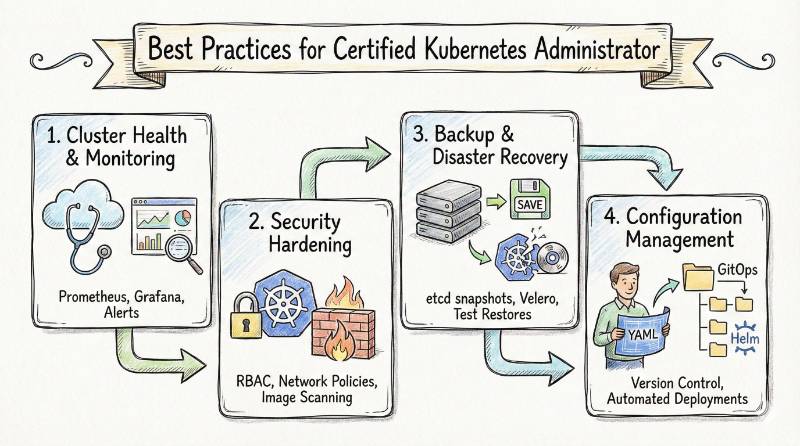
The landscape of modern infrastructure has shifted. We are no longer just managing servers; we are orchestrating entire ecosystems. Having witnessed the transition from monolithic data centers to the cloud-native era, I have seen Kubernetes become the undisputed operating system of the modern enterprise.
The Certified Kubernetes Administrator (CKA) certification is the industry’s gold standard. It doesn’t just test your knowledge—it tests your ability to act under pressure in a live environment. This guide is a strategic roadmap for engineers and managers in India and across the globe who are ready to master this essential technology.
Strategic Certification Roadmap
Before we dive into Kubernetes, it is helpful to see where it fits in your overall career journey. This table outlines the most impactful tracks available today.
| Track | Level | Who it’s For | Prerequisites | Skills Covered | Recommended Order |
| Kubernetes | Admin | DevOps & Cloud Engineers | Linux Basics, Docker | Cluster Setup, Troubleshooting | 1st (Core) |
| DevOps | Professional | Software Engineers | Git, Coding Basics | CI/CD, Automation, IaC | 2nd |
| DevSecOps | Specialist | Security Engineers | DevOps Basics | Security Auditing, Compliance | 3rd |
| SRE | Reliability | Operations Leads | DevOps Professional | SLOs, Error Budgets, Metrics | 4th |
| AIOps | Advanced | Data & Ops Leads | Python, Stats | AI in Ops, Data Analytics | 5th |
| FinOps | Management | Managers & Architects | Cloud Basics | Cost Optimization, Finance | 6th |
The Complete Guide to CKA Certification Training
What it is
The Certified Kubernetes Administrator (CKA) is a hands-on, performance-based exam. You are required to solve real-world problems in a command-line interface, proving you can manage production-ready Kubernetes clusters efficiently.
Who should take it
- System Administrators moving into the cloud-native space.
- DevOps Engineers who manage containerized infrastructure.
- Software Engineers who want to master the platform where their applications live.
- Engineering Managers looking to understand the technical depth of their team’s stack.
Skills you’ll gain
- Cluster Management: Bootstrapping and maintaining a cluster using
kubeadm. - Networking: Managing pod communication, Ingress, and DNS.
- Storage: Implementing persistent storage solutions for stateful apps.
- Troubleshooting: Deep-dive debugging of nodes, pods, and cluster components.
- Security: Hardening the cluster with Role-Based Access Control (RBAC).
Real-world projects you can do after it
- Build a high-availability production cluster for microservices.
- Design a secure networking policy to isolate sensitive databases.
- Automate the scaling of applications based on real-time user traffic.
- Perform live cluster upgrades and backups with zero downtime.
Preparation Plan
14 Days (The Fast Track)
- First 5 Days: Focus on Core Concepts and the API. Master the
kubectlcommand line. - Middle 5 Days: Intensive practice on Installation, Configuration, and Networking.
- Final 4 Days: Run through mock exams. Focus on speed and precision.
30 Days (Standard Plan)
- Week 1: Review Linux fundamentals and container runtimes (Docker/containerd).
- Week 2: Master Application Lifecycle Management and Services.
- Week 3: Deep dive into Storage, Security, and Networking policies.
- Week 4: Focus on the Troubleshooting domain and practice in simulated exam environments.
60 Days (The Mastery Path)
- Month 1: Theory and manual builds. Follow the “Kubernetes the Hard Way” guide to understand the internals.
- Month 2: Focus on complex scenarios, troubleshooting under pressure, and refining your YAML editing speed.
Common Mistakes
- Manually Writing YAML: Failing to use imperative commands like
kubectl runto generate templates. - Neglecting Contexts: Forgetting to switch to the correct cluster context before answering a question.
- Poor Time Management: Spending too long on a 2% question and missing a 10% question later.
- Documentation Speed: Not knowing the specific keywords to search for in the official K8s documentation.
Best next certification after this
The Certified Kubernetes Security Specialist (CKS) is the natural progression, focusing on the hardening and defense of the clusters you now know how to build.
Choose Your Path: 6 Career Tracks
Successful engineering careers are built on specialization. After your CKA, consider one of these paths:
- DevOps Path: Focus on speed and automation. Integrate Kubernetes into CI/CD pipelines.
- DevSecOps Path: Prioritize security. Learn to scan images and secure the entire supply chain.
- SRE Path: Focus on reliability. Master observability and incident response for large-scale systems.
- AIOps/MLOps Path: Focus on the future. Scale machine learning models using the power of Kubernetes.
- DataOps Path: Focus on the data. Manage complex data pipelines and distributed databases.
- FinOps Path: Focus on efficiency. Learn to balance high performance with cloud cost optimization.
Role → Recommended Certifications
- DevOps Engineer: CKA + Certified DevOps Professional
- SRE: CKA + SRE Certified Professional
- Platform Engineer: CKA + Certified DevOps Architect
- Cloud Engineer: CKA + AWS/Azure DevOps Professional
- Security Engineer: CKA + DevSecOps Certified Professional
- Data Engineer: CKA + DataOps Certified Professional
- FinOps Practitioner: CKA + FinOps Certified Professional
- Engineering Manager: CKA + Certified DevOps Manager
Top Training Institutions for CKA
Choosing the right partner for your training is critical. Here are the leading institutions for 2026:
- DevOpsSchool: This is the primary institution for mentor-led technical training. They focus on real-world labs and provide life-long support. Their curriculum is designed to build “muscle memory,” ensuring you aren’t just memorizing facts but gaining the actual skills needed for a high-paying job.
- Cotocus: Specializes in high-end technical consulting and enterprise-grade training. They are a great choice for senior professionals who need to understand complex architecture and global-scale deployments.
- Scmgalaxy: A community-centric platform that provides a massive library of technical guides, tutorials, and troubleshooting tips. It’s an excellent hub for continuous learners who want to go beyond the exam syllabus.
- BestDevOps: Known for providing streamlined and effective learning modules. They focus on helping working professionals gain mastery in the shortest possible time without sacrificing depth.
- devsecopsschool: The place to go for security-focused engineering. They integrate deep security principles into every part of their Kubernetes curriculum.
- sreschool: Dedicated to the discipline of Site Reliability Engineering. They teach you how to maintain high availability and manage complex incidents in containerized environments.
- aiopsschool: Focuses on the next wave of automation, teaching how to use AI and machine learning to optimize and manage your infrastructure.
- dataopsschool: Specializes in managing data-heavy workloads on Kubernetes, from persistent storage to complex data pipelines.
- finopsschool: The leading provider for cloud financial management. They teach you how to optimize the “unit cost” of your cloud resources while maintaining top performance.
Next Certifications to Take
Once you have cleared the CKA, industry data from GurukulGalaxy suggests these directions:
- Same Track (Expertise): Certified Kubernetes Security Specialist (CKS).
- Cross-Track (Breadth): Hashicorp Certified Terraform Associate for Infrastructure as Code.
- Leadership (Growth): Certified DevOps Manager (CDM) to lead organizational change.
Career Outcome FAQs
1. Is the CKA exam difficult? It is a 7/10 in difficulty. Because it is performance-based, it is harder than multiple-choice exams but very rewarding.
2. How long does it take to prepare? Most working professionals need 4 to 6 weeks of consistent daily practice.
3. What are the prerequisites? You should be comfortable with the Linux command line and have a basic understanding of Docker.
4. Should I take CKA or CKAD? CKA is for those managing infrastructure. CKAD is for developers who want to deploy and manage applications on K8s.
5. Is CKA still relevant in 2026? Yes. Kubernetes is now the industry standard for cloud-native applications globally.
6. Does the certificate expire? Yes, it is valid for 2 years, ensuring you stay updated with the fast-moving ecosystem.
7. Can I use the documentation during the exam? Yes, you can have one tab open with official Kubernetes documentation.
8. What is the passing score? A score of 66% or higher is required to pass.
9. Will this help me get a job in India or abroad? Absolutely. It is one of the most requested certifications in the global DevOps job market.
10. Do I need to know how to code? You don’t need to be a developer, but being comfortable with YAML and basic scripts is essential.
11. What if I fail on my first attempt? Most vouchers from the Linux Foundation (and those provided by DevOpsSchool) include a free retake.
12. Can a manager benefit from the CKA? Yes. It provides the technical credibility needed to lead cloud-native transformations and manage engineering teams effectively.
CKA Training FAQs
1. What makes DevOpsSchool training unique? The focus is on “real-world” practice. You learn from mentors who have managed production clusters, giving you insights you won’t find in a book.
2. Do I get hands-on labs? Yes, we provide cloud labs where you can practice building and breaking clusters in a safe environment.
3. Is there post-training support? Yes, institutions like Scmgalaxy and DevOpsSchool provide community access where you can ask technical questions even after the course ends.
4. Can I attend the training online? Yes, the sessions are designed for working professionals with flexible online batch timings.
5. How do I register for the exam? We provide a step-by-step guide on how to register and schedule your exam with the Linux Foundation.
6. Will I learn about CNI and Storage? Yes, deep dives into Networking (CNI) and Storage Classes (PV/PVC) are core parts of our training.
7. Do I get a certification for the training itself? Yes, you will receive a completion certificate from the institution in addition to the global CKA certification once you pass the exam.
8. How do I get started? Simply visit the official provider link to browse the upcoming batches and start your journey.
Conclusion
The path to becoming a Certified Kubernetes Administrator is a journey of transition—from traditional IT to the cutting edge of cloud-native technology. In my experience, those who take the time to truly master these hands-on skills are the ones who lead the most successful transformations in our industry.
By choosing a structured learning path and a dedicated training partner, you are doing more than just passing an exam; you are securing your place at the forefront of the modern technology landscape.

Best Cardiac Hospitals Near You
Discover top heart hospitals, cardiology centers & cardiac care services by city.
Advanced Heart Care • Trusted Hospitals • Expert Teams
View Best Hospitals