Introduction
In the technology world, technical debt is often described as the “invisible tax” on innovation. You start a project with the best intentions, building fast to meet a market deadline. But as months turn into years, those shortcuts—hardcoded configurations, manual deployment steps, and brittle legacy infrastructure—begin to accumulate. Eventually, your engineering team spends more time fighting fires than building new features.
This is where technical debt stalls growth. It creates a ceiling on your velocity. When your code or infrastructure becomes too fragile to change, you lose your competitive edge. This is not just a problem for developers; it is a critical business risk that impacts your time-to-market and operational costs.
Many organizations attempt to fix this by throwing more engineers at the problem, but this rarely works. You need a structural change, not just more manpower. This is the core value of professional guidance. Engaging in DevOps consulting for technical debt allows organizations to bridge the gap between where they are and where they need to be. By leveraging modern methodologies, expert teams like those at DevOpsSchool, can help you identify, prioritize, and systematically dismantle the debt that is holding your business back.
What Is Technical Debt?
At its simplest, technical debt is the gap between a quick, suboptimal solution and a cleaner, more robust one. Think of it like home maintenance. You might decide to patch a leaking pipe with duct tape because you need the water on immediately. That works for a day or two. But if you never replace the pipe, you are accruing “interest” in the form of potential water damage, mold, and eventual pipe failure.
In software, intentional technical debt happens when teams make trade-offs to release a product quickly. Unintentional technical debt happens when systems grow organically without a clear architectural roadmap, leading to complexity that no one fully understands.
It is not inherently evil. In a startup environment, some debt is necessary to reach product-market fit. However, when you stop paying down the principal—when you stop refactoring, updating dependencies, and automating processes—the interest becomes unmanageable.
Why Technical Debt Becomes a Business Problem
Technical debt is rarely a technical problem in isolation; it is a financial and operational one. When engineers spend 60% of their time on maintenance and “keeping the lights on,” that is 60% of your payroll that is not driving new revenue or innovation.
Consider the enterprise scenario: A legacy application takes three weeks to deploy because it requires manual approval, manual configuration, and manual testing. If a critical bug is found, the rollback takes another week. This friction creates a bottleneck. If your competitor can deploy ten times a day because they have addressed their technical debt, they will inevitably out-innovate you.
The cost includes:
- Reduced Velocity: Developers are afraid to touch code because they do not know what it will break.
- Increased Outages: Brittle systems are prone to failure during updates.
- Talent Attrition: Top-tier engineers want to build, not fight legacy systems. Spending your days debugging technical debt leads to burnout and turnover.
Common Causes of Technical Debt
Understanding where the debt originates is the first step in cleaning it up. Below is an overview of the most common vectors for technical debt.
| Cause | Impact |
| Legacy Systems | Hard to maintain, difficult to integrate with modern APIs, high security risk. |
| Manual Deployments | Prone to human error, inconsistent environments, slow release cycles. |
| Poor Documentation | Institutional knowledge is lost; new hires take months to become productive. |
| Short-term Fixes | “Band-aid” code added to production that becomes permanent. |
| Lack of Automation | Repetitive tasks consume engineering time that should be spent on features. |
| Outdated Infrastructure | Scaling issues, inability to leverage cloud-native features, high infrastructure costs. |
| Monolithic Architecture | Changes in one module ripple out and break unrelated features. |
How DevOps Consulting Identifies Technical Debt
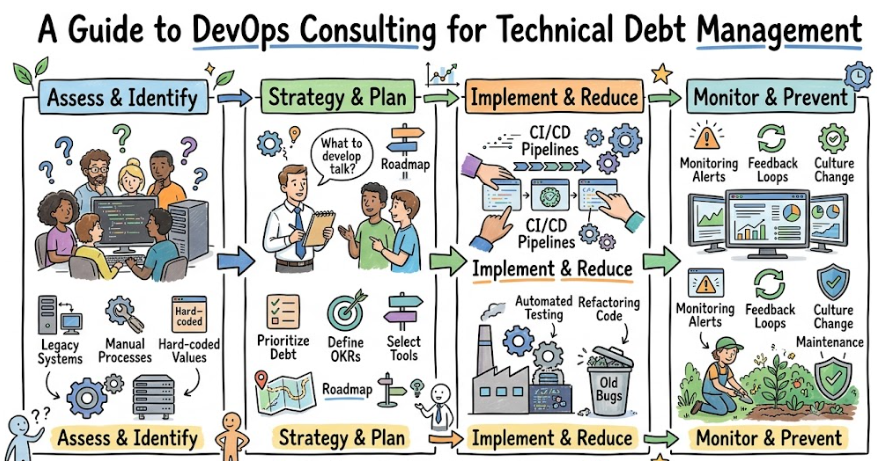
DevOps consulting for technical debt begins with a holistic audit. You cannot fix what you cannot measure. A consultant does not just look at your code; they look at your entire value stream.
Infrastructure Assessment
We review how your infrastructure is provisioned. Is it click-ops (manual clicking in a cloud console), or is it codified? Manual infrastructure is a major debt driver because it cannot be versioned or audited.
Pipeline Evaluation
We analyze your CI/CD pipelines. Are they fast and reliable? If a pipeline takes two hours to run, developers stop running tests. That is a massive red flag. We identify where bottlenecks exist in the feedback loop.
Team Workflow Analysis
We look at how your team interacts with the system. Is there a “wall of confusion” between development and operations? We assess whether the culture supports shared responsibility or if it creates silos that hide technical debt.
By mapping these areas, consultants provide a prioritized roadmap. We do not recommend tearing everything down; we recommend surgical interventions that provide the highest ROI for your engineering productivity.
Role of CI/CD in Reducing Technical Debt
Continuous Integration and Continuous Deployment (CI/CD) are the primary tools for debt repayment. When manual tasks are replaced by automated pipelines, you are essentially “refactoring” your process.
In a mature CI/CD environment, the pipeline acts as a guardrail. When a developer pushes code, the system automatically checks for style, security vulnerabilities, and functional regressions. This prevents new debt from being added to the system.
Without CI/CD, every deployment is an event that requires “all hands on deck.” By automating the delivery process, you convert deployment from a high-risk event into a non-event. This allows your team to focus on the business logic rather than the logistics of moving code from your laptop to the cloud.
Infrastructure Modernization Through DevOps Consulting
Infrastructure as Code (IaC) is the cornerstone of modernizing legacy environments. If your servers are “pets” that you manually configure, they will always accumulate debt. When you treat infrastructure as “cattle”—something that can be replaced, updated, or destroyed—you gain immense control.
DevOps consulting helps teams migrate from manual server management to IaC tools. This means your infrastructure definitions are checked into version control, just like your application code. This provides a history of every change, making it easy to roll back if something goes wrong.
Furthermore, modernization allows you to adopt cloud-native patterns like containerization. By packaging applications in containers, you decouple them from the underlying OS, eliminating the “it works on my machine” syndrome and significantly reducing the complexity of your environments.
How Automation Helps Reduce Technical Debt
Automation is the mechanical act of paying down debt. It removes the human error that usually causes outages. When you automate, you create a standard.
Consider a database migration. Doing it manually requires a detailed checklist, an engineer awake at 2:00 AM, and a high risk of typos. Automating this via a pipeline means the migration is tested in a staging environment first, and the production run is executed by a script that performs exactly the same steps every time.
This reliability reduces the “maintenance tax.” Your team spends less time fixing issues caused by manual mistakes, which frees them up to focus on modernization and feature delivery.
Real-World Example: Company Struggling With Technical Debt
Imagine a mid-sized e-commerce company. They have a legacy monolith. Their deployment process involves manually copying files to a server and restarting services. Every time they deploy, the site goes down for ten minutes. Because of this, they only deploy once a month.
The team is burned out. The code is filled with conditional logic to bypass bugs in the legacy framework. Feature requests take months to implement because the system is too fragile. They are losing market share to competitors who deploy multiple times a day. They are in a classic technical debt trap: they can’t innovate because they are too busy keeping the existing system barely alive.
Real-World Example: DevOps Consulting Success Story
Working with that same e-commerce company, a DevOps transformation strategy was implemented. We did not rewrite the whole monolith immediately. Instead, we:
- Containerized the monolith: This allowed us to standardize the deployment environment.
- Built an Automated CI/CD Pipeline: We automated the build, test, and deployment process.
- Introduced Blue-Green Deployments: This eliminated the ten-minute downtime, allowing for safe deployments during business hours.
Within six months, the deployment time went from one month to daily. The team felt empowered because they were no longer afraid of deployments. The site stability improved significantly because the automated tests caught issues before they reached production. This is the power of strategic DevOps consulting.
Common Mistakes Organizations Make
When tackling technical debt, organizations often fall into traps that make the situation worse.
- The “Big Bang” Migration: Trying to refactor everything at once is a recipe for failure. It disrupts the business and rarely delivers value quickly.
- Tool-First Thinking: Buying an expensive tool without changing the culture or processes will not solve the debt. You will just have an expensive tool running broken processes.
- Ignoring the Human Factor: If the team does not understand why they are changing, they will revert to old habits.
- No Modernization Roadmap: Without a plan, you are just wandering. You need clear milestones and measurable goals.
Best Practices for Managing Technical Debt
To maintain long-term technical health, adopt these practices:
- Prioritize Ruthlessly: Not all debt is created equal. Focus on the debt that causes the most outages or slows down the most developers.
- Invest in Automation First: If you have to choose between a new feature and an automated test, choose the test. It pays off in the long run.
- Improve Documentation: Code is read more often than it is written. Good documentation prevents future debt.
- Modernize Gradually: Use the “Strangler Fig” pattern. Replace parts of the system one service at a time rather than replacing the whole thing.
- Foster a Culture of Learning: Encourage engineers to learn new skills and share knowledge.
Role of DevOpsSchool in Learning DevOps Modernization
Educational resources play a massive role in successful transformations. At DevOpsSchool, the focus is on practical, real-world application. Understanding DevOps is not just about memorizing tool names; it is about understanding the architecture and the philosophy of modern engineering.
Through expert-led training and guidance, professionals learn how to manage CI/CD pipelines, understand infrastructure as code, and master cloud-native patterns. This knowledge is essential for reducing technical debt because it empowers your internal team to maintain the modern systems that consultants put in place. A successful engagement is one where the consultant leaves, and the internal team is fully capable of continuing the modernization journey.
Industries Facing Technical Debt Challenges
Technical debt is universal, but it impacts certain industries more severely:
- Banking & Finance: Highly regulated, relying on decades-old COBOL systems. Modernization is difficult but critical for security and speed.
- Healthcare: Dealing with complex data and compliance requirements, where outdated systems can literally be a matter of life and death.
- E-Commerce: Market speed is everything. Technical debt here directly translates to lost revenue.
- SaaS Companies: High growth means high debt accumulation. Scalability issues are common.
- Telecom: Massive, distributed systems that are incredibly difficult to modernize without service disruption.
- Enterprise IT: Large, siloed organizations often have the most accumulated debt due to internal bureaucracy.
Future of Technical Debt Management
The future of managing technical debt lies in the integration of intelligent automation and platform engineering. We are moving toward:
- AI-Assisted Modernization: Using LLMs and AI tools to help refactor legacy code and identify vulnerabilities in the pipeline.
- Platform Engineering: Building internal platforms that provide developers with self-service capabilities, further abstracting the complexity of infrastructure.
- Automation-First Engineering: In the future, infrastructure will be self-healing. When a component fails, the system will automatically replace it, virtually eliminating the need for manual maintenance.
FAQs
1. What is technical debt?
It is the implied cost of additional rework caused by choosing an easy solution now instead of a better approach that would take longer.
2. Why is technical debt dangerous?
It accumulates interest. Over time, your system becomes slower, more fragile, and more expensive to maintain, eventually halting innovation.
3. How does DevOps help?
DevOps focuses on automation, culture, and CI/CD, which allows you to fix systemic issues, standardize environments, and speed up delivery.
4. What role does CI/CD play?
CI/CD provides the guardrails that prevent new debt, automating testing and deployments to ensure reliability.
5. Can technical debt be eliminated?
It can be managed and significantly reduced, but it is rarely fully “eliminated” in a living system. The goal is to keep it at a sustainable level.
6. Is modernization expensive?
It requires an upfront investment, but it is cheaper than the long-term cost of maintaining a slow, fragile, and inefficient system.
7. How long does technical debt reduction take?
It depends on the complexity. Small improvements can show results in weeks, while full architectural modernization can take months or years.
8. Can startups face technical debt?
Absolutely. Startups often accumulate debt intentionally to move fast, but they must address it as they scale.
9. Do I need a consultant?
If your team is stuck in a cycle of maintenance and cannot innovate, an external perspective can help identify the root causes you might be too close to see.
10. What is Infrastructure as Code?
It is the process of managing and provisioning infrastructure through machine-readable definition files rather than manual hardware configuration.
11. Is technical debt always bad?
No. Sometimes it is a strategic choice to meet a deadline, provided you have a plan to pay it back later.
12. How does DevOpsSchool help?
It provides the educational foundation and practical skills needed for your team to understand and implement modern DevOps practices.
13. What is the “Strangler Fig” pattern?
It is a strategy for replacing a legacy monolith by gradually replacing its functionality with new services until the old system is gone.
14. Does documentation help reduce debt?
Yes. It reduces the time developers spend “reverse engineering” how a system works, which is a major hidden cost.
15. What is the first step in paying off debt?
The first step is visibility. Audit your systems, identify the biggest bottlenecks, and create a prioritized list of tasks.
Final Thoughts
Technical debt is an inevitable part of the software lifecycle, but it does not have to be a permanent roadblock. By shifting your mindset from “keeping the lights on” to “building a sustainable platform,” you change the trajectory of your organization.
Automation is not just about speed; it is about safety. Modernization is not just about new tech; it is about regaining your agility. DevOps consulting provides the roadmap to make this transition structured, predictable, and manageable. You do not need to fix everything overnight. You just need to start, improve consistently, and trust the process of automation and cultural transformation.

Best Cardiac Hospitals Near You
Discover top heart hospitals, cardiology centers & cardiac care services by city.
Advanced Heart Care • Trusted Hospitals • Expert Teams
View Best Hospitals