Introduction
In the current digital landscape, software delivery is no longer just a technical requirement; it is a primary driver of business success. Organizations across all sectors, from banking to healthcare, are finding that their ability to release features, fix bugs, and scale services defines their market position. However, many leaders face the same bottleneck: despite having skilled engineering talent, they struggle with slow delivery cycles, frequent production outages, and disjointed team communication.
This is where the concept of DevOps consulting emerges as a critical business lever. Organizations do not hire consultants simply to buy tools or install software; they hire them to bridge the gap between their current operational state and their desired future state. To understand why this shift is necessary, one must look at DevOpsSchool. At the core of successful transformation is the ability to understand complex CI/CD workflows and engineering practices. Many businesses seek expert guidance to navigate these transitions, aiming to improve their internal processes, reduce waste, and ultimately drive a higher return on investment (ROI).
Before investing in external expertise, it is vital for stakeholders to understand that DevOps consulting is not a plug-and-play solution. It is a strategic partnership that addresses culture, process, and technology simultaneously. Understanding the true ROI of these services allows leadership to move beyond treating DevOps as an IT expense and instead recognize it as a core business investment that directly influences the bottom line.
What Are DevOps Consulting Services?
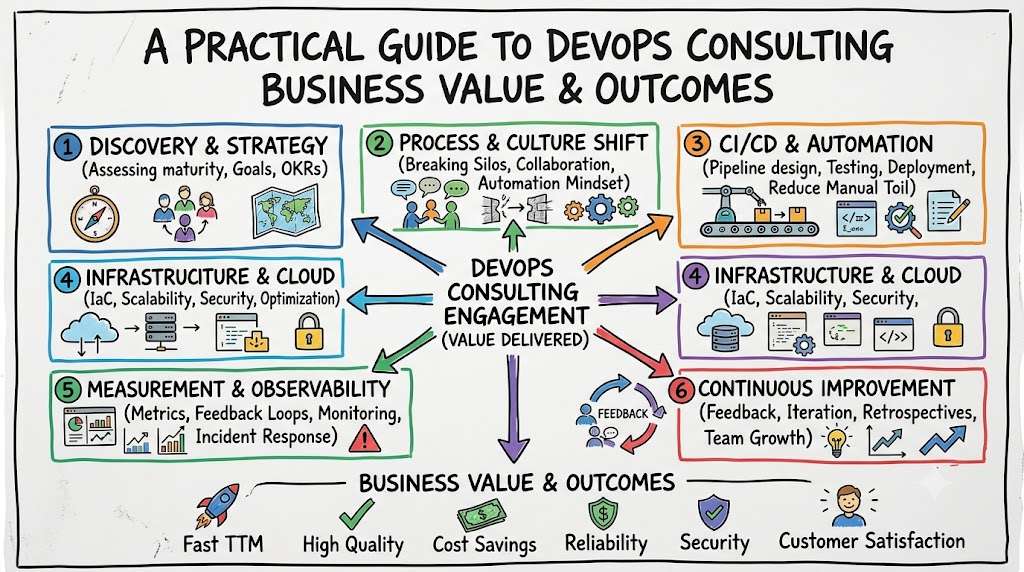
DevOps consulting services encompass the professional guidance and technical implementation strategies provided to help organizations adopt DevOps practices. It is not merely about choosing the right cloud provider or setting up a pipeline; it is about changing how teams build, test, and deploy software.
Process Improvement
Consultants analyze existing bottlenecks in the software development lifecycle (SDLC). They identify where manual handoffs, repetitive approvals, and legacy processes are slowing down the team. The goal is to move from a linear, slow-moving process to a streamlined, iterative flow.
Automation
Automation is the backbone of modern DevOps. Consultants work to automate the “boring” stuff—provisioning infrastructure, testing code, and deploying artifacts. This reduces the margin for human error and frees up engineering teams to focus on building features that drive business value.
CI/CD Enablement
Continuous Integration (CI) and Continuous Deployment (CD) are the mechanics of speed. Consultants help design pipelines that allow developers to push code frequently and safely. They ensure that integration testing, security scanning, and deployment are automated, creating a “push-button” release process.
Culture Transformation
Perhaps the most critical aspect, cultural transformation, involves breaking down silos between development, operations, and security teams. Consultants mentor teams to adopt shared responsibility, where developers are accountable for the performance of their code in production, and operations teams have early visibility into new features.
Why Companies Invest in DevOps Consulting
The investment in DevOps consulting is typically driven by the need to resolve specific pain points that hinder growth.
- Faster Delivery: Companies need to get features to market before competitors. Slow, manual release cycles are a liability.
- Better Reliability: Downtime is expensive. Investing in consulting helps build more resilient systems that can handle traffic spikes and failures gracefully.
- Operational Efficiency: Managing infrastructure manually is costly and error-prone. Consulting helps implement Infrastructure as Code (IaC), which allows teams to manage complex environments with minimal staff.
- Talent Upskilling: Often, internal teams lack the specific expertise required for a full-scale transformation. Consultants bridge this knowledge gap, transferring skills to the internal workforce.
What Does ROI Mean in DevOps Consulting?
In the context of DevOps, ROI is not always a direct, immediate financial gain. It is often measured by the cost of avoidance and opportunity cost.
- Cost vs. Business Value: If a consulting engagement costs $50,000, the ROI is realized when that investment leads to reduced downtime (saving $200,000 in lost revenue) or increased release frequency (allowing the company to capture market share earlier).
- Simple Example: Consider a company with 10 engineers who spend 20% of their week manually deploying code. That is 2 days per engineer, per week, lost to manual toil. If consulting can automate that process, the company recovers 16 days of engineering capacity every week—a massive ROI in salary efficiency alone.
Key Areas Where DevOps Consulting Creates ROI
The following table outlines the primary business areas where consulting services typically generate measurable value.
| Area | Business Impact |
| Faster Software Delivery | Faster time-to-market and quicker feature adoption |
| Reduced Downtime | Lower revenue loss and improved customer trust |
| Infrastructure Efficiency | Lower cloud costs through resource optimization |
| Automation of Manual Work | Increased engineering productivity and morale |
| Better Collaboration | Faster cross-team problem resolution |
| Faster Incident Recovery | Reduced MTTR (Mean Time To Recovery) |
| Better Customer Experience | Consistent service and fewer bugs |
Area #1: Faster Software Delivery
When consulting teams refine CI/CD pipelines, they shorten the feedback loop. In an enterprise scenario, a retailer might struggle to update their inventory system during peak hours. Through consulting, they implement automated testing, allowing them to release patches safely at any time, increasing their competitive edge.
Area #2: Reduced Downtime
Reliability engineering is a major focus. Consultants help implement monitoring, logging, and observability. A financial services firm using these practices can identify a database bottleneck before it crashes the system, saving the company from regulatory fines and reputational damage.
Area #3: Infrastructure Efficiency
Cloud consumption often balloons because of “zombie” servers and over-provisioned resources. Consultants conduct cloud cost audits and implement automated scaling, ensuring the business only pays for the computing power it actually uses.
Area #4: Automation of Repetitive Work
Consider an organization where database schema updates take four hours of manual coordination. By automating this via migration scripts in the pipeline, the task drops to five minutes. This reduces the risk of human error and allows engineers to focus on high-impact work.
Area #5: Better Collaboration
Consultants implement “DevOps culture” rituals, such as blameless post-mortems and shared operational on-call rotations. This reduces the “us vs. them” mentality, leading to faster issue resolution and higher employee retention.
Area #6: Faster Incident Recovery
When a system fails, time is money. Consultants design robust disaster recovery plans and automated rollback procedures. If a release causes a critical bug, the team can revert to the previous stable state in seconds rather than hours.
Area #7: Better Customer Experience
Reliability is a feature. When customers experience seamless app updates and minimal downtime, their loyalty increases. Consulting helps bridge the gap between technical stability and user satisfaction.
Key Metrics Used to Measure DevOps Consulting ROI
To track the effectiveness of consulting, organizations must use quantitative metrics.
| Metric | Why It Matters |
| Deployment Frequency | Measures how often code is shipped to production. |
| Lead Time for Changes | Measures the time from code commit to production. |
| Mean Time To Recovery (MTTR) | Measures how quickly services are restored after failure. |
| Change Failure Rate | Measures the percentage of changes resulting in failure. |
| Infrastructure Cost | Tracks cloud spending and resource utilization. |
| Employee Satisfaction | Gauges the impact of automation on team burnout. |
Real-World Example: Organization Before Consulting
Imagine a mid-sized SaaS company before consulting. They release code once a month because manual testing is slow and prone to errors. When they do release, the entire engineering team stays up all night to monitor the system. They have constant finger-pointing between the Development team (who want new features) and the Operations team (who want stability). This creates high turnover, customer dissatisfaction, and slow innovation.
Real-World Example: Organization After DevOps Consulting
After a 6-month consulting engagement, the same company now releases code daily. They have automated integration tests, so developers are confident in their code. Deployment is a non-event. The Operations and Development teams work as a unified Product Engineering team. The company now captures user feedback daily, allowing them to iterate and grow revenue much faster. The ROI is found in increased market share and reduced operational costs.
Common Misunderstandings About DevOps ROI
- ROI happens instantly: Transformation is a journey. It takes months to see significant financial returns.
- Tools alone create value: Buying a tool does not solve a bad process. Consulting is about the strategy, not just the software license.
- DevOps is only automation: Automation is an enabler, but culture and communication are the pillars.
- Small companies do not benefit: Small startups often gain the most from early DevOps practices, allowing them to scale without massive hiring spikes.
Challenges in Measuring DevOps ROI
Measuring ROI can be difficult because many benefits are indirect. For instance, “better team morale” is hard to put on a balance sheet, but it prevents costly turnover. Cultural change is notoriously slow and often resists quantification. Furthermore, long-term improvements in architecture may take a year to pay off, making short-term ROI analysis incomplete.
Best Practices for Maximizing DevOps Consulting ROI
- Set Measurable Goals: Don’t just say “we want DevOps.” Say “we want to reduce our release lead time by 50%.”
- Start Small: Pick one application or service to pilot. Prove the value, then scale.
- Improve Gradually: Use an iterative approach. Do not overhaul everything at once.
- Measure Outcomes: Track the metrics defined in the previous section religiously.
- Engage Leadership: Ensure the C-suite understands that DevOps is a business strategy, not just a technical upgrade.
Role of DevOpsSchool in Understanding DevOps Consulting
Navigating the transition to a high-performing engineering organization is complex. Professionals and leaders often require a foundational understanding of what is possible before they can successfully engage with consultants or execute a strategy. This is where DevOpsSchool serves as a vital resource. By fostering a deep understanding of CI/CD pipelines, cloud-native operations, and engineering transformation mindsets, it equips teams with the knowledge to make informed decisions. Practical DevOps exposure provided through such platforms ensures that when a company decides to invest in consulting, they have an internal team ready to collaborate effectively, maximizing the ROI of the engagement.
Career Importance of Understanding DevOps Consulting
For modern tech professionals, understanding the business side of DevOps is a differentiator.
- DevOps Consultant: Must understand how to articulate the business value to non-technical stakeholders.
- DevOps Engineer: Needs to understand how their automation scripts impact the bottom line.
- SRE Engineer: Focuses on reliability, directly influencing revenue through uptime.
- Cloud Engineer: Responsible for the cost-efficiency of infrastructure.
- Platform Engineer: Builds internal tools that amplify the productivity of other developers.
Industries Benefiting From DevOps Consulting
- Banking & Finance: High demand for security, compliance, and uptime.
- Healthcare: Focus on data integrity, HIPAA compliance, and reliable access.
- SaaS Platforms: Speed-to-market is the primary competitive differentiator.
- E-Commerce: Scalability is essential for handling seasonal traffic spikes.
- Telecom: Managing massive infrastructure complexity requires deep automation.
- Enterprise IT: Legacy modernization is the biggest challenge, where consulting provides a bridge to the future.
Future of DevOps Consulting ROI
The future of DevOps consulting ROI lies in the intersection of AI and platform engineering. Consultants are increasingly using AI-assisted automation to predict failures before they happen, further driving down MTTR. Additionally, the shift toward Internal Developer Platforms (IDPs) means that consulting is moving toward building platforms that empower developers, rather than just managing tickets. Security-driven consulting (DevSecOps) is also becoming a standard, as the cost of a security breach can be catastrophic.
FAQs
1. What is the primary definition of DevOps consulting ROI?
It is the measure of financial and operational gains achieved by optimizing software delivery and infrastructure management through professional guidance.
2. Why do companies hire consultants instead of doing it internally?
Consultants bring diverse experience from multiple industries and can accelerate the learning curve, avoiding common pitfalls and “reinventing the wheel.”
3. Can small companies benefit from DevOps consulting?
Absolutely. Implementing good practices early prevents technical debt and allows small teams to scale efficiently.
4. How is ROI measured in DevOps?
ROI is measured through metrics like deployment frequency, lead time, MTTR, change failure rate, and overall cost reduction in infrastructure.
5. Does DevOps consulting reduce downtime?
Yes. By implementing better monitoring, observability, and robust deployment pipelines, consulting helps significantly improve system reliability.
6. Is automation the only factor in DevOps consulting?
No, automation is a tool. Culture, communication, and process design are equally important to achieve sustained ROI.
7. How long does a DevOps transformation usually take?
It varies, but meaningful changes often take 6 to 18 months depending on the size and complexity of the organization.
8. Can consulting improve my team’s collaboration?
Yes. Consultants introduce frameworks that align Development and Operations, reducing friction and silos.
9. What if my team is already skilled?
Even skilled teams can benefit from an external perspective to identify “blind spots” and outdated processes.
10. Is DevOps consulting expensive?
It is an investment. The cost is often offset by the savings in reduced downtime, cloud costs, and increased engineering velocity.
11. How do I know if I need a consultant?
If you are struggling with slow releases, frequent outages, or high cloud bills, it is likely time to seek external guidance.
12. Does DevOps consulting help with security?
Yes, modern consulting includes DevSecOps, integrating security practices throughout the CI/CD pipeline.
13. What is the most important metric to track?
There is no single “most important” one, but focusing on “Lead Time for Changes” and “MTTR” provides a great start for assessing speed and reliability.
14. Can consulting help with cloud cost reduction?
Yes, infrastructure optimization is a core service in DevOps consulting.
15. Is DevOps consulting a one-time project?
It is an ongoing process. While initial engagements are project-based, the practices instilled become a continuous part of the operational culture.
Final Thoughts
DevOps consulting is not merely a technical expense or a quick fix for a failing pipeline. It is a strategic investment in the longevity and agility of an organization. When approached correctly, the ROI manifests in a more responsive, efficient, and reliable engineering organization.
Real value comes from gradual change—improving processes, fostering collaboration, and leveraging the right tools. It is not about hype; it is about building a sustainable engineering culture that can adapt to future challenges. Long-term thinking, combined with a clear focus on measurable outcomes, is the key to unlocking the true potential of DevOps transformation.

Best Cardiac Hospitals Near You
Discover top heart hospitals, cardiology centers & cardiac care services by city.
Advanced Heart Care • Trusted Hospitals • Expert Teams
View Best Hospitals