Introduction
Software delivery is often characterized by a tension between speed and stability. Engineering teams frequently find themselves trapped in a cycle of manual, error-prone deployments, long feedback loops, and infrastructure bottlenecks. When a release feels like a high-stakes event rather than a routine operation, the business suffers.
This is where the concept of DevOps efficiency becomes critical. Organizations often struggle with scalability, automation gaps, and cultural silos that prevent them from reaching their full potential. This is where professional guidance becomes essential. By working with experienced DevOps consultants, companies can bridge the gap between their current operational state and a high-performing, automated pipeline. Organizations looking for structured learning paths and professional guidance often refer to resources like DevOpsSchool to build internal expertise and align team skills with modern DevOps practices.
In this guide, we will explore the practical role of DevOps consultants and how they act as catalysts for software delivery efficiency.
Who Are DevOps Consultants?
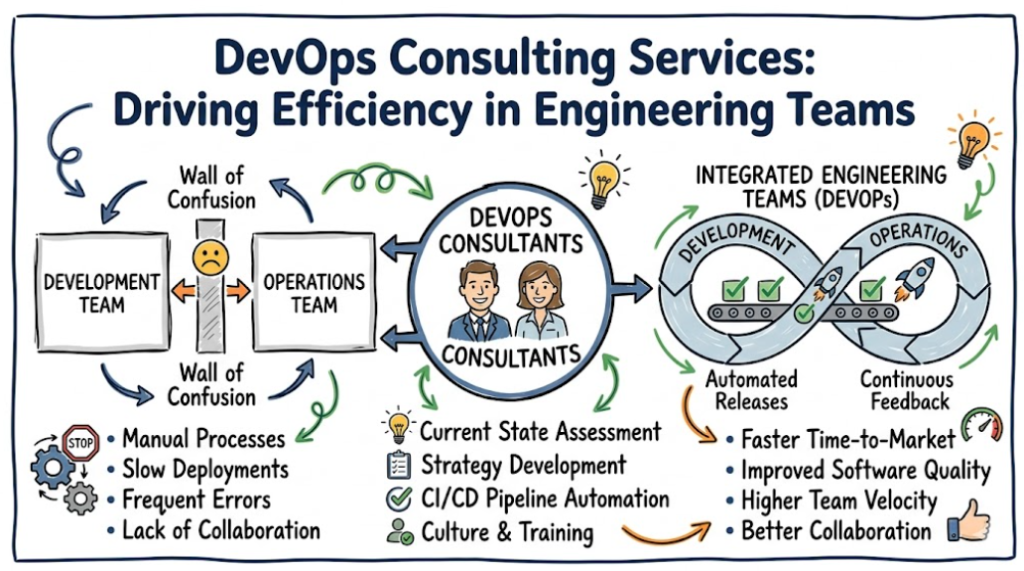
DevOps consultants are experienced engineers and architects who specialize in the intersection of software development, IT operations, and business strategy. Unlike a standard engineer who focuses on specific tasks, a consultant looks at the entire ecosystem.
They are tasked with evaluating current processes, identifying inefficiencies, and designing a roadmap that integrates automation, cultural shifts, and technical toolchains. Their goal is not just to “implement tools” but to foster a culture where the software delivery lifecycle is reliable, scalable, and secure.
Why Companies Hire DevOps Consultants
Organizations typically seek outside expertise when they reach a plateau in their growth. The most common triggers include:
- Slow Release Cycles: Deployments take days or weeks instead of hours.
- Frequent Downtime: High rates of change failure during production releases.
- Scaling Issues: The existing infrastructure cannot handle the increased load or traffic spikes.
- Cloud Migration Challenges: Moving from on-premises to cloud-native environments without losing stability.
- Security and Compliance: The need to integrate security scanning directly into the pipeline without slowing down the developers.
What Does Software Delivery Efficiency Mean?
Efficiency in this context is not about making developers work faster; it is about removing the friction that slows them down. It involves:
- Reliable Deployments: The ability to release code frequently without breaking the environment.
- Reduced Feedback Loops: Developers know if their code works within minutes, not days.
- Automation Maturity: Replacing manual configuration with code-driven processes.
- Visibility: Clear, actionable data on system health and performance.
How DevOps Consultants Improve Software Delivery Efficiency
Consultants approach efficiency by targeting the most significant constraints in the pipeline.
| Area | Traditional Approach | DevOps Consultant Impact |
| CI/CD | Manual handovers and scripted builds | Automated, self-service, and repeatable pipelines |
| Infrastructure | Manual server provisioning | Infrastructure as Code (IaC) with version control |
| Monitoring | Reactive, alert-heavy dashboards | Observability, proactive incident detection |
| Security | Security checks at the end of the SDLC | DevSecOps, automated testing in the pipeline |
| Collaboration | Siloed development and ops teams | Shared accountability and cross-functional teams |
Step 1: Assessing Existing Software Delivery Problems
Consultants begin by conducting a deep dive into the “Value Stream.” They look for bottlenecks—such as manual approval gates, lack of automated testing, or poor environment parity—that stall progress. This analysis establishes a baseline for improvement.
Step 2: Building CI/CD Pipelines
A robust CI/CD pipeline is the backbone of efficiency. Consultants guide teams in implementing tools like Jenkins, GitHub Actions, or GitLab CI/CD. The focus is on automating the “Build, Test, Deploy” cycle to ensure every commit is verified and ready for deployment.
Step 3: Infrastructure Automation
Manual server management is the enemy of scale. Consultants implement Infrastructure as Code (IaC) using tools like Terraform or CloudFormation. This allows the infrastructure to be versioned, tested, and deployed with the same rigor as application code.
Step 4: Improving Monitoring and Reliability
Consultants shift the focus from simple “uptime” alerts to observability. By using tools like Prometheus, Grafana, and the ELK Stack, they help teams understand the why behind failures, enabling faster troubleshooting and resolution.
Step 5: Security Integration Through DevSecOps
Security is often treated as a final hurdle. Consultants integrate security scanning (SAST/DAST) into the CI/CD pipeline, ensuring that vulnerabilities are identified and remediated in the development phase, effectively “shifting left.”
Step 6: Cloud-Native Transformation
For many, moving to containers (Docker) and orchestration (Kubernetes) is essential for modern scalability. Consultants provide the expertise to transition legacy applications into microservices, leveraging auto-scaling and self-healing properties of cloud platforms.
Step 7: Team Collaboration and DevOps Culture
Technology is only half the battle. Consultants work with management to break down silos between development and operations teams. They facilitate a culture of shared responsibility, where developers own the performance of their code in production.
Real-World Example of DevOps Consulting in Action
Consider a retail company struggling with Black Friday traffic. The consulting process typically follows this workflow:
- Assessment: The consultant identifies that the database is a manual bottleneck and scaling happens through ticket requests.
- Pipeline Automation: They implement CI/CD for the frontend, reducing deployment time from hours to minutes.
- Infrastructure Modernization: They refactor the backend into a Kubernetes cluster, enabling horizontal auto-scaling.
- Monitoring: They set up dashboards that visualize real-time user load versus system resource usage.
- Optimization: The team now handles traffic spikes autonomously without needing to manually provision servers during the sale.
Benefits of Hiring DevOps Consultants
- Faster Release Speed: Reducing time-to-market for features.
- Reduced Downtime: Implementing robust rollback and testing strategies.
- Scalability: Systems designed to grow with user demand.
- Cost Optimization: Better resource management in the cloud.
DevOps Consultants vs In-House Teams
| Area | In-House Team | DevOps Consultant |
| Expertise | Deep knowledge of internal product | Broad experience with various industry tech stacks |
| Speed | Learning curve can be slow | Immediate implementation of best practices |
| Cost | Fixed salary overhead | Project-based or retainer-based costs |
| Transformation | May face cultural resistance | Acts as an impartial, external change agent |
Common Challenges Organizations Face
- Resistance to Change: Teams are comfortable with existing, inefficient workflows.
- Legacy Systems: Old architecture that is difficult to automate.
- Skill Shortages: Internal teams lack experience with modern cloud tools.
Common Mistakes Companies Make
- Treating DevOps as a Tool: Buying a license for a tool without changing the process.
- No Automation Strategy: Automating randomly without a plan for long-term maintenance.
- Weak Monitoring: Collecting data but ignoring it until an outage occurs.
- Ignoring Culture: Forcing tools on teams without explaining the “why.”
- Poor Training: Expecting teams to adopt new tech without providing adequate resources.
Best Practices for Working with DevOps Consultants
- Define Business Goals: Don’t just ask for “DevOps.” Ask for “reduced deployment time” or “better uptime.”
- Focus on Knowledge Transfer: Ensure the consultant documents their work and trains your internal team.
- Prioritize Measurable Outcomes: Use DORA metrics (Deployment Frequency, Lead Time, MTTR, Change Failure Rate) to track success.
Role of DevOpsSchool in Learning DevOps Consulting Skills
For professionals looking to build the skills required to provide these consulting services, a structured learning approach is vital. Resources like DevOpsSchool offer hands-on training that covers the entire spectrum of modern CI/CD, cloud-native architecture, and automation strategies. By engaging with real-world project scenarios, individuals can bridge the gap between theoretical knowledge and the practical consulting skills needed to drive enterprise transformation.
Industries Benefiting from DevOps Consulting
- Banking & Finance: Focuses on compliance, security, and high-availability systems.
- Healthcare: Prioritizes data security, audit trails, and interoperability.
- E-Commerce: Focuses on seasonal scalability and 24/7 reliability.
- SaaS Platforms: Focuses on rapid iteration and feature delivery speed.
- Telecom: Prioritizes network automation and infrastructure management.
Career Opportunities Related to DevOps Consulting
The demand for professionals who understand end-to-end delivery is high. Key roles include:
- DevOps Consultant: Strategy and transformation specialist.
- Cloud Architect: Designing secure and scalable cloud infrastructure.
- Platform Engineer: Building internal tools to help developers deploy faster.
- SRE (Site Reliability Engineer): Focusing on system performance and availability.
Certifications & Learning Paths
| Certification | Best For | Skill Level | Focus Area |
| Certified Kubernetes Administrator | Platform Engineers | Advanced | Orchestration & Containers |
| AWS/Azure/GCP Architect | Cloud Engineers | Intermediate | Cloud-Native Infrastructure |
| Terraform Associate | DevOps Engineers | Beginner/Intermediate | Infrastructure as Code |
| CI/CD Pipeline Design | Developers/DevOps | Intermediate | Automation & Workflow |
Future of DevOps Consulting
The future lies in AI-assisted automation and Platform Engineering. Consultants are shifting from building custom scripts to designing internal developer platforms that allow teams to self-serve. GitOps workflows are also becoming standard, ensuring that the state of infrastructure is always aligned with the source code.
FAQs
- What is the primary value of a DevOps consultant?The primary value is the reduction of operational friction. They identify systemic bottlenecks that internal teams, who are often too close to the code, might overlook.
- Do I need a DevOps consultant for a small startup?Startups may not need full-time consultants, but a brief engagement to set up foundational infrastructure and CI/CD pipelines can save months of trial and error later.
- Is DevOps consulting expensive?It is an investment. While the upfront cost exists, the ROI is realized through reduced downtime, faster developer output, and optimized cloud spend.
- Can I become a DevOps consultant with only development experience?Yes, but you will need to expand your skills into operations, networking, cloud platforms, and security to provide comprehensive value.
- What metrics do consultants use to measure success?They typically look at DORA metrics: Deployment Frequency, Lead Time for Changes, Mean Time to Recovery (MTTR), and Change Failure Rate.
- Is Kubernetes mandatory for DevOps?No. It is a tool. Consultants assess if your architecture actually requires Kubernetes’ complexity before recommending it.
- How long does a typical consulting engagement last?It varies from a few weeks for specific pipeline audits to several months for full-scale cultural and infrastructure transformation.
- Do consultants fix the code or the process?They focus on the process of delivering the code. They rarely rewrite application business logic but optimize the pipeline the code travels through.
- What is the difference between an SRE and a DevOps consultant?SREs are usually focused on reliability and operations within a company. A consultant is an external advisor who helps organizations adopt the strategies that SREs practice.
- How does DevSecOps differ from traditional DevOps?DevSecOps explicitly integrates security testing into the CI/CD pipeline, rather than treating security as a post-development check.
- Can DevOps consulting help with legacy systems?Yes. Consultants are experts at “strangling” legacy systems—slowly replacing pieces of them with modern, automated components.
- What is the most important skill for a DevOps consultant?The ability to analyze workflows and communicate effectively with both developers and management. Technical skills are secondary to problem-solving.
- Do consultants work with proprietary or open-source tools?They work with both, but they prioritize tools that best fit the client’s needs, often favoring open-source for its flexibility and community support.
- How do I measure the ROI of a consultant?Look for a decrease in time spent on incident resolution, increased deployment velocity, and more predictable release schedules.
- Is DevOps consulting a sustainable career path?As long as companies need to ship software efficiently, they will need experts to design and optimize the systems that enable that shipping.
Final Thoughts
Improving software delivery efficiency is a journey of continuous improvement, not a one-time project. The goal is to move from manual, high-risk deployments to a state of automated, low-risk delivery. Whether you choose to hire external consultants or upskill your internal teams, the focus must remain on reducing friction and increasing the value delivered to the end user. Practical experience and a deep understanding of the full software lifecycle are the keys to success.

Best Cardiac Hospitals Near You
Discover top heart hospitals, cardiology centers & cardiac care services by city.
Advanced Heart Care • Trusted Hospitals • Expert Teams
View Best Hospitals