Introduction
eDiscovery software helps legal, compliance, and investigation teams find, preserve, review, and produce electronically stored information for legal matters, regulatory requests, internal investigations, and audits. In simple terms, it is the toolkit that turns messy data such as emails, chats, documents, spreadsheets, endpoints, and cloud files into an organized review workflow. It supports legal hold to prevent deletion, collection to gather data defensibly, processing to deduplicate and index content, review to tag and analyze documents, and production to export results in accepted formats.
eDiscovery matters because modern business communication happens across email, collaboration tools, cloud drives, and line-of-business applications. When a dispute, investigation, or regulator request arrives, organizations must respond quickly and defensibly. Manual collection and review is slow, expensive, and risky. eDiscovery platforms reduce cost by automating processing and search, improve accuracy by supporting analytics and quality checks, and strengthen defensibility with audit trails, access controls, and consistent workflows. They also help teams avoid over-collection and focus on high-value data using search, filtering, and review workflows.
Common use cases include:
- Litigation response with large volumes of email and document evidence
- Regulatory requests and compliance investigations
- Internal investigations involving employee communications and files
- Legal hold and retention enforcement across enterprise systems
- Early case assessment to estimate scope, risk, and cost
What buyers should evaluate:
- Legal hold strength: custodians, notices, acknowledgments, tracking, audits
- Collection options: email, cloud drives, chats, endpoints, third-party systems
- Processing speed: indexing, deduplication, OCR, metadata extraction
- Review experience: tagging, filters, privilege workflows, redaction tools
- Analytics: threading, near-duplicate detection, clustering, predictive review options
- Security controls: role-based access, auditing, encryption, segregation by matter
- Scalability: large volumes, many matters, distributed reviewers
- Collaboration: workflows for counsel, vendors, reviewers, and internal teams
- Production: export formats, load files, redaction integrity, quality checks
- Pricing model: per user, per matter, per volume, storage and processing costs
Best for: Legal teams, compliance teams, internal investigations teams, and organizations handling frequent matters, large data volumes, or complex review requirements.
Not ideal for: Very small teams with rare legal matters and low data volume, where outside counsel tooling or simpler document management may be enough.
Key Trends in eDiscovery Software
- More native connectors for cloud apps, collaboration, and enterprise chat tools
- Increased automation for legal hold, collection, and chain-of-custody workflows
- Greater use of analytics to reduce review volume and cost
- More focus on defensible workflows with strong audit trails and reporting
- Better support for remote review teams and distributed collaboration
- More data minimization tools to avoid over-collection and reduce risk
- Improved redaction workflows and quality checks for production readiness
- Stronger security controls for multi-matter segregation and least privilege
- More integration with case management and compliance tracking workflows
- More emphasis on performance for large-scale processing and faster searches
How We Selected These Tools
- Strong adoption and credibility in legal and compliance workflows
- Coverage across the full eDiscovery lifecycle: hold, collect, process, review, produce
- Practical usability for both legal and technical stakeholders
- Scalability for large matters and multi-matter environments
- Strength of analytics to reduce review burden and improve accuracy
- Security posture expectations: access controls, auditing, and data segregation
- Integration readiness for common enterprise data sources
- Quality of production tools and defensible export workflows
- Support maturity and documentation for onboarding and daily operations
- Balanced mix of enterprise platforms and review-first products
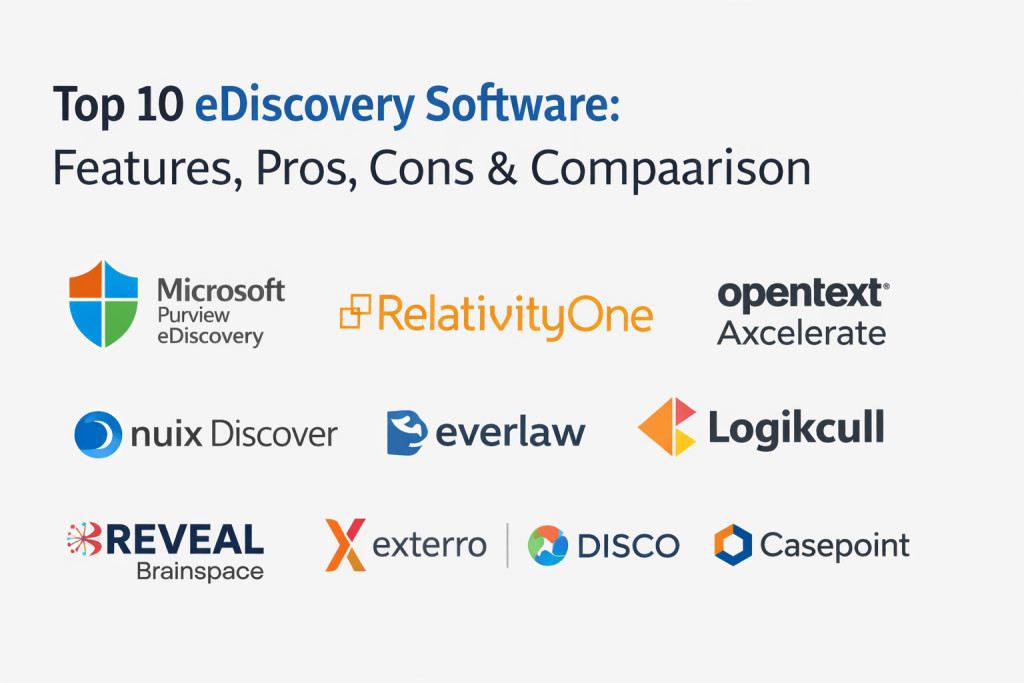
Top 10 eDiscovery Software
1 — Microsoft Purview eDiscovery
Microsoft Purview eDiscovery is commonly used by organizations that run Microsoft ecosystems and need integrated legal hold, search, and export workflows across enterprise content.
Key Features
- Legal hold workflows with custodian management and tracking
- Search and collection workflows across supported content sources
- Processing and review features aligned with enterprise needs
- Export and production workflows for downstream review or delivery
- Audit support and role-based access patterns
- Integrations aligned with Microsoft compliance and governance tooling
Pros
- Strong fit for organizations standardized on Microsoft environments
- Integrated workflows can simplify legal and compliance operations
Cons
- Non-Microsoft data sources may require additional connectors and planning
- Feature depth varies by environment configuration and licensing scope
Platforms / Deployment
Web
Cloud
Security & Compliance
Varies / Not publicly stated
Integrations & Ecosystem
Most effective when your core data lives in Microsoft services and identity.
- Identity integration for role-based access
- Export workflows to downstream review platforms when needed
- Reporting and audit integration patterns
- Connector coverage depends on tenant configuration
Support & Community
Documentation is strong; enterprise support options are common; community resources are extensive.
2 — RelativityOne
RelativityOne is widely used for large-scale review and complex workflows. It fits organizations and service providers that need strong review, analytics, and collaboration for multi-matter operations.
Key Features
- Scalable document review workflows with tagging and privilege controls
- Strong processing and indexing support for large datasets
- Analytics options to reduce review volume and improve accuracy
- Collaboration workflows for distributed review teams
- Strong production tools including redaction and quality checks
- Auditing and role-based access for defensible operations
Pros
- Strong review workflow depth and enterprise scalability
- Mature ecosystem for complex matters and multi-team review
Cons
- Administration and configuration can be complex
- Cost and licensing models can be challenging for smaller teams
Platforms / Deployment
Web
Cloud
Security & Compliance
Not publicly stated
Integrations & Ecosystem
Strong ecosystem for integrations, workflows, and service partners.
- APIs for automation and integrations
- Connectors and import options for many data sources
- SIEM-style logging patterns for audit needs depending on setup
- Integrations with case workflows and review operations
Support & Community
Very large community; strong training ecosystem; support is typically enterprise-grade.
3 — OpenText Axcelerate
OpenText Axcelerate provides eDiscovery processing and review capabilities used by enterprises and service providers. It fits teams that want structured workflows for large datasets and defensible review.
Key Features
- Processing workflows for indexing, deduplication, and metadata extraction
- Review workflows with tagging, privilege handling, and collaboration
- Production support with export and quality checking tools
- Analytics capabilities depending on configuration
- Role-based access controls for multi-matter segmentation
- Reporting features for defensibility and audit tracking
Pros
- Strong processing and review workflows for larger matters
- Useful for enterprises that need structured case operations
Cons
- Setup and administration can be complex
- Feature packaging may vary depending on procurement and deployment scope
Platforms / Deployment
Web
Cloud
Security & Compliance
Not publicly stated
Integrations & Ecosystem
Designed to fit enterprise eDiscovery pipelines and service provider workflows.
- Import and export workflows for multiple evidence sources
- APIs depending on environment setup
- Integrations with case management and review operations
- Supports structured operational processes for legal teams
Support & Community
Support options are typically enterprise; documentation is established; community footprint is moderate.
4 — Nuix Discover
Nuix Discover is used for investigations and eDiscovery workflows that require strong processing and analysis capabilities. It fits teams handling complex datasets and investigative review use cases.
Key Features
- Processing and indexing for large, complex evidence sets
- Review workflows for tagging, collaboration, and privilege handling
- Analytics to help reduce review load and surface key content
- Strong search capabilities and filtering across large datasets
- Production workflows including export and redaction support
- Reporting support for defensible operations
Pros
- Strong processing and search for complex matters
- Useful for investigations that require deep analysis
Cons
- Administration and tuning can require specialist expertise
- Cost and complexity may be high for smaller matters
Platforms / Deployment
Web
Cloud, Self-hosted
Security & Compliance
Not publicly stated
Integrations & Ecosystem
Designed for complex workflows and enterprise integration needs.
- APIs for automation and integrations
- Import options for many data source types
- Export workflows for downstream review and productions
- Integrations with investigation and compliance processes
Support & Community
Strong professional ecosystem; documentation is solid; community footprint is moderate.
5 — Everlaw
Everlaw is known for user-friendly review workflows and strong collaboration for legal teams. It fits organizations that want a modern review experience and practical analytics to reduce review effort.
Key Features
- Review workflows with tagging, filters, and collaboration tools
- Analytics to identify themes, clusters, and related documents
- Strong production workflows including redaction support
- Case organization tools for managing multiple matters
- Search and timeline-style views depending on setup
- Reporting support for defensible review and production steps
Pros
- Friendly user experience for distributed review teams
- Strong collaboration and review workflow design
Cons
- Connector and processing depth should be validated for your sources
- Advanced enterprise customization may be more limited than complex platforms
Platforms / Deployment
Web
Cloud
Security & Compliance
Not publicly stated
Integrations & Ecosystem
Designed to support practical legal workflows with integration options.
- Import workflows for common enterprise sources
- Export tools for productions and case handoff
- APIs depending on plan and setup
- Integrations with review operations and collaboration processes
Support & Community
Support is typically strong; documentation is clear; community footprint is growing.
6 — Logikcull
Logikcull is designed to simplify eDiscovery workflows for teams that want fast time-to-value. It fits organizations that want quick collection, processing, and review without heavy administration.
Key Features
- Streamlined workflows for processing and review
- Search, filters, and tagging to reduce review time
- Production workflows including redaction and exports
- Collaboration workflows for legal teams and outside counsel
- Tracking features that support defensible operations
- Practical interface designed for non-technical users
Pros
- Simple onboarding and usable workflows for many teams
- Faster setup compared to heavier platforms
Cons
- May be less flexible for very complex enterprise workflows
- Connector coverage should be validated for specialized sources
Platforms / Deployment
Web
Cloud
Security & Compliance
Not publicly stated
Integrations & Ecosystem
Designed for practical workflows with common import and export patterns.
- Import options for common file types and exports
- Production export workflows for counsel and delivery
- API support depending on environment
- Collaboration patterns for reviewers and stakeholders
Support & Community
Support is generally helpful; documentation is practical; community footprint is moderate.
7 — Reveal Brainspace
Reveal Brainspace is known for analytics that help reduce review volume and improve speed by clustering and surfacing patterns. It fits teams that want strong analytics to drive early case assessment and review strategy.
Key Features
- Analytics-driven review acceleration and clustering
- Concepts and relationships to reduce manual review effort
- Search and filtering for large evidence sets
- Review workflows aligned with analytics-driven operations
- Reporting support for defensible use of analytics
- Production workflows depending on setup
Pros
- Strong analytics to reduce review effort and cost
- Useful for large matters needing fast prioritization
Cons
- Teams need training to interpret analytics correctly
- Usually best when paired with structured review workflows
Platforms / Deployment
Web
Cloud
Security & Compliance
Not publicly stated
Integrations & Ecosystem
Often used as an analytics engine within broader eDiscovery workflows.
- Import and export workflows for data exchange
- Integration patterns with review platforms and processing tools
- APIs depending on environment setup
- Fits early case assessment and review optimization workflows
Support & Community
Support is generally strong; documentation is good; community footprint is moderate.
8 — Exterro eDiscovery
Exterro eDiscovery provides end-to-end eDiscovery and legal hold workflows, often used by enterprises needing structured governance and investigation processes. It fits teams that want a unified approach from hold through production.
Key Features
- Legal hold management with tracking and reporting
- Collection workflows aligned with defensible operations
- Processing and review features for eDiscovery matters
- Analytics options to reduce review effort depending on setup
- Production workflows including export and redaction support
- Case tracking and reporting for governance and audits
Pros
- Strong end-to-end workflow coverage
- Useful for enterprises with repeatable governance needs
Cons
- Setup effort can be higher for complex enterprise environments
- Feature depth depends on configuration and licensing scope
Platforms / Deployment
Web
Cloud, Self-hosted
Security & Compliance
Not publicly stated
Integrations & Ecosystem
Designed for enterprise legal operations integration.
- Connectors and import workflows depending on data sources
- APIs for automation and integration
- Export workflows for productions and external counsel
- Integration with internal compliance and case processes
Support & Community
Enterprise support is common; documentation is established; community footprint is moderate.
9 — DISCO eDiscovery
DISCO eDiscovery is known for fast processing and modern review workflows. It fits teams that want strong speed, clear review collaboration, and practical analytics for litigation and investigations.
Key Features
- Fast processing and indexing for large evidence sets
- Review workflows with tagging, privilege, and collaboration tools
- Search and filters designed for speed and usability
- Production workflows including redaction and export options
- Analytics features to support prioritization and review strategy
- Reporting support for defensible review and production workflows
Pros
- Strong performance for processing and search
- Modern review interface that supports legal team productivity
Cons
- Advanced customization needs should be validated for your workflow
- Connector coverage depends on your data sources and collection approach
Platforms / Deployment
Web
Cloud
Security & Compliance
Not publicly stated
Integrations & Ecosystem
Designed to support litigation workflows and collaboration.
- Import workflows for common collections and exports
- Export formats for productions and counsel handoff
- APIs depending on plan and setup
- Supports structured legal review workflows
Support & Community
Support is generally strong; documentation is practical; community footprint is growing.
10 — Casepoint
Casepoint provides eDiscovery review and production workflows often used by enterprises and government-style environments. It fits teams that want structured review controls, governance features, and scalable operations.
Key Features
- Review workflows for tagging, privilege, and multi-team collaboration
- Processing tools for indexing and deduplication
- Production workflows with redaction and quality checks
- Role-based access and segregation for multi-matter operations
- Reporting and audit support for defensible workflows
- Scalability features for large matters and many reviewers
Pros
- Strong fit for structured review and governance needs
- Useful for multi-matter environments with access controls
Cons
- Setup and administration can be complex
- Feature packaging and licensing may vary by environment
Platforms / Deployment
Web
Cloud, Self-hosted
Security & Compliance
Not publicly stated
Integrations & Ecosystem
Designed to integrate into enterprise legal operations.
- Import and export workflows for evidence handling
- APIs for integration and automation depending on setup
- Supports structured production handoffs
- Integrates with internal case processes and review operations
Support & Community
Enterprise support is common; documentation is established; community footprint is moderate.
Comparison Table
| Tool Name | Best For | Platform(s) Supported | Deployment | Standout Feature | Public Rating |
|---|---|---|---|---|---|
| Microsoft Purview eDiscovery | Microsoft ecosystem legal hold and search workflows | Web | Cloud | Integrated compliance and eDiscovery workflows | N/A |
| RelativityOne | Large-scale review and complex multi-matter operations | Web | Cloud | Mature review ecosystem and scalability | N/A |
| OpenText Axcelerate | Enterprise processing and structured review workflows | Web | Cloud | Strong processing plus review structure | N/A |
| Nuix Discover | Complex investigations with strong processing and search | Web | Cloud, Self-hosted | Deep processing and analysis capability | N/A |
| Everlaw | Collaborative review with modern usability | Web | Cloud | User-friendly review collaboration | N/A |
| Logikcull | Quick time-to-value for simpler workflows | Web | Cloud | Streamlined review and production | N/A |
| Reveal Brainspace | Analytics-driven review acceleration | Web | Cloud | Strong analytics to reduce review volume | N/A |
| Exterro eDiscovery | End-to-end legal hold through production workflows | Web | Cloud, Self-hosted | Unified workflow coverage | N/A |
| DISCO eDiscovery | Fast processing and modern review experience | Web | Cloud | Speed-focused processing and review | N/A |
| Casepoint | Structured governance and scalable review controls | Web | Cloud, Self-hosted | Strong access control and review governance | N/A |
Evaluation and Scoring of eDiscovery Software
Weights used: Core features (25%), Ease of use (15%), Integrations and ecosystem (15%), Security and compliance (10%), Performance and reliability (10%), Support and community (10%), Price and value (15%).
| Tool Name | Core (25%) | Ease (15%) | Integrations (15%) | Security (10%) | Performance (10%) | Support (10%) | Value (15%) | Weighted Total |
|---|---|---|---|---|---|---|---|---|
| Microsoft Purview eDiscovery | 7 | 8 | 8 | 7 | 7 | 8 | 7 | 7.40 |
| RelativityOne | 9 | 6 | 8 | 7 | 8 | 8 | 5 | 7.35 |
| OpenText Axcelerate | 8 | 6 | 7 | 7 | 7 | 7 | 5 | 6.95 |
| Nuix Discover | 8 | 6 | 7 | 7 | 8 | 7 | 5 | 7.05 |
| Everlaw | 8 | 8 | 6 | 7 | 7 | 7 | 6 | 7.20 |
| Logikcull | 7 | 9 | 6 | 6 | 7 | 7 | 7 | 7.10 |
| Reveal Brainspace | 8 | 6 | 7 | 6 | 7 | 7 | 5 | 6.75 |
| Exterro eDiscovery | 8 | 6 | 7 | 7 | 7 | 7 | 5 | 6.95 |
| DISCO eDiscovery | 8 | 8 | 6 | 6 | 8 | 7 | 6 | 7.25 |
| Casepoint | 8 | 6 | 7 | 7 | 7 | 7 | 5 | 6.95 |
How to interpret the scores:
- Scores are comparative within this list and help shortlist tools for your review workflow and matter volume.
- Core reflects legal hold, collection, processing, review, analytics, and production coverage.
- Ease reflects admin effort, reviewer experience, and learning curve.
- Validate with a pilot matter to confirm connector coverage, review speed, and production quality checks.
Which eDiscovery Software Is Right for You?
Solo / Freelancer
If you handle occasional matters, prioritize simplicity, fast onboarding, and clear production workflows. You want a tool that reduces admin overhead and supports quick review without complex configuration.
SMB
SMBs should prioritize streamlined legal hold, straightforward collection and processing, and an easy review experience for small teams. A tool with predictable pricing and strong support can reduce risk.
Mid-Market
Mid-market teams benefit from better analytics, stronger case management, and integrations with enterprise content systems. Choose a platform that scales across multiple matters without operational complexity exploding.
Enterprise
Enterprises should prioritize legal hold governance, strong security controls, multi-matter segregation, audit trails, advanced analytics, and defensible productions. Validate global performance and collaboration across many reviewers.
Budget vs Premium
Budget-focused tools can work well for simpler matters and smaller volumes. Premium platforms often reduce review volume and legal cost through analytics, stronger governance, and better collaboration workflows.
Feature Depth vs Ease of Use
If your team is small or inexperienced, prioritize usability and guided workflows. If you handle frequent complex matters, prioritize deeper workflow controls, analytics, and governance features.
Integrations and Scalability
Confirm connectors for your email, cloud drives, and collaboration tools. Scalability means you can run multiple matters, support many custodians, and process large volumes without major slowdowns.
Security and Compliance Needs
If regulatory audits matter, focus on role-based access, audit logs, defensible holds, strong reporting, and clear chain-of-custody handling. For certification claims, ask vendors for official documentation during procurement.
Frequently Asked Questions
1) What is eDiscovery in simple terms?
It is the process of finding and preparing digital information such as emails and documents for legal or compliance matters using defensible workflows.
2) What is a legal hold and why does it matter?
A legal hold prevents relevant data from being deleted or changed. It matters because it protects evidence integrity and reduces legal risk.
3) How do eDiscovery tools reduce review costs?
They automate processing, deduplication, indexing, and analytics so reviewers focus on fewer, higher-value documents.
4) What data sources are most important to support?
Email, cloud drives, collaboration chat exports, endpoint collections, and shared file systems are common priorities depending on your organization.
5) Do we always need analytics?
Not always, but analytics can greatly reduce review volume in large matters and help teams find key themes faster.
6) What is the biggest mistake teams make in eDiscovery?
Over-collecting data without clear scope. It increases cost, delays review, and raises privacy and security risk.
7) How long does implementation usually take?
It depends on connectors, governance, and volume. A pilot matter is the fastest way to estimate real rollout effort.
8) How do we handle privileged content?
Most platforms offer privilege tagging, privilege review workflows, and redaction tools. You should test these workflows in a pilot.
9) Can eDiscovery tools support internal investigations?
Yes. They are commonly used for HR, compliance, fraud, and insider threat investigations due to strong search and audit trails.
10) How do we choose the right eDiscovery software?
Shortlist two or three, run a pilot matter, validate collection and processing speed, check reviewer usability, and confirm production quality and audit trails.
Conclusion
eDiscovery software helps organizations respond defensibly to legal and compliance demands by managing legal hold, collecting data safely, processing it into searchable form, enabling efficient review, and producing results in accepted formats. The best tool depends on your data sources, matter volume, reviewer workflow, and how much governance and analytics you need. Start by shortlisting two or three platforms that match your primary sources such as email, cloud drives, and collaboration exports. Run a pilot matter with realistic volume and real reviewers, then measure processing speed, search relevance, review usability, redaction and production quality checks, and audit reporting clarity. Once you pick a platform, standardize legal hold templates, collection playbooks, and review protocols so every matter follows a consistent, defensible process and costs stay predictable.

Best Cardiac Hospitals Near You
Discover top heart hospitals, cardiology centers & cardiac care services by city.
Advanced Heart Care • Trusted Hospitals • Expert Teams
View Best Hospitals