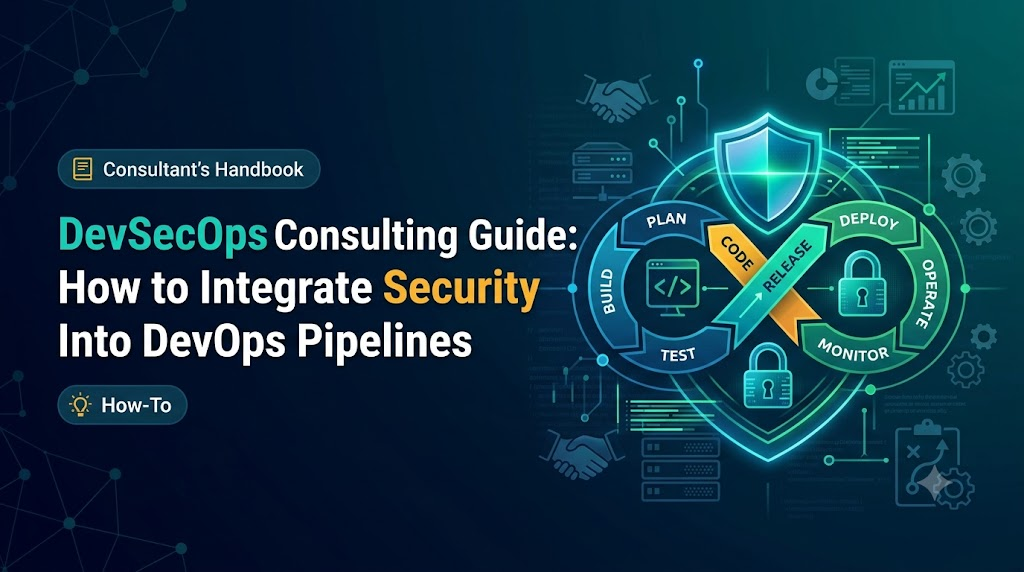
Modern engineering teams rely on continuous integration, automated pipelines, cloud infrastructure, and containers to ship software at rapid speed, but isolating security checks until late in the delivery cycle regularly results in exposed secrets, unpatched dependencies, misconfigured cloud assets, and costly release bottlenecks. Integrating security directly into DevOps—the core principle of DevSecOps—solves this friction by embedding automated testing, policy guardrails, and shared operational accountability throughout every stage of the software delivery lifecycle. Rather than treating security as an afterthought or an obstacle to velocity, DevSecOps consultants bridge the technical and cultural divide between development, operations, and security teams. By systematically evaluating current delivery environments, designing code-driven controls, and establishing sustainable engineering practices, consultants help organizations embed robust security into their CI/CD pipelines and cloud architectures without sacrificing deployment speed.
What Does It Mean to Integrate Security With DevOps?
Integrating security with DevOps—commonly referred to as DevSecOps—means shifting from isolated, periodic security gates to continuous, collaborative security activities embedded directly into the engineering workflow.
Traditionally, software security functioned as an external, late-stage gate. Development teams wrote software, operations teams prepared deployment environments, and security teams conducted manual penetration tests, compliance checklists, or code audits just prior to release. In rapid delivery cycles where deployments happen daily or hourly, this reactive approach creates an unsustainable bottleneck. Vulnerabilities discovered days before launch require costly architectural redesigns or force teams to accept unvetted risks to meet commercial deadlines.
Traditional Approach:
[ Plan ] → [ Code ] → [ Build ] → [ Test ] → [ Release ] → [ Security Audit (Bottleneck) ] → [ Deploy ]

DevSecOps Approach:
[ Plan ] ────► Threat Modeling & Security Requirements
    │
[ Code ] ────► IDE Linting, Pre-commit Hooks & Secret Detection
    │
[ Build ] ───► Software Composition Analysis (SCA) & Static Analysis (SAST)
    │
[ Test ] ────► Dynamic Testing (DAST) & Infrastructure as Code (IaC) Validation
    │
[ Release ] ─► Container Scanning, Image Signing & Policy as Code Gates
    │
[ Deploy ] ──► Least-Privilege IAM & Ephemeral Credentials
    │
[ Operate ] ─► Continuous Monitoring, Runtime Protection & Observability
Effective security integration introduces security checks throughout development, provisioning, and deployment across several distinct technical disciplines:
- Security Requirements During Planning: Evaluating threat models, data classification, and regulatory compliance criteria before application code is written.
- Secure Coding Practices: Providing developers with real-time feedback in their integrated development environments (IDEs) through security linters and pre-commit hooks.
- Automated Application and Dependency Testing: Running Static Application Security Testing (SAST) and Software Composition Analysis (SCA) automatically during code builds to identify syntax flaws and vulnerable open-source libraries.
- Infrastructure and Cloud Configuration Validation: Scanning Infrastructure as Code (IaC) scripts for misconfigurations, exposed endpoints, and compliance deviations prior to resource provisioning.
- Container and Kubernetes Security: Inspecting container base images for operating system vulnerabilities, verifying image signatures, and applying strict runtime admission controls and security contexts.
- Access Management and Secrets Protection: Eliminating static, long-lived API keys in repositories by using short-lived credentials, centralized secrets managers, and workload identity federation.
- Deployment Policies and Approval Controls: Defining automated Policy as Code guardrails that evaluate artifact compliance and enforce risk-based deployment rules without manual bureaucracy.
- Continuous Monitoring and Incident Response: Ensuring production environments generate centralized, structured audit logs and telemetry to detect anomalies and feed operational insights back into development backlogs.
Integrating security does not mean attempting to automate every nuanced risk decision, nor does it eliminate the need for skilled cybersecurity specialists. Instead, it turns security into a shared, transparent discipline supported by automated feedback loops, technical guardrails, and well-defined operational ownership.
What Role Does a DevSecOps Consultant Play?
A DevSecOps consultant serves as an objective advisor, technical architect, and implementation partner. Their primary function is to bridge operational silos between software developers, operations engineers, site reliability engineers (SREs), compliance officers, and cybersecurity teams.
Rather than enforcing rigid mandates, an experienced consultant assesses organizational reality, designs pragmatic roadmaps, and helps engineering teams take operational ownership of security.
       ┌────────────────────────────────────────────────────────┐
       │                 DevSecOps Consultant                   │
       └───────────────────────────┬────────────────────────────┘
                                   │
         ┌─────────────────────────┼─────────────────────────┐
         ▼                         ▼                         ▼
┌─────────────────┐       ┌─────────────────┐       ┌─────────────────┐
│   Development   │       │   Operations    │       │    Security     │
│      Teams      │       │     & SRE       │       │  & Compliance   │
└────────┬────────┘       └────────┬────────┘       └────────┬────────┘
         │                         │                         │
         └────────────────► Shared Ownership ◄───────────────┘
                            & Delivery Goals
Security Assessment and Gap Analysis
Consultants begin by examining the client’s current software delivery ecosystem. They inspect source repositories, continuous delivery configurations, build scripts, cloud architectures, network boundaries, and vulnerability triage mechanisms. Beyond technical tooling, consultants review team interactions, handoff procedures, and compliance reporting requirements. This analysis reveals critical vulnerabilities, structural blind spots, and points of organizational friction, which are then prioritized according to overall business impact and technical risk.
DevSecOps Strategy and Roadmap
A common failure in DevSecOps initiatives is trying to solve every security challenge simultaneously. Consultants translate technical assessment findings into a phased, measurable implementation roadmap. They define clear milestones—such as securing CI/CD pipelines, establishing baseline secrets management, and implementing container scanning—ensuring engineering teams absorb changes incrementally without destabilizing core business releases.
Security Tool Selection and Integration
The modern cybersecurity market contains hundreds of specialized scanning platforms. A consultant evaluates an organization’s existing software stack, engineering skills, and commercial licensing constraints to select the right tools for the job. Instead of introducing sprawling, redundant software, consultants emphasize interoperability, low false-positive rates, and seamless native integration into existing developer workflows (such as pull request interfaces and chatops channels).
Process Improvement and Team Enablement
Tools alone cannot alter software security outcomes if teams lack the bandwidth or understanding to interpret their findings. Consultants establish actionable triage workflows, build internal documentation, define clear remediation Service Level Objectives (SLOs), and guide developers on secure coding patterns. They facilitate joint sessions between security and engineering leads to turn raw security findings into actionable backlog items.
Governance and Risk Management
Consultants help organizations translate regulatory standards (such as SOC 2, ISO/IEC 27001, PCI DSS, and HIPAA) and internal compliance frameworks into programmatic, auditable rules. They define formal exception workflows, risk-acceptance processes, and automated audit trails.
Important Boundary: The specific scope and responsibilities of an engagement depend entirely on contractual agreements. A DevSecOps consultant guides, designs, and integrates robust controls; they do not provide blanket guarantees that an organization will be completely immune to security incidents or software vulnerabilities.
Step-by-Step Process Consultants Use to Integrate Security With DevOps
Experienced consultants follow a structured, multi-phase methodology to integrate security into continuous delivery workflows. This phased process minimizes workflow disruptions while progressively hardening the delivery lifecycle.
  Step 1: Understand Environment & Architecture
     │
  Step 2: Perform Comprehensive Security Risk Assessment
     │
  Step 3: Define Security Policies & Requirements
     │
  Step 4: Integrate Security Controls Into CI/CD Pipelines
     │
  Step 5: Secure Cloud Infrastructure & Container Workloads
     │
  Step 6: Enforce Least Privilege & Ephemeral Secrets Management
     │
  Step 7: Establish Centralized Observability & Incident Response
     │
  Step 8: Deliver Hands-on Training & Knowledge Transfer
Step 1 — Understand the Existing Environment
Before recommending specific tools or altering deployment workflows, consultants build an accurate technical inventory of the client’s software delivery ecosystem. They gather context across several domains:
- Development and Delivery Workflows: Branching strategies, release cadences, pull request review policies, and deployment approval mechanisms.
- Infrastructure and Cloud Topology: Cloud service providers, on-premises data centers, virtualization layers, and serverless architectures.
- Source Repositories and Build Platforms: Git hosting providers, build servers, artifact registries, and deployment agents.
- Current Security Controls: Existing firewalls, web application firewalls (WAF), vulnerability management tools, and endpoint protection agents.
- Regulatory and Business Obligations: Industry standards, data privacy laws, customer contractual security commitments, and internal audit requirements.
- Historical Operational Risks: Past security incidents, recurring infrastructure misconfigurations, and persistent backlogs of unpatched technical debt.
Understanding this operational context prevents consultants from proposing theoretical solutions that run counter to how engineering teams actually work.
Step 2 — Perform a Security Risk Assessment
With the environment mapped, consultants analyze technical attack surfaces and workflow vulnerabilities. This includes:
- Evaluating access controls and commit history across source-code repositories to check for exposed credentials or unverified contributors.
- Auditing cloud infrastructure configurations for publicly accessible storage buckets, unencrypted databases, and over-privileged IAM roles.
- Analyzing build environments and container base images for vulnerable third-party dependencies and missing security patches.
- Reviewing network boundaries, ingress routing, API endpoints, and egress traffic rules.
Rather than relying purely on Common Vulnerability Scoring System (CVSS) base metrics, consultants contextualize findings using business impact, asset exposure, exploitability, and existing perimeter mitigations. A high-severity vulnerability hidden inside an internal, non-routable microservice with zero access to sensitive data carries a vastly different operational priority than a medium-severity vulnerability sitting on a public-facing payment processing service.
Step 3 — Define Security Requirements and Policies
Consultants work with security leaders, systems architects, and engineering managers to establish unambiguous, code-enforced security requirements. Examples include:
- Requiring peer reviews and passing status checks before merging code into production-track branches.
- Enforcing pre-commit scanning to block private keys, passwords, and sensitive tokens from ever entering Git history.
- Mandating that all open-source third-party dependencies undergo automated vulnerability checks before inclusion in application builds.
- Validating all Infrastructure as Code templates against organizational compliance rules prior to cloud provisioning.
- Enforcing role-based access control (RBAC) and least privilege for human users and automated deployment pipelines.
- Requiring that all production workloads generate structured JSON logs sent to immutable, centralized security storage.
Step 4 — Integrate Security Into CI/CD Pipelines
Consultants embed automated security controls directly into the organization’s continuous integration and continuous delivery pipelines. Rather than treating security as a post-build chore, checks run at predictable stages:
[ Git Push / PR ]
       │
       ▼
┌────────────────────────────────────────────────────────┐
│ Static Application Security Testing (SAST)             │
│ Software Composition Analysis (SCA)                    │
│ Secret Detection (Pre-commit / Pull Request)           │
└──────────────────────┬─────────────────────────────────┘
                       │
                       ▼
┌────────────────────────────────────────────────────────┐
│ Build Application Artifact / Container Image          │
└──────────────────────┬─────────────────────────────────┘
                       │
                       ▼
┌────────────────────────────────────────────────────────┐
│ Container Image Vulnerability Scanning                 │
│ Infrastructure as Code (IaC) Static Analysis           │
│ Policy as Code Evaluation                              │
└──────────────────────┬─────────────────────────────────┘
                       │
                       ▼
┌────────────────────────────────────────────────────────┐
│ Automated Risk-Based Release Gate                      │
│ (Pass / Non-blocking Warning / Hard Block)            │
└──────────────────────┬─────────────────────────────────┘
                       │
                       ▼
[ Deployment to Environment (Staging / Production) ]
Consultants configure these checks using a tiered enforcement strategy:
- Advisory (Warning) Mode: New scanners are initially integrated into pipelines without blocking builds. This allows teams to benchmark initial scan times, observe baseline vulnerability counts, and refine false-positive suppression rules.
- Targeted Blocking Mode: Once baseline accuracy is verified, strict pipeline-blocking gates are activated for high-confidence, critical-risk issues—such as newly committed plaintext API tokens, unencrypted production storage configurations, or critical vulnerabilities with active, known public exploits.
- Selective Dynamic Testing: Where appropriate, automated Dynamic Application Security Testing (DAST) or API security testing runs against ephemeral staging environments to detect runtime flaws such as cross-site scripting (XSS) or broken object-level authorization (BOLA).
Step 5 — Secure Cloud Infrastructure and Containers
Modern applications rely heavily on cloud-native primitives. Consultants harden these layers using code-driven controls:
- Infrastructure as Code (IaC) Validation: Writing rules that analyze Terraform, OpenTofu, AWS CloudFormation, or Azure Resource Manager templates. This prevents misconfigured security groups, unencrypted EBS volumes, or missing resource tags from ever reaching cloud APIs.
- Container Image Hardening: Implementing minimal base images (such as Alpine Linux or distroless images), stripping unnecessary compilers, running containers as non-root users, and enforcing read-only root filesystems.
- Kubernetes Security Configuration: Setting up admission controllers to enforce Pod Security Standards (PSS), defining network policies to restrict pod-to-pod communications, and disabling direct mounting of the host operating system.
Step 6 — Improve Secrets and Access Management
Static credentials stored in pipeline configuration files, environment variables, or codebases represent one of the most common vectors for unauthorized access. Consultants mitigate this risk by:
- Deploying centralized secrets management systems (such as HashiCorp Vault, AWS Secrets Manager, or Azure Key Vault) that generate short-lived, dynamically rotated credentials.
- Implementing Workload Identity Federation (such as OpenID Connect / OIDC) between CI/CD runners and cloud providers, removing the need to store long-lived cloud access keys inside CI/CD settings.
- Establishing least-privilege IAM policies for automated deployment agents, limiting their permissions to the exact resources and environments they manage.
- Outlining credential revocation and rotation procedures. If a secret is committed to a repository, consultants verify that teams understand that simply deleting the commit or file does not remediate the leak; the exposed credential must be immediately revoked, rotated, and audited for misuse in access logs.
Step 7 — Establish Monitoring and Incident Response
Security controls in the delivery pipeline must connect with production runtime observability. Consultants configure logging frameworks to collect security-relevant events—such as API authentication failures, privilege escalations, unexpected network connections, and container crashes.
These runtime events are piped into centralized Security Information and Event Management (SIEM) or observability platforms. Crucially, consultants design feedback loops: when a runtime vulnerability or policy failure is detected in production, incident response processes automatically generate engineering tickets that trace the flaw back to the offending code commit, pipeline build, or infrastructure template.
Step 8 — Train Teams and Transfer Knowledge
The ultimate measure of a consulting engagement is whether an organization can sustain and improve its security posture after the consultants leave. Effective engagements prioritize continuous knowledge transfer:
- Conducting collaborative workshops that teach developers how to interpret scanner outputs, run local security checks, and fix insecure code patterns.
- Documenting pipeline security architectures, exception handling policies, and false-positive triage procedures in centralized engineering wikis.
- Running simulated incident response exercises and tabletop drills to validate that both engineering and security staff know how to isolate compromised containers, revoke credentials, and deploy out-of-band security hotfixes.
Important Tools Consultants Use for DevSecOps Integration
Rather than deploying tools indiscriminately, consultants select software based on specific operational requirements, technology stacks, and integration capabilities. The table below outlines major functional categories, representative tooling, consulting use cases, and key operational considerations.
| Tool Category | Example Tools | How Consultants Use Them | Important Consideration |
| Source-Code Analysis (SAST) | Semgrep, SonarQube | Scan application code for insecure coding patterns, injection flaws, and syntax errors during pull request reviews. | Must be tuned with custom rulesets to avoid overwhelming developers with false positives; scan times must remain fast. |
| Dependency Security (SCA) | OWASP Dependency-Check, Snyk | Analyze open-source libraries, package manifests, and transitive dependencies for known vulnerabilities (CVEs) and license compliance issues. | Transitive dependencies can produce large backlogs. Triage must prioritize reachable, exploitable vulnerabilities over raw library counts. |
| Secret Detection | Gitleaks, TruffleHog | Prevent API keys, SSH keys, database credentials, and certificates from entering Git commits via pre-commit hooks and pipeline checks. | Scanning must cover both pull requests and historical repository commits; teams need clear playbooks for rotating exposed secrets immediately. |
| Infrastructure as Code (IaC) Scanning | Checkov, Trivy | Validate Terraform, OpenTofu, CloudFormation, and Helm templates against security baselines before cloud resources are provisioned. | Catching misconfigurations during IaC validation is vastly cheaper than remediating insecure cloud resources after they are active in production. |
| Container & OS Scanning | Trivy, Grype, AWS ECR / Azure ACR Scanners | Inspect base container images and Linux packages for OS-level vulnerabilities during container build and registry push events. | Use minimal, distroless, or regularly updated base images to minimize vulnerability counts and build overhead. |
| Policy as Code (PaC) | Open Policy Agent (OPA), Kyverno | Enforce organizational guardrails across Kubernetes admissions, Terraform plans, and pipeline execution policies programmatically. | Policies should be tested thoroughly using unit tests in version-controlled repositories to prevent accidental application downtime. |
| CI/CD Orchestration | GitHub Actions, GitLab CI/CD, Jenkins | Coordinate automated build steps, trigger security analyzers, manage artifact promotion, and enforce release gates. | Secure the CI/CD runners themselves; lock down runner permissions, isolate build environments, and protect pipeline configuration files. |
| Cloud Security Posture Management (CSPM) | AWS Security Hub, Microsoft Defender for Cloud, Google Cloud Security Command Center | Continuously audit live cloud environments for drifted configurations, publicly exposed endpoints, and compliance deviations. | CSPMs provide runtime verification that matches what IaC checks verified pre-deployment, catching out-of-band manual cloud alterations. |
| Monitoring & Runtime Observability | Prometheus, Grafana, Datadog, Falco | Track container behavior, system calls, network telemetry, and authentication logs to identify runtime anomalies and security breaches. | Telemetry must be structured, queryable, and correlated with deployment metadata to trace production issues back to specific build artifacts. |
These tools are not interchangeable; they evaluate fundamentally different layers of the software delivery stack. Tool selection depends heavily on an organization’s existing technology investments, team maturity, language ecosystems, and operational budget.
Practical Example — Securing a CI/CD Pipeline
To illustrate how these concepts translate into a real-world implementation, consider an engineering organization deploying a cloud-hosted web application via an automated continuous delivery pipeline.
Illustrative DevSecOps Pipeline Flow:

[ Developer Workstation ]
       │
       ▼ (Pre-commit hook: secret check)
[ Git Commit & Push ]
       │
       ▼
[ CI Pipeline Starts ] ──► Step 1: Secret Scan (Gitleaks)
       │                  Step 2: SAST (Semgrep) & SCA (Trivy) (Parallel Execution)
       ▼
[ Build Artifact ] ──────► Step 3: Container Build & Image Scan
       │
       ▼
[ Infrastructure Plan ] ─► Step 4: IaC Scan on Terraform (Checkov)
       │
       ▼
[ Evaluation Gate ] ─────► Policy Check: Any Critical CVE with Exploit?
       │                   ├── Yes ──► Pipeline Blocked & Dev Alerted with Context
       │                   └── No  ──► Deployment Approved
       ▼
[ Deploy to Cloud ] ─────► Step 5: Ephemeral OIDC Cloud Authentication
       │
       ▼
[ Continuous Ops ] ──────► Step 6: Runtime Observability & Drift Detection
Initial Operational Challenges
Prior to consulting intervention, the organization faces several recurring delivery problems:
- Open-source dependencies are updated without automated vulnerability scanning, resulting in unpatched production CVEs.
- Cloud API credentials and database passwords have accidentally been committed into internal Git repositories on multiple occasions.
- Terraform infrastructure code is merged without security review, leading to storage buckets and databases inadvertently being exposed to the internet.
- Automated CI/CD deployment agents use long-lived cloud administrator credentials stored as plain text inside pipeline project settings.
- Formal security reviews occur every six months via external penetration tests, identifying dozens of critical vulnerabilities that require weeks of urgent rework.
How the Consultant Improves the Workflow
The consultant restructures the delivery pipeline systematically:
- Conducts Pipeline Review: The consultant maps every build stage, repository permission, and deployment runner to identify points of exposure and vulnerability.
- Implements Developer-Side Checks: The consultant configures local pre-commit hooks using
Gitleaksto catch accidental secrets before developers push code to the remote repository. - Adds Fast, Parallelized Code Scanning: The consultant embeds
Semgrep(for static analysis) andTrivy(for software composition analysis) into the pull request build workflow. These scanners run concurrently in under three minutes, providing immediate feedback in pull request comments. - Integrates Infrastructure Validation: The consultant adds
Checkovto the pipeline to scan all Terraform templates for insecure configurations beforeterraform applyexecutes. - Establishes Risk-Based Release Gates: The consultant and engineering leads establish automated rules:
- Info / Low / Medium findings: Logged to developer dashboards as warnings without breaking the build.
- High / Critical findings with known exploits: The pipeline fails the build automatically and outputs direct links to remediation instructions.
- Remediates Pipeline Access Control: The consultant replaces long-lived cloud keys stored in the CI/CD platform with OpenID Connect (OIDC) authentication, allowing the pipeline runner to request short-lived, least-privilege cloud IAM tokens dynamically for each deployment.
- Establishes Remediation Ownership: High-priority vulnerability reports are routed directly into the engineering team’s task backlog, with assigned triage responsibilities and 14-day remediation targets.
- Monitors and Refines: Two weeks post-implementation, the consultant reviews false-positive rates with senior developers, fine-tunes custom scanning rules, and runs a live walkthrough demonstrating how to triage and suppress non-exploitable alerts.
What Happens When a Security Gate Fails?
When an automated security check fails, the pipeline does not simply fail with an obscure error code. Instead, the tooling provides clear, actionable feedback directly within the developer’s pull request interface:
- The exact file path and line number of the offending code or dependency.
- The specific CVE identifier, CWE classification, or policy violation.
- An explanation of the operational risk (e.g., “This Terraform template provisions an S3 bucket with public read access enabled”).
- Concrete remediation guidance (e.g., “Set
block_public_acls = trueins3_bucket.tf“ or “Upgrade packageaxiosto version>=1.7.4to resolve CVE-XXXX”).
How Consultants Balance Security and Delivery Speed
A poorly architected DevSecOps implementation can significantly degrade delivery speed. If every build requires twenty minutes of deep static analysis and fails on minor informational alerts, developers will find ways to bypass, disable, or ignore security tooling altogether.
Consultants use specific operational strategies to balance strong security controls with high developer velocity:
- Automating Repeatable Checks: Replacing manual configuration reviews, spreadsheet-based dependency tracking, and ad-hoc checklists with automated, code-defined validation checks.
- Prioritizing High-Risk Findings: Focusing strict build-blocking gates on critical, reachable, and exploitable risks. Lower-priority issues are routed to normal sprint backlogs rather than interrupting release pipelines.
- Running Checks in Parallel: Structuring CI/CD pipelines so that unit tests, SAST, SCA, and IaC validation execute concurrently across distributed runners, keeping total pull request check times within acceptable limits (typically under 5–10 minutes).
- Delivering Actionable, In-Workflow Feedback: Delivering scan results directly into pull requests, IDEs, and Slack/Teams channels where engineers already work, rather than requiring them to log into separate security dashboards.
- Using Staged Policy Enforcement: Introducing new scanners in non-blocking advisory mode first. This allows teams to observe baseline behavior and tune policies before activating hard pipeline gates.
- Actively Managing False Positives: Regularly reviewing scanner findings to suppress irrelevant rules, adjust severity ratings, and account for contextual mitigations.
- Defining Formal Exception Workflows: Establishing transparent, code-based mechanisms for temporary risk acceptance when urgent business hotfixes must be deployed despite unresolved, non-critical warnings.
- Integrating Controls Into Existing Tools: Embedding security steps natively into existing Git and deployment platforms rather than introducing standalone, duplicative governance layers.
Common Challenges During Security Integration
Integrating security into established DevOps environments often uncovers organizational and technical hurdles. Consultants address these challenges using pragmatic mitigation strategies:
1. Legacy Applications and Inconsistent Infrastructure
- The Challenge: Older codebases, monolithic architectures, and manually provisioned servers often lack CI/CD pipelines, automated tests, or clear dependency manifests.
- Mitigation Strategy: Avoid attempting full-scale automated scanning on day one. Establish container or virtual machine perimeter controls first, introduce basic secret detection, and gradually modularize components into manageable, build-tested packages.
2. Limited Security Expertise Within Engineering Teams
- The Challenge: Developers and operations engineers are often unfamiliar with secure coding principles, threat modeling, or how to remediate complex cryptographic or dependency flaws.
- Mitigation Strategy: Provide targeted, contextual training. Pair security engineers with developers during remediation efforts, create internal “how-to” documentation, and introduce IDE plugins that provide real-time explanations as code is written.
3. Cultural Resistance to Changing Existing Workflows
- The Challenge: Engineering teams may view security as an external policing force that only slows down feature velocity and imposes unrealistic requirements.
- Mitigation Strategy: Involve engineering leads early in the process of defining security policies. Focus on shared operational metrics (such as reducing unplanned downtime and eliminating emergency patches) and recognize engineering teams that maintain high security hygiene.
4. Alert Fatigue and High False-Positive Rates
- The Challenge: Security scanners out of the box frequently flag hundreds of low-risk, theoretical issues, overwhelming developers and leading them to ignore all alerts.
- Mitigation Strategy: Aggressively disable rules that do not apply to the application’s runtime context. Enforce build breaks only on verified, high-confidence vulnerabilities, and conduct regular policy-tuning reviews.
5. Tool Overlap and Operational Complexity
- The Challenge: Organizations frequently purchase multiple commercial security tools that perform redundant functions, leading to fragmented reporting and high licensing overhead.
- Mitigation Strategy: Conduct a thorough capability mapping exercise to consolidate tooling. Standardize on platforms that offer multi-layer analysis (e.g., SAST, SCA, and container scanning within a unified reporting plane).
6. Unclear Vulnerability Ownership
- The Challenge: When security scanners identify flaws in shared base images, shared libraries, or cloud infrastructure, development and operations teams may disagree on who is responsible for the fix.
- Mitigation Strategy: Define a clear Responsible, Accountable, Consulted, and Informed (RACI) framework. Assign repository code and direct dependencies to application teams, while assigning base container images, cloud IAM, and network policies to platform/SRE teams.
7. Slow CI/CD Pipelines Caused by Security Checks
- The Challenge: Adding deep binary analysis, DAST scans, or full container builds to every commit increases pipeline run times from minutes to hours.
- Mitigation Strategy: Split security testing by pipeline trigger. Run fast, lightweight linting, secret detection, and incremental SAST on every pull request commit; reserve deeper container scanning, DAST, and integration tests for nightly builds or pre-release staging deployments.
8. Incomplete Documentation and Governance
- The Challenge: Security requirements are buried in lengthy PDF policy documents that engineers never read, leading to compliance failures during audits.
- Mitigation Strategy: Express governance policies as executable code (Policy as Code). Store security rules, exceptions, and architectural baselines directly in version-controlled repositories alongside application code.
9. Conflicting Delivery and Compliance Deadlines
- The Challenge: Commercial pressures to launch new features collide with strict regulatory compliance milestones, forcing rushed risk decisions.
- Mitigation Strategy: Establish transparent, pre-negotiated risk-acceptance protocols. Allow temporary exceptions with documented remediation deadlines, automated reminders, and senior leadership sign-off.
10. Multi-Cloud and Hybrid Configuration Drift
- The Challenge: Maintaining uniform security baselines across heterogeneous environments (such as AWS, Azure, on-premises Kubernetes, and bare-metal servers) is difficult.
- Mitigation Strategy: Centralize configuration management through standardized Infrastructure as Code (e.g., Terraform or OpenTofu) and employ cloud-agnostic Policy as Code frameworks (e.g., Open Policy Agent) across all target environments.
Best Practices for Successful DevSecOps Consulting
To deliver lasting security improvements, consultants and internal teams should adhere to the following foundational best practices:
                  FOUNDATIONAL DEVSECOPS BEST PRACTICES
 ┌───────────────────────────────────────────────────────────────────────┐
 │ 1. Start With an Assessment  │ 8. Define Clear Vulnerability Ownership│
 │ 2. Prioritize Critical Risks │ 9. Secure Pipeline Access & Run Time   │
 │ 3. Align Controls With Goals │ 10. Test Policies Before Enforcing     │
 │ 4. Reuse Existing Tooling    │ 11. Document & Review Exceptions       │
 │ 5. Store Policy as Code      │ 12. Prioritize Knowledge Transfer      │
 │ 6. Automate Repeatable Steps │ 13. Measure Pragmatic Outcomes         │
 │ 7. Provide Clear Fix Context │ 14. Continuously Reassess Controls     │
 └───────────────────────────────────────────────────────────────────────┘
- Start With a Documented Assessment: Never introduce new platforms or processes without first establishing a clear baseline of current development workflows, risks, and technical debt.
- Prioritize the Most Critical Risks First: Address severe, high-exposure vulnerabilities—such as exposed credentials and public cloud storage—before attempting to optimize lower-tier code quality metrics.
- Align Controls With Business and Engineering Realities: Design security guardrails that support, rather than obstruct, the organization’s delivery cadence and commercial objectives.
- Reuse Suitable Tools Before Purchasing New Platforms: Evaluate whether existing CI/CD runners, cloud-native services, and open-source utilities can achieve your security goals before purchasing expensive enterprise platforms.
- Keep Security Policies and Infrastructure in Version Control: Maintain all compliance rules, infrastructure definitions, and scanner configurations as code within Git repositories to ensure change auditing and traceability.
- Automate Repeatable Security Checks: Eliminate error-prone manual reviews for routine tasks like secret detection, dependency inventorying, and configuration verification.
- Provide Developers With Clear Remediation Guidance: Ensure security scanner outputs include actionable remediation instructions, code samples, and context rather than raw vulnerability notices.
- Define Unambiguous Ownership for Vulnerabilities: Clarify whether the application engineering team, platform team, or security operations team owns the remediation of each class of security finding.
- Protect Pipeline Credentials and Deployment Permissions: Secure the CI/CD pipeline itself by eliminating long-lived access tokens, isolating build runners, and enforcing least privilege across deployment environments.
- Test Security Controls Before Enforcing Hard Blocks: Validate new rules in non-blocking advisory mode to calibrate false-positive rates before configuring them to halt builds.
- Document Exceptions and Review Them Regularly: Maintain an auditable, time-bounded record of all accepted risks and policy exceptions, with mandatory periodic re-evaluations.
- Include Practical Training and Knowledge Transfer: Pair technical implementations with hands-on workshops, runbooks, and mentoring to build internal engineering self-sufficiency.
- Establish Measurable Objectives and Review Progress: Track implementation milestones using pragmatic, outcome-oriented metrics rather than arbitrary scanner counts.
- Reassess Controls as Threats and Architectures Evolve: Regularly review security pipelines, cloud configurations, and operational assumptions as new technologies, attack vectors, and frameworks emerge.
How to Measure the Success of a DevSecOps Consulting Engagement
Evaluating the success of a DevSecOps consulting engagement requires looking beyond superficial vanity metrics. Organizations should assess technical, operational, and organizational indicators in context:
                        DEVSECOPS SUCCESS METRICS
                                    │
         ┌──────────────────────────┼──────────────────────────┐
         ▼                          ▼                          ▼
┌─────────────────┐        ┌─────────────────┐        ┌─────────────────┐
│ Technical Depth │        │ Operational Flow│        │  Team Adoption  │
├─────────────────┤        ├─────────────────┤        ├─────────────────┤
│• Pipeline Check │        │• Mean Time to   │        │• Training       │
│  Coverage (%)   │        │  Remediate (MTTR│          Completion Rate │
│• Exposed Secret │        │• Pipeline Scan  │        │• Self-Service   │
│  Incidents (#)  │          Duration (min)  │          Triage Rate     │
│• Cloud Baseline │        │• False Positive │        │• Up-to-date     │
│  Compliance (%) │          Rate (%)        │          Runbooks & Docs │
└─────────────────┘        └─────────────────┘        └─────────────────┘
- Coverage of Repositories and Pipelines: The percentage of active repositories, deployment pipelines, and cloud workloads that have integrated automated security checks (SAST, SCA, IaC, secrets).
- Mean Time to Remediate (MTTR) High-Risk Vulnerabilities: The average time required for engineering teams to patch, test, and deploy fixes for critical and high-severity security vulnerabilities.
- Frequency of Exposed Secret Incidents: The reduction in detected API keys, passwords, and private tokens committed to internal or public repositories over time.
- Recurrence of Cloud Misconfigurations: Whether recurring infrastructure flaws (such as open security groups or unencrypted disks) decrease as IaC validation matures.
- Pipeline Build Durations: Ensuring that automated security scans do not cause excessive pipeline execution delays that hamper developer velocity.
- False-Positive and Exception Rates: The frequency with which alerts are dismissed as non-issues or granted exceptions, indicating whether scanners are properly calibrated to the codebase.
- Team Enablement and Training Completion: The percentage of developers, operations engineers, and security analysts who have completed hands-on training and actively manage their own vulnerability backlogs.
- Documentation and Runbook Completeness: The availability of clear, maintained documentation covering triage processes, exception handling, and incident response runbooks.
Metric Interpretation Note: Metrics must always be evaluated within operational context. For example, an initial spike in identified vulnerabilities immediately following a DevSecOps implementation does not indicate that software security has worsened—it indicates that automated scanning has provided visibility into previously undetected technical debt. Baseline metrics should always be recorded before new tools are deployed.
When Should an Organization Hire a DevSecOps Consultant?
Engaging external DevSecOps consulting expertise can accelerate an organization’s security maturity, but it is not necessary for every team or situation. Organizations should evaluate their internal capabilities, project scope, and operational pain points.
Scenarios Where External Consulting Is Highly Valuable
- Lack of In-House DevSecOps Architecture Experience: The organization has talented developers and system administrators, but lacks specialized knowledge in pipeline security automation, Policy as Code, and cloud compliance architecture.
- Security Bottlenecks Repeatedly Delay Releases: Features regularly miss deployment deadlines because manual security reviews occur right before release, causing widespread friction between teams.
- Enterprise Cloud Migration or Modernization: The company is moving from legacy data centers to modern cloud platforms, microservices, or Kubernetes, requiring secure-by-default architecture from the ground up.
- Upcoming Regulatory or Customer Compliance Audits: The organization must meet SOC 2, ISO 27001, PCI DSS, or FedRAMP requirements, requiring technical proof of continuous delivery controls and automated audit trails.
- Overwhelming Alert Fatigue and Ineffective Tooling: The organization has already purchased security tools, but they run uncalibrated, generating thousands of unprioritized findings that developers actively ignore.
- Cross-Team Standardization Across Multiple Business Units: Different engineering groups use disparate tools, conflicting branching strategies, and inconsistent security practices that require central alignment.
When Internal Teams Can Lead the Effort
If an organization already employs experienced cloud security architects and DevSecOps practitioners who possess sufficient engineering bandwidth and cross-departmental authority, internal leadership may be the optimal path. Internal teams possess intimate knowledge of organizational culture and legacy systems. In such cases, external consulting can be reserved for specialized, narrow tasks—such as an independent third-party architecture review, targeted penetration testing, or advanced threat modeling for critical workloads.
How DevOpsSchool Can Support DevSecOps Learning
For individual practitioners and organizations seeking to build internal DevSecOps skills, targeted professional education provides the foundational knowledge required to design, implement, and maintain modern secure delivery workflows.
DevOpsSchool provides training programs and educational resources focused on DevOps, cloud architecture, container management, and DevSecOps practices. Their curriculum covers foundational automation principles, continuous integration workflows, infrastructure management, and modern security integration patterns.
When evaluating technical learning resources on DevOpsSchool, prospective students and engineering managers should review:
- Curriculum Alignment: Ensuring the course topics cover practical technical competencies, such as CI/CD security automation, Software Composition Analysis, Infrastructure as Code scanning, and container hardening.
- Hands-on Labs and Practical Exercises: Verifying that training includes realistic lab environments where participants configure real-world pipelines and triage security findings.
- Prerequisites and Course Depth: Matching course difficulty with the current skill levels of your software developers, operations engineers, or security staff.
- Instructor Experience and Mentorship: Confirming that courses are led by experienced practitioners with background in enterprise DevOps and cloud security implementations.
Exploring structured learning resources helps organizations foster the in-house engineering culture necessary to sustain DevSecOps practices over the long term.
Frequently Asked Questions About Integrating Security With DevOps
1. What does a DevSecOps consultant do?
A DevSecOps consultant assesses an organization’s existing software delivery pipelines, cloud environments, and team workflows to design and implement automated security controls. They bridge the gap between development, operations, and security teams, selecting appropriate tooling, defining Policy as Code, establishing remediation processes, and training internal teams to maintain secure software delivery independently.
2. How do consultants integrate security into DevOps workflows?
Consultants embed automated security controls directly into the software development lifecycle. This includes pre-commit hooks for secret detection, Static Application Security Testing (SAST) and Software Composition Analysis (SCA) during code builds, Infrastructure as Code (IaC) validation during staging, container vulnerability scanning prior to registry promotion, and automated, risk-based release gates in CI/CD pipelines.
3. What is the difference between DevOps and DevSecOps?
DevOps focuses on breaking down silos between software development and IT operations to maximize delivery velocity, collaboration, and software quality. DevSecOps builds upon this model by making security a shared, continuous responsibility throughout that same delivery lifecycle, introducing automated testing, governance, and compliance guardrails without unnecessarily sacrificing release speed.
4. Why should security checks be included in CI/CD pipelines?
Including security checks in CI/CD pipelines provides developers with immediate, automated feedback on vulnerabilities, exposed credentials, and misconfigurations at the moment code is committed. This “shift-left” approach significantly reduces the cost, complexity, and operational delays associated with patching security flaws compared to finding them late in testing or post-production.
5. Which tools are commonly used for DevSecOps integration?
Common tools are organized by functional layer:
- SAST: Semgrep, SonarQube
- SCA & Dependency Management: OWASP Dependency-Check, Snyk, Trivy
- Secret Detection: Gitleaks, TruffleHog
- IaC Security: Checkov, Trivy, tfsec
- Container Scanning: Trivy, Grype, cloud-native container registry scanners
- Policy as Code: Open Policy Agent (OPA), Kyverno
- Orchestration: GitHub Actions, GitLab CI/CD, Jenkins
6. How do consultants secure cloud infrastructure?
Consultants secure cloud environments by enforcing Infrastructure as Code (IaC) scanning, designing least-privilege Identity and Access Management (IAM) roles, restricting public network exposure, enforcing encryption at rest and in transit, and using Cloud Security Posture Management (CSPM) tools to detect drift and unapproved manual changes in runtime environments.
7. How does Infrastructure as Code improve security?
Infrastructure as Code (IaC) defines cloud and system architectures through version-controlled declarative templates (such as Terraform or CloudFormation). This allows security teams to treat infrastructure like application code—enabling peer reviews, automated security scanning, policy validation, and audit logging before any live cloud resources are provisioned.
8. How can consultants reduce security-related pipeline delays?
Consultants optimize pipeline speed by running lightweight scans (such as secret detection and linting) on individual commits, executing static analysis and dependency checks in parallel, reserving heavy scans for staging or nightly builds, and establishing automated blocking rules only for high-confidence, critical-risk findings while routing lower-priority issues to backlogs.
9. What is the role of automated security testing?
Automated security testing provides repeatable, continuous verification of code, dependencies, containers, and infrastructure configurations. It identifies known vulnerabilities, syntactic flaws, and configuration drifts at machine speed, freeing cybersecurity specialists to focus on higher-value activities such as threat modeling, complex architecture reviews, and incident response.
10. When should an organization hire a DevSecOps consultant?
An organization should consider hiring a DevSecOps consultant when it lacks internal expertise in delivery pipeline automation, experiences recurring release delays caused by late-stage security audits, is migrating to cloud or Kubernetes environments, struggles with alert fatigue from existing scanners, or needs to comply with rigorous industry security regulations.
11. How do consultants measure DevSecOps implementation success?
Consultants measure success using balanced technical and operational metrics, such as pipeline security test coverage across repositories, Mean Time to Remediate (MTTR) critical vulnerabilities, frequency of committed secrets, reduction in recurring cloud misconfigurations, false-positive rates, pipeline run times, and the percentage of staff trained on remediation workflows.
12. Can small organizations benefit from DevSecOps consulting?
Yes. Small organizations often benefit significantly because they can establish secure-by-default architectures and automated pipeline guardrails before technical debt and architectural complexity accumulate. For smaller teams, consultants typically focus on lightweight, cost-effective, open-source tooling and cloud-native managed controls.
13. How is secret management handled in secure delivery pipelines?
Consultants eliminate hardcoded credentials by integrating centralized secrets management platforms (e.g., HashiCorp Vault, AWS Secrets Manager) and configuring OpenID Connect (OIDC) between CI/CD runners and cloud providers. This enables deployment pipelines to use short-lived, dynamically generated, and automatically rotated credentials rather than static, long-lived access tokens stored in environment variables.
14. What challenges commonly affect DevSecOps implementation?
Common challenges include high false-positive rates causing developer alert fatigue, cultural friction between engineering and security teams, slow CI/CD pipelines caused by unoptimized scanners, legacy architectures that resist automation, unclear vulnerability ownership, and poorly calibrated blocking rules that disrupt business deliveries.
15. How can organizations maintain security improvements after consulting ends?
Organizations sustain improvements by ensuring that the consulting engagement includes comprehensive documentation, automated Policy as Code guardrails, designated internal vulnerability owners, integrated developer training, actionable runbooks, and recurring cross-functional reviews between engineering, operations, and security stakeholders.
Conclusion
Ultimately, integrating security with DevOps is not a one-off tool procurement exercise, but a structural evolution toward making security a shared, automated, and continuous discipline across the entire delivery lifecycle. DevSecOps consultants accelerate this transition by transforming subjective security reviews into programmatic pipeline guardrails, aligning Policy as Code with operational realities, and empowering engineering teams with the technical runbooks and training needed to sustain security autonomously. To strengthen your organization’s delivery workflows, start by identifying your most critical operational vulnerability—whether uninspected container base images, hardcoded secrets, or unvalidated Infrastructure as Code—and introduce an automated, non-blocking check into your build pipeline today, or deepen your team’s practical implementation capabilities through the specialized courses and learning pathways available at DevOpsSchool.

Best Cardiac Hospitals Near You
Discover top heart hospitals, cardiology centers & cardiac care services by city.
Advanced Heart Care • Trusted Hospitals • Expert Teams
View Best Hospitals