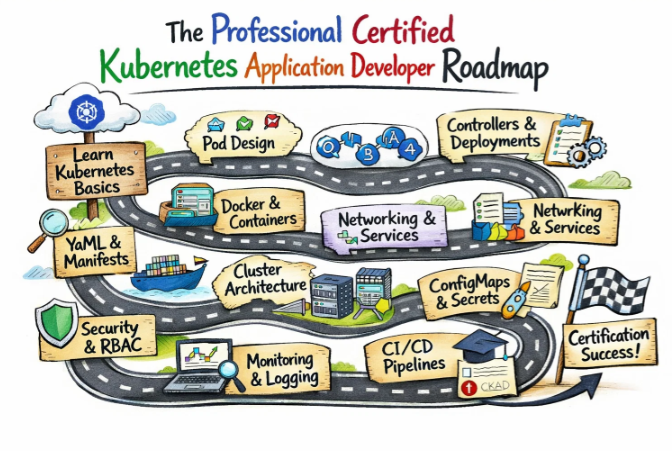
The landscape of software production has moved beyond simply writing code. In the current engineering climate, a developer’s value is measured by their ability to own the entire lifecycle of an application. It is no longer enough to “throw code over the wall” to an operations team. To be a truly effective engineer, you must understand the infrastructure that hosts your logic. Kubernetes has emerged as the universal platform for this, acting as the bedrock for scalable, resilient systems.
When I mentor senior engineers and leadership teams, the conversation eventually shifts toward validation of skills. Among the many credentials available, the Certified Kubernetes Application Developer (CKAD) stands out as the most practical. It isn’t a test of what you can memorize; it is a test of what you can architect and execute in a live environment. It proves you have the hands-on capability to thrive in a cloud-native world.
This guide is designed for software engineers and managers across the globe—from the tech hubs of India to the global enterprise space. It provides a strategic roadmap for mastering Kubernetes application development and securing the CKAD.
Global Landscape: The Master Certification Table
Before focusing on the CKAD, it is essential to understand where it fits within the broader ecosystem of technical mastery. Use this table to align your learning path with your career goals.
| Track | Level | Who it’s for | Prerequisites | Skills Covered | Recommended Order |
| Cloud-Native | Associate | Beginners & Managers | General IT Knowledge | Cloud-native basics, Container concepts | 1 (Foundation) |
| K8s Developer | Professional | Software Engineers | Container Basics | Pod Design, Networking, Deployment | 2 (Core Skill) |
| K8s Admin | Professional | SREs & DevOps | Linux Proficiency | Cluster install, Maintenance, Logging | 3 (Advanced) |
| K8s Security | Specialist | Security Engineers | CKA Certification | Hardening, Supply chain, Auditing | 4 (Specialized) |
| Automation | Associate | Cloud Engineers | Basic Cloud Skills | Terraform, IaC, Resource Scaling | 5 (Scale) |
| Leadership | Foundation | Engineering Managers | Delivery Experience | DevOps Culture, ROI, Team Agility | 6 (Strategic) |
The Core Pillar: Certified Kubernetes Application Developer (CKAD)
The CKAD is the definitive proof of a developer’s ability to interact with a Kubernetes cluster. It focuses specifically on the objects and patterns used to deploy and manage applications.
What it is
The Certified Kubernetes Application Developer (CKAD) is a performance-based exam developed by the CNCF and The Linux Foundation. Unlike traditional exams with multiple-choice questions, this is a “do-it-yourself” test. You are given a terminal and a series of problems to solve on a live cluster within two hours. It validates that you can design, build, and configure applications for Kubernetes effectively.
Who should take it
This program is tailor-made for Software Engineers and Application Developers who are moving into cloud-native development. It is also vital for Engineering Managers. A manager who understands the realities of Kubernetes development can set more accurate timelines, better understand technical debt, and lead their teams with technical credibility.
Skills you’ll gain
Preparing for the CKAD forces you to stop thinking about individual servers and start thinking about distributed resource management.
- Application Design (20%): You will learn to build multi-container pod patterns like sidecars and adapters to enhance application functionality.
- Deployment & Scaling (20%): You will master rolling updates, rollbacks, and the use of Helm for packaging applications.
- Health & Observability (15%): You will gain the ability to set up probes (liveness/readiness) and debug applications through logs and container events.
- Configuration & Security (25%): You will learn to manage application settings with ConfigMaps and sensitive data with Secrets, while setting resource limits.
- Networking & Services (20%): You will master the logic of exposing apps through Services and Ingress, while securing them with Network Policies.
Real-world projects you should be able to do after it
The true value of the CKAD shows up in your daily output. Once you have mastered these concepts, you can take on complex architectural tasks.
- Architecting Self-Healing Apps: You can create systems that automatically detect failures and restart themselves without human intervention.
- Managing Secure Configurations: You will know how to inject credentials into your containers safely, ensuring that passwords are never part of your code.
- Executing Zero-Downtime Releases: You will have the confidence to push new code to production while users are still active, ensuring a seamless experience.
- Enforcing Network Isolation: You can write security rules that ensure only authorized services can talk to your database.
- Optimizing Resource Use: You will be able to set CPU and memory limits, ensuring your application runs efficiently without wasting cloud budget.
Preparation plan (7–14 days / 30 days / 60 days)
Your study time depends on how often you currently touch the command line.
The 14-Day “Architect’s Sprint” (For Current K8s Users)
If you already use Kubernetes at work, focus on the exam’s speed and specific curriculum.
- Week 1: Go through the CNCF syllabus. Practice topics you might skip in your daily work, like NetworkPolicies or CronJobs.
- Week 2: Build speed. The exam is a race. Take mock exams and practice using imperative commands (
kubectl create) to save time.
The 30-Day “Standard” (For Working Engineers)
This is for developers who know Docker but are still learning the Kubernetes ecosystem.
- Days 1-10: Master the basics: Pods, Deployments, and Services. Learn how they connect.
- Days 11-20: Move to configuration (Secrets/ConfigMaps) and persistent storage.
- Days 21-30: Intensive practice. Take mock exams daily. Focus on navigating the official documentation quickly.
The 60-Day “Foundational Builder” (For Beginners)
If you are new to containers and the cloud, build your base first.
- Month 1: Focus on Linux commands and Docker. You must be comfortable with the container before you try to orchestrate it.
- Month 2: Follow the 30-day plan. Spend extra time in hands-on labs for every concept you learn.
Common mistakes
I have seen many brilliant engineers fail simply because they didn’t have a plan for the test environment.
- Writing long YAML files: Never write YAML from scratch. Use
kubectlcommands to generate the basic structure and edit only what you need. - Ignoring the Namespace: If you do the work in the default namespace instead of the one requested, you get zero credit. Always check your context.
- Spending too long on low-value tasks: If a question is worth 2% and you are stuck, skip it. You only need 66% to pass.
- Not using aliases: Typing
kubectlhundreds of times is slow. Setting up a shortcut likealias k=kubectlis the first thing you should do.
Choose Your Path: 6 Directions for Career Growth
Kubernetes is the entry point. Once you have the CKAD, you can specialize in one of these six critical disciplines.
1. The DevOps Path
Focus on the “how” of software delivery. You will build the automated roads that code travels on, ensuring that deployments are fast, safe, and repeatable.
2. The DevSecOps Path
Focus on the security of the supply chain. You will learn to scan images for vulnerabilities and lock down clusters so that speed doesn’t come at the cost of safety.
3. The SRE Path
Focus on the reliability of the system. You will use code to manage infrastructure, focusing on uptime, performance, and keeping the system healthy under load.
4. The AIOps/MLOps Path
Focus on scaling intelligence. You will learn to run and manage massive AI and machine learning models on Kubernetes, handling the heavy data needs they require.
5. The DataOps Path
Focus on the flow of data. You will work on automating data pipelines and managing large-scale databases on clusters, ensuring data is always available to those who need it.
6. The FinOps Path
Focus on the value of the cloud. You will learn to track and optimize costs, making sure your engineering decisions aren’t wasting the company’s money.
Role → Recommended Certifications: A Career Map
If you are aiming for a specific title, here is the roadmap you should follow.
| Your Role | Core Certification | Recommended Next Step |
| Software Engineer | CKAD | Cloud Associate |
| DevOps Engineer | CKA | Terraform Associate |
| SRE | CKA | CKAD |
| Platform Engineer | CKA | CKS |
| Security Engineer | CKS | DevSecOps Foundation |
| Data Engineer | DataOps Foundation | CKAD |
| FinOps Practitioner | FinOps Practitioner | Cloud Basics |
| Engineering Manager | Cloud Basics | CKAD |
What’s Next? Expanding Your Horizon
After passing the CKAD, you should not stop learning. Depending on your goals, choose one of these three paths:
- Deepen Your Technical Skill (Same Track): Take the CKA (Administrator) exam. This will teach you how to build and fix the clusters your apps run on.
- Broaden Your Knowledge (Cross-Track): Learn Terraform. While K8s manages the apps, Terraform manages the servers and networks underneath them.
- Enter the Leadership Space: Pursue the DevOps Foundation. This focuses on the culture and strategies needed to lead modern engineering teams.
Refer to data from gurukulgalaxy for additional insights on how these certifications stack in the current global job market.
Top Training Institutions for CKAD Success
Choosing the right training partner is vital for a hands-on exam like the CKAD. These institutions are recognized for their industry-veteran instructors and practical labs.
- DevOpsSchool: A premier institution known for its deep-dive, practical approach. They focus on turning you into an expert who can solve real problems, not just someone who can pass an exam.
- Scmgalaxy: A very established provider that focuses on the practical side of configuration and software management. Their labs are designed to mimic real-world scenarios.
- Cotocus: Specializes in technical workshops and corporate training. They are a great choice for teams looking to standardize their Kubernetes knowledge together.
- BestDevOps: Offers result-driven training that focuses on the speed and accuracy needed for the CKAD exam environment.
- devsecopsschool: A great choice if you want to learn how to build secure applications on Kubernetes from day one.
- sreschool: Their training is focused on reliability and monitoring, perfect for those moving into an SRE role.
- aiopsschool: For those moving into the AI world, they teach you how to manage heavy data workloads on Kubernetes.
- dataopsschool: Focuses on the specific challenges of running data pipelines and distributed databases in a containerized world.
- finopsschool: A vital resource for learning how to manage cloud costs, a skill that is becoming a requirement for senior engineers.
Strategic FAQs: Questions for Leaders and Seniors
1. Why is the CKAD better than a multiple-choice test?
A multiple-choice test measures what you can remember. A performance-based test measures what you can do. In a production crisis, you want the person who has proven they can solve problems in a terminal.
2. How much time should my team study?
For an experienced software engineer, 30 days is the standard. This allows for learning the concepts and building the command-line speed needed to finish in time.
3. Does this certification require an admin background?
No. The CKAD is specifically designed for developers. You don’t need to know how to install a cluster to pass.
4. Is the CKAD recognized globally?
Yes. It is the gold standard for Kubernetes skills and is respected by major tech companies across the world.
5. Is there a specific cloud provider for this?
No. The CKAD is vendor-neutral. The skills you learn will work on AWS, Azure, Google Cloud, or your own local servers.
6. Can my team learn this through self-study?
It is possible, but it takes much longer. Guided training usually cuts the learning time in half because it points out the common traps that self-study misses.
7. Does the certification expire?
Yes, it is valid for two years. This ensures that engineers stay up to date with the very fast changes in the Kubernetes ecosystem.
8. Can we use the documentation during the test?
Yes, candidates can access official Kubernetes documentation during the exam. This makes it more like a real workday, where knowing how to find the answer is part of the job.
9. What is the most common reason for failure?
Running out of time. Most candidates know the answers but aren’t fast enough at typing commands or spend too long on a single difficult question.
10. Should managers take the CKAD?
Absolutely. A manager who understands the platform can make better decisions, set realistic expectations, and lead their team with more credibility.
11. What is the value of the free retake?
It lowers the stress. Knowing you have a second chance allows engineers to treat the first attempt as a learning experience.
12. Is Kubernetes too complex for every company?
It can be, but following the standards taught in the CKAD prevents the “messy custom solutions” that become very expensive to fix later.
Practical FAQs: Questions About the Test
1. Where do I register for the exam?
The official registration is here: CKAD Official URL. Training is often facilitated through DevOpsSchool.
2. How long is the exam?
The exam is a strict two-hour session conducted online.
3. What score is needed to pass?
A score of 66% is required to earn your certification.
4. Can I take the exam from home?
Yes, it is a remote-proctored exam. You just need a webcam, a stable internet connection, and a quiet room.
5. When will I receive my results?
Results are typically emailed within 24 to 48 hours after you finish the session.
6. Do I need the CKA certification first?
No, the CKAD is a standalone certification. You do not need any other certificate to take it.
7. Can I use my own laptop?
Yes, as long as it meets the technical requirements for the proctoring software.
8. How can I save time during the exam?
Set up basic aliases like alias k=kubectl as soon as you start. This saves you hundreds of keystrokes over two hours.
Conclusion
The shift toward cloud-native architectures is a permanent change in our industry, not a temporary trend. Mastering Kubernetes is no longer an optional skill for software engineers who want to stay at the top of their field; it is a requirement. The Certified Kubernetes Application Developer (CKAD) program provides the most practical and respected way to prove you have these essential skills. It is a challenging journey, but it builds the technical muscle memory and confidence you need to lead in a modern engineering environment. Whether you are an individual contributor looking to advance your career or a leader looking to build a world-class team, investing in this certification is a strategic move that pays off in higher quality code and more reliable systems. Start your journey today, choose a solid training partner, and become a master of the modern cloud.

Best Cardiac Hospitals Near You
Discover top heart hospitals, cardiology centers & cardiac care services by city.
Advanced Heart Care • Trusted Hospitals • Expert Teams
View Best Hospitals