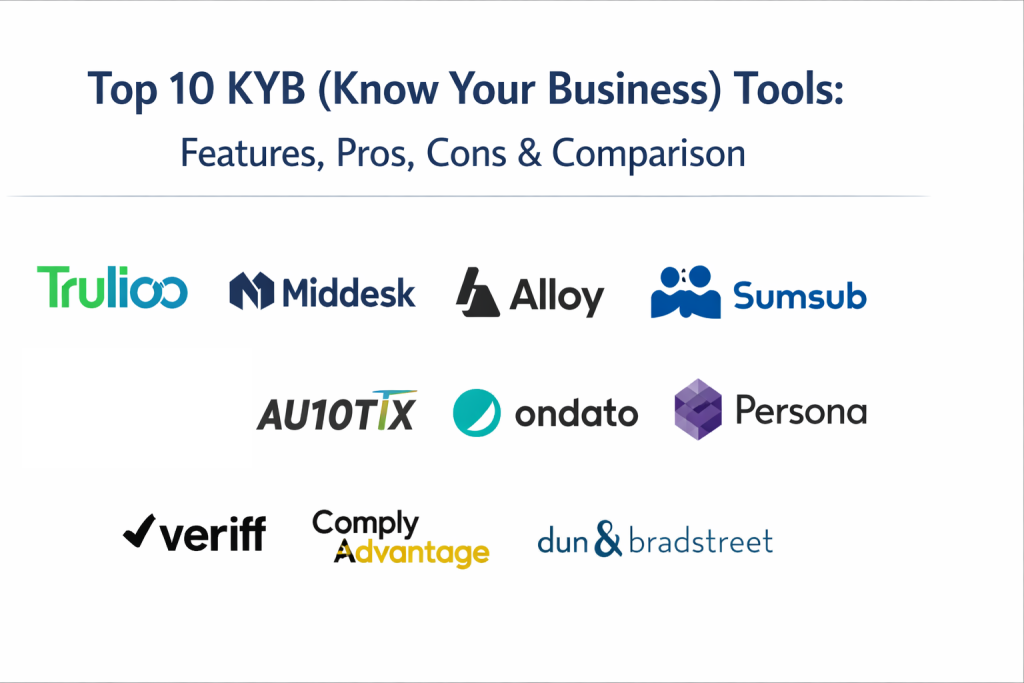
Introduction
KYB tools help companies verify that a business is real, legally registered, and safe to work with. In simple words, these tools support business onboarding, ownership checks, document review, sanctions screening, and ongoing risk monitoring. Today, many companies do not want only a one-time business check. They want a system that can help them monitor risks over time, reduce fraud, and support compliance work with less manual effort.
Common use cases include onboarding merchants, verifying suppliers, approving business borrowers, checking marketplace sellers, and reviewing high-risk business accounts. When comparing KYB tools, buyers should look at registry coverage, beneficial ownership checks, workflow automation, AML screening, case management, document support, API quality, audit readiness, monitoring, and fit for their region.
Best for: banks, fintechs, payment companies, lenders, insurance firms, marketplaces, B2B platforms, and compliance teams that onboard business customers.
Not ideal for: very small businesses with low onboarding volume, teams that only verify individuals, or companies that only need a basic vendor lookup.
Key Trends in KYB (Know Your Business) Tools
- Continuous KYB is becoming more important than one-time verification.
- Many platforms now combine business verification, UBO checks, AML screening, and monitoring in one flow.
- Automation is reducing manual review and helping compliance teams move faster.
- API-first design is becoming important for product and engineering teams.
- Global business verification is now a key need for international platforms.
- More buyers want KYB and KYC to work together in the same process.
- Audit-friendly workflows are becoming a major requirement.
- Flexible integrations are important because many businesses use multiple data sources.
- Risk scoring and rule-based decisioning are now more common.
- Companies want a balance between compliance strength and customer onboarding speed.
How We Selected These Tools
- We focused on tools that are clearly used for business verification or KYB workflows.
- We prioritized products with strong market presence and practical relevance.
- We looked for broad feature coverage across entity checks, ownership review, AML support, and monitoring.
- We included a balanced mix of specialist platforms and broader compliance tools.
- We considered fit for startup, mid-market, and enterprise teams.
- We gave extra weight to integration flexibility and workflow support.
- We looked at operational value, not only feature count.
- We avoided guessing where details were not clearly available.
- We selected tools that are widely discussed in KYB, onboarding, and compliance workflows.
- We aimed for a realistic buyer-focused list rather than hype.
1. Trulioo
Trulioo is a global identity and business verification platform. It is a strong choice for companies that need international coverage and want business verification and identity workflows connected in one system.
Key Features
- Global business verification coverage
- Unified support for business and identity checks
- Registry-based business validation
- Standardized data for review
- Real-time verification workflows
- API-driven onboarding support
- Audit-friendly reporting capabilities
Pros
- Strong global reach
- Good for cross-border onboarding
- Useful for API-driven businesses
Cons
- May be too large for small domestic-only teams
- Pricing is not publicly stated
- Setup may take planning for advanced use cases
Platforms / Deployment
Web
Cloud
Security & Compliance
Not publicly stated
Integrations & Ecosystem
Trulioo works well for companies that want to embed verification directly into onboarding flows. It is useful for businesses building large-scale identity and business verification systems.
- API-based integration model
- Workflow-friendly setup
- Supports layered verification needs
- Useful in wider trust and compliance stacks
Support & Community
Documentation appears strong for product and developer teams. Community visibility is moderate.
2. Middesk
Middesk focuses strongly on business verification and onboarding, especially in the United States. It is useful for fintech, lending, and financial operations teams that want strong domestic business checks.
Key Features
- Business verification API
- U.S. business data coverage
- EIN verification support
- Risk workflow support
- Ongoing business monitoring
- Automation for manual KYB work
- Business onboarding support
Pros
- Strong for U.S. onboarding
- Helpful automation for operations teams
- Good fit for fintech and lending
Cons
- Less natural fit for global-only needs
- Pricing is not publicly stated
- May need extra tools for broader compliance orchestration
Platforms / Deployment
Web
Cloud
Security & Compliance
Not publicly stated
Integrations & Ecosystem
Middesk is best for teams that want authoritative U.S. business checks built into onboarding and approval processes.
- API-based workflow support
- Helpful for underwriting and onboarding
- Useful for business monitoring
- Good fit for domestic business verification flows
Support & Community
Documentation and educational content are strong. Community presence is more product-led than open-community led.
3. Alloy
Alloy is a configurable identity, fraud, and compliance platform. Its strength in KYB comes from workflow orchestration, monitoring, and support for ongoing business risk review.
Key Features
- KYB and business onboarding support
- Continuous business monitoring
- Multiple data provider orchestration
- Risk and compliance decisioning
- UBO and sanctions review support
- AI-assisted investigation support
- Auditable workflows
Pros
- Strong for regulated financial workflows
- Excellent for ongoing risk monitoring
- Useful for teams using multiple providers
Cons
- Can feel heavier than a simple KYB-only tool
- Best value often comes in regulated environments
- Pricing is not publicly stated
Platforms / Deployment
Web
Cloud
Security & Compliance
Not publicly stated
Integrations & Ecosystem
Alloy stands out when companies need orchestration across multiple tools and data providers.
- Strong workflow integration value
- Good for identity and fraud stacks
- Useful for configurable rules
- Supports complex compliance operations
Support & Community
Best for teams with clear compliance and implementation ownership. Public education is strong, while community visibility is moderate.
4. Sumsub
Sumsub offers business verification as part of a wider identity and compliance platform. It is a good fit for companies that want automation, registry checks, document handling, and ownership verification in one place.
Key Features
- Automated KYB checks
- Corporate AML screening
- Corporate registry checks
- Document data extraction
- Full business verification workflows
- Ownership and management checks
- Modular operations support
Pros
- Good balance of automation and workflow depth
- Useful for global compliance teams
- Helps reduce manual verification effort
Cons
- Advanced coverage details may need sales discussion
- Pricing is not publicly stated
- Full setup may require planning
Platforms / Deployment
Web
Cloud
Security & Compliance
Not publicly stated
Integrations & Ecosystem
Sumsub works well for companies that want business verification connected with screening, document review, and workflow control.
- Registry check support
- AML screening support
- Ownership handling support
- Modular workflow design
Support & Community
Documentation looks useful, especially for product and operations teams. Community presence is moderate.
5. Persona
Persona is known for flexible identity infrastructure and supports business verification through API-driven flows. It is a strong option for teams that want customizable verification journeys.
Key Features
- Business verification API
- Business document verification
- Flexible workflow design
- Identity infrastructure support
- Global coverage positioning
- Programmable API model
- Broad industry use
Pros
- Very flexible for product teams
- Good for unified identity architecture
- Strong developer appeal
Cons
- May require more setup design than some packaged tools
- Pricing is not publicly stated
- Teams wanting a KYB-only specialist may prefer a narrower product
Platforms / Deployment
Web
Cloud
Security & Compliance
Not publicly stated
Integrations & Ecosystem
Persona is useful for businesses that want identity and business verification inside one flexible infrastructure layer.
- API-first approach
- Supports custom workflows
- Useful for business and individual verification
- Good fit for modern product teams
Support & Community
Developer documentation is one of its strengths. Community visibility is fair.
6. Veriff
Veriff offers business verification as part of a broader trust and fraud platform. It suits teams that want business onboarding support with fraud and compliance value.
Key Features
- Business verification workflows
- Global business data access
- Fraud prevention support
- Compliance-focused onboarding
- Broader trust platform support
- Useful for financial and platform businesses
- Digital onboarding support
Pros
- Good mix of compliance and fraud value
- Helpful for digital onboarding teams
- Useful broader verification product family
Cons
- Detailed KYB depth is less public than some specialists
- Pricing is not publicly stated
- Some enterprises may want more orchestration strength
Platforms / Deployment
Web
Cloud
Security & Compliance
Not publicly stated
Integrations & Ecosystem
Veriff fits well into wider trust systems because it supports several related verification services.
- Business verification support
- Fraud-related workflow value
- Useful in multi-check onboarding
- Supports broader verification strategy
Support & Community
Commercial support appears strong. Public community depth is respectable but not a main strength.
7. AU10TIX
AU10TIX positions its business verification as an all-in-one KYC and KYB solution. It is strong for companies that want business and owner checks joined in one automated workflow.
Key Features
- Single API for KYC and KYB
- Business validation
- Enhanced due diligence support
- UBO verification workflows
- AML screening
- Organization chart support
- Automated onboarding
Pros
- Clear value for business and owner checks together
- Good for automation-focused teams
- Useful in compliance-heavy onboarding
Cons
- Public product detail is less extensive than some larger brands
- Pricing is not publicly stated
- Coverage depth may require sales discussion
Platforms / Deployment
API-based
Cloud
Security & Compliance
Not publicly stated
Integrations & Ecosystem
AU10TIX is attractive where one automated workflow for company and owner checks matters most.
- Single API support
- UBO workflow support
- AML screening support
- Good for embedded onboarding
Support & Community
Public information suggests a commercial enterprise approach. Documentation visibility is moderate.
8. Ondato
Ondato offers remote business verification with strong support for KYB forms, UBO structure handling, business information collection, and AML screening. It fits companies that want an all-in-one onboarding process.
Key Features
- Remote business verification
- KYB forms
- UBO structure review
- Business information collection
- AML screening
- Global compliance positioning
- End-to-end flow support
Pros
- Strong operational focus for onboarding
- Good fit for one-platform workflows
- Helpful for cross-jurisdiction verification needs
Cons
- Lower market mindshare than some bigger brands
- Pricing is not publicly stated
- Public ecosystem depth is somewhat limited
Platforms / Deployment
Web
Cloud
Security & Compliance
Not publicly stated
Integrations & Ecosystem
Ondato is more workflow-led in public positioning and fits businesses wanting a complete onboarding process.
- Business data collection
- UBO structure handling
- AML workflow support
- End-to-end onboarding support
Support & Community
Commercial support is central. Public community visibility is moderate.
9. ComplyAdvantage
ComplyAdvantage is widely known for AML and risk intelligence. It fits KYB best in companies where screening, monitoring, and risk visibility matter as much as business entity verification.
Key Features
- KYB verification support
- AML and financial crime focus
- Ongoing risk checks
- Screening-oriented workflows
- Monitoring support
- Compliance-focused operations
- Useful risk intelligence support
Pros
- Strong fit for AML-heavy operations
- Useful when monitoring matters a lot
- Good for risk-led teams
Cons
- Less of a pure business verification specialist
- Pricing is not publicly stated
- Some teams may need extra registry or document tools
Platforms / Deployment
Varies / N/A
Varies / N/A
Security & Compliance
Not publicly stated
Integrations & Ecosystem
ComplyAdvantage fits best as part of a wider compliance and monitoring stack.
- Strong AML support
- Good for monitoring-led use cases
- Useful alongside identity tools
- Supports risk operations workflows
Support & Community
Support appears enterprise-oriented. Public community visibility is moderate.
10. Dun & Bradstreet
Dun & Bradstreet is highly relevant for business verification because of its business data, entity matching, and firmographic validation capabilities. It is useful where business identity data is a key input.
Key Features
- Business verification data services
- Global business database access
- Entity matching capabilities
- Firmographic validation
- Principal and linkage information
- API access options
- Useful compliance support data
Pros
- Strong business data heritage
- Useful for entity matching and validation
- Good supporting layer for broader KYB programs
Cons
- Less of a full modern end-to-end KYB workflow tool
- Pricing is not publicly stated
- Some teams may need separate workflow tools
Platforms / Deployment
API access
Varies / N/A
Security & Compliance
Not publicly stated
Integrations & Ecosystem
Dun & Bradstreet is often best used as a business data backbone rather than a full workflow platform.
- API access support
- Global business validation data
- Entity match strengths
- Useful in onboarding and compliance stacks
Support & Community
Documentation exists for technical integration. It is more enterprise data-service oriented than community oriented.
Comparison Table
| Tool Name | Best For | Platform(s) Supported | Deployment | Standout Feature | Public Rating |
|---|---|---|---|---|---|
| Trulioo | Global business onboarding | Web | Cloud | Broad international business verification coverage | N/A |
| Middesk | U.S. business verification | Web | Cloud | Direct connections to U.S. business data sources | N/A |
| Alloy | Regulated financial workflows | Web | Cloud | Continuous KYB and orchestration | N/A |
| Sumsub | Automated end-to-end business verification | Web | Cloud | Ownership and document checks in one flow | N/A |
| Persona | Flexible identity infrastructure | Web | Cloud | Custom API-led business verification flows | N/A |
| Veriff | Fraud-aware business onboarding | Web | Cloud | Business verification inside a broader trust stack | N/A |
| AU10TIX | Combined KYC and KYB automation | API-based | Cloud | Single API for business and owner checks | N/A |
| Ondato | All-in-one onboarding workflows | Web | Cloud | UBO and AML support in one process | N/A |
| ComplyAdvantage | AML-led KYB operations | Varies / N/A | Varies / N/A | Strong risk and monitoring focus | N/A |
| Dun & Bradstreet | Business identity validation data | API access | Varies / N/A | Entity matching and firmographic data strength | N/A |
Evaluation & Scoring of KYB (Know Your Business) Tools
| Tool Name | Core (25%) | Ease (15%) | Integrations (15%) | Security (10%) | Performance (10%) | Support (10%) | Value (15%) | Weighted Total (0–10) |
|---|---|---|---|---|---|---|---|---|
| Trulioo | 9 | 8 | 9 | 8 | 9 | 8 | 7 | 8.35 |
| Middesk | 8 | 9 | 8 | 7 | 9 | 8 | 8 | 8.15 |
| Alloy | 9 | 7 | 9 | 8 | 8 | 8 | 7 | 8.10 |
| Sumsub | 9 | 8 | 8 | 8 | 8 | 8 | 8 | 8.25 |
| Persona | 8 | 8 | 9 | 8 | 8 | 8 | 7 | 8.00 |
| Veriff | 8 | 8 | 7 | 7 | 8 | 8 | 7 | 7.65 |
| AU10TIX | 8 | 7 | 7 | 7 | 8 | 7 | 7 | 7.40 |
| Ondato | 8 | 8 | 7 | 7 | 8 | 7 | 8 | 7.65 |
| ComplyAdvantage | 7 | 7 | 8 | 8 | 8 | 8 | 7 | 7.45 |
| Dun & Bradstreet | 7 | 7 | 8 | 7 | 8 | 7 | 7 | 7.20 |
These scores are comparative editorial scores, not vendor ratings. They help you build a shortlist, but they should not replace a real pilot. A lower-scoring tool can still be the right fit if it matches your region, workflow, and compliance needs better.
Which KYB (Know Your Business) Tool Is Right for You?
Solo / Freelancer
Most solo users do not need a full KYB platform. If you only verify a few vendors or business clients occasionally, a simpler process may be enough.
SMB
SMBs usually benefit from tools that are easy to launch and reduce manual work quickly. Middesk is attractive for U.S.-focused teams, while Sumsub and Ondato can fit businesses wanting more complete workflows.
Mid-Market
Mid-market teams usually need stronger monitoring, workflow control, and integration depth. Sumsub, Persona, and Alloy stand out depending on whether you want packaged compliance, flexible identity infrastructure, or orchestration.
Enterprise
Enterprises should look at scale, control, global reach, and audit support. Trulioo is strong for cross-border use. Alloy is useful for complex financial workflows. Dun & Bradstreet can be a valuable data layer.
Budget vs Premium
If budget matters most, choose a tool that solves your main verification problem well. Premium platforms are often best when your onboarding volume, fraud risk, or compliance pressure is already high.
Feature Depth vs Ease of Use
Some tools are easier to start with, while others offer more flexibility. If you have technical resources, Persona or Trulioo may be attractive. If you want ready-made operational workflows, Sumsub, Ondato, or Middesk may feel easier.
Integrations & Scalability
If you already use internal risk engines, compliance tools, or several data providers, integration quality matters a lot. Alloy is especially strong where orchestration matters.
Security & Compliance Needs
Regulated firms should focus on audit support, monitoring, ownership review, AML alignment, and workflow control. In these cases, Alloy, Sumsub, Trulioo, and ComplyAdvantage deserve close review.
Frequently Asked Questions
1. What does a KYB tool verify?
A KYB tool checks whether a business is legally registered, active, and trustworthy. It may also review ownership, documents, sanctions exposure, and other risk indicators.
2. How is KYB different from KYC?
KYC is for individuals, while KYB is for businesses. In many cases, KYB also includes checks on the people who own or control the business.
3. Do all companies need a KYB platform?
No. Full KYB software is most useful for companies that onboard business customers often or operate in regulated or high-risk sectors.
4. Are KYB tools only for banks and fintechs?
No. They are also useful for marketplaces, lenders, insurance companies, B2B platforms, and vendor onboarding teams.
5. What is a common mistake when choosing a KYB tool?
A common mistake is focusing only on onboarding speed. Buyers should also evaluate ownership checks, monitoring, integrations, and long-term workflow fit.
6. Do KYB tools support ongoing monitoring?
Many do. Ongoing monitoring helps companies spot ownership changes, new risks, or changes in legal business status after onboarding.
7. How do KYB tools usually charge?
Pricing often depends on verification volume, region, workflow complexity, and the number of checks used. In many cases, pricing is not publicly stated.
8. Is a global tool always better than a regional one?
Not always. A global platform is useful for international onboarding, but a regional specialist can be better for deep local data and domestic operations.
9. Can businesses switch KYB tools later?
Yes, but switching can be difficult if workflows and data mapping are deeply connected to internal systems. That is why pilot testing matters.
10. What should be tested during a pilot?
Test registry accuracy, ownership review, false positives, manual review effort, integration speed, reporting quality, and workflow fit with your real operations.
Conclusion
The best KYB tool depends on your business model, region, onboarding volume, and compliance pressure. Some companies need strong global coverage and API flexibility. Others need domestic business verification, better AML monitoring, or a complete onboarding workflow with ownership checks included. Instead of chasing the biggest name, focus on the tool that fits your actual process. Build a shortlist of two or three options, test them in a real pilot, check integration quality, and review how much manual effort each one creates. A practical fit will always matter more than a long feature list.

Best Cardiac Hospitals Near You
Discover top heart hospitals, cardiology centers & cardiac care services by city.
Advanced Heart Care • Trusted Hospitals • Expert Teams
View Best Hospitals