Introduction
An Electronic Lab Notebook (ELN) is a specialized digital platform designed to replace traditional paper notebooks in scientific research and development. These tools allow scientists to document experiments, store raw data, manage protocols, and track laboratory inventory in a secure, searchable environment. Unlike a standard text editor, an ELN is “science-aware,” meaning it includes features like chemical structure drawing, biological sequence alignment, and integration with laboratory instruments to automate data capture directly from the bench.
In the current research landscape, the shift toward digitalization has made ELNs a necessity for maintaining data integrity and accelerating discovery. As laboratories move toward more collaborative and data-intensive workflows, these platforms provide a “single source of truth” that ensures every observation is time-stamped, version-controlled, and easily retrievable. This digital transformation not only saves time but also protects intellectual property by providing an immutable audit trail of the research process.
Real-World Use Cases
- Documenting molecular biology experiments, including plasmid maps and genomic sequences, for biotech startups.
- Managing complex chemical reaction pathways and stoichiometry calculations in pharmaceutical R&D.
- Ensuring compliance with regulatory standards such as FDA 21 CFR Part 11 for clinical trial data.
- Centralizing academic research data across multiple university departments to facilitate grant reporting and peer-reviewed publications.
- Tracking laboratory inventory and reagent usage to prevent stockouts and reduce waste in high-throughput testing facilities.
Evaluation Criteria for Buyers
- The quality of the user interface and how easily it can be adopted by researchers used to paper notebooks.
- Support for specific scientific disciplines, such as built-in tools for chemistry, biology, or clinical research.
- The robustness of security features and adherence to global compliance standards like GDPR and SOC 2.
- The ability to integrate seamlessly with existing Laboratory Information Management Systems (LIMS) and hardware.
- The efficiency of the search engine in locating specific data points across years of research entries.
- The availability of mobile or tablet versions for real-time documentation directly at the laboratory bench.
- The total cost of the platform, including per-user licensing and storage fees for massive datasets.
Best for: R&D scientists, laboratory managers, academic principal investigators, and quality assurance officers in biotech, pharma, and chemical industries.
Not ideal for: General office workers who do not require specialized scientific data structures or organizations looking for a simple, non-compliant note-taking app.
Key Trends in Electronic Lab Notebook Software
- The integration of Generative AI to assist in drafting experiment summaries and predicting optimal reaction parameters.
- A move toward cloud-native architectures that support real-time, global collaboration between distributed research teams.
- The adoption of “Voice-to-ELN” technology, allowing scientists to record observations hands-free while working in sterile environments.
- Increased focus on FAIR data principles (Findable, Accessible, Interoperable, and Reusable) to improve scientific transparency.
- Deepening integration between ELN platforms and laboratory robotics for fully automated experimental execution.
- The rise of modular marketplaces where labs can add specific scientific “widgets” or apps to customize their notebook.
- Enhanced cybersecurity measures, including end-to-end encryption and multi-factor authentication, to protect high-value intellectual property.
- The transition from static data storage to “active data” environments where the software alerts researchers to potential errors in real-time.
How We Selected These Tools
The tools featured in this list were chosen based on their proven reliability in professional and academic research environments. We analyzed market leaders that have demonstrated a long-term commitment to data integrity and technical innovation. Key factors in our selection included the breadth of scientific features provided, the strength of the platform’s security posture, and the quality of user feedback regarding daily usability. We also prioritized tools that offer specialized functionality for biology and chemistry, as these represent the most demanding use cases for digital documentation. Finally, we ensured a balance between enterprise-grade suites and more flexible options for smaller labs and academic institutions.
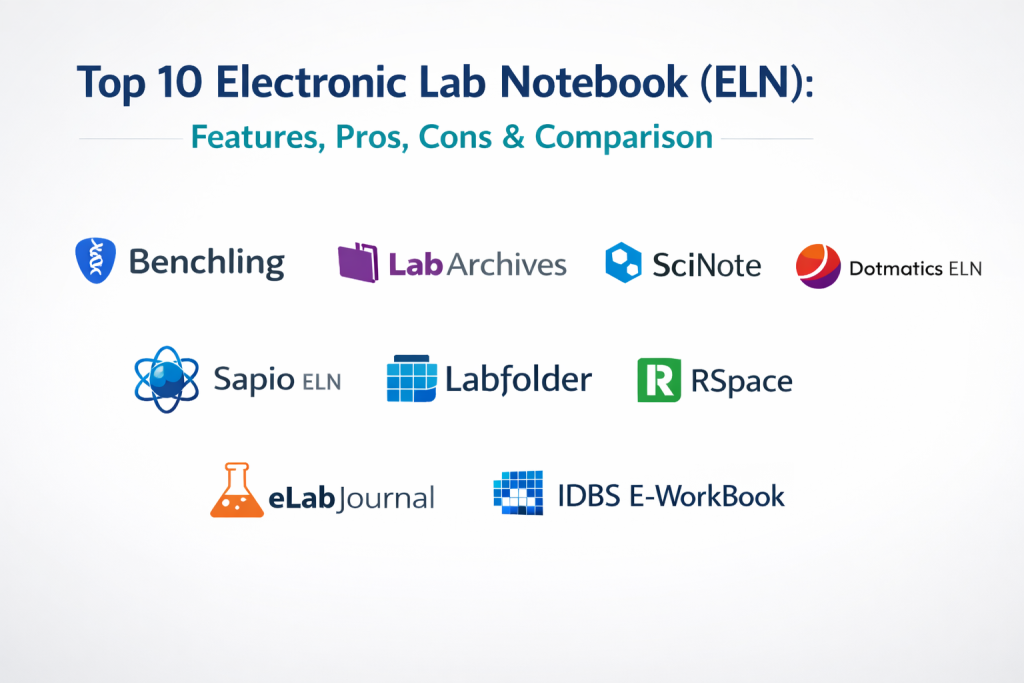
Top 10 Electronic Lab Notebook Software Tools
1. Benchling
Benchling is often considered the industry standard for modern life sciences research. It is a cloud-based platform that combines an ELN with advanced molecular biology tools, making it the primary choice for biopharma teams. Its strength lies in its ability to turn unstructured notes into high-quality, analysis-ready data.
Key Features
- A specialized notebook designed for complex biology and chemistry R&D.
- Built-in molecular biology tools for DNA and protein sequence design.
- Unified registry and inventory system to link data directly to samples.
- Advanced search capabilities to retrieve past entries and experimental metadata.
- Fully compliant with FDA 21 CFR Part 11 for audit trails and e-signatures.
Pros
- Superior collaboration features that function like a “Google Docs for Science.”
- Deeply integrated with other Benchling apps for a seamless research lifecycle.
Cons
- High price point that may be prohibitive for smaller academic labs.
- Extensive feature set can be overwhelming for researchers with simple needs.
Platforms / Deployment
Web / macOS / Windows — Cloud
Security & Compliance
SOC 2 Type II, HIPAA, GDPR, and 21 CFR Part 11.
Integrations & Ecosystem
Benchling provides a robust API and a wide range of native integrations with laboratory instruments and visualization tools. It is designed to act as the central nervous system for a digital lab.
Support & Community
Extensive online documentation, dedicated customer success managers for enterprise clients, and a large professional user base.
2. LabArchives
LabArchives is one of the most widely used ELNs in the academic and government research sectors. It provides a flexible, hierarchical structure that makes it easy for large organizations to manage data across thousands of individual users.
Key Features
- Hierarchical organization by project, experiment, and individual entry.
- Seamless integration with Microsoft Office Online for editing documents within the notebook.
- Customizable widgets for standardized data entry and calculations.
- Comprehensive electronic signature workflow for witness review.
- Automatic redundant backups across geographically distributed servers.
Pros
- Extremely easy for large institutions to deploy and manage.
- Strong focus on pedagogical features for use in science classrooms.
Cons
- The user interface can feel slightly less modern than newer cloud-native tools.
- Limited built-in advanced molecular design tools compared to specialized suites.
Platforms / Deployment
Web / iOS / Android — Cloud
Security & Compliance
SOC 2, HIPAA, and GDPR compliant.
Integrations & Ecosystem
Integrates with popular research tools like GraphPad Prism, SnapGene, and various institutional storage providers via a flexible API.
Support & Community
Excellent support through video tutorials, live webinars, and a massive community of academic researchers.
3. SciNote
SciNote is a top choice for labs that require a structured, process-driven approach to research. It uses a unique project-experiment-task hierarchy that helps teams visualize their workflows and maintain high levels of organization.
Key Features
- A visualized workflow canvas to show how experimental steps are connected.
- Centralized protocol repository for managing and sharing SOPs.
- Integrated inventory management to track reagents and supplies.
- Automated report generation to save time on data compilation.
- Time-stamped audit trails that cannot be edited or deleted.
Pros
- Highly intuitive interface that requires minimal training for new users.
- Excellent for maintaining audit-ready data in regulated environments.
Cons
- Advanced project management features are gated behind premium tiers.
- Mobile experience is less feature-rich than the desktop web version.
Platforms / Deployment
Web — Cloud / On-premise
Security & Compliance
ISO 27001 certified, 21 CFR Part 11, and GDPR compliant.
Integrations & Ecosystem
SciNote offers a robust API and integrates with laboratory instruments and data processing tools to streamline the research pipeline.
Support & Community
Known for very responsive email support and a comprehensive library of tutorial videos.
4. Dotmatics ELN
Dotmatics is a heavyweight in the enterprise space, particularly for chemistry and multi-disciplinary R&D. It is built to handle massive datasets and provides deep scientific intelligence for drug discovery and material science.
Key Features
- Sophisticated chemistry tools for drawing structures and managing reactions.
- Advanced data visualization and analytics for large-scale screening.
- Flexible templates that can be customized for any scientific discipline.
- Seamless connection between experimental data and high-level analysis.
- Enterprise-grade security and data management for global organizations.
Pros
- Unrivaled for handling complex chemistry data at scale.
- Highly configurable to meet the specific needs of large pharmaceutical companies.
Cons
- The complexity of the system requires significant IT support for implementation.
- Not suitable for small teams looking for a simple “out of the box” solution.
Platforms / Deployment
Web / Windows — Cloud / On-premise
Security & Compliance
ISO 27001, SOC 2, and 21 CFR Part 11.
Integrations & Ecosystem
Part of the broader Dotmatics scientific suite, it integrates deeply with specialized informatics and data capture modules.
Support & Community
Provides dedicated account managers and professional services for custom enterprise configurations.
5. Signals Notebook (Revvity)
Signals Notebook is a modern, web-based ELN designed for fast-paced R&D environments. It is particularly popular in the chemistry sector due to its native integration with ChemDraw, the industry’s leading chemical drawing tool.
Key Features
- Native ChemDraw integration for seamless chemical structure management.
- Free-form experiment pages that support text, images, and files.
- Automated calculation tables for stoichiometry and analytical data.
- Collaboration tools that allow for real-time co-authoring of entries.
- Built-in inventory tracking for reagents and lab supplies.
Pros
- The best choice for chemists who are already dependent on ChemDraw.
- Fast deployment with no software installation required.
Cons
- The free-form nature can sometimes lead to less standardized data entry.
- Pricing can be high for academic or smaller independent labs.
Platforms / Deployment
Web — Cloud (SaaS)
Security & Compliance
SOC 2, 21 CFR Part 11, and GDPR compliant.
Integrations & Ecosystem
Strongest integration is with the Revvity Signals ecosystem, but it also supports a wide range of external file formats and data exports.
Support & Community
Reliable professional support with a strong focus on the commercial R&D sector.
6. Sapio ELN
Sapio Sciences offers a “science-aware” platform that unifies the functions of an ELN, LIMS, and SDMS. It is designed for labs that want a single, highly configurable tool to manage their entire scientific lifecycle.
Key Features
- A unified data model that connects notebooks, samples, and processes.
- AI-powered text generation and data analysis tools.
- No-code configuration that allows scientists to build their own workflows.
- Advanced searching across all scientific entities and files.
- Real-time collaboration with built-in discussion threads.
Pros
- Eliminates the need for separate ELN and LIMS software.
- Highly flexible and adapts to rapidly changing research needs.
Cons
- The breadth of features means a steeper learning curve for simple labs.
- Implementation can take longer due to the highly customizable nature.
Platforms / Deployment
Web — Cloud / On-premise
Security & Compliance
SOC 2 Type II, HIPAA, and 21 CFR Part 11.
Integrations & Ecosystem
Designed as an open platform that easily connects to instruments, ERPs, and external data sources via a modern API.
Support & Community
Strong technical support with a focus on helping labs scale their digital infrastructure.
7. Labfolder (Labforward)
Labfolder is a flexible ELN that focuses on ease of use and organization. It is built to mimic the experience of a traditional notebook while adding the benefits of digital search, collaboration, and data security.
Key Features
- Free-form experiment pages that support drawing, sketches, and files.
- Integrated inventory management system (Labregister).
- Advanced filtering and tagging for quick data retrieval.
- Dedicated mobile app for documenting work away from the desk.
- Group management with granular permissions for team collaboration.
Pros
- One of the most intuitive tools for researchers making the switch from paper.
- Very affordable for small teams and individual researchers.
Cons
- Lacks the deep biological or chemical design tools of more specialized ELNs.
- Less ideal for massive enterprise-level data orchestration.
Platforms / Deployment
Web / iOS / Android — Cloud / On-premise
Security & Compliance
ISO 27001, 21 CFR Part 11, and GDPR.
Integrations & Ecosystem
Focuses on standard integrations and provides an API for custom connections to laboratory hardware.
Support & Community
Active community of researchers in biotech and academia with good online support resources.
8. RSpace
RSpace is designed to be a central hub for research data, focusing on connectivity and interoperability. It is a favorite among research institutions that want to integrate their notebook with existing storage and data management platforms.
Key Features
- A highly connected interface that links to institutional data repositories.
- Support for structured and unstructured data in a single notebook.
- Integrated sample and inventory management tools.
- Powerful collaborative features for large, multi-disciplinary teams.
- Audit trails and e-signatures for intellectual property protection.
Pros
- Excellent for researchers who need to link to large external datasets.
- Very flexible and doesn’t force a specific workflow on the user.
Cons
- The interface can feel a bit technical for non-power users.
- Requires a bit of configuration to get the most out of the integrations.
Platforms / Deployment
Web — Cloud / On-premise
Security & Compliance
21 CFR Part 11, HIPAA, and GDPR compliant.
Integrations & Ecosystem
Exceptional integration with storage services like Box, Dropbox, and specialized research tools like Mendeley and Zotero.
Support & Community
Strong focus on the academic and institutional research community with reliable support.
9. eLabJournal (eLabNext)
eLabJournal is a modular ELN that allows labs to customize their platform through a dedicated marketplace. This “add-on” approach makes it highly versatile for labs with evolving research requirements.
Key Features
- Modular structure where users can add or remove specific features.
- Comprehensive sample and inventory tracking modules.
- Electronic signatures for signing and countersigning experiments.
- Mobile access through a dedicated app for bench-side work.
- Standardized protocol templates to ensure consistency across the lab.
Pros
- The marketplace allows for a highly personalized user experience.
- Very strong sample and storage management capabilities.
Cons
- Managing many separate add-ons can become complex for administrators.
- Total cost can increase as more modular features are added.
Platforms / Deployment
Web / iOS / Android — Cloud / On-premise
Security & Compliance
SOC 2, HIPAA, GDPR, and 21 CFR Part 11.
Integrations & Ecosystem
The eLabNext Marketplace provides a unique ecosystem of tools and integrations that can be plugged directly into the notebook.
Support & Community
Responsive customer service with a strong presence in both Europe and North America.
10. IDBS E-WorkBook
E-WorkBook is an enterprise-grade solution preferred by global pharmaceutical and chemical giants. It is built for robustness, scalability, and deep analytical power, capable of handling the most complex R&D environments.
Key Features
- Enterprise-wide data management with a focus on data integrity.
- Deep analytical tools for interpreting complex experimental results.
- Sophisticated planning and scheduling modules for laboratory resources.
- High-level security and compliance for global regulatory submission.
- Integration with multi-site, multi-disciplinary research pipelines.
Pros
- The most robust choice for very large, global organizations.
- Excellent for managing complex, long-term research programs.
Cons
- Too heavy and expensive for small labs or academic research.
- Requires significant professional services for implementation and training.
Platforms / Deployment
Web / Windows — Cloud / On-premise
Security & Compliance
Fully compliant with GxP, ISO 27001, and 21 CFR Part 11.
Integrations & Ecosystem
Designed to be the centerpiece of a global R&D infrastructure, integrating with ERPs, LIMS, and clinical systems.
Support & Community
Provides top-tier enterprise support and professional services for global deployments.
Comparison Table (Top 10)
| Tool Name | Best For | Platform(s) Supported | Deployment | Standout Feature | Public Rating |
| 1. Benchling | Biotech R&D | Web, macOS | Cloud | Molecular Biology Tools | 4.8/5 |
| 2. LabArchives | Academia | Web, iOS, Android | Cloud | Institutional Scaling | 4.6/5 |
| 3. SciNote | Regulated Labs | Web | Hybrid | Workflow Visualization | 4.7/5 |
| 4. Dotmatics | Chemistry Enterprise | Web, Windows | Hybrid | Scientific Intelligence | 4.5/5 |
| 5. Signals Notebook | Fast-paced Chem | Web | Cloud | ChemDraw Integration | 4.6/5 |
| 6. Sapio ELN | Unified ELN/LIMS | Web | Hybrid | No-code Configuration | 4.7/5 |
| 7. Labfolder | Ease of Use | Web, Mobile | Hybrid | Free-form Design | 4.4/5 |
| 8. RSpace | Data Connectivity | Web | Hybrid | External Repo Linking | 4.5/5 |
| 9. eLabJournal | Modular Flexibility | Web, Mobile | Hybrid | Add-on Marketplace | 4.6/5 |
| 10. E-WorkBook | Global Pharma | Web, Windows | Hybrid | Enterprise Robustness | 4.3/5 |
Evaluation & Scoring of Electronic Lab Notebook (ELN)
| Tool Name | Core (25%) | Ease (15%) | Integrations (15%) | Security (10%) | Perf (10%) | Support (10%) | Value (15%) | Total |
| 1. Benchling | 10 | 7 | 9 | 10 | 9 | 8 | 6 | 8.6 |
| 2. LabArchives | 8 | 9 | 8 | 9 | 8 | 9 | 8 | 8.3 |
| 3. SciNote | 9 | 8 | 8 | 10 | 8 | 9 | 8 | 8.6 |
| 4. Dotmatics | 10 | 4 | 9 | 10 | 9 | 8 | 5 | 7.9 |
| 5. Signals | 9 | 8 | 9 | 9 | 9 | 8 | 7 | 8.4 |
| 6. Sapio | 10 | 5 | 9 | 10 | 9 | 9 | 6 | 8.3 |
| 7. Labfolder | 7 | 10 | 7 | 8 | 8 | 8 | 9 | 8.0 |
| 8. RSpace | 8 | 7 | 10 | 9 | 8 | 8 | 8 | 8.2 |
| 9. eLabJournal | 8 | 8 | 9 | 9 | 8 | 9 | 7 | 8.2 |
| 10. E-WorkBook | 10 | 4 | 8 | 10 | 9 | 8 | 5 | 7.7 |
Scoring is weighted to reflect the needs of a professional laboratory environment. High core feature scores represent a tool’s ability to handle complex scientific data, while high security scores indicate full regulatory readiness. Value scores reflect the price-to-feature ratio for mid-sized organizations.
Which Electronic Lab Notebook (ELN) Tool Is Right for You?
Solo / Freelancer
If you are an independent researcher or a consultant, Labfolder or the basic tier of SciNote are excellent starting points. They offer the essential digital notebook features and cloud security without the high price tag of enterprise suites.
SMB (Small to Medium Business)
Growing biotech startups should prioritize Benchling due to its status as the industry standard, which makes collaboration with partners and investors much easier. For labs with a heavy chemistry focus, Signals Notebook offers the most efficient workflow.
Mid-Market
For established research organizations that need a balance between power and usability, eLabJournal or Sapio ELN provide the flexibility to scale. Their modular and configurable natures allow them to grow alongside your research pipeline.
Enterprise
Large global pharmaceutical or chemical companies require the extreme robustness of IDBS E-WorkBook or Dotmatics. These systems are designed to manage multi-site deployments and ensure that every byte of data meets the highest regulatory standards.
Budget vs Premium
LabArchives and SciNote represent the best value for organizations that need compliance and security on a reasonable budget. Benchling and Dotmatics are premium solutions for those who require the most advanced scientific intelligence tools available.
Feature Depth vs Ease of Use
If your team is non-technical and needs a quick transition from paper, Labfolder is the most intuitive. However, if you need to perform complex sequence design or reaction modeling, you will need the feature depth of Benchling or Dotmatics, despite the longer learning period.
Integrations & Scalability
RSpace is the clear leader for labs that need to connect to a wide variety of institutional data repositories. For those looking to scale an entire digital laboratory ecosystem, Sapio ELN offers the most unified approach by combining notebook and management functions.
Security & Compliance Needs
All the top-tier tools listed provide 21 CFR Part 11 compliance. However, for labs operating under the most stringent ISO and GxP standards, SciNote and E-WorkBook offer the most comprehensive audit-ready frameworks.
Frequently Asked Questions (FAQs)
1. What is the difference between an ELN and a LIMS?
An ELN is primarily for documenting the creative and unstructured notes of an experiment, while a LIMS (Laboratory Information Management System) is designed for managing structured samples, inventory, and repeatable workflows.
2. Can I use an ELN for clinical trials?
Yes, provided the ELN is fully compliant with FDA 21 CFR Part 11 and has robust audit trails and electronic signature workflows to ensure data integrity.
3. Is my data safe in a cloud-based ELN?
Most professional ELNs use enterprise-grade encryption and geographically redundant backups. They often provide higher security than a physical paper notebook or a standard office computer.
4. How do I migrate my existing paper notes to a digital system?
Most researchers start by scanning key protocols and data summaries into the ELN. New experiments are then documented digitally from that point forward to ensure a clean transition.
5. Can these tools handle high-resolution images and large datasets?
Yes, professional ELNs are built to store and preview various file types, including high-resolution microscopy images and massive DNA sequencing files.
6. Do ELNs work without an internet connection?
Many platforms offer a hybrid model or a dedicated mobile app that allows for offline data entry, which then syncs automatically once a connection is re-established.
7. How does an ELN protect my intellectual property?
By using time-stamped, non-editable audit trails and witnessed electronic signatures, an ELN provides legally defensible proof of when an invention or discovery was made.
8. Can I collaborate with external partners using an ELN?
Most cloud-based ELNs allow you to invite external collaborators to specific projects or notebooks while maintaining strict control over their access permissions.
9. Are there free ELN options available?
Many providers offer a free tier for individual researchers or students, though these versions typically lack the advanced compliance and inventory features required by professional labs.
10. How long does it take to implement an ELN across a whole lab?
A small lab can be up and running in a few days, while a large enterprise deployment can take several months to ensure all integrations and compliance standards are met.
Conclusion
Selecting the right Electronic Lab Notebook is a fundamental step toward modernizing your research and protecting your intellectual property. The transition from paper to digital documentation is no longer just an option but a requirement for laboratories that wish to remain competitive and compliant in a data-driven world. Whether you choose the biology-focused power of Benchling, the academic flexibility of LabArchives, or the enterprise robustness of E-WorkBook, the goal remains the same: to create a secure, searchable, and collaborative environment for scientific discovery. In a professional research setting, the most effective tool is one that enhances the scientist’s workflow without becoming a technical burden. As AI and automation continue to integrate into these platforms, the ability to manage and analyze data effectively will only become more critical. By choosing a platform that fits your specific discipline and regulatory needs, you ensure that your lab’s focus remains on the science rather than the paperwork.

Best Cardiac Hospitals Near You
Discover top heart hospitals, cardiology centers & cardiac care services by city.
Advanced Heart Care • Trusted Hospitals • Expert Teams
View Best Hospitals